Team UP Launches

As the Vision Room Curator for Auxano, one of the exciting things I am a part of is creating new resources for church leaders. In addition to the daily curated resources of the Vision Room itself, there is the biweekly release of Sums, our leadership book summaries. Both of these resources are free, requiring only an email registration available here.

Two weeks ago, we rolled out Auxano Founder and Team Leader Will Mancini’s latest book Innovating for Discipleship. It is  Volume 1 of The Church Unique Intentional Leadership Series.

We also released Issue #3 of the Unique 19 series – a look at vision-saturated churches you’ve probably never heard of. We call it the “list for the rest of us.”

Last week, we released the first of a new line of free resources called Team UP. In this inaugural release, we’ve taken our favorite 100 quotes from Rick Warren’s best-selling book, The Purpose Driven Church, and organized them for team discussion and vision implementation in your own church.

Enjoy this free resource and be inspired all over again by these timeless quotes here.

100PDQ

As I was doing the preliminary work during the summer on this resource (reading Purpose Driven Church again, selecting 150 quotes for our team to weed down to 100), I was reminded by the powerful influence this book has had on the church over the years. That was one of the reasons we chose it, and yet in the rereading I was taken back over 16 years to the first time I introduced PDC to the leadership team at the church I was the associate pastor for.

Earlier this summer during the infamous garage cleaning out, I had come across some of the files I had used, and a quick trip down memory lane uncovered the following:

When you look back with 20-20 hindsight, the inevitable will always happen.

The condition had existed for a long time. Actually, it started small but continued to grow. Everybody knew about it but no one really talked about it. As a matter of fact, it was easy to overlook. After all, things were going so well, and the future was bright. But trouble came just the same.

Throughout the entire area, the slopes of the mountains are filled with what geologists call “wedge failures.” That’s when wedges of rock are separated by a fault, fracture, or other weakness. That’s nature’s part.

Then man stepped in and built a road through the wedge failure areas. The road that was blasted through the mountains intersected the wedge failures. Weakened by the cuts made for the road, it was only a matter of time.

Add some rain as a lubricant, and whole sides of mountains can come crashing down on the highway. On July 1, 1997, a section of mountainside 800 feet high by 200 feet wider tumbled down onto I-40 near the TN/NC state line, closing all four lanes. Hundreds of tons of mountainside covered the highway; the rock that didn’t fall remained fragile and unstable.

When a rock slide closes the highway and you have to take a detour, you learn to rely a lot on road signs.

Set up road signs; put up guideposts. Take note of the highway, the road that you take.           Jeremiah 31:21

Isn’t it amazing how we think we are in control and have it all together with our plans – until we encounter a rock slide!

Tomorrow: What a rock slide has to do with Purpose Driven Church

Return on Luck

– a quick personal note: I’m away attending to some urgent family business, so I’ve suspended the 2013 GsD Fall Term for a week. In it’s place, I’m reposting one of the most popular series on 27gen – a look at Jim Collins’ book Great by Choice with application to ChurchWorld. It continues to get views almost every day, so I hope you enjoy the entire series

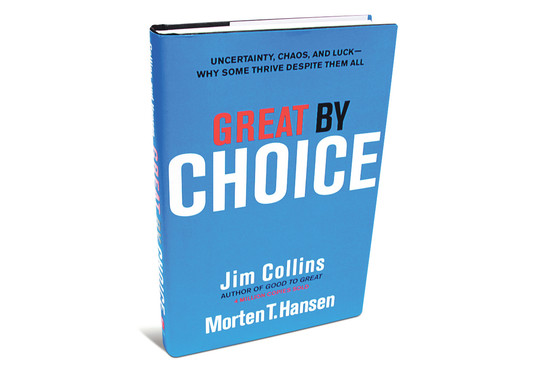
Today marks the final post this week on Great by Choice, the recently released book by Jim Collins and his colleague Morten Hansen. In much the same way as Collins’ previous works (particularly Good to Great), Great by Choice is written to a business leader audience using primarily business examples – but it is dead-center must reading for leaders in ChurchWorld.

Here are Collins’ and Hansen’s summary thoughts on the final principle in the book, Return on Luck.

courtesy jodymichael.com

courtesy jodymichael.com

A luck event is defined as one that meets three tests:

(1) some significant aspect of the event occurs largely or entirely independent of the actions of the key actors in the enterprise;

(2) the event has a potentially significant consequence (good or bad); and

(3) the event has some element of unpredictability.

Luck happens, a lot, both good luck and bad luck. Every company in the research experienced significant luck events in the era of analysis. Yet the 10X cases were not generally luckier than the comparison cases.

  • The 10X companies did not generally get more good luck than the comparisons.
  • The 10X companies did not generally get less bad luck from the comparison.
  • The 10X companies did not get their good luck earlier than the comparisons.
  • The 10X companies cannot be explained by a single giant-luck spike.

There are four possible ROL scenarios

  • Great return on good luck
  • Poor return on good luck
  • Great return on bad luck
  • Poor return on bad luck.

10Xers credit good luck as a contributor to their success, despite the undeniable fact that others also experienced good luck, but the never blame bad luck for setbacks or failures.

“Who Luck” – the luck of finding the right mentor, partner, teammate, leader, friend – is one of the most important types of luck. The best way to find a strong current of good luck is to swim with great people, and to build deep and enduring relationships with people for whom you’d risk your life and who’d risk their lives for you.

How’s your luck today?

Great by Choice

SMaC Down!

– a quick personal note: I’m away attending to some urgent family business, so I’ve suspended the 2013 GsD Fall Term for a week. In it’s place, I’m reposting one of the most popular series on 27gen – a look at Jim Collins’ book Great by Choice with application to ChurchWorld. It continues to get views almost every day, so I hope you enjoy the entire series


All week long I’ve been posting excerpts and summaries from Great by Choice, the latest work by Jim Collins (assisted this time by Morten Hansen). Great by Choice asks a simple question:

Why do some companies thrive in uncertainty, even chaos, and others do not?

Collins and Hansen have answered that question with solid principles, based on nine years of research and interviews. The following are the authors’  comments on SMaC.

SMaC stand for Specific, Methodical, and Consistent.

The more uncertain, fast-changing, and unforgiving your environment, the more SMaC you need to be.

A SMaC recipe is a set of durable operating practices that create a replicable and consistent success formula; it is clear and concrete, enabling the entire enterprise to unify and organize its efforts, giving clear guidance regarding what to do and what not to do. A SMaC recipe reflects empirical validation and insight about what actually works and why.

Developing a SMaC recipe, adhering to it, and amending it (rarely) when conditions merit correlate with 10X success. This requires the three 10X behaviors:

  • empirical creativity (for developing and evolving it)
  • fanatic discipline (for sticking to it)
  • productive paranoia (for sensing necessary changes).
courtesy greeceathena.wordpress.com

courtesy greeceathena.wordpress.com

Amendments to a SMaC recipe can be made to one element or ingredient while leaving the rest of the recipe intact. Like making amendments to an enduring constitution, this approach allows you to facilitate dramatic change and maintain extraordinary consistency.

Far more difficult than implementing change is figuring out what works, understanding why it works, grasping when to change, and knowing when not to.

What is your SMaC recipe? Is it still valid, or does it need amending?

Continually question and challenge your recipe, but change it rarely.

Great by Choice

Leading Above the Death Line

– a quick personal note: I’m away attending to some urgent family business, so I’ve suspended the 2013 GsD Fall Term for a week. In it’s place, I’m reposting one of the most popular series on 27gen – a look at Jim Collins’ book Great by Choice with application to ChurchWorld. It continues to get views almost every day, so I hope you enjoy the entire series

In one of the strangest names I’ve seen applied to a business principle, Jim Collins and Morten Hansen describe three key dimensions of productive paranoia in their book Great by Choice with the following chapter title:

Leading Above the Death Line

courtesy peakfreaks.com

courtesy peakfreaks.com

The authors use a real story (two different climbing teams’ assault on Mt. Everest in 1996; one succeeded, one had a tragic ending) to illustrate the concept of productive paranoia.

  1. Build cash reserves and buffers to prepare for unexpected events and bad luck before they happen.
  2. Bound riskDeath Line risk, asymmetric risk, and uncontrollable risk – and manage time-based risk.
  3. Zoom out, then zoom in, remaining hypervigilant to sense changing conditions and respond effectively.

10Xers understand that they cannot reliably and consistently predict future events, so they prepare obsessively – ahead of time, all the time – for what they cannot possibly predict. They assume that a series of bad events can wallop them in quick succession, unexpectedly and at any time.

It’s what you do before the storm hits – the decisions and disciplines and buffers and shock absorbers already in place – that matters most in determining whether your enterprise pulls ahead, falls behind, or dies when the storm hits.

10Xers build buffers and shock absorbers far beyond the norm of what other do. The 10X companies studied carried 3 to 10 times the ration of cash to assets relative to the median of what most companies carry and maintained more conservative balance sheets than the comparison companies throughout their histories, even when they were small enterprises.

10X cases are extremely prudent in how they approach and manage risk, paying special attention to three categories of risk:

  1. Death Line risk (which can kill or severely damage the enterprise)
  2. Asymmetric risk (in which the downside dwarfs the upside)
  3. Uncontrollable risk (which cannot be controlled or managed)

10Xers zoom out, then zoom in. They focus on their objectives and sense changes in their environment; they push for perfect execution and adjust to changing conditions. When they sense danger, they immediately zoom out to consider how quickly a threat is approaching and whether it calls for a change in plans. Then they zoom in, refocusing their energies into executing objectives.

While you might not face the same circumstances in ChurchWorld as in the business world (especially in terms of generating revenue), you have a risk profile just as any business does.

Take a look at the environment around you – how much time before the risk profile changes?

What have you done to get ready for it?

Great by Choice

Fire Bullets, Then Cannonballs

– a quick personal note: I’m away attending to some urgent family business, so I’ve suspended the 2013 GsD Fall Term for a week. In it’s place, I’m reposting one of the most popular series on 27gen – a look at Jim Collins’ book Great by Choice with application to ChurchWorld. It continues to get views almost every day, so I hope you enjoy the entire series

In Jim Collins’ last book Great by Choice, he and colleague Morten Hansen used extensive research to identify companies whose financial performance bettered their competition by at least a factor of 10 over the study period. Identifying these organizations and their leaders as 10Xers, they then discovered three core beliefs that these organizations had in common. Their research also revealed some common principles these organizations practiced; principles that lead the companies to greatness in environments characterized by big forces and rapid shifts that leaders could not predict or control.

Take this one, which could come out of the latest “Pirates of the Caribbean” movie:

Fire bullets, then cannonballs.

Here is a summary of what Collins and Hansen said about this principle:

A “fire bullets, then cannonballs” approach better explains the success of 10X companies than big leap innovations and predictive genius. A bullet is a low-cost, low risk, and low distraction test or experiment. 10Xers use bullets to empirically validate what will actually work. Based on that empirical validation, they then concentrate their resources to fire a cannonball, enabling large returns from concentrated bets.

courtesy examiner.com

courtesy examiner.com

The 10X cases fired a significant number of bullets that never hit anything. They didn’t know ahead of time which bullets would hit or be successful.

Next, there are two types of cannonballs, calibrated and uncalibrated.

  • A calibrated cannonball has confirmation based on actual experience – empirical validation – that a big bet will likely prove successful.
  • An uncalibrated cannonball means placing a big bet without empirical validation.
Cannon

courtesy jackintheteambox.com

Uncalibrated cannonballs can lead to calamity. The companies researched paid a huge price when big, disruptive events coincided with their firing uncalibrated cannonballs, leaving them exposed.  10Xers periodically made the mistake of firing an uncalibrated cannonball, but they tended to self-correct quickly. The comparison cases, in contrast, were more likely to try to fix their mistakes by firing yet another uncalibrated cannonball, compounding their problems.

Failure to fire cannonballs, once calibrated, leads to mediocre results. The idea is not to choose between bullets or cannonballs, but to fire bullets first, then fire cannonballs.

The difficult task is to marry relentless discipline with creativity, neither letting discipline inhibit creativity nor letting creativity erode discipline. This combination of creativity and discipline, translated into the ability to scale innovation with great consistency, better explains some of the greatest stories – from Intel to Southwest Airlines, from Amgen’s early years to Apple’s resurgence under Steve Jobs – than the mythology of big-hit, single-step breakthroughs.

The Leader’s Key Question

Which of the following behaviors do you most need to increase?

  • Firing enough bullets
  • Resisting the temptation to fire uncalibrated cannonballs
  • Committing, by converting bullets into cannonballs once you have empirical validation

Ready – Aim – Fire!

Great by Choice

20 Mile March

– a quick personal note: I’m away attending to some urgent family business, so I’ve had to suspend the 2013 GsD Fall Term for a week. In it’s place, I’m reposting one of the most popular series on 27gen – a look at Jim Collins’ book Great by Choice with application to ChurchWorld. It continues to get views almost every day, so I hope you enjoy the entire series

Great by Choice is the latest work by Jim Collins, answering a single question: Why do some companies thrive in uncertainty, even chaos, and others do not? Collins and his colleague Morten Hansen enumerate the principles for building a truly great enterprise in unpredictable, tumultuous, and fast-moving times.

Like the world we live in today.

Yesterday’s post looked at the three core behaviors that Collins and Hansen identified in their successful group – the 10Xers.

courtesy gazellessystems.com

courtesy gazellessystems.com

The first of these – Fanatic Discipline – is illustrated by the term “20 Mile March.” You need to read the book to get the full understanding, but here is Collins’ summary:

To “20 Mile March” requires hitting specified performance marks with great consistency over a long period of time. It requires two distinct types of discomfort, delivering high performance in difficult times and holding back in good times.

A good 20 Mile March has the following seven characteristics:

  • Clear performance markers
  • Self-imposed constraints
  • Appropriate to the specific enterprise
  • Largely within the company’s control to achieve
  • A proper timeframe – long enough to manage; yet short enough to have teeth
  • Imposed by the company on itself
  • Achieved with high consistency

A 20 Mile March needn’t be financial. You can have a creative march, a learning march, a service-improvement march, or any other type of march, as long as it has the primary characteristics of a good 20 Mile March.

The 20 Mile March builds confidence. By adhering to a 20 Mile March no matter what challenges and unexpected shocks you encounter, you prove to yourself and your enterprise that performance is not determined by your conditions but largely by your own actions.

Failing to 20 Mile March leaves an organization more exposed to turbulent events. Every comparison case had at least one episode of slamming into a difficult time without having the discipline of a 20 Mile March in place, which resulted in a major setback or catastrophe.

The 20 Mile March helps you exert self-control in an out-of-control environment.

10X winners set their own 20 Mile March, appropriate to their own enterprises; they don’t let outside pressures define it for them.

20 Mile Marching wasn’t a luxury afforded to the 10X cases by their success; they had 20 Mile Marches in place long before they were big successes, which helped them to become successful in the first place.

How far are you going to march today? And tomorrow? And the next day? and the next…

Great by Choice

Are You a 10Xer?

– a quick personal note: I’m away attending to some urgent family business, so I’ve had to suspend the 2013 GsD Fall Term for a week. In it’s place, I’m reposting one of the most popular series on 27gen – a look at Jim Collins’ book Great by Choice with application to ChurchWorld. It continues to get views almost every day, so I hope you enjoy the entire series

Jim Collins’ latest book is out – and it’s another winner, packed with an amazing depth of research that he and colleague Morten Hansen have distilled down into thought-provoking, sticky, and supremely practical concepts. Great by Choice is the equal to Good to Great, and is a must-read for leaders in ChurchWorld. Get your copy today, and dive into it. You’ll soon be introduced to some amazing concepts.

Like the 10Xer.

With a team of more than twenty researchers, Collins and Hansen studied companies that rose to greatness – beating their industry indexes by a minimum of ten times over fifteen years – in environments characterized by big forces and rapid shifts that leaders could not predict or control. The research team then contrasted companies that failed to achieve greatness in similarly extreme environments.

Weaving the story of South Pole explorers Roald Amundsen and Robert F. Scott throughout the narrative, and juxtaposing them with current CEOs, Collins and Hansen paint a vivid picture of what 10X organizations (and their leaders) look like:

  • Fanatic discipline: 10Xers display extreme consistency of action – consistency with values, goals, performance standards, and methods. They are utterly relentless, monomaniacal, and unbending in their focus on their quests.
  • Empirical creativity: when faced with uncertainty, 10Xers do not look primarily to other people, conventional wisdom, authority figures, or peers for direction; they look primarily to empirical evidence. They rely upon direct observation, practical experimentation, and direct engagement with tangible evidence. They make their bold, creative moves from a sound empirical base.
  • Productive paranoia: 10Xers maintain hypervigilance, staying highly attuned to threats and changes in their environment, even when – especially when – all’s going well. They assume conditions will turn against them, at perhaps the worst possible moment. They channel their fear and worry into action, preparing, developing contingency plans, building buffers and maintaining large margins of safety.

Underlying the three core 10Xer behaviors describe above is a motivating force: passion and ambition for a cause or company larger than themselves. They have egos, but their egos are channeled into their companies and their purposes, not personal aggrandizement.

On the one hand, 10Xers understand that they face continuous uncertainty and that they cannot control, and cannot accurately predict, significant aspects of the world around them. On the other hand, 10Xers reject the idea that forces outside their control or chance events will determine their results; they accept full responsibility for their own fate.

Are you a 10Xer?

Great by Choice

Thriving in Uncertainty

– a quick personal note: I’m away attending to some urgent family business, so I’ve had to suspend the 2013 GsD Fall Term for a week. In it’s place, I’m reposting one of the most popular series on 27gen – a look at Jim Collins’ book Great by Choice with application to ChurchWorld. It continues to get views almost every day, so I hope you enjoy the entire series!

Ten years after the worldwide bestseller Good to Great, Jim Collins returns with another groundbreaking work, this time to ask:

Why do some companies thrive in uncertainty, even chaos, and others do not?

Great by Choice distinguishes itself from Collins’s prior work by its focus not just on performance, but also on the type of unstable environments faced by leaders today.

With a team of more than twenty researchers, Collins and his colleague Morten Hansen studied companies that rose to greatness – beating their industry indexes by a minimum of ten times over fifteen years – in environment characterized by big forces and rapid shifts that leaders could not predict or control. The research then contrasted these “10X companies” to a carefully selected set of comparison companies that failed to achieve greatness in similarly extreme environments.

These 10X companies and leaders navigated the chaotic times exceptionally well. They don’t merely react; they create. They don’t merely survive; they prevail. They don’t merely succeed; they thrive. They build great enterprises that can endure.

Thriving in a chaotic world is not just a business challenge. Collins is arguably on of the most widely read and quoted authors in ChurchWorld. His previous works, especially Good to Great, continue to influence leaders in churches both large and small across the country.

Principles like the Hedgehog Concept, First Who, core values, BHAG, the flywheel, Level 5 Leadership and the Five Stages of Decline have all contributed to the success and growth of leaders and their organizations. Great by Choice tests these principles and found that they do apply in a chaotic and uncertain world. But the primary purpose of the book is to share new concepts learned.

Over the next few days I will be diving into sections of Great by Choice and making some applications to ChurchWorld.

Tomorrow – just what is a 10Xer, anyway?

Great by Choice

What’s Shaped the Mindset of Today’s College Freshmen?

It’s August, and school is back in session for most students.

That means it’s time for my annual encouragement for leaders to take a look at the mindset of this year’s entering college freshmen, the class of 2017 – courtesy of Beloit College.

courtesy of warningsignshirts.com

courtesy of warningsignshirts.com

Each August since 1998, Beloit College has released the Beloit College Mindset List, providing a look at the cultural touchstones that shape the lives of students entering college this fall.

Prepared by Beloit’s former Public Affairs Director Ron Nief and Keefer Professor of the Humanities Tom McBride, the list was originally created as a reminder to faculty to be aware of dated references. It quickly became an internationally monitored catalog of the changing worldview of each new college generation.

Leaders – of all ages – need to understand what has shaped the lives of today’s entering college freshman class, those 18 year olds who:

  • Use smart phones in class to indicate they are reading the assignment they should have read last night, or they may be recording every minute of their college experience…or they may be texting the person next to them.
  • Though they have never had the chicken pox, they are glad to have access to health insurance for a few more years.
  • Will search for the academic majors reported to lead to good-paying jobs, and most of them will take a few courses taught at a distant university by a professor they will never meet.

When the Class of 2017 arrives on campus this fall, these digital natives will already be well-connected to each other. They are more likely to have borrowed money for college than their Boomer parents were, and while their parents foresee four years of school, the students are pretty sure it will be longer than that.  If they are admirers of Steve Jobs and Bill Gates, they may wonder whether a college degree is all it’s cracked up to be, even as their dreams are tempered by the reality that tech geniuses come along about as often as Halley’s Comet, which they will not glimpse until they reach what we currently consider “retirement age.”

They will study hard, learn a good deal more, teach their professors quite a lot, and realize eventually that they will soon be in power. After all, by the time they hit their thirties, four out of ten voters will be of their generation. Whatever their employers may think of them, politicians will be paying close attention.

You need to read the whole list here, but these are my Top Ten:

  • They are the sharing generation, having shown tendencies to share everything, including possessions, no matter how personal.
  • Having a chat has seldom involved talking.
  • Their TV screens keep getting smaller as their parents’ screens grow ever larger.
  • With GPS, they have never needed directions to get someplace, just an address.
  • Their favorite feature films have always been largely, if not totally, computer generated.
  • Their parents’ car CD player is soooooo ancient and embarrassing.
  • They could always get rid of their outdated toys on eBay.
  • Plasma has never been just a bodily fluid.
  • Olympic fever has always erupted every two years.
  • They have known only two presidents.

The List was compiled to identify both the common ground that teachers and students share, and the mine fields of misunderstanding that seem to grow wider with every forgotten reference to the Berlin Wall or Monica Lewinsky.

Enjoy!

Bridging the Digital Divide, Part 3

Our leadership brains are dealing with a digital divide in organizations today: team members of different generations think differently. First, there’s the digital natives; then come the digital immigrants. Bringing up the rear (literally) are the digital dinosaurs.

Author Marilee Sprenger, writing in “The Leadership Brain for Dummies,” makes these observations about the digital dinosaur:

courtesy gerbenvanerlelens.com

courtesy gerbenvanerlelens.com


Natives speak the language of their birth; immigrants are learning to translate the digital language of the natives, and then there are those individuals or organizations who are hopelessly out of date – the digital dinosaur.

You may think that Traditionalists (born before WW II) fall into this category, and many do. But anyone or any organization can be a dinosaur.

Digital media is transforming organizations everywhere. If your organization appears to be incapable of change, those who embrace digital technology won’t find it appealing. If your clients are changing their minds and getting plugged into the latest technology, you don’t won’t to present yourself as stuck in an analog world.

Take a close look at what your competition is doing digitally. If they are still dinosaurs, make some changes so your organization can be the first to enter the global age. Rather than feeling safe because they aren’t doing anything that you’re not doing, get out of that reptile brain and use your thinking brain to take some risks to get updated.

Note to church leaders: if my use of the words “client” and “competition” bother you, sorry – you have a whole different set of problems! The people who come to your church are your clients, and you do have competition – but it’s not the church down the street from you.


A closing thought on this series: leadership is all in your head – literally. When your brain is at its best, you will be at your best as a leader. Understanding how your brain works is just the first step. Put your leadership brain to work today!

 
inspired by The Leadership Brain for Dummies, by Marilee Sprenger
Leadership Brain for Dummies