5 Everyday Ways to Love Your Neighbor and Change the World

What would you call someone who listens without judgment, offers you wise counsel but helps you make your own decision, and loves you no matter what?

That’s a friend!

Jesus had a nickname given to him by the religious leaders of His day – Friend of Sinners (Matthew 11:16-19).

Jesus’ simple strategy to reach the world was friendship and blessing.

There is no better model for what it looks like to “go and bless” than Jesus. His entire life was a blessing. The Gospels give us numerous examples of how Jesus blessed the people He encountered.

Dave Ferguson and Jon Ferguson

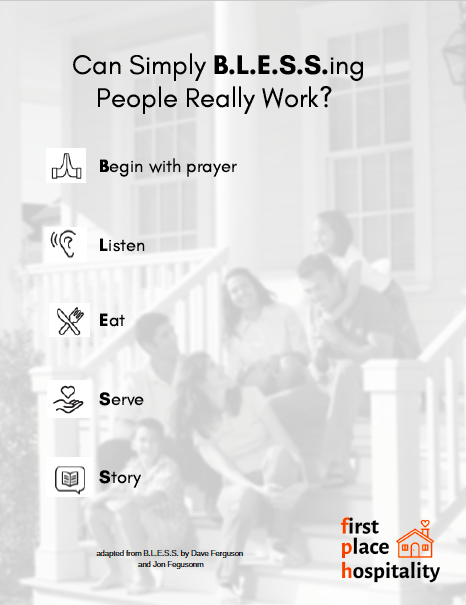
B.L.E.S.S. authors Dave Ferguson and Jon Ferguson made a list of all the ways Jesus practiced being a blessing to people, and narrowed it down to the top five. The resulting B.L.E.S.S. practices are five everyday ways that Jesus loved his neighbors.

B: Begin with prayer

When Jesus started His earthly mission, Luke 6 tells us that He went out on a mountain and prayed. Prayer is both how you discover your mission and how you live out your mission.

L: Listen

Asking questions and then listening was central to Jesus’ life and teachings. Any relationship starts with listening to someone’s words and life. True listening may be the kindest and most loving gift you can give someone.

E: Eat

Jesus liked to eat! Over and over, as in Matthew 9, we find Jesus with tax collectors and sinners…doing what? Eating! There is something about sharing a meal together that moves any relationship past acquaintance toward friendship.

S: Serve

Jesus told us straight up, “The Son of Man did not come to be served, but to serve…” (Matthew 20:28). He modeled for us that once you begin with prayer, listen, and eat with someone, there is a good chance that you’ll discover how you can best serve the person God is asking you to bless.

S: Story

When people were ready to listen, Jesus would share his story, as in John 14 with Thomas. When you befriend and bless people, they feel relationally safe and want to know your story. Then, and only then, can you tell them how the love of God and Jesus’ life, death, and resurrection have changed you.

Using the brief descriptions above, and downloading the PDF tool below, write out practices in each of the five B.L.E.S.S. categories.
How will you use one of these practices each day?

Remember, though: B.L.E.S.S. is not a checklist.

Many well-intentioned people have taken these missional rhythms and turned them into a set of linear steps to be performed one at a time. The B.L.E.S.S. practices are NOT a checklist or another church program you graduate from. They are simple, everyday ways to bless the people around you. Never focus more on the practices than on the people you are seeking to bless!


inspired by B.L.E.S.S. by Dave Ferguson and Jon Ferguson

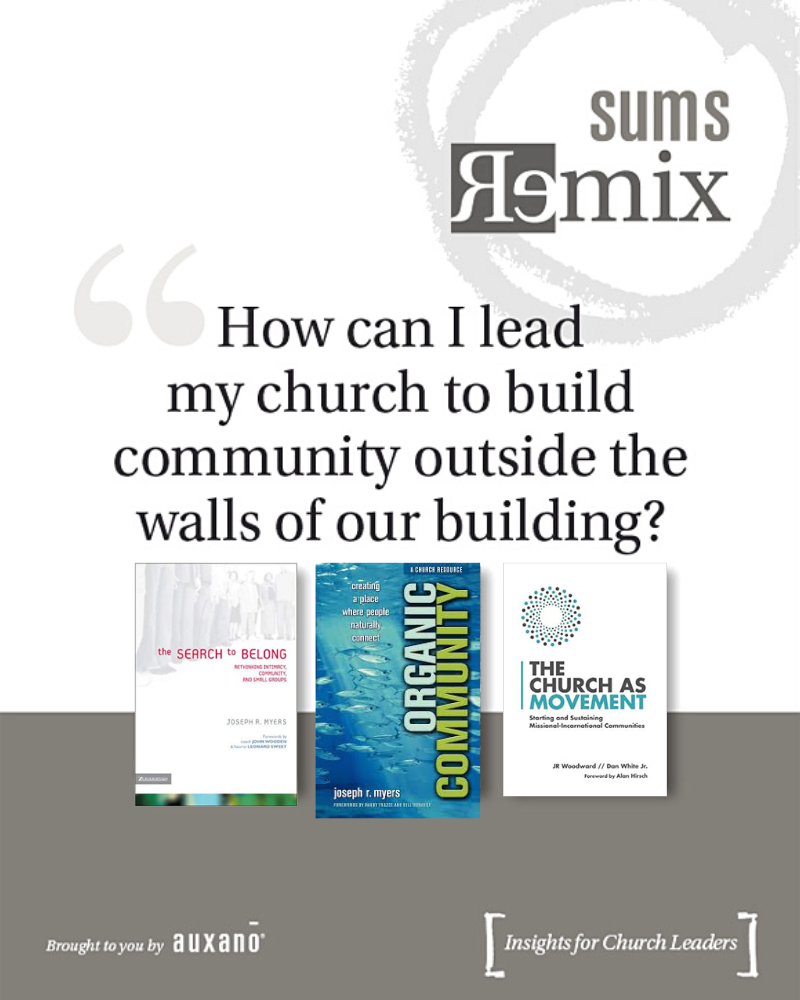
Lead Your Church to Build Community Outside the Walls of Your Building

According to church planter and coach Linda Bergquist, because our lives are already filled with church activities, “neighbor-sphere” friendships continuously elude us. However, when Jesus talked about our becoming salt and light, it was the macrocommunity of people who make up our everyday existence of which He spoke.

It means that we need to figure out how to engage and participate in our larger communities in a healthy way. Being good is not enough; it is a poor imitation of doing good toward others.

The fact that such a small percentage of church members, including leaders, have so little time for people outside their own small group of friends means that something is not working.

This issue of SUMS Remix looks at solutions that will help you lead your church to build community outside the walls of your building. The solutions include: 


Learn to See God at Work in Your Neighborhood

Note: As the original issue of this SUMS Remix was being prepared in March 2020, most of the United States was under some type of mandate restricting movement. Typically called “physical distancing,” the intent is to minimize the chances of the coronavirus being spread by maintaining a distance of at least six feet when you are in public settings.

However, even if “physical distancing” (the more correct term) is no longer required, “social interaction” is needed more now than ever before. 

Efforts taken to slow the spread of the coronavirus should encourage strengthening social ties while maintaining that physical distancing.

Therefore, some of this content may not be applicable under current restrictions in your community; however, the intent is critical in moving forward as we demonstrate hospitality to our neighborhoods, in every season

According to Rosaria Butterfield, 

Christians are called to live in the world but not live like the world. Christians are called to dine with sinners but not sin with sinners. 

She adds,

We live in a world awash with counterfeit hospitality. Knowing the difference between the grace of God and its counterfeit is crucial to Christian living.

Hospitality shares what there is; that’s all. It’s not entertainment. It’s not supposed to be.

This issue of SUMS Remix looks at solutions that will help you understand and practice hospitality in and through your home. The solutions include: 


How to Help Your Church See Biblical Hospitality – Specifically the “Table” – as a Way of Life

In December 2019, the motion picture, “A Beautiful Day in the Neighborhood,” staring Tom Hanks as beloved television icon Fred Rogers made its debut. Rogers was the creator, showrunner, and host of the preschool television series Mister Rogers’ Neighborhood, which ran from 1968-2001.

As a musician, puppeteer, writer, and producer, Fred Rogers’ gentle demeanor brought beautiful simplicity through nurturing interactions with young children to over 30 years of viewers. His enigmatic theme song, from which the motion picture takes its title, includes the following lines, which many adults can recall:

It’s a beautiful day in this neighborhood, 

A beautiful day for a neighbor,

Would you be mine?

Could you be mine?

Fred Rogers was also a Presbyterian minister, and it’s likely those lines were inspired by another story of a neighbor.

In the Parable of the Good Samaritan (Luke 10:25-37), Jesus asked the expert in law, in effect, “Who is your neighbor?”

It’s almost 2020, and the question remains, “Who is our neighbor?”

From the television neighborhoods of Beaver Cleaver and Andy Taylor, to Mr. Rogers, to Sam and Diane, to Jerry and Kramer, to Rachel and Monica and Phoebe and Chandler and Joey, to Phil and Claire, to Jack and Rebecca and Randall and Kate, it’s a question that mainly depicts an unfulfilled longing for a neighborhood that actually works.

It occurs to me that this is not a neighborhood;

It is only a collection of unconnected individuals.

Philip Langdon, A Better Place to Live

Long gone are the days where kids played in the yards and streets all day “till the street lights came on” and where neighbors talked across fences or on front porches.

It seems as if the people we live closest to appear only briefly when the car leaves the garage in the morning and comes back in the evening. 

It seems as if the idea of “neighborhood” has disappeared in reality if not actuality, and with it the idea of knowing for, and caring for, neighbors.

As Lance Ford and Brad Brisco write in Next Door as in Heaven:

What does all this neighborhood business have to do with the gospel? As Jesus followers – people of the Good News – we follow the one who said the most important commandment is to love God with all our heart, soul, and strength, and to love our neighbors as ourselves. We have a tremendous opportunity before us: to take notice and help resurrect rich relationship in our neighborhoods.

If anyone should “neighbor” differently, it should be us.

According to Leonard Sweet, if we really want to learn someone’s story, sitting down at the table and breaking bread together is the best way to start.

This issue of SUMS Remix looks at solutions that will help you see the importance of your “table” as a place of disciplemaking. The solutions include: 

A closing quote, by Rosaria Butterfield, author of The Gospel Comes with a House Key, seems most appropriate:

Radical, ordinary hospitality brings the gospel to our lost friends and neighbors. Such hospitality sees our homes as not our own, but as God’s tools for the furtherance of his kingdom as we welcome those who look, think believe, and act differently from us into our everyday, sometimes messy lives – helping them see what true Christian faith really looks like.  

SUMS Remix 134, released December 2019


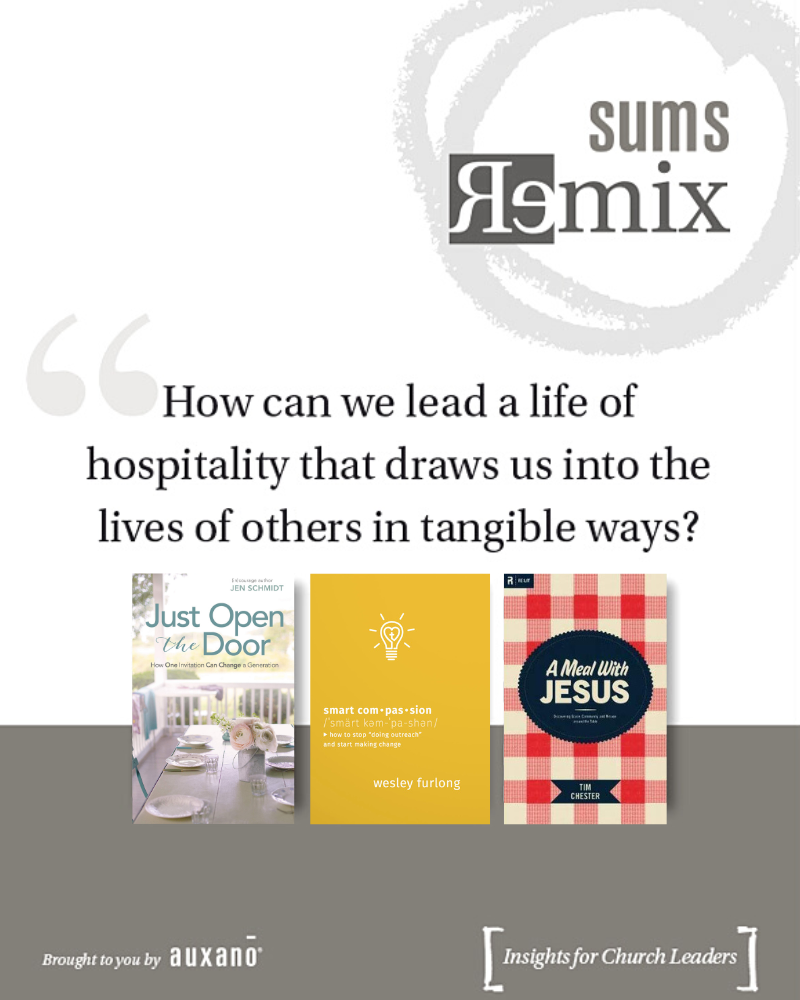
How to Lead a Life of Hospitality that Draws You into the Lives of Others in Tangible Ways

The heart of God’s purpose for humankind is relationships – first, with God Himself; then, with one another. Arguably, there is no better place to build relationships than at the table with good food and great conversation.

Len Sweet, in his book From Tablet to Table states it eloquently:

Remember God’s first command in the Bible? Eat.

Remember God’s last command in the Bible? Drink.

And everything in between is a table – a life-course meal on which is served the very bread of life and cup of salvation.

It’s time to bring back the table to our homes, to our churches, and to our neighborhoods and the world.

The table is a recurring biblical theme, one that our fast-paced, drive-through, Instant Pot culture finds unfamiliar.

What would happen if we brought back the table as a sacred object of furniture in every home, church, and community?

Are we truly hungry to accept Jesus’ invitation –  “Come and follow” – and to go wherever He leads, even if it means next door?

Especially if it means following Him next door!

What would it take for the table to return to the center of our family lives – and by extension, to those God has placed in our circle and situations?

This issue of SUMS Remix looks at solutions that will help you learn how to engage with your neighbors, establishing and deepening your relationships through hospitality. The solutions include: 

SUMS Remix 103, released October 2018


The Neighborhood Initiative – Practical Help in Identifying and Being with Our Neighbors

Simply stated, Neighborhood Initiative is the body of Christ at work in neighborhoods where God has placed us to bring about the transformation that comes through the power of His kingdom.

Lynn Cory

According to founder Lynn Cory, Neighborhood Initiative (NI) is not a program, but a work that God is introducing to bring revival in His church and transformation to our cities. It’s encouraging people to go out into their own neighborhoods to befriend neighbors, open their homes, and lend a hand.

Here are a few highlights of NI:

Jesus’ Plan for Home-Centered Ministry

  • Look for “people who welcome you”
  • Look for “a worthy person”
  • Look for people of peace
  • If they are not responsive, move on
  • Stay with the person of peace

The Five Essentials of Neighborhood Initiative

  • Loving your neighbor starts with the love of God
  • Reinhabit your neighborhood missionally and emotionally
  • Redeem the kairos
  • Have an exponential perspective
  • Recognize that you are authorized and commissioned by the Lord

Be sure to go the the NI website to review and download a wealth of resources available there, including a handbook, leader’s guide, and ideas for practical ministry in your neighborhood.

Also, check out these books by Lynn Cory:

Neighborhood Initiative and the Love of God

The Incarnational Church

The Kairos Adventure

It’s Good to Be Home: Creating First Place Hospitality

In what may seem to be direct opposition to my thoughts about front porches here and here, my wife and I have just completed a series of home renovations over the last three years that did not change our somewhat smallish front porch, but nevertheless, have increased our neighborhood connections.

It’s all about loving where you live!

Here’s the story…

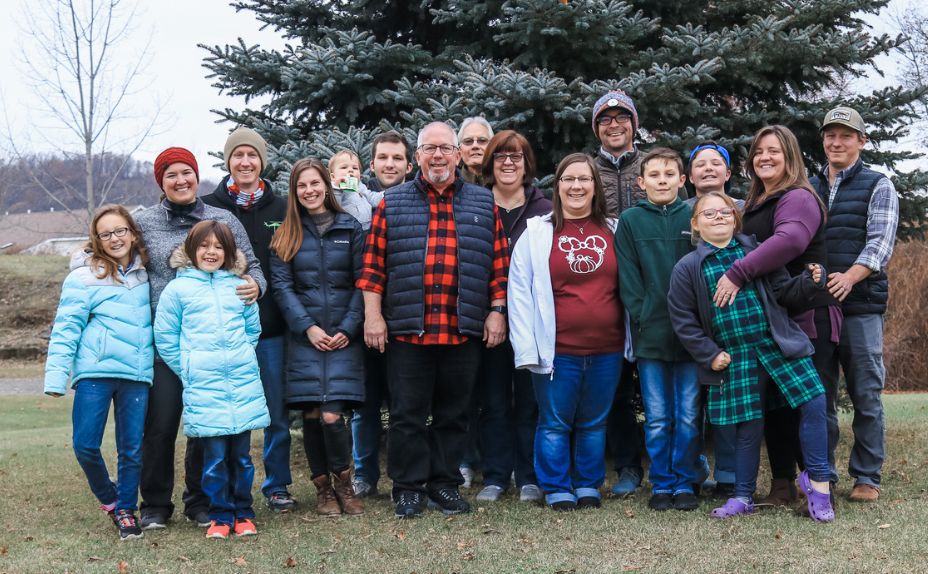
My wife Anita and I have been married for 44+ years. We have three sons, (with three amazing daughters-in-law) and a daughter (married to a great son-in-law). These amazing kids and their spouses have been blessed with eleven children!

The image below represents the last time we were all together: Thanksgiving 2021 in Greenwich, NY. Since then we’ve added three little ones – all this year! Collectively, we are the #AdamsFamilyExperience!

About three years ago my wife and I, as empty nesters, made the decision to stay in our long-time home (29+ years) where our kids grew up – even as they moved away to establish homes of their own from one end of the country (New Mexico) to the other (New York, then Virginia), along with two who have settled in opposite ends of North Carolina. With one family in the military and moving about every three years, we decided to stay put.

With eleven grandchildren grouped into 2 ages (five age 3 and under, and six ages 10-16), we knew we needed space for lots of different activities.

What that means IRL:

  • With 11 grandchildren, our family numbers 21 when we all gather together (plus up to four dogs). We don’t get to do that as often as we would like, but we want to be prepared when we do! Thus…
  • Our renovations, although with different purposes, were all guided by the primary intention of creating more gathering space. Functionally, that meant keeping all four bedrooms useable, but with a different purpose: each of three bedrooms formerly used by our kids became (respectively) an office for my wife, an office for myself, and a Disney room for the grandchildren. Each of those rooms can sleep two or more.
  • With three bathrooms, we had no reservations about removing the garden tub in the master bath, and creating a walk-in shower. Need to bathe infants? No problem; we’ve still got two tubs.
  • In our family room, we were satisfied with the layout, but decided to mount a large screen TV on the wall to free up space below for additional seating. The fireplace, though adequate, seemed a little lonely on the tallest wall in the house, so Anita and I designed a feature wall that our contractor built to perfection.
  • Our biggest renovation, aka “The Project” was just completed and involved adding square footage to our house footprint, totally renovating the kitchen, removing a wall between the kitchen and dining room, and adding a full-width deck across the back of our house.
  • With the interior complete, up next is the final exterior project: some work on our backyard, freshening up outdoor play space for the younger four of our grandkids who are 3 and younger; correcting drainage flow due to the new roof and deck; and adding cafe lights to a portion of our deck.

Even when our family can’t visit as often as we would love to have them, our home is dedicated to hospitality for friends, neighbors, and those we haven’t met yet. In just the first month, we:

  • Kicked off the newest space with a Mexican fiesta luncheon for our church community group
  • Invited our neighbors on one side to a impromptu family dinner as a treat for all the hard work they’ve been doing on a pool install this summer
  • Hosted two of our kids’ families for the long Independence Day weekend: four extra adults, three grandchildren, and one large dog
  • Planned a neighborhood event that had to be postponed (but will be rescheduled)
  • Made our deck and kitchen available for our neighbor’s 12-year old daughter’s birthday party – even when we weren’t at home for the weekend.

In August, our NM kids and grandkids (two adults, three children) will be staying for five days as part of a two-week vacation.

…and we’ve got lots more planned for the late summer and fall!

My wife and I share a passion: creating hospitality culture lifestyles where ordinary people demonstrate extraordinary love.

In order to help make that possible in a physical space, here’s the dedication pledge my wife and I made over our renovations:

When we understand God’s welcome to us, we can better pass it on to someone else.

When we use our lives exactly as they are, desiring only to create a sacred space for our guests, we turn entertaining upside down and it becomes radical hospitality.

We don’t need to be who we used to be; God sees who we’re becoming – and we’re becoming love.

We can’t love people we don’t know. Saying we love our neighbors is simple. But guess what? Doing it is too. We think Jesus’ command to “love your neighbor” means we’re actually supposed to love our neighbors. Engage them. Delight in them. Throw a party for them.

Jesus wants us to show people who He is by what we do, not just tell them what we think.

It’s time to bring back the table to our homes.

If we really want to learn someone’s story, sitting down at the table and breaking bread together is the best way to start. The table is the place where our identity is born – the place were the story of our lives is retold, reminded, and relived.

(Special thanks to the writings of Bob Goff and Len Sweet)

The solution is to get back to the basics of what Jesus commanded:

Love God and love your neighbors.

Think of it as First Place Hospitality – building bridges to your neighbors in your “First Place,” your home.


Next Time: Images and Acknowledgments for The Project

How to Measure the Power of Place Attachment

To be rooted is perhaps the most important and least recognized need of the human soul

Simone Weil

What if a place becomes the right place only by our choosing to love it?

Melody Warnick, author of the fabulous book This Is Where You Belong, sets the whole tone of her book in the first chapter talking about “Place Attachment.”

Humans are instinctively driven to form connection with places. 

The most common term for this is “place attachment,” because it suggests the affectionate, almost familial connection that can form between us and where we live. You mostly know it when you feel it, which you probably have. When you roll into your town after being away for awhile and say, “It’s good to be home,” that’s a product of place attachment. So is feeling drawn as if by magic to a particular city, never wanting to leave the place where you grew up, or never wanting to leave the place you live right now.

If all this sounds a bit touch-feely, it is. Like happiness, place attachment exists partly as emotion and partly as a pattern of thought, which makes it difficult to quantify.

Over the years researchers have developed a “place attachment scale” of statements they use to gauge the sensation. Study participants are usually asked to rank their agreement on a scale of 1 to 5, but for the sake of simplicity, you can assess your own place attachment by answering each of the questions below “true” or “false” about the town or city where you live. Click here or on the image below for a PDF.

The more times you answer “true,” the more likely you are to be attached to your town. Making nineteen or more “true” answers, which puts you in the top quartile, indicates that you probably feel strongly connected to where you live. Six or fewer, on the other hand, suggests that you live somewhere unfamiliar or in a town you’re not particularly over the moon about. And if you’re not very place attached you may be saying to yourself, “Clearly place attachment feels nice. But why should I care? Will it actually make my life feel better?”

According to place attachment research, the answer is a resounding yes. Studies show that when you pit “Stayers” – long-term residents of a place – against “Movers,” the Stayers are generally far more social.

Where we live matters, and staying where we live matters. When it comes to place attachment, our towns are what we think they are.

No matter what anyone else thinks, your town just has to make you happy.

And being a good neighbor starts with you.


I can’t emphasize this enough: If you like the idea of loving where you live, of being a better neighbor, or anything remotely connected, you MUST check out the work of Melody Warnick. Follow her on social media. Buy the book (below). Sign up for her newsletter on her website. Peruse the website for other articles she has written. It’s all PURE GOLD.

Inspired and adapted from

This is Where You Belong, Melody Warnick

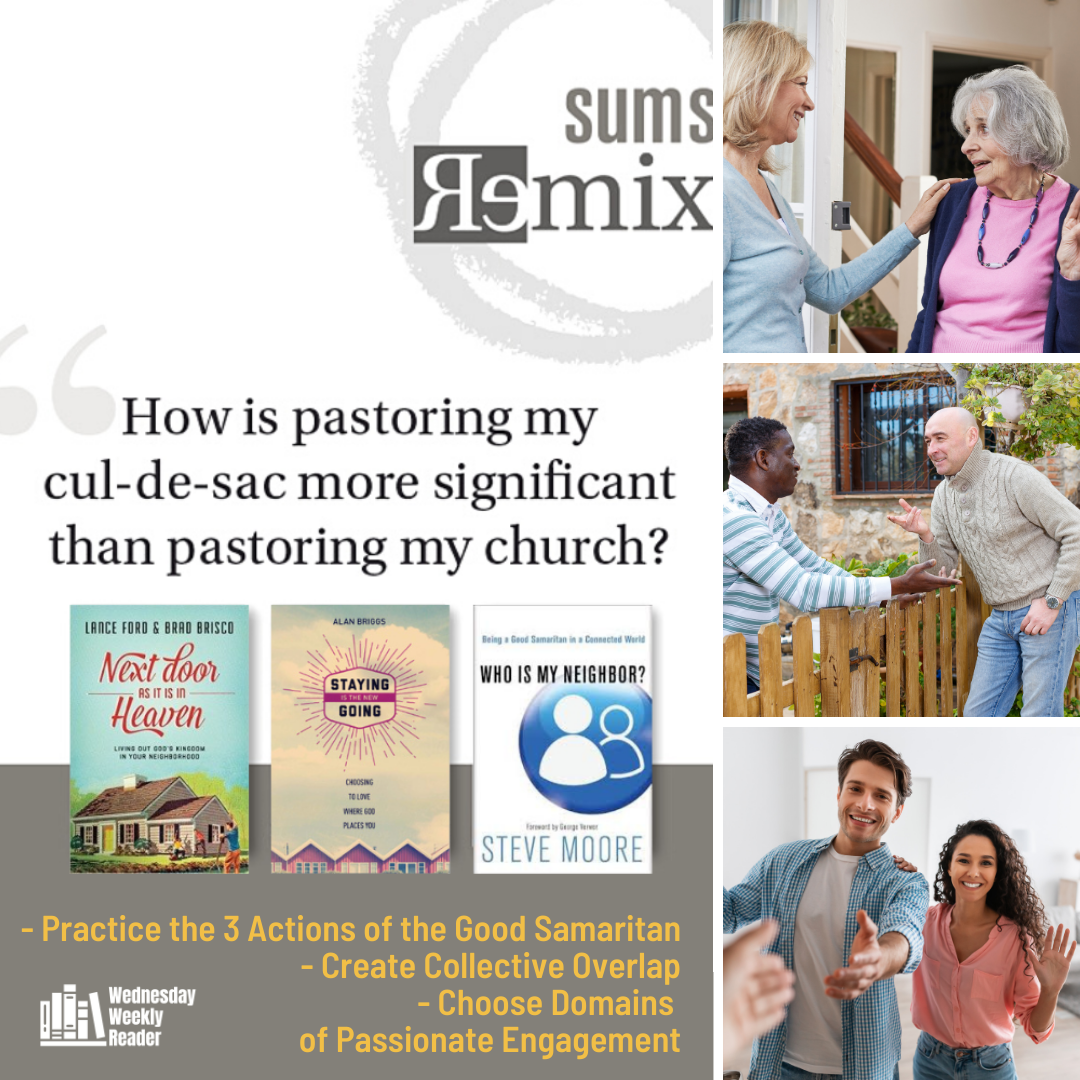
Pastoring a Cul-de-Sac is More Significant than Pastoring a Church

Author Reggie McNeal invites us to get off our ass (biblically speaking) with a focus on the Parable of the Good Samaritan:

25 On one occasion an expert in the law stood up to test Jesus. “Teacher,” he asked, “what must I do to inherit eternal life?”

26 “What is written in the Law?” he replied. “How do you read it?”

27 He answered, “‘Love the Lord your God with all your heart and with all your soul and with all your strength and with all your mind’; and, ‘Love your neighbor as yourself.’”

28 “You have answered correctly,” Jesus replied. “Do this and you will live.”

29 But he wanted to justify himself, so he asked Jesus, “And who is my neighbor?”

30 In reply Jesus said: “A man was going down from Jerusalem to Jericho, when he was attacked by robbers. They stripped him of his clothes, beat him and went away, leaving him half dead. 31 A priest happened to be going down the same road, and when he saw the man, he passed by on the other side. 32 So too, a Levite, when he came to the place and saw him, passed by on the other side.33 But a Samaritan, as he traveled, came where the man was; and when he saw him, he took pity on him. 34 He went to him and bandaged his wounds, pouring on oil and wine. Then he put the man on his own donkey, brought him to an inn and took care of him. 35 The next day he took out two denariiand gave them to the innkeeper. ‘Look after him,’ he said, ‘and when I return, I will reimburse you for any extra expense you may have.’

36 “Which of these three do you think was a neighbor to the man who fell into the hands of robbers?”

37 The expert in the law replied, “The one who had mercy on him.”

Jesus told him, “Go and do likewise.”

Luke 10:25-37 (NIV)

We’re living in a bizarre polarity of unprecedented connectedness and unparalleled isolation.

When we finally get home, joining countless others in our cul-de-sacs or subdivision streets, we want to be home.

The Great Commission may carry you to the ends of the world, but it starts on your street. God has given us a perfect environment for demonstrating the gospel and advancing His mission, if only we would open our eyes to it. It’s that place you probably consider your personal and private fortress – your home. Hospitality is one of the simplest – and most exciting – ways to engage in God’s mission.

If we are ever going to join all our lives to God’s mission to change the world, we need to reclaim all of our ordinary pieces as a part of that gospel mission. We have to reject the notion that something has to be big or unusual to be significant. We will have to view the ordinariness of our lives as significant, and allow God to use our homes as a seed to be planted and grown, not something to be discarded or devalued.

We need to practice neighboring.

This issue of SUMS Remix looks at solutions that will help make your home a hub for ministry instead of a refuge from ministry. The solutions include: 

Just who is our neighbor? And, how can we serve our neighbors?


No More Front Porches

Rebuilding Community in Our Isolated Worlds

Being a part of God’s kingdom is not just having a private relationship with God but also having a communal relationship with His other children.

Linda Wilcox, No More Front Porches

Front Porches. Once they were a vital part of American society. Whether you had a large verandah that circled the house, or little more than a front stoop, you adorned it with comfortable chairs and spent hours there, talking with friends and relatives, watching what was going on in the neighborhood, looking out for others, and keeping in touch with your world. Front porches symbolized relationships and being involved with life beyond your front door.

Today, life has changed.

Few new homes offer a place to nestle as twilight sets in and few people have the leisure time for this lifestyle, or even for the relationships that it represents. We’ve moved ahead and left front porch attitudes behind as quaint relics.

But in recent decades, as the nation has reeled from tragedies such as the September 11 terrorist attacks, countless shootings, and the pandemic, Americans are again scurrying to regain that closeness, care, and compassion we found in communities that sat on front porches. Perhaps, we’re finding, we need the stability of those front porch attitudes in our lives.

In No More Front Porches, sociologist Linda Wilcox looks at how and why communities, churches, and lifestyles have changed. She evaluates the nostalgia for the ’good old days,’ and explores the offerings of today. Though we can never regain the idealized past, she gives us help and hope for building emotional and community ’front porches’ in the frantic society we now zoom through. She helps us learn how to avoid isolation and refocus our methods for building those close, front porch relationships.

Let No More Front Porches help you discover a little bit more about this society in which we live. And in the process, you’re bound to learn how to better enjoy people in your home, neighborhood, church and world.

According to author Linda Wilcox, it’s not uncommon for us, thanks to 24-hour news availability, to know more about what’s happening on the other side of the planet than what’s happening on the other side of the fence.

Written in 2002, that truism is all the more prevalent today. It’s too easy to become trapped in the digital world of 24/7, feeling always on, FOMO, and living life in the hyperspeed lane.

Only in the last decade, the author writes, have we come to “need” this much immediate contact with each other. Now, it seems, we can’t live without our devices right beside us, if not in our hands most of our waking hours.

At the same time, we desire a personal space that allows us to escape the demands of our public (and digital) lives and a place we can call our own.

And so we retreat into our closed garage doors and empty front porches, emerging in our vehicles off on an errand, returning to the same garage door, closing it before we exit the vehicle.

A pointed, and poignant, quote from the author sums it up: Let’s be realistic. Perhaps we can’t save the world [by being on the front porch], but surely we can do a better job than we have in the past.

Americans are hungry to regain the closeness, care, and compassion we used to find right outside our front doors.

inspired and adapted from No More Front Porches