

THE QUICK SUMMARY
Do you get tired sitting in a pew? Have you ever fantasized about traveling to the other side of the world, telling people about the good news of Jesus Christ? Wake up and look around: The world is right here, waiting for the Good News to make itself known.
For too long we’ve outsourced God’s work in the world to missionaries “out there” at the ends of the earth. In reality, God wants us to love our neighbor right next door. He wants us to pray for the welfare of our zip code, to witness to the world outside our window. He wants us to be the church, the people of God, in conversation and meaningful engagement with the people God loves outside the walls of the church.
The stories in this book will change the way you look at your city and provide insights into how you can be an authentic Christian.
A SIMPLE SOLUTION
How well do you know the neighbors on either side of you? What about the ones across the street, or behind you? Live in an apartment complex? How well do you now your neighbors across the hall, on the floor above, or on the floor below?
As Christians, we most certainly have been commanded to “go unto the world,” but most of us forget that “the world” begins at our doorstep.
The place you already live is the most obvious, but most overlooked, place to start ministry. The church was born to a Spirit-filled group of disciples who expected to see the gospel spread from their place to the whole world.
People seeking to live a Jesus life and those who don’t know him alike are feeling the tug to put down roots in places and space again. I happen to think Christians need to hear this message the most, however, because cities are quickly becoming the lifeblood of mission. Our current places are becoming the next frontier, and neighborhoods are becoming parishes again, where churches anchor their communities and every Christian can live out our first vocation as a follower of Jesus eyeball to eyeball.
This is a return to something people understood before the global and digital age distracted us. Something in all of us wants to be connected to a place and the people who live in it. Those in our neighborhood and city are longing for it.
A key element of incarnational ministry is intentionally creating collective overlap where all those we call friends can gather – Christian and non-Christian – in one common space.
Finding collective overlap not only addressed the primary problems of an insular Christian community and a lack of exposure to the gospel among my non-Christian friends; it helped me to close the gap between outreach and relationship. My non-Christian friends were no longer projects; they were friends. The gospel became not something I was selling, but something I was living and weaving into every aspect of relationships.
Intentionally creating collective overlap for people who do know Jesus and those who don’t is a risk, but it’s surprisingly simple: our front yards, living rooms, and social gatherings are great, natural spaces for collective overlap to occur.
Alan Briggs, Staying is the New Going
A NEXT STEP
Recreate the drawing below on a chart tablet.
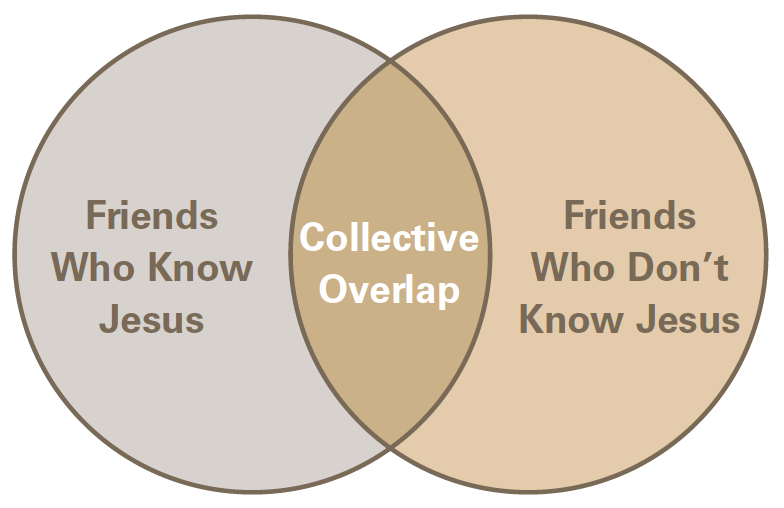
Author Alan Briggs believes that “God’s people become translators of the Good News when we are rooted in relationships and places.
With the above diagram in mind, read through the following questions for reflection from Alan Briggs. As you ponder each question, add names and answers to the questions to the diagram on the chart tablet.
- Write the names of both kinds of friends.
- What are some specific things you can do to develop collective overlap between friends who know Jesus and friends who do not? Write these alongside the names in a different color marker.
- What are some ordinary ways you can start the practice of faithfully loving those around you?
 27gen.com