Breaking Free from Aimless Wandering: The Call to Follow


It is into this deeply tired world of ours that God sends Jesus to speak the voice of love. Jesus says, “Follow me. Don’t keep running around. Follow me. Don’t just sit there. Follow me.”
Henri Nouwen

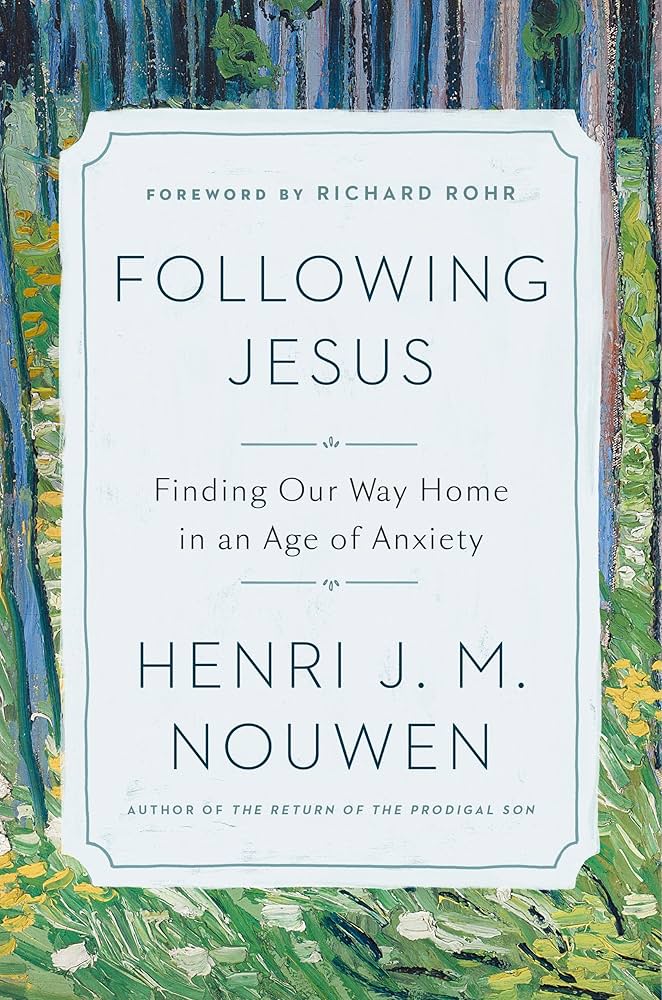
Following Jesus explores the spiritual concept of truly following Jesus, addressing a common human tendency to either be constantly busy or completely inactive. The author observes that many people live life in two extreme modes: perpetual restlessness or complete disengagement.

In the first mode, individuals are constantly moving, doing numerous activities, attending events, and meeting people, yet feeling a profound sense of meaninglessness. They’re exhausted by their own busyness, often unable to articulate what they’re actually accomplishing. This restless wandering leads to deep fatigue and a sense of being lived, rather than living purposefully.

The alternative state is total passivity, where people give up on their pursuits and sink into a state of apathy. They lose interest in life, spending time watching television, sleeping, or engaging in mindless activities. Some might seek escape through substances or other distractions, but fundamentally, they feel empty and unmotivated.

The core message is that Jesus offers a transformative alternative to these states through a gentle, loving call to “follow me.” This invitation isn’t forceful but is a sensitive, quiet voice that can reshape one’s entire existence. When people hear and respond to this call, their lives gain focus, purpose, and meaning. The wandering and listlessness are replaced by a clear direction and renewed excitement.

Author Henri Nouwen encourages readers to quiet themselves and listen for this voice of love, which speaks personally and intimately, calling each individual by name and offering a path out of spiritual exhaustion into a meaningful, directed life.


Henri Nouwen’s Following Jesus is a tender meditation on Christian discipleship that invites readers into a deeply personal and transformative journey of faith. At its core, the book is less a theological treatise and more a compassionate invitation to experience Christ’s love in the most intimate ways possible.

Nouwen begins by challenging the conventional understanding of following Jesus. It’s not about rigid adherence to rules or performing grand religious gestures, but about cultivating a profound, personal relationship with Christ. He emphasizes that discipleship is fundamentally about love – a love that transforms, heals, and provides radical hope.

Throughout the book, Nouwen explores several key themes of Christian discipleship. He speaks eloquently about vulnerability, suggesting that true following of Jesus means embracing our own brokenness and weakness. Instead of seeing our limitations as obstacles, Nouwen encourages readers to view them as sacred spaces where God’s grace can most powerfully manifest.

The spiritual journey, as Nouwen describes it, is not a linear path but a continuous process of surrender and discovery. He draws beautiful parallels between Jesus’s own life and the challenges believers face, highlighting that following Christ means walking a path of both profound joy and deep suffering. This isn’t a journey of achievement, but of continuous becoming – allowing oneself to be shaped by divine love.

Nouwen also delves into the importance of community and compassion. Following Jesus, he argues, isn’t a solitary endeavor but a collective experience of transformation. We grow closer to Christ not by isolating ourselves, but by opening our hearts to others, especially those who are marginalized or suffering. He challenges readers to see Christ in every person, particularly those society often overlooks.

Prayer and contemplation are central to Nouwen’s understanding of discipleship. He doesn’t present them as dutiful practices, but as intimate conversations with a loving God. These moments of stillness, he suggests, are where we truly learn to listen and align our hearts with divine purpose.

Another profound aspect of the book is Nouwen’s exploration of spiritual poverty. He suggests that truly following Jesus means letting go of our need for control, status, and self-sufficiency. It’s about creating space within ourselves for God’s grace to work – a radical act of trust and surrender.

Nouwen’s writing is characteristically gentle and deeply personal. He doesn’t lecture but invites readers into a reflective journey, sharing his own struggles and insights with remarkable honesty. His words feel like a compassionate conversation with a wise, loving spiritual mentor who understands the complexities of human faith.

The book ultimately presents following Jesus as a dynamic, living relationship rather than a static set of beliefs. It’s an ongoing dialogue of love, transformation, and grace. Nouwen reminds us that discipleship isn’t about perfection, but about persistent, humble openness to God’s transformative power.

For anyone seeking a more intimate, authentic understanding of Christian faith, Following Jesus offers a profoundly moving roadmap. It’s an invitation to experience divine love not as a distant concept, but as a lived, breathed reality that can reshape our entire existence.


Part of a regular series on 27gen, entitled Wednesday Weekly Reader.

During my elementary school years one of the things I looked forward to the most was the delivery of “My Weekly Reader,” a weekly educational magazine designed for children and containing news-based current events.

It became a regular part of my love for reading, and helped develop my curiosity about the world around us.
Economics Principles at Your Church

My college experience included four years serving as a student assistant in the office of the chairman of our school’s economics professor. For 10 hours each week I got a healthy dose of Economics – everything from Econ 101 to advanced statistical analysis. Dr. Cho certainly knew his subject matter, and the quizzes, exams, and homework I graded made me appreciate the field of study, even to the point of taking extra classes and obtaining a minor in economics.

Over the 30 years since college, various economic concepts have popped up in my work on a church staff and as a church consultant. The most regular of these has been “The Pareto Principle,” first written about in 1906 by Italian economist Vilfredo Pareto.

You probably know it as the “80/20 Rule.”

John Maxwell recalls learning of it in a college business management course, calling it one of the most profound eureka moments in his life:

The professor was teaching the Pareto Principle, and as he explained its impact, my eyes were opened. He explained that:

  • 80 percent of traffic jams occur on 20 percent of the roads
  • 80 percent of classroom participation comes from 20 percent of students
  • 80 percent of the time you wear 20 percent of your clothes
  • 80 percent of the profits come from only 20 percent of the customers
  • 80 percent of problems are generated by 20 percent of the employees
  • 80 percent of all decisions can be made on 20 percent of the information

What an eye opener! It meant that the best 20 percent of my activities were sixteen times more productive than the remaining 80 percent. (from Leadership Gold, by John Maxwell)

Dozens of books in my Leadership Library refer to the 80/20 rule, most often in terms of resource and time efficiency. In this context, I think it is appropriate, and a very useful rule of thumb. Certain assumptions can follow from this idea – you should focus on your best customers, or your hardest working staff members, or your most profitable selling item – with these you reap the greatest results for the least effort.

In ChurchWorld, a handful of members typically account for most of the effort in the congregations. (A corollary to this principle is that a few members cause most of the headaches, but I’ll save that for another day.)

  • How can you shift more of your church members from sitting to serving, from being spectators to engaging more deeply?
  • Would doing so help more people to grow and develop spiritually?

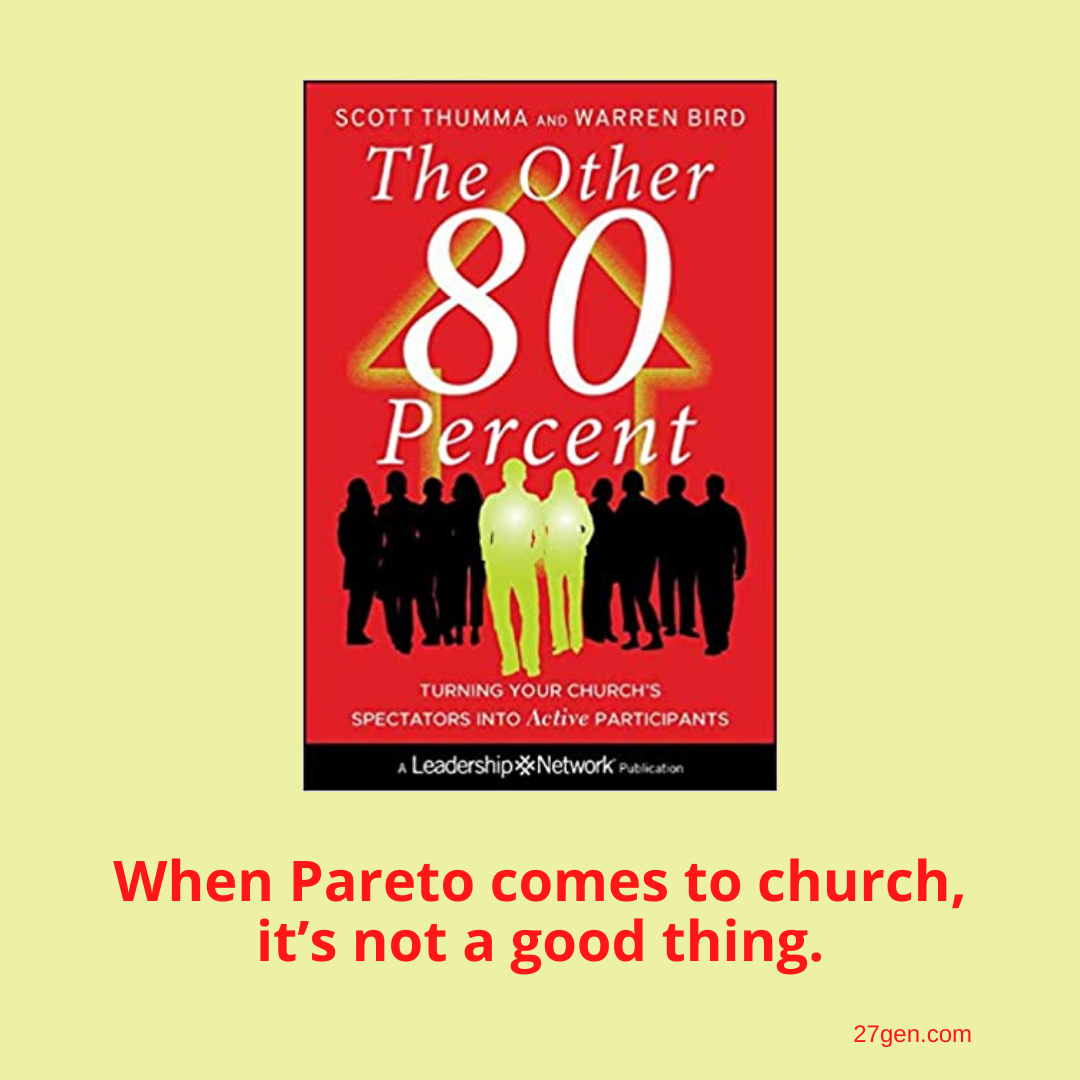
A classic Leadership Network publication may just be what you are looking for to answer those questions. The Other 80 Percent is a practical guide for church leaders, written by respected researcher Scott Thumma and noted author Warren Bird. The authors draw upon research across a broad range of Protestant churches of all kinds.

I can almost hear Dr. Cho now: “the distribution of your sheep can be shown like this…”

Beginning tomorrow, I would like to invite you to look deeper into The Other 80 Percent and see how you might use it to help move your church forward.

The LEGO Principle

Pastor Joey Bonifacio, author of The LEGO Principle, has written a brilliantly simple book about discipleship – built on the metaphor of the LEGO brick.

LEGO brick orange copy

The LEGO Principle: Connect first to God and then to one another.

You’ve gotta love it!

Regardless of the shape, size, or color of a LEGO brick, each one is designed to do just one thing: connect. LEGO pieces are designed to connect at the top with studs and the bottom with tubes.

Like LEGO, if you can connect to the top with God and to the bottom with others, you can pretty much shape the world you live in.

Here are a few examples pulled from the LEGO world, with Bonifacio’s application to the life of the believer:

Not all LEGO pieces have the same ability to connect. Some have the capacity to connect with as many as twelve or more bricks while others are limited. There are pieces that can connect to only one other brick. The secret of LEGO is not that every brick connects with the same number of other pieces but that each piece has the capacity to connect.

This secret applies to believers as well: every believer has the ability to connect directly to God.

Each LEGO brick comes with studs that give it the ability to connect. Every stud has the LEGO trademark engraved on it, a symbol of trust. In the past others have tried to copy LEGO bricks but have been unsuccessful. Their studs did not connect as well.

Like trusted LEGO bricks, we connect best when we are the real thing.

Two eight-stud LEGO bricks can be combined in twenty-four ways. Three eight-stud bricks can be combined in 1,060 ways. Six eight-stud bricks can be combined in 102,981,500 ways. With eight bricks the possibilities are virtually endless.

Just like LEGO bricks, using love to connect with people has endless possibilities.

By 1968, nineteen years after the first LEGO brick was made, the LEGO company built its first LEGOLAND – an entire city of LEGO structures in its hometown of Billund, Denmark. Something was missing: people.

In 1974 LEGO began making people, starting with the LEGO family. These mini figures soon became the biggest-selling product, enjoyed by both boys and girls. Several billion of these figures have been built to date. LEGO realized that people love people. What good is a world without people?

To the degree that we value and love people will we  engage our community and culture.

LEGO bricks are built to connect multigenerationally. That means bricks made in the 1950s connect just as well with those made in 2013. Connecting bricks made decades apart is not a problem.

In the same way, when people make disciples through relationships, generational, traditional, and denominational differenced fall by the wayside.

And like LEGO bricks, when the connections happen, the possibilities are endless.

The Lego Principle

The LEGO Principle

Celebrate the Supernatural

It’s that time of year again – spooks, goblins, and witches take to the streets on Halloween. Most parents don’t know the origins of Halloween –from ancient Celtic celebrations about the end of summer and the beginning of winter, to the Romanized adaptations of All Hallow’s Eve, All Saints Day, and eventually All Soul’s Day. Consumerism has taken over in books, movies, and a whole industry devoted to the supernatural. In recent years, there has been an increasing involvement of adults in Halloween activities, even those formerly limited to children.

Where should the church stand in all this? I say “Celebrate the Supernatural”!

I’m not a heretic, and I don’t advocate a focus on the dark side of things. I simply encourage you to look at the word “supernatural” and what it should mean for believers.

At its very basic level, supernatural means “above nature”. Is this not a great definition for believers in Christ? We are to be “in the world, but not of it”. But there is an even greater reason that we should celebrate the supernatural, and that is in the area of spiritual gifts.

The scriptural basis for spiritual gifts is found in a few New Testament passages, but our additions to these few verses over the years could fill a small library. I don’t want to enter into a theological debate about gifts – I simply say the Bible teaches us about them, and we should celebrate them by putting them into practice by serving others in God’s name.

Many definitions of spiritual gifts exist, but the one that I have adapted over the years and that resonates most with me is a “supernatural capacity of grace from God, used to serve Him for His purposes”. To me, it is a given that these gifts are from God and to be used by us for His purposes.

Through the Holy Spirit, we have been empowered to carry out His purpose and contribute meaningfully to His body. We know that we belong to Him, that our inherent worth is to be found in Him. He made us, redeemed us, gifted us, and placed us in the body of Christ – the church – just as He chose.

If that’s not “super natural”, I don’t know what is!

How will you celebrate this week?