Valentine’s Day in the Future

Well, at least what scientists are telling us how chocolate will change in the future…

2014Melt-Proof Wrappers. Candy companies are developing wrappers that prevent chocolate from melting in temperatures up to 104 degrees.

20163D Chocolate Printer. Using edible purees in place of ink, engineers have created a printer that creates totally edible forms.

2018Low-Fat Chocolate. Through selective breeding of cacao trees, scientists hope to grow beans with less fat.

2021Cookie-Baking Robot. Scientists have created a robot that can mix up a batch of cookies and pop them in the oven; it takes 2 1/2 hours currently.

2032$20 Candy Bars. Some industry experts say the world is running out of affordable chocolate, primarily because of declining production.

The delicious (except for the final one) tidbits above came from the Food Network Magazine March 2012 issue.

I hope you have enjoyed these enticing chocolate posts (start here to see the whole series) on Valentine’s Day 2012!

Now, it’s off for a late dessert date with my Valentine!

 

Beware of Bite Size Chocolate Bars

During a three-year study by researchers in Canada, people showed more restraint when eating regular-size candy bars than when eating mini ones. Bite-size snackers tended to eat four or five treats – about 50 percent more than the full-sized candy bar eaters consumed.

That’s why I only eat regular sized candy bars!

Okay, so I define regular size a little different from most people…

I’m Only Trying to be Generous

People with a sweet tooth are sweeter.

According to a study by Gettysburg College psychology professor Brian Meier, if you treat yourself to chocolate, you’re probably a more generous person. In his study, researchers gave subjects either a piece of chocolate, a cracker, or no food at all and then asked the subjects to volunteer for something and estimate how much time they could give.

The chocolate eaters offered 42 percent more time than the cracker group and almost 68 percent more than the subjects who ate nothing, During another part of the study, subjects prejudged others based on whether they liked sweets; those who did were ranked more agreeable.

According to Meier, “It’s hard to imagine people fighting while eating chocolate.”

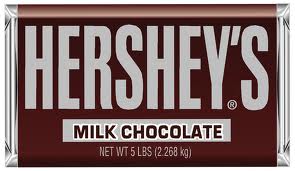
I agree; pass me a Hershey’s bar, please.

What’s Your Chocolate IQ?

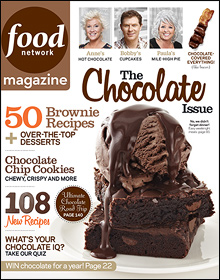
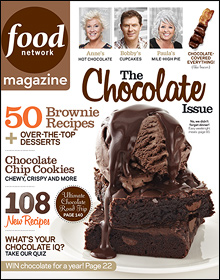
That would be “Super Sweet,” according to Food Network Magazine’s Chocolate IQ Test in the March 2012 issue.

To earn that dubious honor, I scored a 16 out of 20. Willy Wonka would be proud.

Grab a copy of the magazine to take your own Chocolate IQ test.

And there’s also…


…50 brownie recipes

…secrets to make different types of chocolate chip cookies

…how to cover anything in chocolate

…a chance to win chocolate for a year

…dozens of recipes and tips involving all things chocolate

Now that I’ve proven my IQ, I think it’s time to pursue a PhD in Chocolate!

Study materials…


Chocolate Can Help Your Workout

Give yourself a reward before you hit the gym: Dark chocolate might increase your exercise performance.

University of California researchers gave mice a dose of epicatechin, a purified form of cacao’s most prevalent flavonoid and had them hit the treadmill. The mice ran 50 percent farther and faster than the control mice who received water. The experts predict similar results in humans, but don’t go celebrating with a king-size candy bar.

You need only five grams (about the size of one Hershey’s Kiss) to reap the benefit.

Don’t you just hate the fine print?

Emulate Chefs

With the culinary art/leadership connection going on, and the fact that I’ve been rereading Jason Fried and David Heinemeier Hansson’s great book “Rework“, I thought the following post from last year would be appropriate again.

You’ve probably heard of Emeril Lagasse, Mario Batali, Rachel Ray, Paula Deen, Bobby Flay, Jacque Pepin, or Julia Child. They’re great chefs, but there are a lot of great chefs out there. So why do you know these few better than others?

Because they share everything they know.

They put their recipes in cookbooks and show their techniques on cooking shows. They want you to take what they have developed and make it your own.

Great organizations should share everything they know, too. Don’t be paranoid and secretive, but be open and generous.

A recipe is much easier to copy than a business idea. Shouldn’t that scare someone like Mario Batali? Why would he go on TV and show you how he does what he does? Why would he put all his recipes in cookbooks where anyone can buy and replicate them? Because he knows those recipes and techniques aren’t enough to beat him at his own game. No one’s going to buy his cookbook, open a restaurant next door, and put him out of business. It doesn’t work like that, but many organizations think that’s what will happen if others learn how they do things.

Emulate famous chefs. They cook, so they write cookbooks.

What do you do? What are your “recipes”? What’s your “cookbook”? What can you tell the world about how you operate that’s informative, educational, and promotional?

What’s cooking in your “kitchen” that you should share?


Pursuing Excellence…

Always.

From an instructor at the Culinary Institute of America:

Cooking is an inexact science, and this is where the art comes in. You’ve got standard ratios that work up to a point. There are always variables, as far as: Did you cook all the roux out? How high was your cooking temperature? How much evaporation did you have? How much did it reduce? You have to take all those things into account, and see what your final product is, and figure out how to fix it. You have to be not so stressed out or under pressure that you can say “I know it’s not right and I need to fix it.”

“You can’t ever send a product out if it’s not right,” he continued. It doesn’t matter how busy you are – your reputation is on the line every time you put a plate out. If you send it out hoping they won’t notice, then that’s the kind of chef you will be all your life.

“So. Start. Good habits. Early! Do it right. Take your time.”

As Tom Peters would say:

EXCELLENCE.

Always.

If not EXCELLENCE, what?

If not EXCELLENCE now, when?

Excellence is not a goal – it’s the way we live, who we are.

What’s up at your place, excellence-wise? Are you content with the same old, same old? Is is good enough? Or are you pursuing excellence?

Strive for excellence – ignore success.

What’s Your Stock?

Stock…

…the foundation for all classical French cooking.

At the CIA (that’s Culinary Institute of America), you start off your three-year education by learning how to peel vegetables and prepare a basic stock. You don’t do it once – you do it every day during the three-week rotation of the first class. Students move on after the first three weeks, but will continue to use the stock prepared by the next class of new students. Every three weeks, a new rotation of prospective chefs learn how to prepare stock.

A great stock is judged by:

  • Flavor
  • Clarity
  • Color
  • Body
  • Aroma

The perfect stock has what is referred to as a “neutral” flavor. This is a kind way of saying it doesn’t taste like anything you’re used to eating or would want to eat. But you can do a million different things with a great stock because it has the remarkable quality of taking on other flavors without imposing a flavor of its own. It offers its own richness and body anonymously. When you reduce it, it becomes its own sauce starter. You can add roux to stock and create a demi-glace, and with a demi-glace, you can make over a hundred distinct sauces that define classic French cooking.

What’s your stock?

Personally. Organizationally. However you want to define it.

What’s that basic “thing” you are, have, or do that makes everything else come together to make things happen?

Learn to make a basic stock, and the possibilities become endless.

Making a Leadership Emulsion

Some of the most flavorful, satisfying, and versatile sauces in the culinary world are an emulsion – but you’ve got to work to make one.

This is an emulsion: an agreement between two unlike elements (butter and water), achieved by heat and motion. If you get it slightly wrong – as when the sauce starts to dry out, destroying the balance between the fat and the liquid – the unlike elements pull apart and break up. When that happens, it takes more work to get the emulsion back to where you want it than it did to get it in the first place.

As a ChurchWorld leader, you are, in effect, an emulsion.

Both leadership and management are necessary skills to bring your organization forward. While many people separate “leadership” and “management,” they are both necessary.

Leadership involves inspiring, motivating, crafting a vision, setting direction, strategic thinking, and bringing out the best in your people.

Management involves planning, tracking, and measuring – in short, handling all the nuts-and-bolts of day-to-day business operations.

People in positions of responsibility and leadership – like you – need to do both well in order to be successful. This need dramatically intensifies during times of economic uncertainty, shifting internal and external forces, and the constant need to do more with less – like now.

You need to be an “emulsified leader:” building solid skills in both leadership and management AND the ability to switch gracefully between the two.