The Leadership Lessons of Starbucks

A man sits alone at lunch in his favorite Starbucks store and tells a green apron-clad Starbucks barista that the store is his midday refuge, noting, “At Starbucks, you are nice to me, you remember me, and you seem genuinely grateful that I am here.” – from Leading the Starbucks Way

Stories like this exemplify a company whose leaders establish a compelling vision and manifest behaviors that culminate not only in product sales but also in powerful, loyalty-rich human connections.

Here’s my personal Starbucks “Aha” story:

On a cold January day over six years ago, I was at “my” Starbucks for an hour’s worth of quiet study, accompanied by a White Chocolate Mocha and a warm Apple Fritter. I settled into a comfortable seat, observing the friendly, welcoming interactions between the baristas behind the counter and their customers as they walked in. I didn’t know I was in for Guest Experience 101.

While I was observing the barista’s interactions with customers, a young mother and her 3 year-old daughter came into the store. As they were walking in the door, the barista came out from behind the counter, said hello to the mom, then knelt down in front of the daughter, calling her by name and engaging in a conversation for several minutes – all while other customers continued to come into the store. The store was well staffed, so no one was held up by the barista’s actions. A seemingly small gesture? Maybe so, but it sparked a single question in me, one that I am still seeking the answer to today:

What would it take for churches to have the same kind of passion and enthusiasm in greeting their Guests?

That fleeting interaction between a barista and a Guest launched a journey that continues to expand into new territory. It’s only appropriate, though, to come back to Starbucks for new insights and applications for Guest Experiences in ChurchWorld.

One of the best-recognized and admired brands in the world, Starbucks singlehandedly transformed the ordinary delivery of coffee into a cultural phenomenon – a result of the company’s exemplary leadership practices.

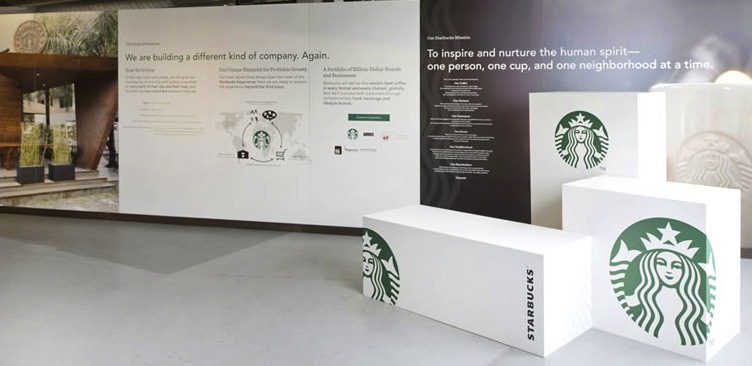
Joseph Michelli, author of the bestseller The Starbucks Experience, explains that the international success of Starbucks begins with a promise: to inspire and nurture the human spirit – one person, one cup, and one neighborhood at a time.

Michelli offers a perspective on the leadership principles that drove the iconic coffee company’s resurgence from serious setbacks during the economic downturn – one of the few turnaround stories of this time. The foundation of the turnaround was a Transformation Agenda (For more about this turnaround, see Starbucks CEO Howard Schultz’s book Onward; you can read some excerpts from it in a series of posts beginning here).

Here’s a list of Starbucks’ Transformation Agenda in seven bold moves:

  1. Be the undisputed coffee authority
  2. Engage and inspire our partner
  3. Ignite the emotional attachment with our customers
  4. Expand our global presence – while making each store the heart of the local neighborhood
  5. Be the leader in ethical sourcing and environmental impact
  6. Create innovative growth platforms worthy of our coffee
  7. Deliver a sustainable economic model

Those seven moves resulted in 13 consecutive quarters of global comparable store sales growth greater than 5%. Today, there are over 200,000 people serving more than 60 million weekly customers who frequent more than 18,000 stores in more than 60 countries worldwide.

Starbucks had positioned itself for enduring profitability and brand respect.

For his latest book Leading the Starbucks Way, author Michelli conducted over two years of research, with uninhibited access to leaders and partners at all levels of the company. More than 500 hours of interviews and research produced the following five leadership principles:

  1. Savor and elevate
  2. Love to be loved
  3. Reach for common ground
  4. Mobilize the connection
  5. Cherish and challenge your legacy

In this series of posts focusing on these five principles, I want to encourage you to accompany Michelli as he asks questions like these – but translated for ChurchWorld application:

  • How do leaders at Starbucks strategically and tactically steward the company’s products and people to build customer engagement, loyalty, advocacy, and even brand love?
  • How to these leaders model and inspire excellence in product delivery, the creation of moments of authentic service, and enterprise-wide appreciation for the importance of shareholder value, and a contagious demonstration of social conscience?
  • How do Starbucks partners expand relationships beyond the café environment?
  • How does Starbucks leverage technology to enhance customer experiences?
  • What does Starbucks do to customize offerings to address local desires around the globe?

As a ChurchWorld leader, I hope you realize that by changing just a few words in the questions above, you will have an excellent guide for your own journey of discovery.

Part 1 of a series in the 2013 GsD Fall Term

Leading the Starbucks Way: Information, Insights, and Analysis Needed to Create a High-Performance Guest-Oriented Organization

inspired by and adapted from Leading The Starbucks Way, by Joseph Michelli

Print

Transformation Hurts

If you are comfortable where you are, or if things are okay as they are, you wouldn’t go through transformation.

Only when the pain of changing things overcomes the pain of status quo would you ever consider transformation.

That’s where Starbucks found itself in early 2008. Chronicled in CEO Howard Schultz’s 2011 book Onward, Starbucks – at the apparent height of its success – was declining inwardly, and on the edge of declining outwardly. Onward details the transformation Starbucks went through in 2008-2010, utilizing a Transformation Agenda developed by the senior leadership team at Starbucks as the primary guide.

The Transformation Agenda featured 7 “Big Moves” – innovations and advancements designed to return Starbucks to its core practices. The Big Moves also contained one final, painful set of actions designed to reverse sales trends and bolster stock value.

600 stores closed.

12,000 partner positions eliminated in these stores.

1,000 non-store positions eliminated.

Schultz called it the most painful decision he has ever made. Only the certainty that closing the stores would keep Starbucks operational in the long run allowed him to make the decision. He understood the reasoning, but it was impossible to take the emotion out of the equation:

For all the flak about Starbucks’ ubiquity, almost every store maintained a devoted following inside and out. A soul. With each closing, we would be erasing a fingerprint, and that was a reality I could not possibly ignore.

Fast forward to the fall of 2010: Starbucks regained a healthy balance with a culture that celebrates creativity and discipline, entrepreneurship and process, as well as rigorous innovation. Their fiscal 2010 operating margin was the highest consolidated one in their 40-year history. The transformation worked.

But according to Schultz,

…perhaps the most valuable thing that came out of the two-year transformation was the confidence we gained knowing that we could preserve our values despite the hardships we faced. Holding fast to those values steadied us throughout the tumultuous journey, and the ways in which we conduct our business will continue to bring our partners pride and fuel their engagement as we continue to grow.

Success is not sustainable if it’s defined by how big you become. Large numbers are not what matter. The only number that matters is “one.”

brewed coffee in cup

One cup.

SB customer

One customer.

barista handing drink over counter

One partner.

SB interior

One experience at a time.


Question for ChurchWorld leaders:

What’s your “one”?

an updated post from a series reviewing Onward, by Howard Shultz

Onward

preparation for a new series coming soon on Leading the Starbucks Way, by Joseph Michelli

Print

Transformation Initiatives at Starbucks

A previous post was a brief look at the bold Transformation Agenda that Starbucks put into place early in 2008 to overcome their decline. The Agenda contained a mission statement and 7 Big Moves designed to return Starbucks to success.

Within a few months, at their April 2008 shareholders meeting, Starbucks rolled out the following six transformation initiatives:

  • The Mastrena – a finely crafted, Swiss made espresso machine that would provide baristas with the ability to give customers a high-quality consistent shot of espresso second to none, transforming the espresso experience in their stores. By the end of 2008 the machine was in 30% of stores, and by 2010 a majority of Starbucks had the Mastrena.
  • Conservation International – a partnership with CI, begun in 1998, was expanded so that Starbucks could buy fair-trade coffee, produced in shade-grown conditions with fair compensation and safe working conditions for coffee farm workers. By 2009, all Starbucks espresso beans and espresso-based products would qualify for a new marking designed to articulate their practices: Responsibly Grown. Ethically Traded. Proudly Served.
  • The Rewards Card – designed to recognize their most loyal customers with freebies, the Card addressed an emerging need for value. Existing Starbucks Card holders could register their cards online, instantly turning it into a Rewards Card.
  • MyStarbucksIdea.com – an interactive website designed to listen to customers suggestions, rants, and comments. Moderated by 50 veteran Starbucks employees, the website was launched live by uploading ideas submitted by shareholders that morning. Within minutes, more ideas came streaming in from people listening to the meeting’s broadcast or following rolling blog posts. In the next 24 hours, over 7,000 ideas were posted.
  • Pike Place Roast – announcing that Starbucks would once again grind whole beans in their stores, two master baristas introduced Pike Place Roast, a smooth, well-balanced, lighter blend of coffee, designed to give full flavor while not being as bold as traditional blends.
  • Clover – a commercially viable way to replicate the benefits of the French Press method of brewed coffee, Clover was a local invention acquired by Starbucks early in 2008. It created a fantastic cup of coffee at a pace designed to keep up with the demand of most Starbucks stores.

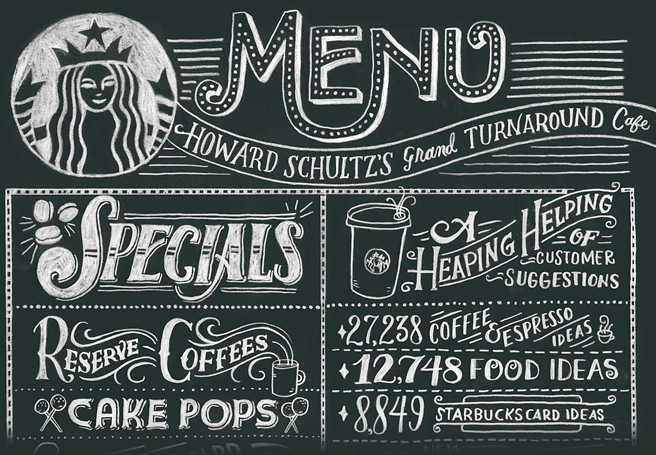
SB turnaround menu fastcompany.com

Seven Big Moves.

Six Transformation Initiatives.

All of these engaging tools that helped Starbucks navigate through a very unpredictable journey, one milestone at a time.

The initiatives introduced at that meeting each heralded a return to the core values of Starbucks – coffee, customers, innovation, and values – but they weren’t enough by themselves to bring the company back from the brink.

Painfully personal decisions were the final step in the transformation.

Lessons for ChurchWorld

  • Take a look at the initiatives above, and translate them into your world. What actions can you dream up – and then put into action – that would help you accomplish your transformation agenda?
  • Are you secure enough in your core values to put anything – and everything – on the table?
  • Transformation is not just about nuts and bolts, about systems and processes. Is your vision lived out in the lives of your people?

an updated post from a series reviewing Onward, by Howard Shultz

Onward

preparation for a new series coming soon on Leading the Starbucks Way, by Joseph Michelli

Print


Transformation Agenda

Continuing the transformation journey at Starbucks – and what it can teach your organization…

Once Starbucks Chairman Howard Schultz decided to return as CEO, he pulled together a team to began working on the process of turning the company’s performance around.

As noted in this post, one of the team’s key realizations was the need to focus on the ones: one cup of coffee, served to one customer, at one store. That thought drove the team to draft a transformation agenda that would be used company-wide to implement decisions.

The Transformation Agenda started with a compelling strategic vision, and was followed by a backbone of seven big moves, each with specific tactics. Here’s a synopsis:

Our Aspiration – To become and enduring, great company with one of the most recognized and respected brands in the world, known for inspiring and nurturing the human spirit.

courtesy touchworldwide.com

courtesy touchworldwide.com

Seven Big Moves

  • Be the undisputed coffee authority – Starbucks could not possibly transform the company if they did not excel and lead in their core business. Focusing on their quality and passion they exhibit in sourcing, roasting, and brewing coffee, actions included improving the quality and delivery of espresso drinks, reinventing brewed coffee, delivering innovative beverages, and increase the share of the at-home market. Undergirding all these actions was the push to continue telling their story.
  • Engage and inspire their partners – Every Starbucks partner (employee) should be passionate about coffee – from soil to cup – and possess the skills, enthusiasm, and permission to share that expertise with customers. Actions included significantly improving training and career development for partners at all levels as well as developing meaningful and groundbreaking compensation, benefit, and incentive packages for partners.
  • Ignite the emotional attachment with their customers – People come to Starbucks for coffee and human connection. Their goal was to put customers back in the center of the experience by addressing their needs, providing the “value” in a manner congruent with the brand, and developing programs that recognize and reward the most loyal customers. In the stores, that meant achieving operational excellence, finding new ways to deliver world-class customer service and perfect beverages while keeping costs in line and retail partners engaged.
  • Expand their global presence-while making each store the heart of the local neighborhood – The challenge was to grow their retail presence while striving to connect with and support the neighborhoods and cultures that each store serves. Enhancing local relevancy would mean redesigning existing and new stores, offering new products that reflected the tastes of particular cultures, and reaching out by volunteering or fund-raising to support local programs and causes.
  • Be a leader in ethical sourcing and environmental impact – Starbucks has led the way in treating farmers with respect and dignity. These efforts would expand, strengthening existing partnerships and forging new ones. They also have a goal of reducing each store’s environmental footprint and sharing their initiatives with others.
  • Create innovative growth platforms worthy of their coffee – Starbucks would grow not just by adding stores and selling coffee, buy also by extending its brand and/or expertise to new product platforms expanding or complementing coffee, such as tea, cold beverages, instant coffee, food, and the booming health and wellness market. Innovation that was relevant to their core values would be the hallmark of their transformation.
  • Deliver a sustainable economic model – Without a profitable business model, Big Moves 1-6 would not be possible. It was imperative that the refocus on customers and core also be matched by an improvement on how they operated their business. Creating a culture that drove quality and speed, managing expenses on an ongoing basis, reducing costs, and building a world-class supply chain would be the primary tactics in this area. Big Move 7 would be the most painful, least sexy, and most difficult part of transforming the company.

Launched at a global summit of 200 of Starbucks’ most senior leaders from around the world, the Transformation Agenda was in Schultz’s words “to make sure that we level set the reason we exist.”

courtesy nbcnews.com

courtesy nbcnews.com

Schultz felt ultimately that the summit helped align Starbucks’ top global leaders around two very important statements: the Transformation Agenda, which outlined what everyone at Starbucks needed to do, and the mission statement, which reminded them why.

Lessons for ChurchWorld Leaders:

  • Do you know what you are doing?
  • Do you why you are doing it?
  • Do you know how you are doing it?
  • Do you know when you are successful?
  • Do you know where God is taking you?

For a better understanding of these questions in terms of your church, take a look at the Church Unique Visual Summary here, or download it here as a free e-book.

It might just be the start of your own Transformation Agenda.

an updated post from a series reviewing Onward, by Howard Shultz

Onward

preparation for a new series coming soon on Leading the Starbucks Way, by Joseph Michelli

Print

Ones Add Up

Starbucks’ CEO Howard Schultz’s 2011 book Onward details the amazing comeback story of Starbucks: after more than three decades of success, in 2008 they found themselves with sales sliding at a distressing rate, a falling stock value, and relentless competition. Compounding the problem, the world’s economy was in a tailspin.

With aggressive, sometimes painful moves and a powerful transformation agenda to guide them, they were able to reverse their decline, and by the end of 2010 were once again on top of their game.

What happened?

Here’s an excerpt from the book that gives you a big clue:

Like a doctor who measures a patient’s height and weight every year without checking blood pressure or heart rate, Starbucks was not diagnosing itself at a level of detail that would help ensure its long-term health. We predicated future success on how many stores we opened during a quarter instead of taking the time to determine whether each of those stores, would, in fact, be profitable. We though in terms of millions of customers and thousands of stores instead of one customer, one partner, and one cup of coffee at a time.

With such a mind-set, many little things dangerously slipped by unnoticed, or at least went unacknowledged. How could one imperfect cup of coffee, one unqualified manager, or one poorly located store matter when millions of cups of coffee were being served in tens of thousands of stores?

We forgot that “ones” add up.

courtesy freemarketmediagroup.com

courtesy freemarketmediagroup.com

Lessons for ChurchWorld:

  1. What “business” are you in?
  2. What are the roots of that business?
  3. It’s okay to have a 30,000 foot view, but eventually you’ve got to land the plane.
  4. You’ve got to produce results.
  5. You may see the crowds, but never forget the “ones“.

an updated post from a series reviewing Onward, by Howard Shultz

Onward

preparation for a new series coming soon on Leading the Starbucks Way, by Joseph Michelli
Print


Change Lessons from Starbucks

Readers know of my fondness of using Starbucks as a model for excellence in Guest Experiences. Over the past several years I have probably referred to them a couple of dozen times or more. One of my most requested presentations on an introduction to Guest Experiences uses Starbucks as a model. When something works well, and can serve as a model for what churches can do, why not use it?

There’s a flip side to Starbucks as well. In late 2007, the company was not doing well, and the future looked bleak. To address the emerging problems, former CEO Howard Schultz, who had stepped aside almost eight years earlier to become chairman of the board, did something unexpected: he returned as CEO to oversee day-to-day operations.

Schultz came back to Starbucks with a passion and a plan, and over the next two years, Starbucks returned to sustainable, profitable growth.

Schultz has recounted this story in Onward, released in 2011. It is a fascinating and extraordinarily intimate look at Schultz’s leadership – one that I think church leaders would find appropriate for their own journey.

Onward also serves as a great refresher and prelude to a brand new book on Starbucks: Leading the Starbucks Way, by Joseph Michelli. It was just released and I am currently working through it, preparing a new series of leadership principles demonstrated by your friendly neighborhood baristas at Starbucks.

So, for the next few days, I want to dive back into Onward and pull out some lessons for ChurchWorld leaders. What’s the best place to start?

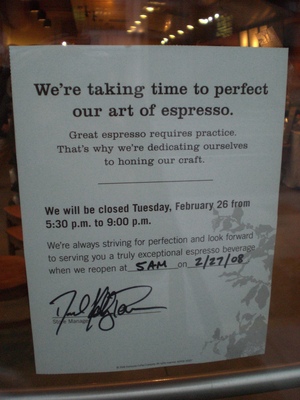
A closed sign.

On February 26, 2008 – the following sign appeared on all 7,100 Starbucks stores in the US as they closed for three hours:

SB barista training store closed

That’s right – Starbucks closed the doors early and spent three hours retraining the baristas to make sure they were doing their best. Touted by some as a marketing stunt, taken advantage of by the competitors, losing over $6 million dollars – what was up with Starbucks?

It was a symbolic act – three hours of education would not solve the huge problems Starbucks was facing.

But it worked.

Over the next year and a half, Starbucks followed a “Transformation Agenda” that provided some great leadership principles that leaders in ChurchWorld will find helpful. Here is a summary from Schultz listing those leadership lessons:

  • Grow with discipline.
  • Balance intuition with rigor.
  • Innovate around the core.
  • Don’t embrace the status quo.
  • Find new ways to see.
  • Never expect a silver bullet.
  • Get your hands dirty.
  • Listen with empathy and over communicate with transparency.
  • Tell your story, refuse to let others define you.
  • Use authentic experiences to inspire.
  • Stick to your values, they are your foundation.
  • Hold people accountable but give them the tools to succeed.
  • Make the tough choices; it’s how you execute that counts.
  • Be decisive in times of crisis.
  • Be nimble.
  • Find truth in trials and lessons in mistakes.
  • Be responsible for what you see, hear and do.
  • Believe.

Ready to learn from Starbucks’ painful journey of transformation?

an updated post from a series reviewing Onward, by Howard Shultz

Onward 

preparation for a new series coming soon on Leading the Starbucks Way, by Joseph Michelli
Print

Beyond Mickey’s Ten Commandments: Leadership Lessons from Disney’s Imagineers

There are two ways to look at a blank sheet of paper. It can be the most frightening thing in the world because you have to make the first mark on it. Or it can be the greatest opportunity in the world because you get to make the first mark – you can let your imagination fly in any direction, and create whole new worlds.  -Marty Sklar’s words to the Imagineers in 1966

Retired Disney Imagineer Mary Sklar had a remarkable 54-year career with the Disney organization. His work covered many areas of the organization, but focused on Imagineering, the group Walt created that blended creative imagination with technical know-how.

Sklar is best known for “Mickey’s Ten Commandments,” but in his recently published book Dream It, Do It! he revealed 3 additional lists: 2 on “The Leader’s Bible” and 1 on “Followership.”

The Leader’s Bible, Part One

  1. Create and maintain a climate of trust.
  2. Be responsive and make decisions – that’s what leader’s do!
  3. Empower your teammates – it takes many hands to bake a success.
  4. Create opportunities for new birds to fly.
  5. Remember: experience is not a negative.
  6. Make sure yours is not the only voice you are listening to.
  7. Celebrate diversity and different points of view.
  8. Never rest on your laurels – the next at-bat is your most important.
  9. Take a chance – support risk-taking.
  10. Provide plenty of blank paper.

The Leader’s Bible, Part Two

  1. Be optimistic – if you are not positive, who else will be?
  2. Courage and confidence are major cross streets on the road to success.
  3. Make curiosity your search engine.
  4. Learn to love you next assignment – be passionate about whatever you do.
  5. Provide time to explore – but deadlines are great motivation and discipline.
  6. Take time to teach – mentors are mensches.
  7. Forget the politics – it’s not an election!
  8. Traditions are important – but change is the great dynamic.
  9. Team and work are four-letter words – but together they spell “winner.”
  10. Remember: the last three letters of trend are E-N-D!

WD Quote Dream It Do It

Sklar’s ideas and principles were developed and implemented over decades of leadership with Disney’s Imagineers. They were formed by lessons learned from Sklar’s mentors, most notably Walt Disney and designer John Hench. They served the team of designers, engineers, architects, technicians, and others responsible for creating the Disney theme park experiences well…

…they will be pretty good for leaders in your organization, too!


Inspired by Dream It, Do It: My Half-Century Creating Disney’s Magic Kingdoms, by Marty Sklar Disney Legend and Imagineering Ambassador

Dream It Do It

Bridging the Digital Divide, Part 3

Our leadership brains are dealing with a digital divide in organizations today: team members of different generations think differently. First, there’s the digital natives; then come the digital immigrants. Bringing up the rear (literally) are the digital dinosaurs.

Author Marilee Sprenger, writing in “The Leadership Brain for Dummies,” makes these observations about the digital dinosaur:

courtesy gerbenvanerlelens.com

courtesy gerbenvanerlelens.com


Natives speak the language of their birth; immigrants are learning to translate the digital language of the natives, and then there are those individuals or organizations who are hopelessly out of date – the digital dinosaur.

You may think that Traditionalists (born before WW II) fall into this category, and many do. But anyone or any organization can be a dinosaur.

Digital media is transforming organizations everywhere. If your organization appears to be incapable of change, those who embrace digital technology won’t find it appealing. If your clients are changing their minds and getting plugged into the latest technology, you don’t won’t to present yourself as stuck in an analog world.

Take a close look at what your competition is doing digitally. If they are still dinosaurs, make some changes so your organization can be the first to enter the global age. Rather than feeling safe because they aren’t doing anything that you’re not doing, get out of that reptile brain and use your thinking brain to take some risks to get updated.

Note to church leaders: if my use of the words “client” and “competition” bother you, sorry – you have a whole different set of problems! The people who come to your church are your clients, and you do have competition – but it’s not the church down the street from you.


A closing thought on this series: leadership is all in your head – literally. When your brain is at its best, you will be at your best as a leader. Understanding how your brain works is just the first step. Put your leadership brain to work today!

 
inspired by The Leadership Brain for Dummies, by Marilee Sprenger
Leadership Brain for Dummies

Bridging the Digital Divide, Part 2

The brains of those who are digitally connected are different from those who are not. Here’s how Marilee Sprenger, author of “The Leadership Brain for Dummies,” sees this divide:

courtesy facebook.com

courtesy facebook.com


Some Traditionalists (born before WW II), many Baby Boomers (born 1945-1964), and the early Gen Xers (born 1965-through the 70s) fall into the category of digital immigrants. They didn’t grow up learning the second language of the digital world and speak it with varying degrees of fluency.

Many digital immigrants:

  • Insist on paper bills even though receiving copies via email
  • Print out emails and attachments
  • Rely on printed newspapers, books, and so on
  • Are somewhat leery of paying bills online
  • Believe that methods taught years ago should work for everyone
  • Don’t understand the informal language used in emails and texts
  • Believe a social network consists of people he meets with for parties

Digital immigrants have much to offer to your organization. Wisdom derived from years of storing patterns in the brain gives them the ability to see the big picture, predict accurately, foresee future consequences, and draw on mental templates to help store new information.

Challenging tasks activate more areas in the frontal lobes of the brains of digital immigrants than in the brain of digital natives. The immigrants have little choice because their brains change as they increase their skills with technology. The natives may need to practice more skills that their brains haven’t used very much, like building rapport face to face.

How do you lead digital natives and immigrants to work together?

Next: Bridging the Digital Divide, Part 3

inspired by The Leadership Brain for Dummies, by Marilee Sprenger

Leadership Brain for Dummies

Bridging the Digital Divide

Using the Leadership Brain to Understand Generational Differences

Marilee Sprenger, author of “The Leadership Brain for Dummies,” does a good job of outlining the differences in organizations that have multiple generations involved – like the church.

This post isn’t about that – you’ll have to read her book on page 223 to understand those differences. Instead, let’s take a look at the digital divide.

courtesy resetsanfrancisco.org

courtesy resetsanfrancisco.org

The brains of those who are digitally connected are different from those who are not. Since your organization has different kinds of brains working together, maybe you should understand a little about it.

The Digital Native

Today’s world requires a new language and a new literacy – digital literacy. The late Generation X’ers (born in the late 70’s) and the generations that follow them are digital natives – they speak the language well. These people have grown up with video games, cell phones, computers, the Internet, and other techno toys. The ABCs of learning have been replaced with the XYZs of technology.

The digital natives grew up communicating in a very different and fast-paced way from their parents and older siblings. They’re proud of their ability to come up with hard data quickly and easily. It’s a wide learning gap between these generations and the prior ones.

The digital natives who believe that their world isn’t complete if they aren’t constantly connected are always trying to multitask (you can’t, but that’s another post). They’re always working hard, switching from one task to another and back again without skipping a beat.

Former Microsoft executive Linda Stone called this problem continuous partial attention.

Not truly giving anything complete attention has a number of negative effects, not the least of which is the inability to accomplish anything! Efforts to stay connected may prohibit you from bringing deep thought and closure to any one project, which may lead to stress. Elevated stress leads to distraction which starts the cycle over again.

Recognize yourself?

Next: Bridging the Digital Divide, Part 2

inspired by The Leadership Brain for Dummies, by Marilee Sprenger

Leadership Brain for Dummies