Three Empires, One Continent: The Race for North America


January and February – Seeds of Rebellion Part Two

As previously discussed, Taylor’s continental approach reveals that North America was never destined to become an English-speaking nation. For nearly three centuries, the outcome remained genuinely uncertain as Spanish, French, and British empires pursued radically different colonial strategies across the continent. Understanding why Britain ultimately gained the upper hand requires examining not triumphalist inevitability, but the specific demographic, economic, and military factors that determined outcomes among competing visions of what “America” would become. Each empire brought distinct goals and methods to colonization, creating what Taylor describes as “new worlds compounded from the unintended mixing of plants, animals, microbes, and peoples on an unprecedented scale.” By the mid-eighteenth century, these competing imperial projects had produced dramatically different results – setting the stage for the dramatic events that would culminate in the American Revolution.

When European powers first cast their eyes westward across the Atlantic in the late fifteenth and early sixteenth centuries, North America represented an almost unimaginable prize: vast territories, untapped resources, and the promise of wealth and strategic advantage. Three nations – Spain, France, and Britain – would emerge as the dominant colonial powers on the continent, each pursuing distinctly different strategies shaped by their unique motivations, resources, and relationships with indigenous peoples.

Spain: The Pioneer of Empire

Spain arrived first and dreamed biggest. Emboldened by Christopher Columbus’s voyages and driven by the spectacular wealth extracted from Mexico and Peru, Spanish conquistadors and missionaries pushed northward into what is now the American Southwest and Southeast. Their colonial model was one of extraction and conversion: find precious metals, establish missions to convert Native Americans to Catholicism, and create a hierarchical society that mirrored the rigid class structures of Spain itself.

Spanish colonization followed the pathways of rumor and hope. Expeditions like those of Hernando de Soto through the Southeast and Francisco Vásquez de Coronado into the Southwest sought cities of gold that existed only in imagination. What they established instead was a chain of missions, presidios (military forts), and small settlements stretching from Florida through Texas, New Mexico, Arizona, and into California. St. Augustine, founded in 1565, became the first permanent European settlement in what would become the United States – predating Jamestown by more than four decades.

However, Spain’s North American colonies never matched the wealth of its holdings farther south. The indigenous populations were smaller and more dispersed than in Mesoamerica, and the fabled gold never materialized in significant quantities. Spanish settlements remained thinly populated, heavily dependent on a coercive labor system that exploited Native Americans, and primarily served as defensive buffers protecting the more valuable territories of New Spain. By the eighteenth century, Spanish colonization had created an impressive geographic footprint but lacked the demographic and economic dynamism that would prove crucial in the imperial competition ahead.

France: Masters of the Interior

France took a different approach entirely. Rather than establishing densely populated agricultural colonies, French explorers and traders penetrated deep into the continental interior, following the St. Lawrence River, the Great Lakes, and the Mississippi River system. From Quebec, founded in 1608, French influence spread westward and southward, creating a vast arc of territory that technically stretched from Canada to the Gulf of Mexico.

The French colonial model was built on adaptation and alliance. French traders, particularly the coureurs de bois (runners of the woods), integrated themselves into indigenous trading networks, often marrying Native American women and adopting local customs. The fur trade became the lifeblood of New France, exporting beaver pelts and other furs to insatiable European markets. Jesuit missionaries worked to convert indigenous peoples, though often with more respect for existing cultures than their Spanish counterparts demonstrated.

This approach had significant advantages. France maintained generally stronger alliances with Native American nations than either Spain or Britain, and French traders could operate across enormous distances with relatively small numbers. The downside was demographic: New France remained perpetually underpopulated. While British colonies attracted hundreds of thousands of settlers, French Canada struggled to grow beyond about 70,000 residents by the mid-eighteenth century. France’s colonial policies, which discouraged Protestant Huguenots from emigrating and focused settlement efforts on urban centers rather than agricultural expansion, meant that New France commanded vast territories but lacked the population to defend them effectively.

Britain: The Power of Numbers

British colonization began haltingly with the establishment of Jamestown in 1607 and Plymouth in 1620, but it accelerated rapidly throughout the seventeenth century. Unlike Spain’s extraction model or France’s trading networks, Britain’s colonies were fundamentally settlements – places where English, Scots-Irish, German, and other European migrants came to establish permanent communities, cultivate land, and recreate (or reimagine) the societies they had left behind.

The diversity of British colonization was remarkable. New England developed around Puritan religious communities, small-scale farming, fishing, and eventually maritime commerce and shipbuilding. The Middle Colonies became breadbaskets of grain production and models of relative religious tolerance. The Southern Colonies built plantation economies dependent on tobacco, rice, and indigo, increasingly reliant on enslaved African labor. This economic diversity created resilience and interconnected markets that strengthened the colonial system as a whole.

By the mid-eighteenth century, the British colonies boasted populations exceeding one million – dwarfing their French rivals and rendering Spanish Florida and the Southwest demographically insignificant by comparison. This population advantage translated into economic productivity, military manpower, and an ever-expanding hunger for land that pushed inexorably westward into territories claimed by France and inhabited by Native American nations.

Britain’s Ascendancy: Why the English Prevailed

Several factors explain Britain’s dominant position by the 1760s. First and most important was demography. The sheer number of British colonists created facts on the ground that neither French traders nor Spanish missionaries could match. More people meant more cleared land, more towns, more economic production, and more soldiers when conflicts arose.

Second, Britain’s constitutional system, for all its flaws, created a more dynamic economy than the absolutist monarchies of France and Spain. Property rights were better protected, entrepreneurship was encouraged, and colonial assemblies gave settlers a stake in their own governance that fostered loyalty and investment. The Navigation Acts tied colonial economies to Britain, but they also guaranteed markets and naval protection.

Third, British naval supremacy proved decisive. The Royal Navy could project power, protect maritime commerce, and prevent French and Spanish reinforcement of their colonies during wartime. The series of imperial wars culminating in the Seven Years’ War (1756-1763) demonstrated this advantage repeatedly.

Finally, Britain benefited from the weaknesses of its rivals. Spain’s empire was overextended and increasingly ossified. France faced the impossible task of defending an enormous territory with inadequate population and resources, particularly when facing Britain’s combination of naval power and demographic advantage.

The Irony of Success

The Treaty of Paris in 1763, ending the Seven Years’ War, marked the zenith of British power in North America. France ceded Canada and its claims east of the Mississippi. Spain surrendered Florida. Britain stood supreme, master of the Atlantic seaboard and beyond.
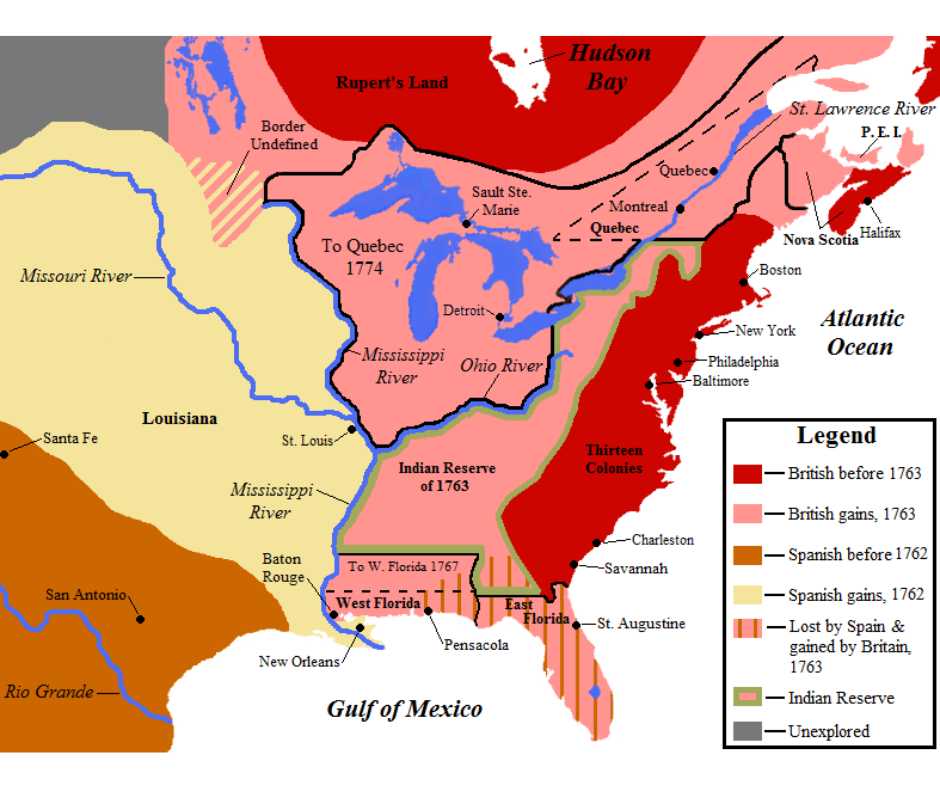
Yet this very success contained the seeds of imperial crisis. The war had been expensive, and Britain expected its prosperous colonies to help pay the costs. The colonists, having helped win the war and no longer facing French threats, increasingly questioned why they needed British rule at all. The very demographic and economic dynamism that had made the British colonies strong now made them confident and restive.

Britain had won the race for North America, but in doing so, it had created colonies powerful enough to imagine independence. The path to revolution would emerge not from weakness, but from strength – the ultimate irony of imperial triumph.

A Note on This Series

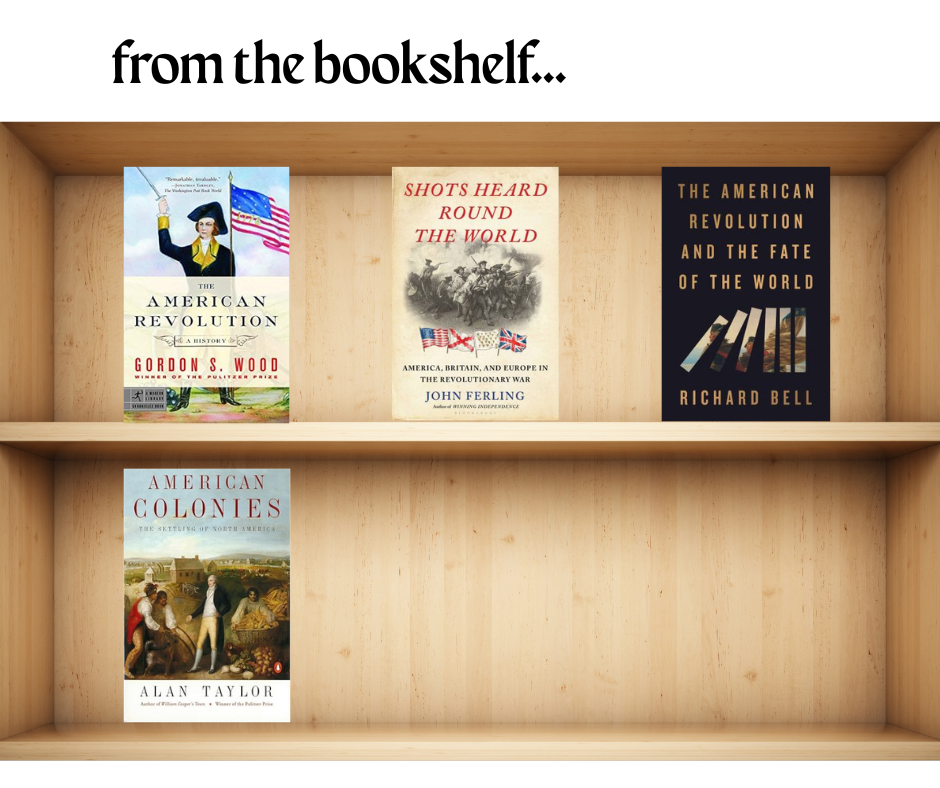
This journey through Revolutionary history is as much about the evolution of historical understanding as the Revolution itself. History isn’t static – each generation reinterprets the past through its own concerns, asking different questions and prioritizing different sources. By reading these books in dialogue across 250 years, we’ll witness how scholarship evolves, how narratives get challenged, and how forgotten stories resurface.

This isn’t about declaring one interpretation “right” and another “wrong,” but appreciating the richness that emerges when multiple perspectives illuminate the same transformative moment. These books won’t provide definitive answers – history rarely does – but they equip us to think more clearly about how real people facing genuine uncertainty chose independence, how ideas had consequences, and how the work of creating a more perfect union continues. As we mark this anniversary, we honor the Revolutionary generation by reading deeply, thinking critically, and engaging seriously with both the brilliance and blind spots of what they created.


Color map by Jon Platek

You can find the entire series listing here.

Reimagining a Continent’s Contested Past


January and February – Seeds of Rebellion Part One

Until the 1960s, American colonial history focused narrowly on English-speaking men along the Atlantic seaboard, portraying a triumphalist narrative of “American exceptionalism.” This conventional story treated women as passive, Indians as primitive obstacles, and African slaves as unfortunate aberrations in an otherwise uplifting tale of expanding English freedom and prosperity. Spanish, French, Dutch, and Russian colonies were dismissed as hostile, irrelevant backdrops to the English settlements that supposedly spawned the United States. 

This narrative placed “American” history as beginning in 1607 at Jamestown, spreading slowly westward to the Appalachians, and ignoring lands like Alaska and Hawaii until much later. While this simplification contains partial truths – many English colonists did achieve greater land ownership, prosperity, and social mobility than possible in hierarchical, impoverished England – it excludes the complex realities of women, enslaved Africans, Native peoples, and rival empires that shaped the colonial experience. This appealing but incomplete narrative persists in popular culture despite historians’ efforts to present a more comprehensive, diverse account of early America.

In an era when Americans fiercely debate whose stories belong in history textbooks, Alan Taylor’s American Colonies: The Settling of North America offers a sobering reminder: the fight over who controls the narrative is nothing new. For three centuries before the Revolution, indigenous nations, European empires, and African peoples struggled not just for land and resources, but for the power to define what “America” would become. 

In his precise and detailed opening chapter, Taylor provides a great deal of highly speculative information concerning the existing Native populations of the Americas. Long thought of as unchanging, new discoveries through archeology and anthropology have shown that the Native American cultures had a long and complicated history in the centuries before 1492.

Taylor opens his account of Spanish colonization with the Aztec capital of Tenochtitlan in 1519, a city of perhaps 200,000 people – larger than any European city save Constantinople – about to be shattered by Spanish invasion. This image of a sophisticated civilization on the brink captures the book’s central insight: American history is a story of multiple advanced societies colliding, not civilization bringing light to wilderness.

The Historian Behind the Synthesis

Alan Taylor, a two-time Pulitzer Prize winner and specialist in early American history, published this volume in 2001 as part of the Penguin History of the United States series. His perspective matters because he belongs to a generation of historians who fundamentally reconceptualized colonial America. Where earlier scholars focused narrowly on the thirteen English colonies that became the United States, Taylor takes a continental approach, examining Spanish, French, Dutch, Russian, and Swedish colonies alongside English settlements. Trained in social history and influenced by Native American studies, environmental history, and Atlantic World scholarship, Taylor writes from a position that refuses to see American history as exceptional or inevitable. His work reflects decades of scholarly effort to decenter triumphalist narratives and take seriously the perspectives of colonialism’s victims and participants alike.

The Core Argument: Contingency Over Destiny

Taylor’s central interpretation dismantles the notion that North America was destined to become an English-speaking, Protestant nation devoted to liberty. Instead, he argues that colonial outcomes remained genuinely uncertain for centuries, shaped by disease, environmental factors, indigenous resistance, and the particular economic and religious motivations of different colonizers. “The varied peoples of early America had radically different goals, which they pursued with mixed results over three centuries of conflict and negotiation,” Taylor writes, emphasizing that what we call American history represents merely one possible outcome among many that seemed equally plausible at various moments.

The book challenges readers to recognize that indigenous peoples weren’t simply reacting to European arrival but were “making their own history” by forming strategic alliances, adapting to new technologies, and leveraging European rivalries to their advantage. Taylor insists that we cannot understand colonial America without recognizing Native Americans as central actors whose choices profoundly shaped events. Similarly, he argues that African slaves, despite their bondage, “became essential actors in the creation of colonial societies,” maintaining cultural practices and exercising whatever agency circumstances allowed.

The Author’s Voice: Complexity Without Judgment

Taylor’s prose combines scholarly precision with narrative power. Describing the Spanish conquest, he notes that while Cortés commanded only a few hundred men, “he benefited from invisible, unintended, and unanticipated allies: the microbes that carried epidemic diseases.” This formulation captures Taylor’s insistence on multi causal explanations that include biological and environmental factors alongside human agency.

His treatment of English colonization avoids both celebration and condemnation. Of Virginia, he writes: “The English came to Virginia as violent intruders intent on subordinating, displacing, or destroying the Indians who claimed the land.” Yet he also notes that “most colonists were themselves desperate people, escaping poverty and seeking opportunities denied them in England.” This even-handedness characterizes the entire book, as Taylor seeks to understand rather than judge, to complicate rather than simplify.

Perhaps most memorably, Taylor describes the Columbian Exchange as creating “a new world – indeed, new worlds – compounded from the unintended mixing of plants, animals, microbes, and peoples on an unprecedented scale.” This image of unintended consequences and biological transformation running ahead of human intentions recurs throughout the narrative.

Dialogue with the Field

Taylor’s work builds upon and synthesizes several historiographical traditions. He shares with Alfred Crosby’s “Ecological Imperialism” an emphasis on disease and environmental transformation as historical forces. His continental perspective echoes Herbert Bolton’s early twentieth-century call for a “borderlands” approach, though Taylor is far more critical of Spanish colonialism than Bolton.

Where traditional histories like Samuel Eliot Morison’s celebrated Puritan New England as the seedbed of American democracy, Taylor presents the Puritans as religious extremists whose “intolerance exceeded that of the English establishment they had fled.” His interpretation aligns with more recent scholars like Jill Lepore and James Brooks, who have emphasized colonial violence and indigenous perspectives.

Taylor also engages implicitly with the “Chesapeake School” of historians like Edmund Morgan and Kathleen Brown, who revealed how Virginia’s tobacco economy and racial slavery developed together. However, he places these regional stories within a broader hemispheric context, showing how Caribbean sugar colonies pioneered the brutal plantation system that mainland colonies would later adopt.

What We’ve Learned Since 2001

The two decades since publication have deepened rather than overturned Taylor’s interpretations. DNA evidence has confirmed the devastating scale of disease mortality among indigenous peoples, with some studies suggesting population declines of 90 percent or more – even worse than Taylor estimated. Archaeological work has continued revealing the sophistication of pre-Columbian societies, from Cahokia’s urban complexity to Amazonian landscape engineering.

Recent scholarship has further emphasized indigenous agency and survival. Books like Pekka Hämäläinen’s The Comanche Empire and Kathleen DuVal’s The Native Ground have shown powerful Native American polities dominating regions well into the nineteenth century, extending Taylor’s argument about indigenous power. Meanwhile, historians of slavery like Stephanie Smallwood and Vincent Brown have illuminated enslaved Africans’ cultural resilience and resistance in ways that complement Taylor’s brief treatment.

Climate history has also advanced, with research showing how the Little Ice Age affected colonial outcomes and how indigenous land management practices had shaped the “wilderness” Europeans thought they discovered. These developments enrich rather than challenge Taylor’s framework.

Why Read This in 2026?

In our current moment of contentious debates about how to teach American history, Taylor’s book offers invaluable perspective. It demonstrates that taking seriously the histories of indigenous peoples and enslaved Africans doesn’t diminish American history – it makes that history richer, more accurate, and more interesting. The book shows that the colonial past was genuinely multicultural, not through modern celebration but through conquest, coercion, and negotiation.

For readers seeking to understand how racial inequality became embedded in American society, Taylor traces slavery’s development with clarity and moral seriousness. For those curious about why the United States exists as an English-speaking nation when Spanish colonizers arrived first and French settlers often had better relations with Native Americans, Taylor explains the demographic, economic, and military factors that determined outcomes.

Most fundamentally, American Colonies teaches readers to think continentally and hemispherically, to see American history as connected to global processes rather than exceptional and isolated. In an increasingly interconnected world, this perspective seems more relevant than ever. Taylor’s work reminds us that the land we call America has always been contested ground where different peoples pursued competing visions of the future – and that understanding this contested past is essential for navigating our contested present.


A Note on This Series

This journey through Revolutionary history is as much about the evolution of historical understanding as the Revolution itself. History isn’t static – each generation reinterprets the past through its own concerns, asking different questions and prioritizing different sources. By reading these books in dialogue across 250 years, we’ll witness how scholarship evolves, how narratives get challenged, and how forgotten stories resurface.

This isn’t about declaring one interpretation “right” and another “wrong,” but appreciating the richness that emerges when multiple perspectives illuminate the same transformative moment. These books won’t provide definitive answers – history rarely does – but they equip us to think more clearly about how real people facing genuine uncertainty chose independence, how ideas had consequences, and how the work of creating a more perfect union continues. As we mark this anniversary, we honor the Revolutionary generation by reading deeply, thinking critically, and engaging seriously with both the brilliance and blind spots of what they created.

You can find the entire series listing here.

Before the First Shot, There Was the First Sentence


Why the American Revolution Was Written Before It Was Fought

Scroll. Refresh. Skim. In our world, information arrives instantly and in overwhelming volume. News breaks in seconds, arguments metastasize in minutes, and public opinion can shift before lunch. We live inside an always-on torrent of words, images, and reactions – so fast that reflection often lags behind reaction.

Now imagine the opposite.

Imagine waiting weeks for a newspaper. Imagine arguments unfolding over months. Imagine political ideas traveling by horseback, ship, or memory. Imagine reading the same pamphlet aloud to neighbors because it might be the only new text your community sees for weeks. In the years leading up to the American Revolution, information moved slowly – but when it arrived, it mattered profoundly.

As we approach the 250th anniversary of the Declaration of Independence and the Revolution that followed, it’s tempting to focus on the drama of muskets and marches, of midnight rides and battlefield heroics. Those moments deserve attention. But they came late in the story. Long before the first shot was fired, the Revolution was already underway – through sermons, in ink, on paper, through the written word.

This year-long series will explore the American Revolution as a reading event before it became a fighting one. It’s important to reference the books, pamphlets, sermons, letters, and newspapers that didn’t merely comment on the Revolution but made it possible. To understand how thirteen disparate colonies became a people capable of declaring independence, we must first understand how they learned to read, argue, and imagine together.


A Culture Prepared for Words

By the mid-18th century, British North America possessed a surprising advantage: a population unusually comfortable with texts. Literacy rates – especially among white men, and to a notable extent among women in New England – were high by European standards. But this wasn’t literacy for convenience alone. Colonists didn’t just read to conduct business; they read to make meaning.

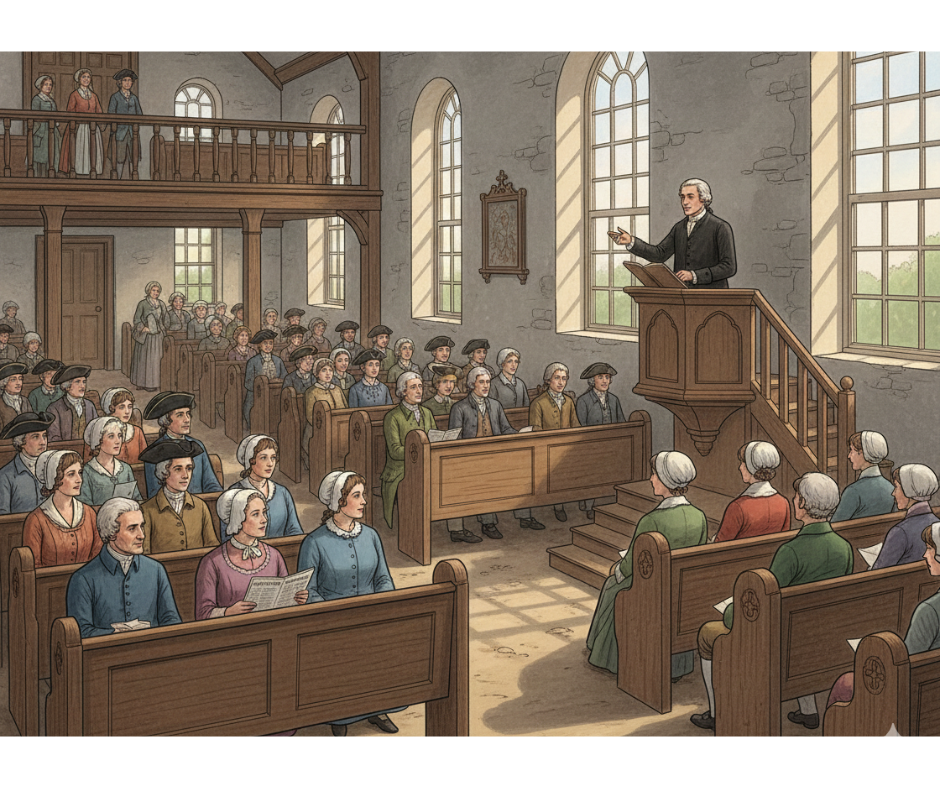
This habit had deep roots in Protestant culture. Sermons were long and intellectually demanding. Congregants were expected to follow complex theological arguments, grounded in careful textual interpretation. Disagreement wasn’t a flaw in the system – it was a feature. Competing interpretations of scripture trained people to weigh evidence, assess authority, and argue their case using words.

Long before colonists debated Parliament, they had debated doctrine. They had learned that texts mattered, that interpretation mattered, and that authority could be questioned on paper. When political conflict with Britain intensified after 1763, the colonies already possessed a population capable of sustained written argument. The Revolution did not have to invent this capacity; it inherited it.

Pamphlets: The Engine of Revolutionary Thought

If there was a dominant medium of revolutionary persuasion, it was the pamphlet. Cheap to print, easy to distribute, and brief enough to be read in a single sitting, pamphlets functioned as the social media of their day – though slower, denser, and far more deliberate.

Pamphlets could be passed hand to hand, read aloud in taverns, or discussed in homes and meetinghouses. A single copy could reach dozens. Writers often used pseudonyms, which encouraged boldness and protected reputations. The result was an explosion of argument.

The Stamp Act crisis of 1765 unleashed a wave of pamphlets asserting that Parliament had violated colonial rights. These texts did something crucial: they framed resistance not as rebellion, but as fidelity – to law, to history, to inherited rights. The argument was not “we reject authority,” but “you have misunderstood it.”

Over time, pamphlets standardized the language of resistance. Words like “liberty,” “tyranny,” and “rights” acquired shared meaning across colonies that otherwise differed dramatically in economy, religion, and culture. The Revolution began to sound the same everywhere because people were reading the same arguments.

That shared vocabulary mattered more than we often realize. You cannot coordinate a movement if people lack common terms for their grievances. Pamphlets supplied the grammar of revolt.

When Independence Became Readable

No single text illustrates the power of the written word better than Thomas Paine’s Common Sense. Published in January 1776, it did not introduce radically new ideas. What it did was far more important: it made independence understandable.

Paine stripped away legal jargon and elite restraint. He wrote plainly, emotionally, and morally. He asked readers to imagine a future not tethered to monarchy. He treated independence not as a technical problem but as common sense.

The impact was electric. Tens of thousands of copies circulated in a population of roughly two and a half million. More importantly, it shifted the terms of debate. After Common Sense, the question was no longer whether independence was unthinkable, but whether it was unavoidable.

This is a recurring theme we will return to throughout this series: revolutions require not just anger or injustice, but imagination. Before Americans could fight for independence, they had to read their way into believing it was possible.

Newspapers and the Birth of a Shared Story

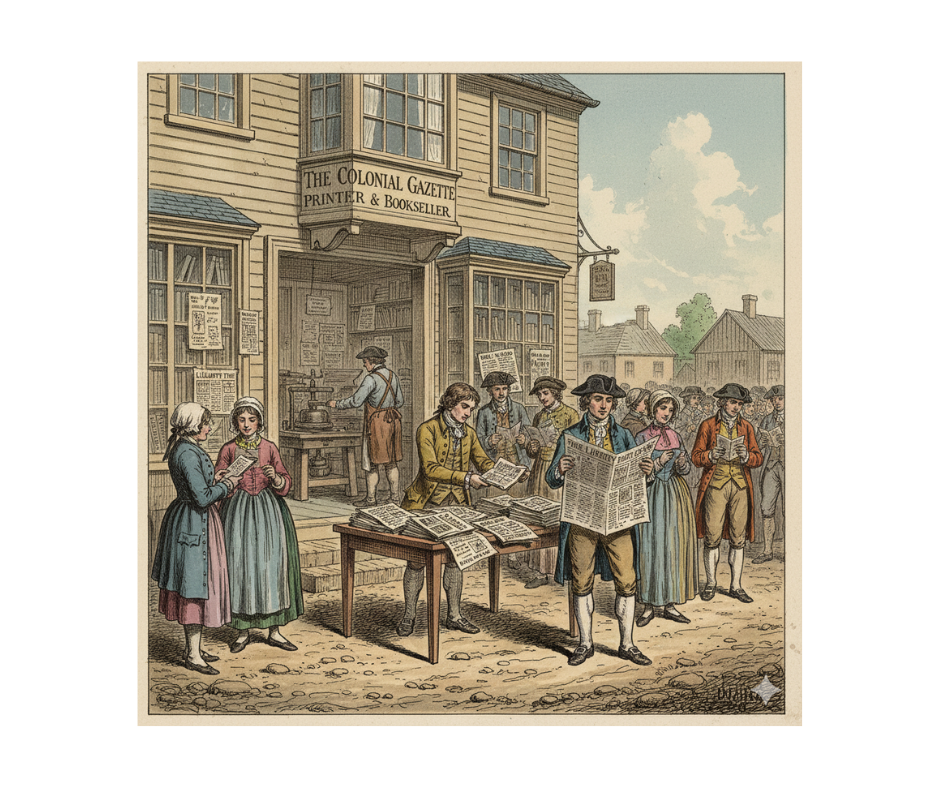
Pamphlets sparked arguments, but newspapers sustained them. Colonial newspapers reprinted essays, letters, speeches, and resolutions from other colonies, creating a shared political timeline. Events in Boston were read about in Charleston. Decisions in London were debated in Philadelphia.

This slow but steady flow of information had an unexpected benefit. Arguments unfolded over weeks and months, allowing readers time to absorb, discuss, and respond. Political persuasion was cumulative rather than explosive.

Writers often adopted classical pseudonyms – Brutus, Cato, Publius – signaling that this conflict belonged to a larger historical tradition. Readers were invited to see themselves not as isolated subjects but as participants in a drama that stretched back to Rome and beyond.

The colonies were not just informed by newspapers; they were formed by them.

Writing as Organization, Not Just Opinion

Words did more than persuade. They organized.

Letters between merchants, ministers, and political leaders coordinated boycotts and protests. Committees of Correspondence formalized writing as a tool of governance, linking towns and colonies long before any central authority existed.

Trust traveled on paper. So did strategy. Long before independence was declared, Americans were already practicing self-government through correspondence. Writing became the connective tissue of resistance.

This is an often-overlooked point: the Revolution did not spring fully formed in 1776. It was rehearsed for years in letters, resolutions, and shared texts. Americans learned how to govern themselves by writing to one another.

A Revolution Argued from Texts

Perhaps the most striking feature of the American Revolution is how insistently textual it was. Colonists grounded their resistance in written authorities: Magna Carta, English common law, colonial charters. Their case was not emotional alone; it was documentary.

Parliament responded with statutes. Colonists responded with interpretations. What ultimately broke was not communication, but agreement on what the texts meant. When shared interpretation failed, violence followed.

Even the Declaration of Independence reflects this mindset. It is not a manifesto shouted to the crowd, but an argument addressed to “a candid world.” It assumes readers. It assumes judgment. It seeks legitimacy through persuasion.

Why This Matters Now

As we approach the 250th anniversary of the founding of the United States of America, revisiting the Revolution through its reading life offers a timely corrective. It reminds us that the nation was not born from impulse, but from prolonged argument. That independence was not seized in a moment, but constructed over years of writing, reading, and debate.

This series will follow that paper trail as historians and biographers examine the texts that shaped revolutionary thought, the ideas they carried, and the habits of mind they formed. Not to romanticize the past, but to better understand it.

In an age of instant information, the Revolution invites us to remember a different tempo of change – one where ideas traveled slowly, but took root deeply. Before there was a nation, there was a conversation. And before there was a battle, there was a sentence.

The United States, in many ways, was written into existence.

As we embark on this exploration of how words shaped revolution, it’s worth anchoring ourselves in the broader journey of reflection unfolding in 2026. 

In What Does 1776 Mean in 2026? A Year of Revolutionary Reading, I invited readers to mark the semiquincentennial not simply with celebration, but with deep engagement in the very texts that have shaped our understanding of independence over the past 250 years. This series positions 1776 as more than a date – it’s a lens through which we can examine the ideas, individuals, and interpretations that have animated American history from the Bicentennial to today. My focus on the written word about the Revolution challenges us to slow down and read the past with care, recognizing that the arguments, debates, and narratives we inherit matter as much as the events they describe.


What’s up the rest of the month: We begin with the world the revolutionaries inherited, exploring Alan Taylor’s American Colonies and Bernard Bailyn’s Ideological Origins of the American Revolution – establishing the essential foundations for understanding how British subjects became American rebels.

images created with Gemini

You can find the entire series listing here.