The Power of Story in Guest Experience

Stories can be very engaging. We fill our lives with stories. When we tell our friends what happened on our vacation, what we say to our coworkers after the big meeting, talk about our kids’ activities, what happened at the grocery store, we are storytelling. Stories are powerful methods of communication.

The concept of “story” is coming together for me in several areas of my life. While doing research for a work project, I read the following by Robert McKee in his book Story: Substance, Structure, Style, and the Principles of Screenwriting:

Stories fulfill a profound human need to grasp the patterns of living – not merely as an intellectual exercise, but within a very personal, emotional experience.

The last phrase of McKee’s quote reminded me of the importance that emotion plays in a Guest Experience. Extending that thought, the power of stories and anecdotes should not be underestimated as you consider how you might weave them into the design of your Guest Experience.

The power of stories is very captivating. When you are sitting down and watching a good movie you can become captivated (in the same way discussed here). Movies and theatre are just stories in another form. What’s your favorite film? You can probably recite the story line in great detail. As you are doing that, you can even remember how you felt when you were watching it. The movie captivated you, you were laughing and crying with the characters – you were the character, you were in the film.

You feel the emotion they do. People talk about being “on the edge of their seats.” Movies evoke emotions in powerful ways. Recently, a group of friends, my wife, and I saw the movie “Argo,” based on the true story of the Iranian hostage crisis in 1979. Since all of us are about the same age, we were young adults in our early 20s when the story was news, not a movie. In a discussion following the movie, everyone could recall what they saw and felt and talked about during those tense times. The movie took us back over 30 years to bring back memories that were vivid.

That is the power of story – it is an experience that enables us to escape to another world, to be captivated and be in the moment.

So ask yourself this:

What are the stories that your Guests would tell about you?

Remember that those great movies that you remember every detail about don’t just happen. They are planned and scripted. In the same way, organizations that aspire to WOW! Guest Experiences spend hours planning that Guest Experience. Every detail is considered and the senses are used to evoke emotions. In the same way a movie uses music, a tender love scene, and great dialogue to evoke emotions in the viewer, you must use the same principles to create a great Guest Experience.

Over the last few weeks I have been referring a lot to the work of Beyond Philosophy, one of the world’s leading experts on customer experience. In conversations with their staff and in researching their great resources, I have been able to “translate” the world of corporate customer experience to that of Guest Experiences in ChurchWorld.

In Beyond Philosophy founder Colin Shaw’s book Revolutionize Your Customer Experience, expert storyteller and story coach Doug Stevenson tells of the power of story. I have modified the language to that of Guest Experience:

For a Guest Experience to come alive and captivate an audience, the content, structure, and performance must be crafted strategically. The Guest Experience itself is only a beginning. Guest Experience is an art and the designer of the Guest Experience, the artist. And all artists need tools. The actor needs a stage, props, and costumes. The musician needs her instrument. The artist needs his brushes and paint. And the Guest Experience designer needs form, content, and presentation skills and techniques. The great designers of Guest Experiences distinguish themselves not just by their talent, but also by their dedication to their craft. They think about their Guest Experiences constantly. They structure the sequence and flow of the Guest Experience, and experiment to find the right words that are genuinely theirs. They work on a gesture or movement until it is just right. Then they rehearse if over and over again until it becomes second nature – the line and the gesture effortlessly married together. The incorporate acting skills and turn their Guest Experiences into little theatrical events. In order to have an end result that is amazing, you will have to spend many hours working on your Guest Experience. Your Guest Experience must be worked and re-worked, formed and re-formed. You’ll want to find the drama and comedy of your Guest Experience and let them shine.

Can you see that stories are essential enablers of the Guest Experience?
What is Your Share of Your Guest’s Mind during a Guest Experience?

Beyond Philosophy has created some great ideas and tools for understanding customer experience in the corporate world. In their book Revolutionize Your Customer Experience by Colin Shaw, the concept of Share Your MindTM is introduced.

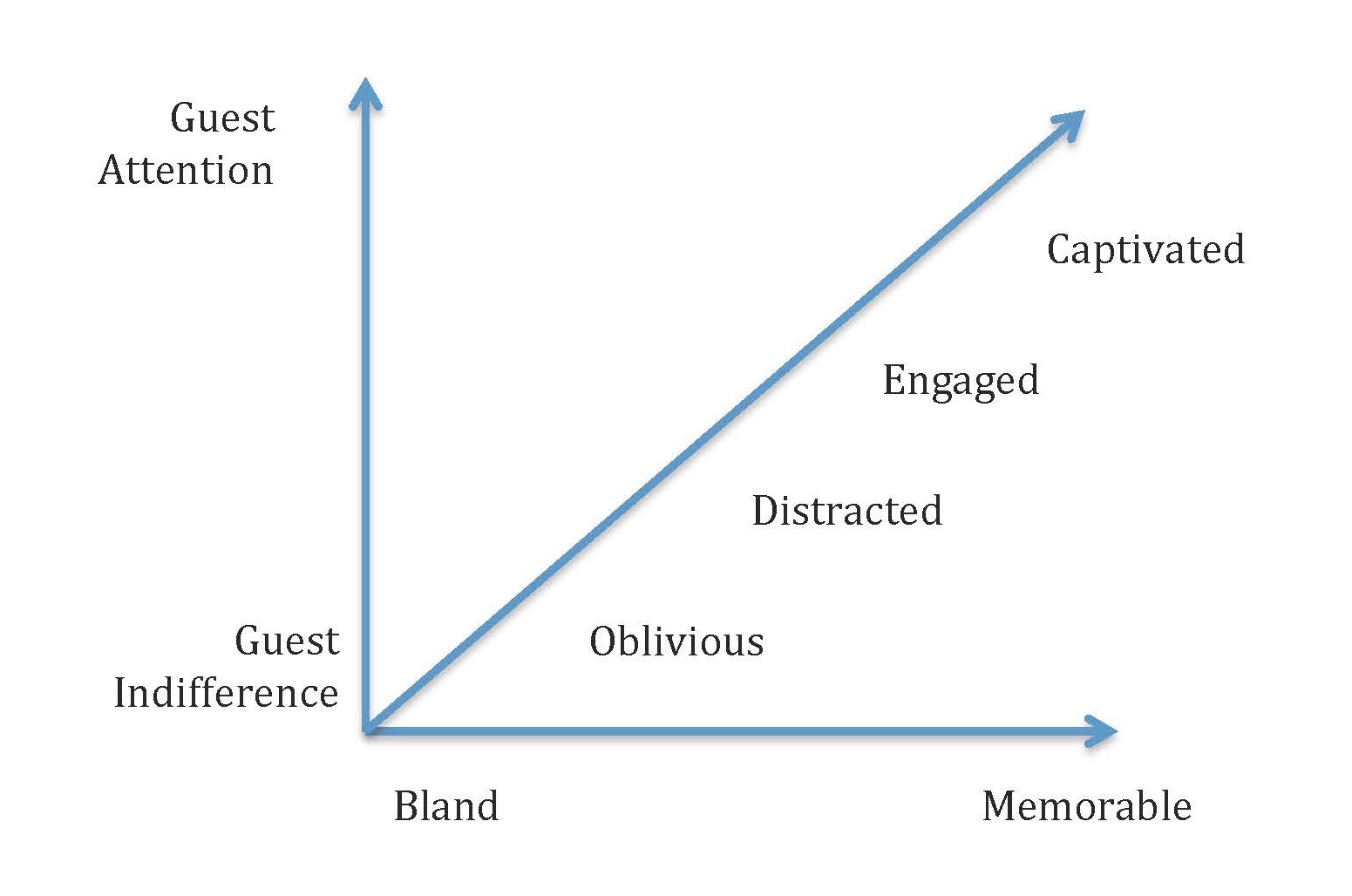
Beyond Philosophy discovered that there are four different levels of customer attention:

  • Oblivious
  • Distracted
  • Engaged
  • Captivated

Graphically it looks like this (modified to reflect Guest language):

Oblivious Guest Experiences

There are many organizations that try to grab your attention as a consumer – even in ChurchWorld – and yet you are oblivious to their advances. You haven’t seen their billboards, direct mail pieces, signs, bulletins, newsletters, worship guides, etc. You are exposed to thousands of “messages” every day, and yet you ignore most of them. Giving someone an oblivious Guest Experience costs organizations – like your church – a lot of money for nothing in return.

Distracted Guest Experiences

When you are distracted, you are not focused on the Guest Experience. For instance, a Guest may come to your church and wander around, thinking about other things. A greeter does not engage them. They do not see a special opportunity coming in two weeks. They aren’t challenged to take the next step. If you are not careful, they will slip in, be a spectator, and slip right out again. When this happens, organizations have not captivated or engaged the mind of the Guest, and they are distracted and indifferent enough to not pay attention to the Guest Experience being provided. Organizations that allow their Guest’s mind to wander and be distracted are losing a massive opportunity to build on future interactions.

Engaged Guest Experience

In the engaged stage you have 95 percent of your Guests’ attention, but it is not captivating, and therefore Guests can easily be distracted. There is a danger that their minds may wander and you may lost an opportunity to connect with them. For example, if your organization has wonderful connection points and eager people but not alignment of purpose, it would be easy for a Guest to lose their overall connection curiosity because they are literally inundated with messages. They may be engaged, but are eventually lost in an overwhelming amount of information or they find something else that pulls them away.

Captivating Guest Experiences

The goal is to create a captivating Guest Experience by capturing your Guest’s whole mind and thus ensure they give you their full and undivided attention. It is the stimulating of their senses to such a degree that positive emotions are evoked, rendering them captivated. Nothing stops them from focusing on your Guest Experience, and more importantly, nothing can distract them from it. They are so engrossed in your Guest Experience that nothing will pull them away from it. Your “share of mind”TM is total.

Captivating Guest Experiences are memorable by nature. Creating a memorable Guest Experience is important when considering the culture we live in. If your Guest Experience does not stand out, your organization will blend in, becoming part of the noise and blandness of this world.

Organizations must seize Guest’s attention from the first point of contact (often digital). Organizations must stimulate Guest senses (all 5 of them) to create a captivating Guest Experience, one that will evoke deep emotions – and create a connection that will allow the possibility of a transformed life.

This post is part of a journey translating Customer Experience learnings in the corporate world to Guest Experience in ChurchWorld. Material in today’s post was excerpted from “Revolutionize Your Customer Experience” by Colin Shaw.

Did God Think We Would Forget This?

It’s the only commandment that begins with the word remember – almost as if God knew we would forget.

Well, guess what?

We did.

Remember the Sabbath day, to keep it holy. For in six days the Lord made the heavens and the earth, the sea, and all that is in them, and rested the seventh day. Therefore the Lord blessed the Sabbath day and made it holy. Exodus 20:8,11

I first met Matthew Sleeth at a Creation Care Conference at Northland Church in Orlando in 2008. We were both speakers at the conference, and it was there that I learned Sleeth’s amazing story as he moved from an emergency room doctor to one of the leading voices for Creation Care.  Our paths have crossed several times in the last few years, most recently at the White House Greening America’s Congregations Conference.

Sleeth is the author of Serve God, Save the Planet, and founder of Blessed Earth, a nonprofit organization that focuses on Creation Care. It’s very much a family affair as wife Nancy (Go Green, Save Green and Almost Amish) and daughter Emma (It’s Easy Being Green) have contributed much to the healthy conversation about Creation Care by not just writing by living out their values.

Mathew Sleeth’s newest book 24/6 provides a life-giving prescription for a healthier more God-centered life amidst a digitally crazed, always-on world. It will help you better understand how your life can be radically transformed – physically, emotionally, relationally, and spiritually – by adopting a 24/6 lifestyle.

His years of experience as an ER physician in hospitals qualifies him as a veteran in a culture of demanding overwork. His entry into the Christian faith ten years ago provides a total reorientation of his imagination in the Hebrew/Christian culture of Sabbath keeping. And most impressive of all, he explores the many details of what is involved in practicing Sabbath in a world that is unrelenting in its distractions and pressures to work longer and harder.

All this is done not from a theoretical position but firmly in the context of marriage and family life, with all the domestic and relational details involved in doing nothing where doing nothing always requires constant coordination and relationship.

24/6 is a book that restores Sabbath to its extensive biblical narrative context. Jesus, not rules, sets the tone. Sabbath keeping is conveyed in stories – doctor stories, stories of friends, stories of family, stories of Jesus. These stories keep Sabbath “nested” – integral to the tie and place in which relationships form and develop.

To illustrate how well Sleeth accomplishes this, here are a few excerpts from a section entitled “What God Created on the Seventh Day.”

In Genesis, we find a seven-day week. God begins to create the universe, and finds everything “good.” Each succeeding day, things get more complicated. On day six, God forms Adam, and then – because she is even more complicated – God makes Eve. “Yes! Excellent! Very good! Tov m’od!”

How can God top creating a universe and my wife and daughter?

The piece de resistance comes out of left field. Up to this point, everything has been created out of nothing, but on the morning of the seventh day, God makes nothing out of something. Rest is brought into being.

The point is that something very important about the character of God is revealed on the seventh day: God stops.

God doesn’t need to rest after creating the universe because he’s tired. He rests because he’s holy, and everything that God does is holy.

God rests. God is holy. Therefore, rest is holy. It’s simple math.

24/6 is a powerfully personal story of one man’s exploration of our 24/7 world, why we need the Sabbath, how we do the Sabbath, and how to create a 24/6 life.

Consider the Sabbath close to home: what would it look like if you and your family remembered?

Celebrate the Supernatural

It’s that time of year again – spooks, goblins, and witches take to the streets on Halloween. Most parents don’t know the origins of Halloween –from ancient Celtic celebrations about the end of summer and the beginning of winter, to the Romanized adaptations of All Hallow’s Eve, All Saints Day, and eventually All Soul’s Day. Consumerism has taken over in books, movies, and a whole industry devoted to the supernatural. In recent years, there has been an increasing involvement of adults in Halloween activities, even those formerly limited to children.

Where should the church stand in all this? I say “Celebrate the Supernatural”!

I’m not a heretic, and I don’t advocate a focus on the dark side of things. I simply encourage you to look at the word “supernatural” and what it should mean for believers.

At its very basic level, supernatural means “above nature”. Is this not a great definition for believers in Christ? We are to be “in the world, but not of it”. But there is an even greater reason that we should celebrate the supernatural, and that is in the area of spiritual gifts.

The scriptural basis for spiritual gifts is found in a few New Testament passages, but our additions to these few verses over the years could fill a small library. I don’t want to enter into a theological debate about gifts – I simply say the Bible teaches us about them, and we should celebrate them by putting them into practice by serving others in God’s name.

Many definitions of spiritual gifts exist, but the one that I have adapted over the years and that resonates most with me is a “supernatural capacity of grace from God, used to serve Him for His purposes”. To me, it is a given that these gifts are from God and to be used by us for His purposes.

Through the Holy Spirit, we have been empowered to carry out His purpose and contribute meaningfully to His body. We know that we belong to Him, that our inherent worth is to be found in Him. He made us, redeemed us, gifted us, and placed us in the body of Christ – the church – just as He chose.

If that’s not “super natural”, I don’t know what is!

How will you celebrate this week?

Attic Memories

It is better to dwell in a corner of the housetop, than with a brawling woman in a wide house. Prov 21:9 KJV

I’m nearing the end of a week of traveling that has taken me through 6 airports on 4 airlines in order to: observe and document the weekend worship experiences of one of the pioneer multisite churches in the US; participate in a 3 day conference; launch Auxano’s Vision Room; and take part in a training initiative. The last event ended up in Nashville, where I joined the rest of the Auxano team for a daylong Navigator learning opportunity.

I was able to take advantage of my schedule and spend the night at my mother’s house, working on a few projects around the house before heading back to Charlotte later today.

One of those projects required me to go up into the attic of our house to bring something down. Once I climbed the folding stairs, a rush of memories flooded me. This wasn’t your normal attic – this was my teenage bedroom.

A little more about information is necessary. In the late 60’s, as my older brother was beginning high school and I was beginning to start junior high, my father thought it would be a good idea if my brother and I had separate rooms – we had been sharing a room since I was born. My dad asked if I would work with him and convert our attic into a bedroom for me.

What an adventure! Over the course of several months, we spent time putting in floors and walls, carpet, an air conditioner, and shelving. It worked great! During the remaining years of junior high then into high school I enjoyed using the initial bedroom plus an expansion that more than doubled the size of the original room.

Walking into that space this morning, my eyes fell on this:

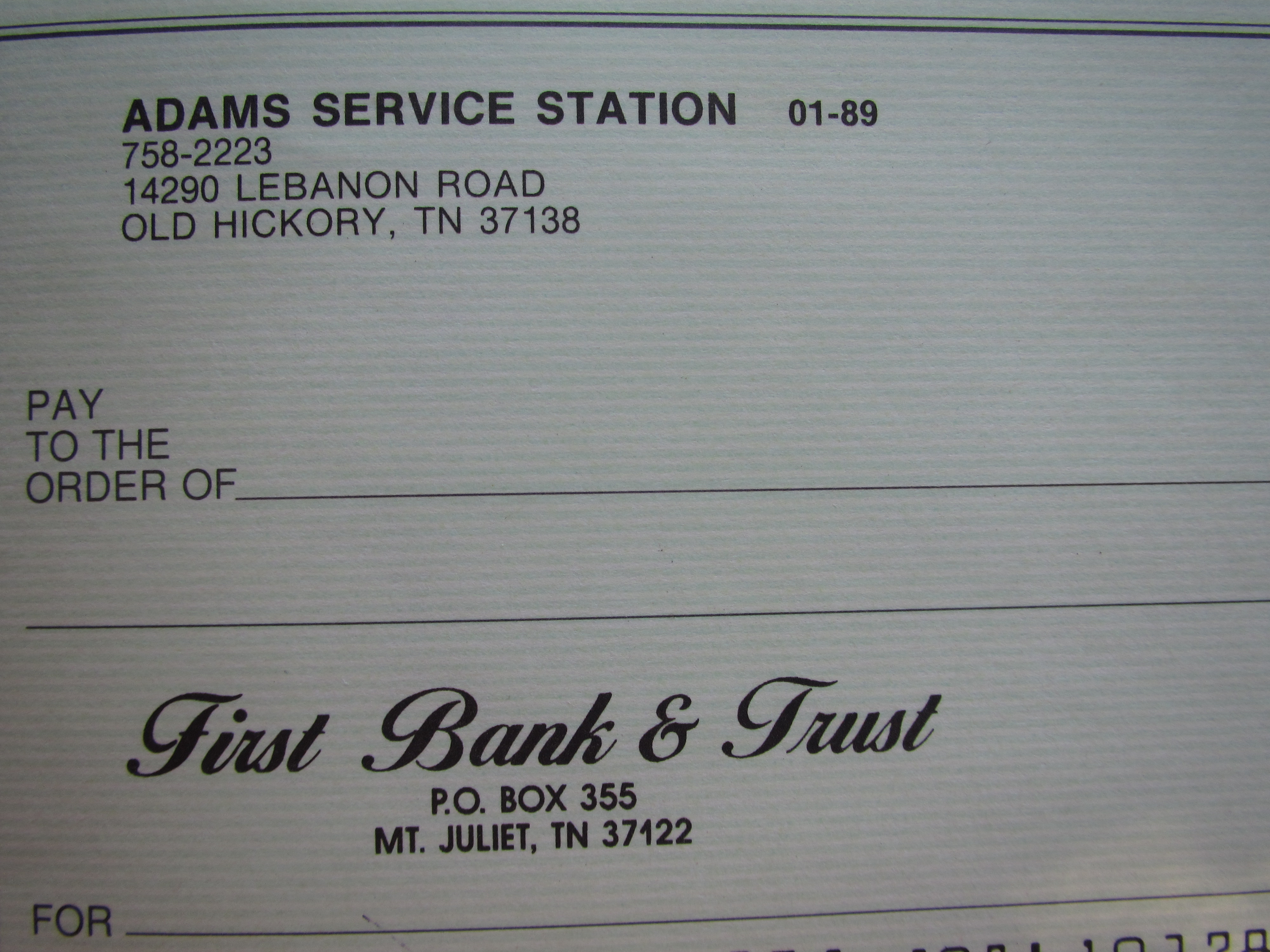
It was my dad’s business checkbook, with the last check written to close out the account when he retired in 1994 after 44 years of operating a Gulf gas station.

That visual took me back in an instant to the years I spent in, around, and all over the gas station. Over the next few minutes, as I finished my work in the attic-turned-bedroom-turned into a storage room, I was transported back in time.

I won’t bore you with those stories (at least not now), but my point is this:

Images convey stories that touch the heart

How are you using images in your church?

The Vision Room Launches Today

Auxano’s Vision Room goes live today.

For almost as long as I have known Will Mancini, he has dreamed of the Vision Room. When I first met him in 2008 at a conference we were both speaking at (courtesy of Karen Butler, editor of Church Solutions magazine), he was talking about it.

In dozens of conversations since then, he has continued to talk about it.

In February of this year, he was still talking about it – and in the same breath, asking me to join Auxano as the Vision Room Curator.

I’m still like a kid in a candy store about that…but, here it is:

You can read Will’s official welcome to the Vision Room here.

You can read my initial take on being the Vision Room Curator here.

Of course, I’m sure that will be changing as the dream has become reality…

But for now, the Vision Room is live and

Come on in, look around, but just don’t be a Guest – register your own MyVisionRoom and let me know what you think.

How Are You Celebrating “Evaluate Your Life Day?”

I haven’t been to the Hallmark store to see if there’s a card for it, but today is apparently “Evaluate Your Life” day. Being reminded to reflect on your life – where it is, where you want it to go – can be a valuable exercise. In the spirit of that thought, here’s a repost from an earlier series called “Brand You.”

Very Old New Job Security

Tom Peters was one of the early leaders of the “Brand You” movement. First writing about it in Fast Company magazine, he soon expanded into a series of books. Writing in “The Brand You 50”, Peters has the following comments about job security:

Job security – as we have known it – is vanishing.

So…what now?

My answer: Return to Job Security. Actually, it’s Very Old New Job Security.

It’s what job security was all about before – long before – Big Corporations. Before Social Security. And unemployment insurance. Before there was a big so-called safety net that had the unintended consequence of sucking the initiative, drive, and moxie out of millions of white-collar workers.

I’m talking about job security in the Colonies and in the first century after our country was founded. Which was:

  • Craft
  • Distinction
  • Networking skills

Craft = marketable skill… Determination = Memorable. Networking Skills = Word of Mouth Collegial Support.

It’s about being so good and meticulous and responsible, about what you do (and making sure that what you do is work that needs to be done) that the world taps a speed path to your laptop (or mobile phone – or iPad).

My modern-language term for this ancient, self-reliant, networked, word-of-mouth-dependent, distinguished craftsperson: Brand You.

What are you doing to create “Brand You?”


Other Brand You posts you might be interested in: