Walt Disney – the Father of Guestology

Walt Disney was the originator of the practices that came to be called Guestology. The Disney organization remains the world’s foremost practitioner of the Art & Science of serving their Guests.

Because of that, I’m starting Summer Term II of the 2013 GsD program with Applied Guestology 201, a quick review of some of the leading organizations who deliver exemplary Guest Experiences with application to ChurchWorld. We begin with Walt Disney and move from there to several well-known organizations, wrapping this course up by returning back to the Magic Kingdom.

Walt Disney – the Father of Guestology

courtesy 9hdw.com

courtesy 9hdw.com

In order to understand the magic of Disney’s Guestology, you need to know a little about Walt Disney, and why he cared so much about customer service. When he threw his energies into the creation of Disneyland in the early 1950s, he was totally concentrated on the guest experience. The very idea for Disneyland was born in Saturday trips to amusement parks that Walt Disney made with his two daughters. In those days, amusement parks were disreputable, dirty, and often in poor condition. While watching and waiting on his daughters to finish their rides, he began to watch the other customers and how they reacted to the parks.

A single question drove Disney: How could this experience be improved for the entire family?

Walt’s answer was to create a new kind of amusement park, a “theme” park with an intense focus on the guest experience. With his successful background in animation and movies, and with a studio of brilliant, creative minds to work with, Disney created a “living show.”

With a little bit of the same magic, your organization can do the same.

Be Our Guest” has been the invitation to Disney visitors long before the song from Beauty and the Beast became a box office hit. It underscores an important element in the Disney vocabulary, that customers are not referred to as such, but rather as Guests. In the Disney nomenclature, the word “Guest” is capitalized and treated as a formal noun.

What’s the difference between treating someone like a customer, and treating someone like a Guest?

The obvious analogy is that we do things differently when we bring Guests into our home. We clean up the house. We dress up. We prepare something special to eat. We host them. We take care of their real needs.

Disney expects Guests

This principle has to be the starting point, the foundation on which all else is built. Everything – and I mean everything – is done with the Guest in mind. At Walt Disney World, exceeding Guest expectations is the standard call to duty for all cast members, both those “onstage” and “backstage”.

Quality Service is Disney’s behind-the-scenes name for its customer service processes, and is simply defined as follows:

Quality Service means exceeding your Guests’ expectations by paying attention to every detail of the delivery of your products and services.

That’s it. The magic of Disney’s customer service is paying attention to details. But as you might expect, the simplicity of those few words is lived out daily by tens of thousands of Cast Members performing and interacting with hundreds of thousands of Guests, all delivered with a magical smile.

The WOW! Factor of Exceeding Guest Expectations

  • Superlative face-to-face service
  • Paying close attention to every aspect of the Guest Experience
  • Analyzing that experience from the Guest’s perspective
  • Understanding the needs and wants of the Guest
  • Committing every element of the organization – from the design of the infrastructure to the interaction between Guest and Cast – to the creation of an exceptional experience

Be Our Guest, The Disney Institute

Exceeding Guests’ expectations is Disney’s service strategy, and paying attention to every detail is the tactic by which it is accomplished.

That’s how Disney does customer service. A common purpose generates quality standards. The standards are defined and delivered using three basic systems that every organization shares: its people, its physical assets, and its processes. All three are integrated and aligned to produce the Disney brand of magic.

At Walt Disney World, they expect Guests – and plan to exceed their Guests’ expectations every time. What about you?

Are you expecting Guests?

Application to ChurchWorld

When it comes to ChurchWorld, more often than not we have visitors.

It may be a little thing to you, just a word, but I think it’s actually a powerful first impression that needs to change.

Do you have Visitor parking? Visitor packets? A Visitor’s Center? Do you welcome your visitors during the worship experience? And on and on…

The first step in creating a WOW! Guest experience is to remove the word visitor from your vocabulary, never to be used again.

It’s a little thing to be sure. But it’s a mindset change that will really impact how you create the rest of the experience at your church.

You are expecting Guests this weekend.

Guests come to your place, looking for a warm greeting, a smiling face, and an experience designed to make them feel like, well, Guests. Nothing phony, manipulative, or in-your-face; just welcome them as guests with the most sincere, energizing, and loving experiences you can.

Start with this simple change that conveys a powerful image, one that will be reflected through your church – and you have taken a HUGE step in understanding what Guestology is all about.

Recommended Reading:

(For a complete reading list, see The Essential Guest Experience Library)

Guestology – the art and science of knowing and understanding your guests – is a term originated by Bruce Laval of the Walt Disney Company. The use of GsD is a tongue-in-cheek acknowledgment that organizations that really want to understand and deliver a WOW Guest Experience need to study the best practices and principles in use today, and then adapt them to the context of their own environment.

the GsD (Doctor of Guestology) journey: 2013 Summer Term II


Bridging the Digital Divide, Part 3

Our leadership brains are dealing with a digital divide in organizations today: team members of different generations think differently. First, there’s the digital natives; then come the digital immigrants. Bringing up the rear (literally) are the digital dinosaurs.

Author Marilee Sprenger, writing in “The Leadership Brain for Dummies,” makes these observations about the digital dinosaur:

courtesy gerbenvanerlelens.com

courtesy gerbenvanerlelens.com


Natives speak the language of their birth; immigrants are learning to translate the digital language of the natives, and then there are those individuals or organizations who are hopelessly out of date – the digital dinosaur.

You may think that Traditionalists (born before WW II) fall into this category, and many do. But anyone or any organization can be a dinosaur.

Digital media is transforming organizations everywhere. If your organization appears to be incapable of change, those who embrace digital technology won’t find it appealing. If your clients are changing their minds and getting plugged into the latest technology, you don’t won’t to present yourself as stuck in an analog world.

Take a close look at what your competition is doing digitally. If they are still dinosaurs, make some changes so your organization can be the first to enter the global age. Rather than feeling safe because they aren’t doing anything that you’re not doing, get out of that reptile brain and use your thinking brain to take some risks to get updated.

Note to church leaders: if my use of the words “client” and “competition” bother you, sorry – you have a whole different set of problems! The people who come to your church are your clients, and you do have competition – but it’s not the church down the street from you.


A closing thought on this series: leadership is all in your head – literally. When your brain is at its best, you will be at your best as a leader. Understanding how your brain works is just the first step. Put your leadership brain to work today!

 
inspired by The Leadership Brain for Dummies, by Marilee Sprenger
Leadership Brain for Dummies

Bridging the Digital Divide, Part 2

The brains of those who are digitally connected are different from those who are not. Here’s how Marilee Sprenger, author of “The Leadership Brain for Dummies,” sees this divide:

courtesy facebook.com

courtesy facebook.com


Some Traditionalists (born before WW II), many Baby Boomers (born 1945-1964), and the early Gen Xers (born 1965-through the 70s) fall into the category of digital immigrants. They didn’t grow up learning the second language of the digital world and speak it with varying degrees of fluency.

Many digital immigrants:

  • Insist on paper bills even though receiving copies via email
  • Print out emails and attachments
  • Rely on printed newspapers, books, and so on
  • Are somewhat leery of paying bills online
  • Believe that methods taught years ago should work for everyone
  • Don’t understand the informal language used in emails and texts
  • Believe a social network consists of people he meets with for parties

Digital immigrants have much to offer to your organization. Wisdom derived from years of storing patterns in the brain gives them the ability to see the big picture, predict accurately, foresee future consequences, and draw on mental templates to help store new information.

Challenging tasks activate more areas in the frontal lobes of the brains of digital immigrants than in the brain of digital natives. The immigrants have little choice because their brains change as they increase their skills with technology. The natives may need to practice more skills that their brains haven’t used very much, like building rapport face to face.

How do you lead digital natives and immigrants to work together?

Next: Bridging the Digital Divide, Part 3

inspired by The Leadership Brain for Dummies, by Marilee Sprenger

Leadership Brain for Dummies

Bridging the Digital Divide

Using the Leadership Brain to Understand Generational Differences

Marilee Sprenger, author of “The Leadership Brain for Dummies,” does a good job of outlining the differences in organizations that have multiple generations involved – like the church.

This post isn’t about that – you’ll have to read her book on page 223 to understand those differences. Instead, let’s take a look at the digital divide.

courtesy resetsanfrancisco.org

courtesy resetsanfrancisco.org

The brains of those who are digitally connected are different from those who are not. Since your organization has different kinds of brains working together, maybe you should understand a little about it.

The Digital Native

Today’s world requires a new language and a new literacy – digital literacy. The late Generation X’ers (born in the late 70’s) and the generations that follow them are digital natives – they speak the language well. These people have grown up with video games, cell phones, computers, the Internet, and other techno toys. The ABCs of learning have been replaced with the XYZs of technology.

The digital natives grew up communicating in a very different and fast-paced way from their parents and older siblings. They’re proud of their ability to come up with hard data quickly and easily. It’s a wide learning gap between these generations and the prior ones.

The digital natives who believe that their world isn’t complete if they aren’t constantly connected are always trying to multitask (you can’t, but that’s another post). They’re always working hard, switching from one task to another and back again without skipping a beat.

Former Microsoft executive Linda Stone called this problem continuous partial attention.

Not truly giving anything complete attention has a number of negative effects, not the least of which is the inability to accomplish anything! Efforts to stay connected may prohibit you from bringing deep thought and closure to any one project, which may lead to stress. Elevated stress leads to distraction which starts the cycle over again.

Recognize yourself?

Next: Bridging the Digital Divide, Part 2

inspired by The Leadership Brain for Dummies, by Marilee Sprenger

Leadership Brain for Dummies

SMART or SAFE? Setting Goals and the Leadership Brain

Goal setting is vital to the success of every team – and the process also increases brain performance. According to neuroscience consultant Marilee Sprenger in ” The Leadership Brain for Dummies,” the brain sees goal-setting as an extension of itself – it takes ownership of the goal and the accomplishment.

But what do you do when your team has different kinds of “brains” trying to set goals? Could it be that you need to consider two kinds of goals?

The SMART approach to goal-setting is linear, logical, and very left-brain oriented. Those teams that think in a left-brained format appreciate this type of goal setting because it is easy to track and measure. SMART goals are:

  • Specific – each goal specifies your target exactly.
  • Measurable – each goal must be measurable so you know when you’ve reached it – or not.
  • Achievable – a goal that is within reach increases motivation and those brain chemicals that keep you motivate.
  • Realistic – a realistic goal is one your team has the resources to realize.
  • Time – specific time frames provide clear deadlines for action.

But what about teams that aren’t as left-brained? How do they set goals? Consider SAFE goals. Approaching goals in a nonlinear manner appeals more to the right hemisphere of the brain. If your team members are creative, visual, and right-brain dominant, consider SAFE goals:

  • See it – see yourself working toward the goal; then picture it already achieved.
  • Accept it – accept that you can achieve the goal, and picture what that looks like.
  • Feel it – adding emotion to your visualization is very powerful: feel good about your accomplishment; enjoy the satisfaction of a job well done.
  • Express it – visualize yourself telling others about the accomplishment of the goal; make presentations at team meetings about your contribution to the success.

The SAFE method is especially good for those brains that need to have the big picture in order to accept the fact that they can in fact accomplish their goals.

So, does your team need SMART or SAFE goals? Or a combination of both?

As leader, it’s your job to know the difference and lead accordingly!

Next: Bridging the Digital Divide


inspired by The Leadership Brain for Dummies, by Marilee Sprenger

Leadership Brain for Dummies

Brain Science and Decision-Making

Making good decisions under a variety of circumstances is a critical leadership skill. Your brain works differently to decide when you have little time than it does when you can consider your options.

courtesy tvblogs.nationalgeographic.com

courtesy tvblogs.nationalgeographic.com

Marilee Sprenger, author of “The Leadership Brain for Dummies,”, offers the following ideas to help you make the best decision when you have the time to research the situation:

  • Clearly define the problem – exactly define the challenge
  • Gather all the data related to the problem – enlist your team’s help
  • List all possible solutions – even the crazy ones
  • Consider the consequences of each solution – with a little thought, the right solution may turn out to be a disaster in waiting

When you’re making decisions with little time:

  • Consider previous situations – the decisions you made in that situation probably apply to the current one
  • Look to the future impact – even when pressed for time, considering the ramifications of your choice is critical
  • Gather as much information as you can
  • Listen to your instincts – as well as your logic

Making good choices is a matter of gathering input from all areas of your brain. Understanding how your brain processes information – even in a time crunch – will help you make better decisions.

Next: SMART or SAFE?

inspired by The Leadership Brain for Dummies, by Marilee Sprenger
Leadership Brain for Dummies

Feed Your Brain

I always thought Cherry Coke and a Hershey’s bar was brain food, but neuroscience is proving me wrong.

courtesy nu-spoon.com

courtesy nu-spoon.com

Marilee Sprenger, author of “The Leadership Brain for Dummies,” thinks that our leadership brains can be nourished so that they excel. You can provide great leadership and brain “nourishment” for your team by:

  • Providing training opportunities – on the job, onsite, offsite, virtually – you name it. Learning never stops, and the brain thrives on it.
  • Conducting personal meetings – by letting team members know you value their contributions, they are secure and will be more productive.
  • Keeping stress levels low – high stress interferes with the brain’s functions; offer coaching, mentoring, and partnering programs to help your team thrive without stressing out.
  • Celebrating successes – big or small, celebrations help teams bond. Make them regular and special; after all, humans are social animals.
  • Connecting teamwork and the organizational goals – help your team’s brains make pathways to work more efficiently.
  • Promoting life outside of work – emphasize exercise, rest, and family time; without breaks, the brain can’t work at its best.

Tomorrow: Using Your Leadership Brain in Decision-Making

 
inspired by The Leadership Brain for Dummies, by Marilee Sprenger
Leadership Brain for Dummies

I Like Dummies…

… the books, that is.

Dummies Man

courtesy thefinancialcoach.co.za

I’ve been a big fan of the “Dummies” books for a long time. I own at least 15 and have read many more – they serve as great introductions to a new topic and help chart a course for expanded learning later on.

I guess you could say they are like Cliff Notes on steroids – or is that mixing too many metaphors?

For instance, when our youngest son decided to give rugby a try after 14 years of playing soccer, it was “Rugby for Dummies” to the rescue. From a brief history of the game to key terms to strategy, after a few nights reading I felt somewhat knowledgeable about the game and could appreciate the fact that my son was a hooker. That’s another story.

A couple of years ago, I became aware of a book by John Medina entitled “Brain Rules”, a fascinating study of how the latest studies in neuroscience were helping us understand more about our brains. After reading though that book, I wanted to learn more about brain science.

Enter “The Leadership Brain for Dummies.” Author Marilee Sprenger translates the recent abundance of brain science into leadership principles which help your team keep operating at its best.

Applying Brain Science to Leadership

When you lead with the brain in mind, you address the structures of the brain and its needs. Scientists commonly consider the brain as a structure with three separate “brains” that have their own specialized jobs. Understanding how these different brains work and what they need enable you to better relate to and lead your team.

  • The survival brain wants safety and security. In a nutshell, its job is to keep you alive, and so it’s always on the lookout for changes in the environment that might put you in jeopardy. You address this brain’s needs by providing a predictable ans stable workplace – agendas, schedules, information, and procedures.
  • The emotional brain deals not just with emotion but memory. You help keep this brain moving along by being socially aware (noting your feelings but not letting them rule you), and you put it to work for you by giving your team an emotional connection to training. Any information that is connected to an emotion has a better chance of becoming a long-term memory. Also, remember that your emotions are contagious – whatever you are feeling will spread to your team.
  • The thinking brain handles the brain’s executive functions: decision-making, future planning, judgment, and emotional control. The brain learns through feedback. Change your team’s minds by providing immediate, constructive feedback.

Tomorrow: Feed Your Brain


inspired by The Leadership Brain for Dummies, by Marilee Sprenger

Leadership Brain for Dummies


Is Your Life a Story?

Tom Peters thinks so.

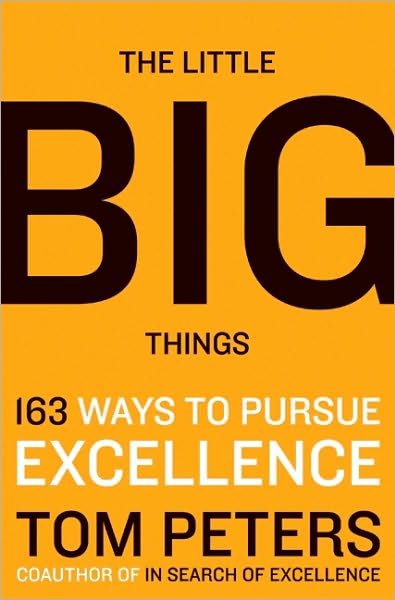
In fact, he goes even further. In his book The Little BIG Things! Peters has a chapter entitled:

You Are Your Story – So Work on It!

A few highlights:

He/she who has the most compelling/most resonant story wins:

  • In life
  • In business
  • In front of the jury
  • In front of the congregation

Stories are 100 percent about emotion – and emotion, far more than dynamite, moves mountains.

-> Your schedule today is…a short story with a beginning, narrative, end, and memory that lives on.

-> Your current project is…an unfolding story about making something better, exciting users, etc.

-> Your organization’s reason for existence and therefore its effectiveness, is…a story.

-> Your career is…a story.

Master the art of storymaking-storytelling-story doing-story presenting.

How are you writing – and telling – your story today?


inspired by The Little Big Things, by Tom Peters

The Little Big Things

Want a Truly Innovative Organization? Think INSIDE the Box…

Stuck in a rut? Facing a deadline to a particularly vexing problem with no solution in sight? Maybe you just want to mix things up to get some new momentum, but you don’t know where or how to start…

Are you tempted to think outside the box?

A very traditional view of innovation and creativity is that it should be unstructured and not follow any patterns or rules. Leaders everywhere are encouraged to “think outside the box.” The problem facing you should be a launching pad for brainstorming ideas, no matter how wild or far-fetched they are. The theory is that moving as far from your problem will help you come up with a breakthrough idea.

Maybe it’s time to think inside the box instead.

I first heard the term “think inside the box” when I became a part of Elevation Church in Charlotte NC over 4 years ago. Elevation’s core values are expressed in what we call The Code – here’s the definition:

We understand what God has done in and through our church is not normal. The only explanation is God’s hand of favor and mercy over a group of people willing to follow Him faithfully. To help maintain our unity, tone, and trajectory, we developed 12 core values as a church that make us unique. We call it The Code.

One of those values is “We think inside the box.”

The Code 6I’ve seen it demonstrated time and time again – from a choreographed dance step illustrating the battle of Elijah and the prophets of Baal to creative videos for worship to innovative partnerships with local groups who serve our community.

Thinking inside the box is now the norm at Elevation.

For many organizations, though, the concept is unknown. Fortunately, that’s about to change.

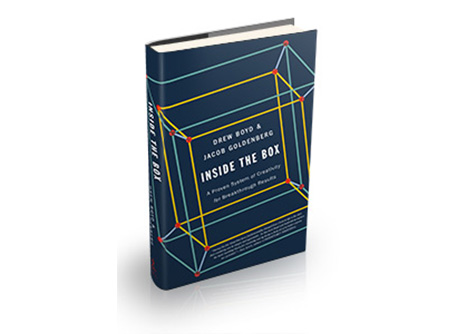
Authors Jacob Goldenberg and Drew Boyd recently released their new book, Inside the Box: A Proven System of Creativity for Breakthrough Results. It is the first book to detail their innovation method called Systematic Inventive Thinking – inside the box thinking.

Here’s a quick overview of five techniques Goldenberg and Boyd have discovered after studies of innovation-related phenomena in a variety of contexts.

  • Subtraction: Innovative products and services tend to have had something removed, usually something that was previously thought to be essential to use the product or service. The original Sony Walkman had the recording function subtracted, defying all logic to the idea of a “recorder.” Even Sony’s chairman and inventor of the Walkman, Akio Morita, was surprised by the market’s enthusiastic response.
  • Task Unification: Innovative products and services tend to have had certain tasks brought together and “unified” within one component of the product or service, usually a component that was previously thought to be unrelated to that task. Crowdsourcing, for example, leverages large groups of people by tasking them to generate insights or tasks, sometimes without even realizing it.
  • Multiplication: Innovative products and services tend to have had a component copied but changed in some way, usually in a way that initially seemed unnecessary or redundant. Many innovations in cameras, including the basis of photography itself, are based on copying a component and then changing it. For example, a double flash when snapping a photo reduces the likelihood of “red-eye.”
  • Division: Innovative products and services tend to have had a component divided out of the product or service and placed back somewhere into the usage situation, usually in a way that initially seemed unproductive or unworkable. Dividing out the function of a refrigerator drawer and placing it somewhere else in the kitchen creates a cooling drawer.
  • Attribute Dependency: Innovative products and services tend to have had two attributes correlated with each other, usually attributes that previously seemed unrelated. As one attribute changes, another changes. Transition sunglasses, for example, get darker as the outside light gets brighter.

The authors have found that the key to using these five techniques is the starting point. It is an idea called they call “The Closed World.”

We tend to be most surprised with those ideas “right under noses,” that are connected in some way to our current reality or view of the world. This is counterintuitive because most people think you need to get way outside their current domain to be innovative. Methods like brainstorming use random stimulus to push you “outside the box” for new and inventive ideas. Just the opposite is true. The most surprising ideas are right nearby. We have a nickname for The Closed World…we call it Inside the Box.

Are you ready to do some thinking – inside the box?

inspired by Inside the Box, by Drew Boyd and Jacob Goldenberg
Inside the Box