Always Remember Your Guest Gets to Make the Call

When it comes to measuring the success of your Guest’s experience, you don’t get to make the call – your Guest does.

No matter how hard you prepare, no matter how well you execute, and no matter how extraordinary the experience, in the end, it’s your Guest who decides if the experience was a success.

What do you do, then?

The best, the only thing you can do, is set the stage for success.

And that is accomplished through people – your Guest Experience Teams.

Are you looking for help in developing friendly, knowledgeable, passionate Guest Teams that deliver a WOW Guest Experience every time?

Maybe it’s time for you to go back to the university – but not just any university…

One year ago today, one of the most significant books related to the Disney organization and Guest Experiences was released. Entitled Disney U, it’s a very powerful and personal story by Doug Lipp, former team leader of the acclaimed Disney University. Lipp mentored under a number of Disney University visionaries, most notably Disney U founder Van France.

In honor of the one year anniversary of the release of Disney U, I will be revisiting a series from the book that originally ran last year.

Disneyland will never be completed. We’ve certainly lived up to that promise. But what about the people who operate it? Are we growing with the show or just getting older? The trouble with people is that we get hardening of the mental arteries, cirrhosis of the enthusiasm, and arthritis of the imagination, along with chronic and sometimes acute allergies to supervision, subordinates, and the whole darned system. 

Is it possible that what we have gained through experience we have lost through habit, and that what we have gained through organization, we have lost in enthusiasm?

Van France, Introduction to his “Proposed Program of the University of Disneyland, 1962-1963

Your Guest Experience Teams are the foundation of the measure of success of your Guest’s experience.

Disney U will give you that foundation.

Next: Begin the Disney U experience with Setting the Stage for Success


Disney U

Have a Slice of Pi

Today is one of the few days when the nerd geek wanna-be in me surfaces…

It’s National Pi Day – the day we celebrate that wonderful irrational number.

Pi Day is celebrated on March 14th (3/14) around the world. Pi (Greek letter “π”) is the symbol used in mathematics to represent a constant — the ratio of the circumference of a circle to its diameter — which is approximately 3.14159.

Pi has been calculated to over one trillion digits beyond its decimal point. As an irrational and transcendental number, it will continue infinitely without repetition or pattern. While only a handful of digits are needed for typical calculations, Pi’s infinite nature makes it a fun challenge to memorize, and to computationally calculate more and more digits.

Pi didn’t earn its name until the 18th century, when Welsh mathematician William Jones started using it symbol ( “π”, the first letter in the Greek word for perimeter). In Medieval Latin it was known as quantities, in quam cum multiplicetur diameter, proveniet circumferential, or “the quantity which, when the diameter is multiplied by it, yields the circumference.” What a mouthful. Not as easy as pi. (from Wired magazine, by Matthew Hutson).

The average sinuosity of a river (its length as the fish swims divided by its length as the crow flies) is pretty close to pi. Why? Water on the outside of the bend erodes the bank, while slow-moving water on the inside of the curve deposits silt. Eventually the shape morphs into a loop – until an overflow cuts off the detour, straightening the curve. Rinse and repeat. (from Wired magazine, by Matthew Hutson).

Finally, Albert Einstein was born on Pi day – March 14, 1879.

How much more geeky can you get than that?

Have a piece of Pi!

Pi Day

The Influence of a Father: Servanthood

The true leader serves. Serves people. Serves their best interests, and in so doing will not always be popular, may not always impress. But because true leaders are motivated by loving concern rather than a desire for personal glory, they are willing to pay the price.

–  Eugene B. Habecker

 My father was born in 1927 into a rural family, the youngest of six children. It was the eve of the Great Depression, and he was helping out on the farm from an early age. As soon as he graduated from high school, he enlisted in the Army Air Corps. After his discharge, he came back to Tennessee and built a gas station, which he operated for 44 years. His life was that of hard work, long hours, and low pay.

When you think of servanthood, do you envision it as an activity performed by relatively low-skilled people at the bottom of the positional totem pole? If you do, you have a wrong impression.

Servanthood is not about position or skill – it’s about attitude.

What does it mean to embody the quality of servanthood? John Maxwell thinks a true servant leader:

  1. Puts others ahead of his own agenda
  2. Possesses the confidence to serve
  3. Initiates service to others
  4. Is not position-conscious
  5. Serves out of love

All week long I have been reflecting on the life of my father by looking at some of his character qualities including passion and integrity. This final post is a look at servanthood, and that quality, among all others, epitomized my father.

My father would not describe himself as a leader, but he was. He led quietly – to the high school boys who worked for him over the course of four decades, to the customers who came to him looking for more than just gasoline, to the church he loved and served all of his life. He was a servant leader.

Good leaders do good things. Their lives matter. Servant leaders do great things. They help others’ lives to matter by serving them. Servant leadership is great leadership.

If you want to lead on the highest level, be willing to serve on the lowest.

H. D. Adams

08/09/1927 – 02/25/2012

He made a living by what he got; he made a life by what he gave.

reflections following my father’s death two years ago, and revisited now as my mother begins a major transition in her lifestyle

The Influence of a Father: Integrity

My father had his act together.

Over the last few decades, various surveys and case studies have consistently identified honesty or integrity as the most desired characteristic in leaders. It makes sense: if people are going to follow someone, they want assurance that their leader can be trusted. They want to know that he will keep promises and follow through with commitments.

As I continue to spend this week looking back at the life of my father in his various roles of father, businessman, church leader, friend, and community leader, I have been reminded time and again that his actions matched up with his words: if he said it, it was as good as done.

My father was a product of a time and place (the Depression in the South) in which honestly was a common trait. It had to be for people to get along and survive. But I think it went beyond that: he knew and practiced the combination of ethics, morality, and integrity.

  • Ethics refers to a standard of right and wrong
  • Morality is a lived standard of right and wrong
  • Integrity means to be sound, complete, and integrated

A person can have a high or low ethic; they can also be moral or immoral. Those are choices. But if you want to have integrity, you must choose your ethics and live to match them.

My father followed the high and holy ethics of the Scriptures. By living and working by those biblical standards, he made a commitment to a certain morality. His integrity demonstrated that his actions matched his words. There is no substitute for a man of consistent Christ-like character.

Integrity doesn’t demand perfection. Even the most ethical and moral committed person can blow it. Integrity doesn’t guarantee a perfect life, but it does require an integrated life. People with integrity have a moral center that integrates their behavior. When they violate that moral center, they recognize that violation as sin and treat it as an aberration. They confess it, make restitution, seek forgiveness, and reconfirm the standard.

Where do you find yourself on the integrity scale?

Integrity is something that is earned over time. It does not come automatically with the job or the title. It begins early in our lives and careers. People tend to assume initially that someone who has risen to a certain status in life, acquired degrees, or achieved significant goals is deserving of their confidence. But complete trust is granted (or not) only after people have had the chance to get to know more about the person. The integrity foundation is built brick by brick.

The integrity of leadership is what determines whether people will want to give a little more of their time, talent, energy, experience, intelligence, creativity, and support.

High integrity earns intense commitment from others. When people perceive their leaders to have high credibility, they are significantly more likely to:

  • Be proud to tell others they are part of the organization
  • Feel a strong sense of team spirit
  • See their own personal values as consistent with those of the organization
  • Feel attached and committed to the organization
  • Have a sense of ownership for the organization

Wouldn’t you like to be the leader of an organization like that?

Get your act together.


reflections following my father’s death two years ago this week, and revisited now as my mother begins a major transition in her lifestyle

The Influence of a Father: Passion

My father never worked a day in his life.

Do not misunderstand me: my father was a hard worker. He was born on the eve of the Great Depression, the youngest of six children. He grew up on the grounds of the Hermitage, Andrew Jackson’s home, where his father was the stock keeper. He moved a couple of times before entering high school. Upon graduation, he entered the Army Air Corps and served until the fall of 1946. Upon returning home he worked in a factory for two years, when at age 22, he opened a Gulf Service Station with his brother. He continued to operate that gas station for the next 44 years, mostly by himself. The hours were long: 6 days a week, 12 hours a day.

He dealt with steaming hot cars in the summer, and worked through cold wet winters as well. His gas station opened up as a full-service station, and stayed that way for the entire 44 years. For those of you unfamiliar with the term, that means my father pumped the gas into the cars – and washed the windshields, and checked the oil in the engine, and sometimes checked the air in the tires. That’s for every car that pulled up to the gas pumps.

Looking back over my years at home, and in the years following my going off to college, starting a family, and all the way up until the close of the gas station upon his retirement in 1993, I realize now that my father never worked a day in his life.

No, he followed this advice: find something you like to do so much that you would gladly do it for nothing; then learn to do it so well that people are happy to pay you for it.

That’s what my father did: his passion for serving people by pumping their gas was his career.

Following your passion is the key to finding your potential. When a person doesn’t have passion, life can become pretty monotonous. Everything is a “have to” and nothing is a “want to.”

John Maxwell had this to say about passion:

Passion is an incredible asset for any person, but especially for leaders. It keeps us going when others quit. It becomes contagious and influences others to follow us. It pushes us through the toughest of times and gives us energy we did not know we possessed.

Passion fuels us in ways that the following assets can’t:

  • Talent…is never enough to enable us to reach our potential
  • Opportunity…will never get us to the top by itself
  • Knowledge…can be a great asset, but it won’t make us “all we can be”
  • A great team…can fall short

Passion is a real difference-maker.

For 44 years my father lived off of the energy that came from loving what he did and doing what he loved.

To most people, there is a big difference between work and play. Work is what they have to do to earn a living so that someday they can do what they want to do. Don’t live your life that way. Choose to do what you love and make the necessary adjustments to make it work in your life.

And you will never work another day in your life.

reflections following my father’s death, and revisited two years later as my mother begins a major transition in life

8 Lessons on Innovation, Brought to You by Philips and the LED

One of the classic (and most overused) images of innovation is a light bulb:

lightbulb

It’s only fitting, then, to look at 8 lessons in innovation by way of Philips’s 50-year exploration of LEDs – courtesy of the following excerpts from Fast Company’s March 2014 issue, from the article How Philips Altered the Future of Light.

LEDMarch2014FastCompany

photo by Kelvin Van Aelst

How did Philips take the LED to this point, and where does it go next? Which leads to another question: If the LED happens to be much more than just a better light–that is, if it happens to be an innovation, like the PC or cell phone, that alters the world in a significant way–what can it teach us about how big innovations happen, and why?

Screen Shot 2014-02-17 at 5.27.45 PMTo understand where the LED is going, it helps to understand where it came from. An LED is not a light bulb, really–it’s a light source, tiny and not much larger than a pencil dot, lodged deep within a larger package of plastic, metal, and glass that has been constructed to resemble a light bulb mainly because consumers still prefer a familiar, time-tested shape.

At the start, it is very difficult to predict whether a breakthrough can evolve into something that will actually change the world.

Screen Shot 2014-02-17 at 5.27.57 PMIf the LED wasn’t quite an innovation in the early 1990s, then what made it potentially revolutionary a decade later? Early on, the challenge for the LED, as with any fledgling innovation, was straightforward: It must do something either better, or cheaper, than the existing product it is trying to displace.

To look at the future of light in the mid-1990s was to see that the LED did neither. It was expensive, hard to make, dim. Yet even then, a few people saw the early trends and predicted that the technology might be able to achieve astounding gains, given the right amount of research, funding, and time.

Screen Shot 2014-02-18 at 7.13.00 AMIn the early 2000s, Philips believed that the product could only achieve scale or impact–the very definition of an innovation–if its manufacturing costs could be reduced and its quality greatly improved. The only way to get there was to gain one modest step at a time. Thus, Philips had to improve manufacturing processes, experiment with new materials, and make a host of improvements to help the LED surpass existing lighting technologies. And it had to imagine all the possible applications, no matter how small, because of a strategic reality: A radical new product will need to infiltrate markets at the margins before it can claim the center.

Screen Shot 2014-02-18 at 7.13.12 AMHow to bring the cost down further? How to do it faster? With novel hardware, it often requires the resources of a large company to support a product during the long haul preceding its mass manufacture. At the same time, government policy and funding often help push a breakthrough innovation into the market.

Philips demonstrated their LED bulb could now provide light that was just about as good as an incandescent and measurably better than a typical compact fluorescent. But the “cheaper” aspect was still a problem. Even in 2010, the prices of Philips’s 60-watt LED bulbs, at about $40, were still stratospheric.

Screen Shot 2014-02-18 at 7.13.24 AMHuman beings have a tendency to underestimate how long it takes for a ­scientific breakthrough to become a practical innovation. The LED, with origins in the early 1960s, has progressed only slightly faster. But what likewise seems true is that adoption rates can change quickly, just as they did with smartphones. As costs plummet and quality improves, a new technology can suddenly achieve an accelerating, global popularity.

At this point, Philips estimates that LEDs are improving by 15% annually in terms of light output while decreasing about 10% annually in cost. The main question now is whether consumers will refuse such a deal: a lamp that pays for itself in a few years in energy savings and lasts 15 years beyond the payback.

Screen Shot 2014-02-18 at 7.13.36 AMSo efficiency and economics can explain why LEDs will soon infiltrate our homes and offices–but not how the technology might subsequently evolve. The reasons behind the initial appeal of an innovation don’t predict the range of problems it will someday solve. The “second wave” of lighting will involve harnessing the “intelligence” these devices can contain–software and sensors that can allow LEDs to “understand” where light is needed, and at what intensity and color.

On Philips’s Hue LED concept, some light recipes already offer settings so users can “relax,” “concentrate,” and “energize.” The descriptions arise from Philips’s ­research on how settings in schools can improve student concentration, and how particular wavelengths have a relaxation effect. They’re not the whim of an app designer.

Screen Shot 2014-02-18 at 7.13.50 AMListening to Philips executives map out the future can lead to a realization: Older digital technologies–the Internet, for instance, or smartphones–accentuate the impact of newer digital technologies, such as the LED. Internet connectivity makes the product controllable by smart phone, but also endows it with a vast capacity for improvements.

Big data, the buzziest of recent trends, plays into the LED future, too. Because LEDs are controllable and connectable, they can follow instructions from remote sources. But they can also relay data back.

Screen Shot 2014-02-18 at 7.13.59 AMThere is a downside to every innovation, and LEDs are no different. What if your company’s main product is something that effectively never needs replacing? And what if it will soon become a low-cost commodity? Disruptive innovations don’t just disrupt markets or change the way people live; they disrupt old business models, too.

There seems to be a consensus within Philips that the shape, color, price, and functionality will soon make the LED device as common as the incandescent bulb. Yet there also seems to be a consensus that the market for the devices will rise steadily until about 2019 or 2020 and will then level off or drop from saturation.

///   ///   ///

And what if the market isn’t quite ready for this? “You didn’t have an iPhone seven years ago,” Philips’s CEO for Global Lighting Eric Rondolat says. “You didn’t even know you needed one.” Technologies like the Hue LED strike him the same way. Soon everyone will know that a better light has been discovered, and that its benefits are there for the buying. “The world is moving fast,” he says with a shrug. It’s just a matter of time.

 
inspired by and adapted from How Philips Altered the Future of Light by Jon Gertner


Leaders Should be Students of History

Usually the word “history” elicits one of two responses: a glassy-eyed stare and memories of those required classes in school that were mind-numbing, or an excited look followed by the phrase “Did you know that…”

I, proudly, am guilty of the latter.

Not content to read and study “normal” history (both my undergraduate and graduate minors are in history), I default to the obscure and strange. Who else would read books on the history of salt – or the history of dust – or the history of cod. Yes, cod. The little fish, that when salted, kept it edible for long sea voyages, allowing the “discovery” of the Americas by Europeans, among other uses (that’s a two-for-one use of history, in case you didn’t notice).

Leaders need to understand history, too.

Not just the history of books, though that’s a great start. Leaders in the local church need to know the history of the people and place they are serving. Only by understanding the past can you ever hope to lead to the future. Will Mancini, author of Church Unique and founder of Auxano, calls that “vision equity.” It’s the stories and actions over the years that have led that church to the place it is today. It’s the solid foundation that tomorrow is built on. To be ignorant of it or to ignore it is an invitation to mediocrity at best, or disaster at worst.

There is history in a place, too. Last week I was onsite for a Guest Perspective Evaluation at Cape Christian Fellowship in Cape Coral, FL. During my Saturday evening walk around of the campus, I was struck by the visual and audible impact of 3 existing water features, and 1 more in the construction phase:

IMG_5966

A simple aeration spray in the lake on the edge of the property.

IMG_5969

This beautiful waterfall is at the edge a a large grassy play area by the children’s building.

IMG_6403

This water jet fountain is the first thing you see on the path from the parking lots to the worship center.

IMG_5949

Fellowship Park, under construction. The splash fountains in the center circle will be a kids and family magnet.

These water features are part of the history – past, present, and future – of Cape Christian. They are telling a powerful story in the community.

History is a rock. Not an anchor to the past, but a bridge to the future.

Are you a student of the history of the people and place you serve? If not, there’s still time.

Class starts today.


Is Your Church Practicing the 4 Habits Behind a Successful Guest Experience?

I have no talents. I am only passionately curious.   – Albert Einstein

One of the joys of my work at Auxano is that I get to serve in multiple roles. My primary role of Vision Room Curator allows me to thrive in my giftedness of research and curiosity, as I am constantly looking for content that creates break-thru clarity with church teams to realize their vision.

In addition, our value of Carnivorous Learning is demonstrated daily in my research, reading, and curation of the cloud of information available for church leaders.

But when my primary role of Vision Room Curator intersects with my secondary role of Guest Experience Navigator, it’s a really good day.

Today’s Vision Room post “4 Habits Behind a Successful Guest Experience” is a great example of the mashup of my two roles. The post speaks to the idea that a primary factor in creating a great Guest Experience comes down to having great people on your front line teams and training them well.

7-Guest Experience

The post itself stands alone, but I was also able to connect it to our most recent SUMSa free book summary – on Judgment on the Front Line by Chris DeRose and Noel Tichy. The book is essential reading for any church leader whose role involves leading Guest Services, Hospitality, or First Impressions teams. The SUMS is a good introduction, but I encourage you to pick up the book as well.

What makes it a great day is that I get to live out the ideas and thoughts above in a couple of ways: this weekend, I will be conducting a Guest Perspective Evaluation for one of our client churches. Front line interaction is a key indicator of the success of a church’s Guest services. During my evaluation, I will take over 400 images and 3-7 minutes of video, which will be edited into a 2-hour presentation for the senior leadership team the following Monday.

In that presentation, I don’t really have to say much – if “a picture is worth a thousand words,” the several hundred images and a few minutes of video have to be worth a book!

On any given weekend, Auxano Navigators are at a church somewhere across the country making the same kind of evaluations for our clients. It’s a powerful service that we love providing.

Beyond the occasional onsite consultation, I also get to live out my role mashup by serving on a Guest Services team at my church, Elevation Church’s Lake Norman campus. After 4 years as a Guest Services Coordinator at our Uptown campus, I stepped over to the launch of our newest campus in the Lake Norman area to serve on the parking team. (I serve an additional role on the Leadership Development team for the church as a whole, but that’s a story for another day).

My Team Coordinator Skyler and Team Leader Jason have demonstrated an excellent grasp of the 4 activities mentioned in the Vision Room post above:

  1. In spite of intentional preplanning for the launch, they listened to our team’s suggestions each of the following 3 weekends to improve traffic flow, increase pedestrian safety, and make sure our Guests felt welcome at all times.
  2. As Coordinator, Skyler is working with our Boot Camp Team (Elevation’s volunteer enlistment strategy) to make sure Parking Team members have a great attitude.
  3. Our Parking Team – like all Elevation teams – is crystal clear on our purpose, because it’s the same as our church purpose: To reach people far from God so that they might be raised to life in Christ.
  4. Our Team Leader Jason encourages creativity and autonomy – from Ryan who “hooks and lands” VIP (first-time Guests) cars into special parking to Christiana who leads the Lake Norman Taxi Team (golf carts to get our Volunteers from their designated lot 1/3 mile away from the church) to Lindsay whose smile contest makes us all laugh – and smile even bigger.

If you lead or serve on a Guest Services, Hospitality, First Impressions or similarly functioning team, I hope you will click on the links above to read more.

Want to know more? Leave a comment below or use the contact tab above to get in touch with me.

Remember…

How your front line teams represent themselves – what they do (or don’t do), what they say (or don’t say) – that’s the powerful human “first impression” your Guest is experiencing – and will remember.

I’m Going to Need a Bigger Whiteboard

Over the recent holidays I managed to fill up a whiteboard with notes and ideas for a project I’m working on. Now the pace of imagination is picking up, and I need to add another whiteboard to my office.

By the way, when I say whiteboard, I am talking about a 4’ x 8’ whiteboard.

I’ve gone vertical, so now I have a whiteboard surface that is 8’ wide and 8’ tall. After I capture the original content that is now sideways, I will erase it. Borrowing the concept of the library ladder, I can write all the way to the top of both boards.

2014 whiteboards

Let the ideas continue…

The goal is not to speculate on what might happen, but to imagine what you can actually make happen.   – Gary Hamel

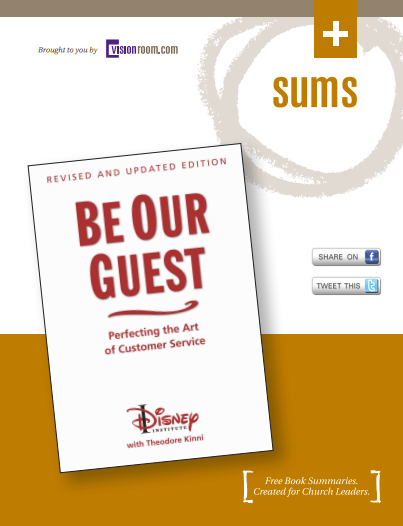
Be Our Guest – How Disney Exceeds Guest Expectations

Exceeding Guests’ expectations is Disney’s service strategy, and paying attention to every detail is the tactic by which it is accomplished.         – Be Our Guest

All week long my focus has been on books and reading:

What better way to close the week than to combine reading with another passion of mine – Guest Experience – with a summary of Disney’s Be Our Guest.

All organizations are driving toward the same goal – serving the people who purchase or use their products and/or services. Whether they are called clients, customers, constituents, or in Disney-speak, Guests – organizations must satisfy them or risk losing them.

Be Our Guest outlines proven Disney best practices and processes for generating customer loyalty and sound financial results. These principles can help your organization focus its vision and align its people and infrastructure into a cohesive strategy that delivers on the promise of exceptional customer satisfaction.

Want to get a glimpse of the Disney magic? You can download a free book summary of Be Our Guest here.

SUMS_BeOurGuest

Reading this Sums will only whet your appetite, so I encourage you to pick up Be Our Guest at your earliest opportunity – it will make a great New Year’s gift to your organizations’ leadership team!