Thinking for a Change

I close Thinking Week by presenting the main points of “Thinking for a Change” by John Maxwell. Maxwell is probably my favorite author of pure leadership writings, and I have never been disappointed by his works. In this case, they speak volumes for anyone interested in developing their thinking.

  1. Understand the Value of Good Thinking
  2. Realize the Impact of Changed Thinking
  3. Master the Process of Intentional Thinking
  4. Acquire the Wisdom of BigPicture Thinking
  5. Unleash the Potential of Focused Thinking
  6. Discover the Joy of Creative Thinking
  7. Recognize the Importance of Realistic Thinking
  8. Release the Power of Strategic Thinking
  9. Feel the Energy of Possibility Thinking
  10. Embrace the Lessons of Reflective Thinking
  11. Question the Acceptance of Popular Thinking
  12. Encourage the Participation of Shared Thinking
  13. Experience the Satisfaction of Unselfish Thinking
  14. Enjoy the Return of Bottom-Line Thinking

You can change the way you think.

Whatever things are true…noble…just…pure…lovely…are of good report, if there is any virtue and if there is anything praiseworthy; think on these things Philippians 4:8
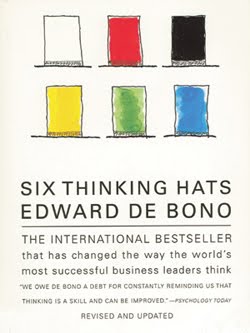

 

Got Your Thinking Hat On?

Thinking is the ultimate human resource. Yet we can never be satisfied with our most important skill. No matter how good we become, we should always want to be better.
-Edward de Bono
 
Dr. de Bono is an internationally acclaimed authority in the teaching of thinking as a skill. I’ve posted on his most famous book, The Six Thinking Hats, here. In this week’s ongoing discussion of thinking, I wanted to revisit his work briefly.
 
In “Six Thinking Hats” the author presents a simple but effective way to become a better thinker. He separates thinking into six distinct modes, identified with six colored “thinking hats”:
  • White – facts, figures, and objective information
  • Red – emotions and feelings
  • Black – logical negative thoughts
  • Yellow – positive constructive thoughts
  • Green – creativity and new ideas
  • Blue – control of the other hats and thinking steps
“Putting on” a hat focuses thinking; “switching” hats redirects thinking. With the different parts of the thinking process thus clearly defined, discussions can be better focused and more productive.
 
There are two main purposes to the six thinking hats concept. The first purpose is to simplify thinking by allowing a thinker to deal with one thing at a time. Instead of having to take care of emotions, logic, information, hope and creativity all at the same time, the thinker is able to deal with them separately.
 
The second main purpose of the six thinking hats concept is to allow a switch in thinking. If a person at a meeting has been persistently negative, that person can be asked to take off “the black thinking hat.” This signals the person that he has is being persistently negative. A person may be asked to put on “the yellow thinking hat;” this is a direct request to be positive.
 
By referring to the color of the hat instead of the emotion or perceived style, the concept of the hats minimizes the impact on a person’s ego or personality and allow for the possibility of focusing on one thing at a time – instead of trying to do everything at once.


Got a tough meeting coming up?

Make sure you carry six hats in!


The Power of Thinking Without Thinking

Continuing our Thinking Week, let’s move from the structure of Morgan Jones to the adaptive unconscious of the mind as depicted in Malcolm Gladwell’s classic book “blink“.

Gladwell weaves compelling stories as diverse as the uncovering of a fraud in ancient statuary to that of a classical trombonist auditioning for the lead chair in a world-class orchestra. The power of these and other stories in the book is that our mind has an uncanny ability to quickly make decisions that can be every bit as good as decisions made curiously and deliberately. So much for structure and analysis!


The problem is that our unconscious is a powerful force. But it can be fallible. It can be thrown off, distracted, and disabled. Our instinctive reactions often have to compete with all kinds of other interests and emotions and sentiments. Are we then not to trust our instincts?
 
Gladwell does an amazing job of laying out the case that the mind can be educated and controlled when it comes to making snap judgements and first impressions. Gladwell captivates the reader with stories that help us understand the power of instantaneous impressions and conclusions that spontaneously arise whenever we meet a new persons or confront a complex situation or have to make a decision under conditions of stress.
 
What do you think? Can there be as much value in the blink of an eye as in months of rational analysis?
 

Thinking About Thinking

Have you ever thought about how we think? Since reading Brain Rules and the sequel Brain Rules for Baby, I have been fascinated by the thought process we go through to make decisions. Here’s a whirlwind tour of some great resources on thinking.

The Thinker’s Toolkit

Former CIA analyst Morgan Jones argues that the single most important factor missing from most decision-making processes is structure. Structure for him means a logical framework in which to focus discussion on key points, keeping it focused so that each element and factor of a problem is analyzed separately, systematically, and sufficiently. Jones goes on to say that humans tend to avoid analytic structure that because structuring one’s analysis is fundamentally at odds with the way the human mind works.

Human beings are problem solvers by nature. Yet in order to reach most solutions, we go through a process of trial and error. In all human affairs, from marriage to marketing to management, success is generally built upon failure. And why some failures are justly attributable to bad luck, most result from faulty decisions based on mistaken analysis.

Here is a list of some of what Jones calls analytic sins:

  • We commonly begin our analysis of a problem by formulating our conclusions; we thus start at what should be the end of the analytic process.
  • Our analysis usually focuses on the solution we intuitively favor; we therefore give inadequate attention to alternative solutions.
  • Not surprisingly, the solution we intuitively favor is, more often than not, the first one that seems satisfactory.
  • We tend to confuse “discussion/thinking hard” about a problem with “analyzing” it, when in fact the two activities are not at all the same.
  • We focus on the substance (evidence, arguments, and conclusions) and not on the process of our analysis.
  • Most people are fundamentally illiterate when it comes to structuring their analysis.

If we take a structured approach in thinking, the mind remains open, enabling one to examine each element of the decision or problem separately. The outcome is almost always more comprehensive and more effective than following our instincts alone.

Think about that…


The Window and the Mirror

Yesterday our campus pastor was talking with our leaders about being a Level 5 Leader as developed in Jim Collins’ book “From Good to Great.”
 
The conversation triggered a quick revisit to the book, and to this little gem by Collins:

Level 5 leaders look out the window to apportion credit to factors outside themselves when things go well (and if they cannot find a specific person or event to give credit to, they credit good luck).


At the same time, they look in the mirror to apportion responsibility, never blaming bad luck when things go poorly.

 
Every leader looks out the window and in the mirror.

What do you see today?

The Meatball Sundae Goes to Church

Seth Godin’s 2007 book The Meatball Sundae examines fourteen trends of the realities of what he calls New Marketing. As with all of Godin’s books, it’s a fairly quick read that will have you wondering “Why didn’t I think of that?” So, with apologies to Seth Godin, here is a quick analysis of the fourteen trends in The Meatball Sundae as applied to ChurchWorld.

  1. Direct communication and commerce between producers and consumers – The Internet; need I say more? Organizations hear more, and more often, directly from consumers. Church leader, you may hate that word consumer, but your church is full of them, and there are many more in your community that you could reach. Are you listening to them?
  2. Amplification of the voice of the consumer and independent authorities – In a market where everyone is a critic, the need to create products and services that appeal to and satisfy critics becomes urgent. The same is true for after-purchase issues of service and quality. Your church probably doesn’t have a guest experiences department, team, or even single person. Why not?
  3. Need for an authentic story as the number of sources increases – Consumers hear about organizations from many sources, not just one. As a result, you have to get your story straight. Saying one thing and doing another fails, because you’ll get caught. Wait a minute – didn’t the church invent hypocrisy?
  4. Extremely short attention due to clutter – The death of mass marketing is partly due to the plethora of choices and the deluge of interruptions. As a result, complex messages rarely get through. Does your vision take a wall to display – or can you put it on a t-shirt in large type? Do you communicate one big idea every week – or dozens of unconnected thoughts?
  5. The Long Tail – it’s a book by Chris Anderson, but it also demonstrates that in almost every market, “other” is the leading brand. Domination by hit products is fading and consumers reward providers that offer the most choices. Wait – doesn’t that contradict number 4? Maybe; maybe not. You’ve got to figure out the difference and do it.
  6. Outsourcing – it’s not just possible to find someone to make/code/do something for you quickly and cheaply; it is now easy. The means of productions of physical goods and intellectual property is no longer based on geography but is based on talent and efficiency instead. The biggest resource for churches is surprise, within the church; it just may not be your church.
  7. Google and the dicing of everything – No one visits a Web site’s home page anymore – they walk in the back door, to the page Google sent them to. By atomizing the world, Google destroys the linear, end-to-end solutions offered by most organizations (churches). It is being replaced by a pick-and-choose, component-based solution. Chaordic is a term I’ve come to like very well; church leaders might want to get comfortable with it!
  8. Infinite channels of communication – New forms of publishing, communication, and interaction are arriving by the second in an already cluttered world. Some organizations will thrive from this increased chaos, some will be unprepared, and some will merely fight it and lose. Which will you be?
  9. Direct communication and commerce between consumers and consumers – eBay and Craig’s list on the commercial side, social networking on the personal communication side. As these networks become more powerful, consumers will gravitate to each other, not just informing each other about their experiences but banding together into groups that will pressure organizations for more of what consumers want. How do you know if someone is talking about you? To someone else?
  10. The shifts in scarcity and abundance – your organization is based on exploiting scarcity. Create and sell something scarce and you can earn a profit. But when scarce things become common, and common things become scarce, you need to alter what you do all day. Okay, this one really messes with my head. Churches don’t “sell” – or do they? They don’t make a profit, right? What are the things that are becoming ever scarcer? How can the church leverage these things? Here’s a biggie to get your brain spinning: time.
  11. The triumph of big ideas – in the industrial society of commoditization, little ideas are the key to success. Small improvements in efficiency or design can improve productivity and make the product a little more appealing. New Marketing in a noisy marketplace demands something bigger. It demands ideas that force people to sit up and take notice. The Church is happily humming along, tweaking ideas, practices, and policies from the 50’s – the 1850’s. Have you checked your calendar lately?
  12. The shift from “how many” to “who” – organizations used to market to the mass: shovel attention in the top of the funnel, and over time, sales come out the bottom. The funneling process sorts the wheat from the chaff, separating those who can buy from those who aren’t interested or can’t afford to participate. That works if you assume all consumers are pretty much the same, or if you can’t tell them apart. Unfortunately, they aren’t, and you can. Now we need to focus on who is hearing and talking about our message, and reach out to them.
  13. The wealthy are like us – rich people used to be all the same, just different from the rest of us. Now they’re not just different from the rest of us but different from each other. As the number of people considered rich increases daily, the diversity of the rich increases as well. It may not seem like it in this troubled economy, but we in the US are filthy rich in comparison to the rest of the world. Even in the US, there is a growing gap between groups of people. How will this play out in ChurchWorld?
  14. New gatekeepers, no gatekeepers – one way big organizations got bigger was by working with the other big guys. It was who you knew, and what they could do for you. There were channels to work through, gatekeepers to work with. Not now; it’s YouTube, Facebook, Twitter, and dozens of other social networking options. It’s you going to the world, and the world discovering you.

Movements are at the heart of change and growth. A movement – and idea that spreads with passion through a community and leads to change – is far more powerful than any advertisement ever could be. ChurchWorld – or at least what it could be, what it started out as – is all about that kind of movement and message. After all, it’s the Good News we have.

How are we sharing it?


The Airplane Effect (Explained)

I don’t fly a lot – maybe 4 or 5 times a year. But over the last couple of years, I have been curious about something – flying seems to accelerate my brain.

 Most of my flight involves the eastern half of the US; though occasionally I head west. My typical pattern is to buy a magazine that I would not normally read at the airport while I am waiting to board. Once on the flight, I will read the magazine from cover to cover, including ads. I highlight stories, phrases, and photos – anything that catches my eye and categorize them for later use. I find that the difference in environment stimulates thinking patterns. It also forces me to focus, as there are relatively few distractions on the flight.

Oftentimes, a single phrase, sentence, or photo will form the genesis of a blog post, magazine article, or presentation for a client. Take this illustration from yesterday’s post: a Swiss Army Knife combined with a 2 GB flash drive.

When I saw this item in a magazine, my first thought was – this is really cool! Then, in a stream of consciousness, the following thoughts occurred:

  • The use of a Swiss Army knife (scissors) in the most recent Pink Panther movies
  • The time when my youngest son cut the tip of his thumb nearly off with a Swiss Army knife (that he “borrowed” from his older brother)
  • Dealing with that crisis while simultaneously dealing with my daughter’s broken wrist, which happened 5 minutes before
  • Trying to explain both of these to the ER personnel while avoiding being reported to Family Services
  • The ubiquitous Swiss Army brand and how it is used (my brief case, for example)
  • How did the Swiss Army brand originate?
  • Can you take this item through TSA at the airport?
  • Do we have Swiss Army items in the church?

So, in about 15 seconds thought, I surmised that it was a great idea but maybe not practical for an airline traveler.

That last thought about Swiss Army items in the church was just – weird. But it made me ponder that those two items can’t possibly go together.

Which puts it in the category of a meatball sundae.

Which is for tomorrow’s post.


The Airplane Effect

Yesterday during a flight to Arlington, TX, I finally put my finger on something that had been bugging me: flights  really turn my brain loose. I read parts of three different books (love that Kindle!); took an innovation quiz that measures my innovation aptitude; and completed some editing on a writing project I’m working on.

On a 2 1/2 hour flight.

What’s up? I will be posting more on this topic, but here’s a visual to get you started:

Where does this take your thought process?

Reading Right Now…

I’ve always believed that active and diverse reading is a necessity for creative leaders. Really putting in practice this week…

On Optimist’s Tour of the Future: One Curious Man Sets Out to Answer “What’s Next, by Mark Stevenson

Six Frigates: The Epic History of the Foundation of the U.S. Navy, by Ian Toll

Culture: Leading Scientists Explore Societies, Art, Poetry, and Technology, edited by John Brockman

Now You See It: How the Brain Science of Attention Will Transform the Way We Live, Work, and Learn, by Cathy Davidson

Missional Communities: The Rise of the Post-Congregational Church, by Reggie McNeal

To Transform a City: Whole Church, Whole Gospel, Whole City, by Eric Swanson and Sam Williams

AND: The Gathered and Scattered Church, by Hugh Halter and Matt Smay

The Case for Antioch: A Biblical Model for a Transformational Church, but Jeff Iorg

Democratizing Innovation, by Eric von Hippel

Zarrella’s Hierarchy of Contagiousness: The Science, Design, and Engineering of Contagious Ideas, by Dan Zarrella

The Elements of Cooking, by Michael Rhulman

I’m trying to emulate Thomas Edison, who believed that voracious reading was the key to self-improvement. He read books on a remarkable range of subjects to address his endless queries. As Edison noted, “I didn’t read a few books, I read the library.”

I prefer to think of it as creating innovation literacy.


The Hardest Work There Is

It’s the work of making far-reaching change in long-established organizations.

One of my dream jobs would be a change architect. I’ve been fortunate to be able to practice change in several different venues – from family life to church staff positions to my current consultant role. Each one brings something different to the table, and each one has been instructive for the next one.

As I’ve often said to churches I work with, change is a constant reality. It’s not meant to be an oxymoron, but some would see it that way. Change is a matter of life – biological (while you are reading this tens of thousands of cells have been created in your body) to our physical world (the season of fall is here) to organizational (restructuring, new plans, etc).

We are constantly undergoing transformation in all areas of our existence.  To that end, a few comments from William Taylor, co-founder of Fast Company magazine and author of the book “Practically Radical” are worth repeating.

Five Truths of Organizational Transformation

  1. Most organizations in most fields suffer from a kind of tunnel vision, which makes it hard to envision a more positive future. The first challenge of change is originality – for leaders to see their organization and its problems as if they’ve never seen them before. with new eyes, to develop a distinctive point of view on how to solve them.
  2. Most leaders see things the same way everyone else sees them because they look for ideas in the same places everyone else looks for them. Why do you want to look at your competition and develop benchmarks for comparison? Instead, learn from innovators outside your field as a way to shake things up.
  3. In troubled organizations rich with tradition and success, history can be a curse – and a blessing. The challenge is to break from the past without disavowing it. The most effective leaders don’t disavow the past – they reinterpret what’s come before to develop a line of sight into what comes next.
  4. The job of the change agent is not just to surface high-minded ideas. It is to summon a sense of urgency inside and outside the organization, and to turn that urgency into action. The opposite of urgency is complacency, and complacent individuals, unfortunately, see themselves as behaving quite rationally.
  5. In an environment that never stops changing, change agents can never stop learning. The best leaders, regardless of their field, experience, or personal style, are insatiable learners.

Problems cannot be solved at the same level of awareness that created them.

 – Albert Einstein

If all you ever do is all you’ve ever done, then all you’ll ever get is all you’ve every got.

– Unknown Texas Genius

Are you ready to roll up your sleeves for the hard work of change in front of you?