
South African Oscar Pistorius is asked by current world champion Kirani James of Grenada to exchange race bibs after Pistorius comes in last in the semi-final of the 400 meter race.
By the way, Oscar Pistorius is a double amputee.

South African Oscar Pistorius is asked by current world champion Kirani James of Grenada to exchange race bibs after Pistorius comes in last in the semi-final of the 400 meter race.
By the way, Oscar Pistorius is a double amputee.

The “rocket ride” comment in yesterday’s post reminded me of some remarks by Andy Stanley when he came to Elevation Church in Charlotte NC for one of our leader training sessions. They are an appropriate reminder as we consider changing change.
Recalling the dispute in Antioch and the resulting Jerusalem Council in Acts 15, Stanley developed the following thoughts about what the church should be vs. gravitational pull of culture.
1. There’s always a gravitational pull toward insiders and away from outsiders
People who were nothing like Jesus liked Jesus
2. There’s always a gravitational pull toward law and away from grace
With conversations you can always extend grace
3. There’s always a gravitational pull toward complexity and away from simplicity
Complexity always slows things down, is expensive, and makes you lose distinctiveness in the community
4. There’s always a gravitational pull toward preserving and away from advancing
Back when we had nothing, what would we have done?
If you want to defy gravity:
That’s how you keep the church in orbit.
After my design thinking diatribe in yesterday’s post, maybe it’s time for a little balance in the ever-present battle between the linear, analytical left brain and the chaotic, creative right brain. There is an unavoidable but healthy tension between creating the new and preserving the best of the present; between innovating new ideas and maintaining healthy existing ones. As a leader, you need to learn how to manage that tension, not adopt a wholly new set of techniques and abandon all of the old. It’s not that many analytic approaches are bad – it’s just that in many organizations, it’s all they’ve got.
The VUCA (volatile, uncertain, complex, ambiguous)future we’re living in will require multiple tools in the leader’s tool kit – a design suite especially tailored to starting up and growing new ventures in an uncertain world, and an analytic one suited to running established organizations in a more stable environment.

What leaders need is not a right brain transplant that throws the old left brain tool kit away – they need to be taught some new approaches to add to the tool kit they’ve already got. Business as usual can help leaders do things designers have trouble with. Design needs business thinking for good reasons:
Novelty doesn’t necessarily create value
The flip side of the defense of the status quo because of its familiarity is the pursuit of novelty only because it’s new. How many times have you seen (or have been guilty yourself) ChurchWorld leaders who have attended the latest conference and returned to their church to try the latest and greatest geewhizjimmyhawthingy guaranteed to (fill in the blank) your church?
Even value creation is not enough
Churches, in order to survive, must care about more than just creating value for the existing organization. It is an important, but insufficient, first step. To survive long-term, churches need to be able to execute and capture part of the value they create in a duplicatable process that accomplishes their mission and reproduces their “product” – disciples. While doing creating and innovating, they must in Jim Collins’ words “remain true to the core.” This requires solid businesslike thinking: can we translate a new and innovative idea from small experiment to a significant part of the organization’s being without messing up the recipe?
How many more stylish worship environments or new group ideas do any of us need?
Cool stuff is great, but design has the potential to offer so much more. Design has the power to change the world – not just make it pretty or more functional. Just because you can do a thing doesn’t mean you should do it. The discipline of design should address our most challenging problems, not just pretend to make us better or fulfill our dreams.
Part of an ongoing adaptation of Designing for Growth by Jeanne Liedtka and Tim Ogilvie to fit ChurchWorld realities
Watching the Olympics is a biannual tradition in the Adams household. Of the two of us, my wife is hands down the biggest sports fan in the family.
I’m just trying to figure out how to keep score.
Basketball I’ve got covered: shots from behind the free-throw line are 1 point each. Shots inside the arc are 2 points each, and shots scored outside the arc are 3 points each. At the end of regulation play, the team with the highest score wins.
There are lots of other sports in the Olympics with similar scoring rules – I’m pretty good with them. But then it starts to get complicated.
In gymnastics, scoring is a 2-tier system with technical difficulty which starts at 0 and points are added for the performance difficulty combined with execution and technique which starts at 10 and points are subtracted as mistakes are made. I would probably meet myself coming and going – it’s no wonder coaches and judges are always glaring at each other. Then there’s that visible money changing hands thing…
What about diving? A judge in a diving contest shall award from 0 to 10 points for a dive according to his or her overall impression using the following criteria:
– 10: Excellent
– 8½ – 9½: Very good
– 7 – 8: Good
– 5 – 6½: Satisfactory
– 2½ – 4½: Deficient
– ½ – 2: Unsatisfactory
– 0: Completely Failed
If that wasn’t complicated enough, you move to synchronized diving and get two competitors diving simultaneously from the springboards or platform. The competition is judged on how the two divers individually perform their dives, and how the two divers as a team synchronize their performance. The factors to be considered when judging synchronized diving are: - the starting position, the approach and the take-off, including the similarity of the height - the coordinated timing of the movements during the flight - the similarity of the angles of the entries - the comparative distance from the springboard or platform of the entry - the coordinated timing of the entries…(insert snoring sounds here).
How about trampolining? It’s a math formula where the score = difficulty + execution + time of flight. The difficulty is measured from 0 up and the execution is measured from 10 down. Heaven help the judge who meets in the middle! The time of flight (debuting at these Olympics) is measured by digital device. Here’s the kicker: the athlete must begin and end their routine on flat feet – with the landing being held for 3 seconds. Have you ever tried to stop on a trampoline?
With the Olympics singular nod to equality of the sexes, there is the equestrian events, where the rider who finishes the course with the fewest penalties in the fastest time gets the best score. Men and women compete together.
Finally, let’s head out to the water for Olympic Sailing. There are two races: Fleet Racing is run on a low points system; the boat at the end of the competition with the least number of points wins. Then there’s Match Racing – each match is sailed between two boats, with the first boat to cross the finish line the winner, receiving one point. The team with the highest core wins. One can only hope the captains don’t get their races mixed up.
As for me, I will continue to watch the 2012 Summer Olympics from the comfort of my recliner, occasionally participating in our family’s own competition that’s been running for over a year now: The Adams Family Pizza Quest.
There’s no scoring difficulty here: try out new pizza restaurants and rate them on a 5 slice (by half slice increments) scale:
1 – a complete failure in every way
2 – barely functional; won’t be back or recommend to friends
3 – serious flaws; the jury is still out
4 – downsides outweigh the upsides
5 – recommended with reservations
6 – a solid meal with some issues
7 – very good, but not quite great
8 – excellent, with a little room to grow
9 – nearly flawless; we’ll be back again with friends
10 – metaphysical and culinary perfection
I’m enjoying the Olympics best when I don’t worry about the score – how about you?
Walt Disney had a burning desire for excellence in everything he did. He was always thinking, ‘We can do it better.’ That’s a common trait of all successful people.
Royal Clark, former treasurer of WED Enterprises
Walt Disney’s life provides powerful lessons that can be applied in any leadership position. Author Pat Williams recognized this, and went behind the legend to discover a man every bit as fascinating as the world he created.
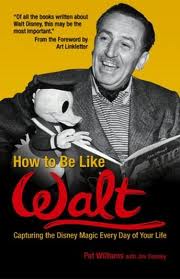
How to Be Like Walt is the result of thousands of hours of interviews of the people who knew Walt best. In addition to being a fascinating life story of one of our nation’s most creative minds, the author has distilled Walt’s life into 17 lessons – lessons that we all could learn from. I introduced the topic yesterday; here are a few more:
Plus Every Experience: Sometime during the 1940s, Walt coined the term “plussing.” Normally, the word “plus” is a conjunction, as in “two plus two equals four.” But Walt used the word as a verb – an action word. To “plus” something is to improve it. “Plussing” means giving your guests more than they paid for, more than they expect, more than you have to give them. No matter what “business” you are in, your success depends on your commitment to excellence and attention to detail. If you deliver more than people expect, you will turn people into fans. Pursue excellence in everything you do.
Be a Person of Stick-to-it-ivity: Today we look at Disneyland and say, “Of course! Just what the world needed. How could it miss?” But in 1955, Disneyland was the biggest gamble in the history of American business. The risk paid off – not because Walt was lucky or favored or a genius. It paid off because Walt wouldn’t quit. The success of Disneyland is, first and foremost, the result of sheer dogged determination and persistence in the face of obstacles and opposition. In his own words, “Get a good idea and stay with it. Dog it, and work at it until it’s done, and done right.”
Become Like a Sponge for Ideas: Walt continually fed his mind with information and ideas. He absorbed inspiration wherever he went. If you want to be like Walt – more creative, more imaginative, and more successful – then keep your eyes and ears open. Read. Watch. Travel. Talk to people wherever you go. Ask questions. Invite opinions. Become a sponge for ideas.
Ask Yourself “How About Tomorrow?”: Walt embraced the future and put the stamp of his own personality on tomorrow. If we want to help shape a better tomorrow, then we need to continually ask ourselves the same question Walt asked Ray Bradbury: “How about tomorrow?” The difference between today and tomorrow is something called change. It takes courage to embrace the future, because the future is about change, and change brings uncertainty and anxiety. We fear change; we prefer the comfort of the familiar. But change is inevitable. If we do not become future-focused, we are doomed to obsolescence when tomorrow arrives. There are so many possible futures – which one will you choose?
Here are the rest of the author’s “How to Be Like Walt” lessons:
Each of the 17 lessons in the book are richly illustrated with stories by and about Walt Disney. I encourage you to get a copy and prepare to be delighted – and challenged.
Walt’s life challenges us to dream bigger, reach higher, work harder, risk more, and persevere as long as it takes. That is the rich legacy Walt Disney left us. That is the supreme lesson of his endlessly instructive life. The riches of an incredible, adventure-filled life are within our grasp – if we will dare to be like Walt.
Pat Williams
If you liked these two posts, here a few more select Disney-related posts:
It depends on the year.
In 1896, freestyle swimming for sailors was on the lineup. In 1920, tug-of-war. Live pigeon shooting was a new event in 1900 (like 184 other events through the years, it lasted for only one Olympiad).
For a look at how long each Olympic category has been around, take a look at a fascinating infographic from Wired magazine here.
It’s time for the biannual event of bleary eyes and arcane sports again, otherwise know as the Olympics.
Summer or Winter, my wife and I have always been huge fans of the Olympic Games. While it’s very easy to get jaded because of the commercialism, nationalism, and hype of the Games, we prefer to take a simpler view – we are seeing men and women function at their peak performance, often putting years of training, hardship, and practice on the line for a few minutes in which they will be remembered (for a while) or forever forgotten.
Over the next few weeks, I will probably interrupt the usual flow of 27gen to drop in an Olympic-themed post from time to time. And to launch these posts, a fascinating story from Wired magazine with this assertion:
Olympic athletes are made, not born.
Forget about recruiting the best athletes; if you really want to build a great athletic team, it’s time to recruit the best PhDs.
Following the 1976 Summer Olympics in Montreal, in which Australia won just one silver and four bronze medals, a throughly embarrassed Australian government created an academy modeled in part on the sports factories of the Eastern Bloc. They hoped to capture the intensity and success of the Soviet academies without going to the same excesses. The idea was simple: Get the best coaches and the best athletes together on a year-round basis, without any distractions, and hope that athletic magic would result.
It worked well: Australia won 14 medals in 1988 and 27 in 1992. But in 1993 when it was announced the 2000 Summer Games would be held in Sydney, the Australians decided that a standout performance was crucial, and athletic funding was radically increased. Rather than smaller efforts based around a specific athlete, the scientists at the Australian Institute of Sport (AIS) were able to take on larger projects that had a profound impact for Australian sports as a whole.
AIS researchers:
The results were astonishing: At the Sydney Games, Australia won 58 medals, placing it third in the podium count. That performance was even more stunning on a per capita basis. Australia’s population was a little over 19 million, meaning the country received one medal for every 328,000 citizens. China, which also won 58 medals in Sydney, scored one medal for very 21.7 million citizens.
“For every swimmer in Australia, there are three swimmers in the USA and 10 in China,” says Bruce Mason, head of aquatic training and research at AIS.
Australia had used technology to close the gap. They are now a global leader in merging science with athletic talent.
You can read the entire fascinating article online from Wired here.
It will make a great warm-up for armchair athletes like my wife and me as the 2012 London Olympics begin tonight.

More great stuff from Andy Sernovitz’s book “Word of Mouth Marketing“:
The Five Ts of Word of Mouth Marketing
Here’s your homework assignment: go here and download the 5 Ts worksheet. Now complete it for your church.
What are you waiting for? Dive into the Ts and turn them loose!
UPDATE
If you are doing something worth talking about, it’s time to put a plan together to help the conversations happen. Here’s a great worksheet to do just that, by Andy Sernovitz who is the author of the 5 T Worksheet above. The action plan will help you think about:
Remember, everyone’s talking – why not help them talk about your organization?
Why not give them a reason to talk about you?
Word of mouth marketing has been defined as ” a) giving people a reason to talk about you and b) making it easier for the conversation to take place”.
Andy Sernovitz, author of “Word of Mouth Marketing”, has compiled some great ideas about how to use Word of Mouth: check them out here.
What’s the lesson for ChurchWorld?
Sernovitz lists 4 Rules for Word of Mouth Marketing. I’ve listed them here, along with my interpretation of how a church might apply them:
In today’s hyper-connected world, word of mouth is more important than ever – even when the “word” is digitally transmitted.
Every community has a story – a unique story. Every community has a character, a “feel”, and an attitude shaped by its own peculiar events and circumstances.

courtesy switchboard.nrdc.org
Does your church want to make an impact on your community in a meaningful way?
Don’t rush in with your plans and dreams and schemes for what you want to accomplish. First, you ask what’s the story? What are the real issues, the real problems, the real needs?
He who answers before listening – that is his folly and his shame. Proverbs 18:13

