
March and April – The Gathering Storm, Part Six
On the morning of April 19, 1775, Captain John Parker assembled about seventy-seven men on Lexington Green to face a column of perhaps seven hundred British regulars. The story most of us learned positions this confrontation as a dramatic clash between liberty-loving patriots and imperial tyrants – brave farmers standing on principle against the mightiest military power on earth. But who, exactly, were those farmers? What did they owe each other? What did they fear losing? What had they quarreled about the week before?
Robert A. Gross wanted to know. And in asking those questions, he produced one of the most quietly revolutionary books in American historical writing.
The Author and His Moment
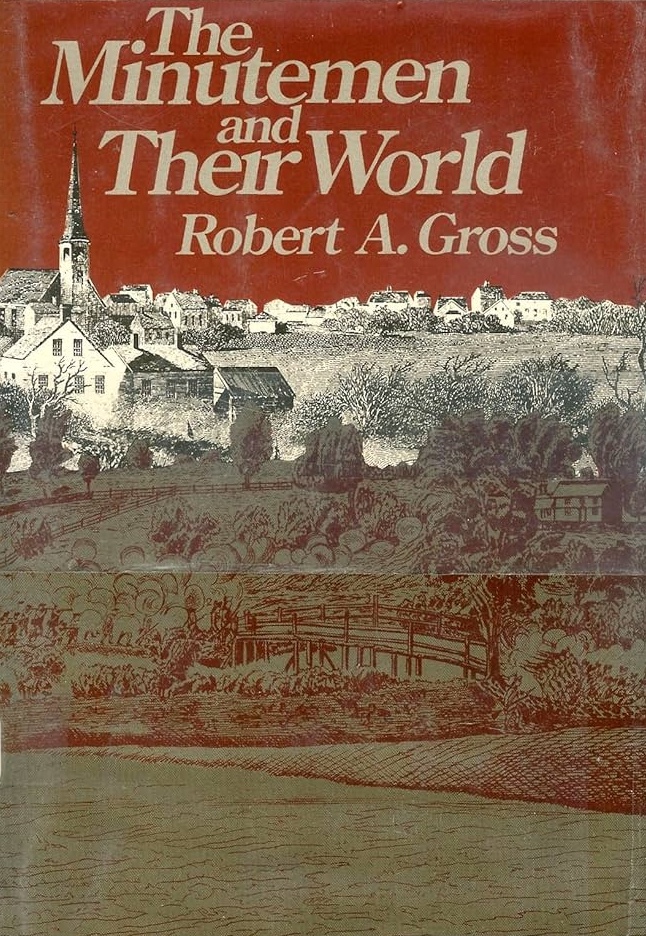
The Minutemen and Their World was published in 1976, arriving precisely as America was staging its Bicentennial pageant – a moment drenched in patriotic nostalgia, triumphal displays, and the comforting myth of a unified founding generation. Gross, then a young historian at Amherst College, offered something far more interesting: a close, almost novelistic examination of a single community, Concord, Massachusetts, in the decades before and after the Revolution.
The timing was not incidental. The 1970s were also the years of Vietnam, Watergate, urban fracture, and deepening skepticism about official narratives. Gross belonged to a generation of social historians who had absorbed the influence of the French Annales school and were redirecting the American historical gaze downward – away from generals and statesmen and toward the lives of ordinary people. His model was not the triumphalist narrative but the community study: granular, demographic, attentive to land records and probate files and church membership lists.
The result won the Bancroft Prize and has remained continuously in print for nearly fifty years. It is, by any measure, a classic.
The Central Argument: Anxiety Before Ideology
The conventional story of Concord on April 19 is essentially ideological: colonists committed to Enlightenment principles of liberty and self-governance took up arms against tyrannical overreach. Gross does not dismiss this framing, but he deepens and complicates it considerably.
His central argument is that the men who fought at the North Bridge were not primarily motivated by abstract political theory. They were defending a particular way of life – a specific, fragile community – that was already under enormous internal stress before a single British soldier appeared on the horizon.
By the 1770s, Concord was a town in quiet crisis. Population growth had outpaced the land’s capacity to sustain the traditional agricultural inheritance system by which fathers subdivided farms among sons. Young men faced diminishing prospects. Soil exhaustion was widespread. The old reciprocal networks of neighborly exchange – borrowing tools, sharing labor at harvest, extending credit – were fraying as market relationships penetrated the town’s economy. Social distinctions were hardening. The church was fracturing along new denominational lines.
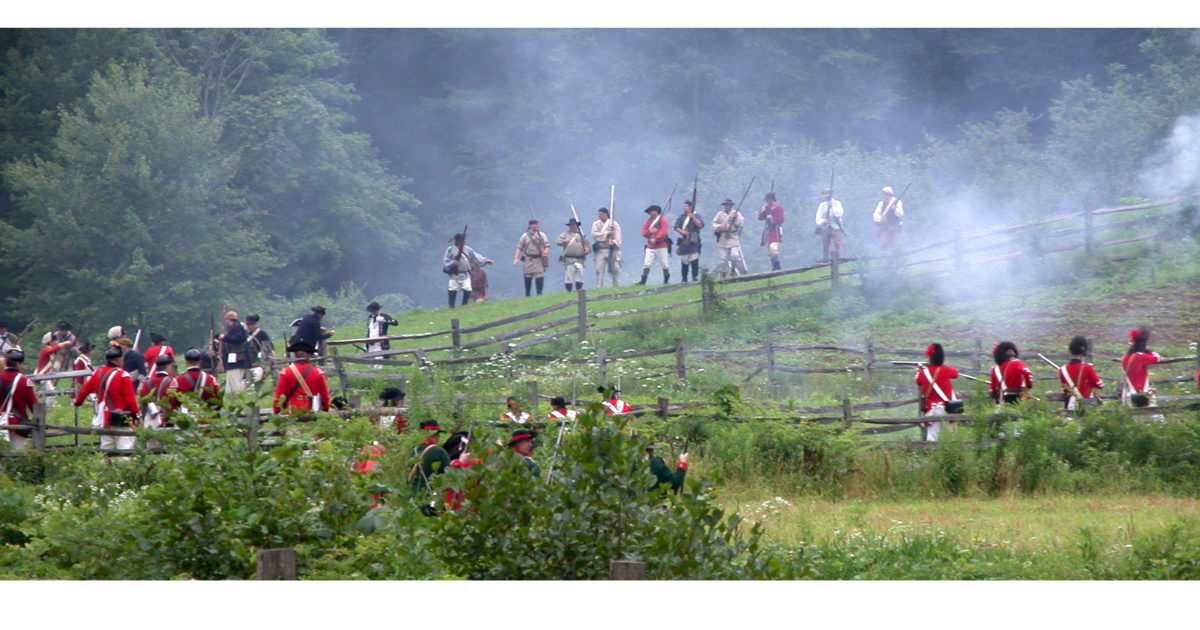
Into this anxious community arrived the imperial crisis. And Gross’s insight is that British policy threatened not just abstract liberties but the very social fabric that Concordians had been struggling to maintain. The Coercive Acts of 1774, which suspended Massachusetts self-government, struck directly at the local institutions – the town meeting, the militia, the county courts – through which Concord managed its internal tensions and regulated its collective life.
As Gross writes, the men of Concord fought “to preserve a Christian, corporate community” – not to inaugurate a new liberal order, but to defend the old one.
The Voice on the Page
What distinguishes Gross from many social historians is his prose. The book reads with the warmth and particularity of good narrative writing. Consider his description of the town’s social geography: Concord “was a community of neighbors who knew each other’s business, borrowed each other’s tools and labor, and watched each other’s children grow up. There was little privacy and less anonymity.” This is not dry demography; it is an evocation of a world.
Or his account of the town’s agricultural predicament, rendered with almost elegiac feeling: the farms that grandfathers had carved from wilderness were now too small to support their grandsons. The Revolution, in this light, was not merely a political event but a moment of communal self-preservation but a people fighting to hold together a world that was already slipping away.
The book’s most affecting passages involve the individual men who appear in the records: farmers negotiating debts, deacons managing congregational disputes, young men eyeing distant lands because there was no room left at home. Gross makes the aggregate data breathe.
In Dialogue: Agreements, Tensions, Departures
The Minutemen and Their World enters into productive conversation with several other essential works in the Bicentennial-and-after tradition of Revolutionary history.
T.H. Breen’s American Insurgents, American Patriots (2010) shares Gross’s commitment to recovering the experience of ordinary colonists rather than the Founding Fathers. Breen emphasizes the role of popular rage – the grassroots anger that preceded and ultimately drove elite political leadership – and his portrait of a self-mobilizing populace broadly corroborates Gross’s picture of communities defending local ways of life. But where Gross is resolutely local, Breen pans outward to trace a continental insurgency, showing how thousands of Concords were simultaneously activated across thirteen colonies. The books are complementary: Gross gives you the texture; Breen gives you the scale.
Kevin Phillips’ 1775: A Good Year for Revolution (2012) offers a useful counterweight to Gross’s social-historical intimacy. Phillips argues that 1775 – not 1776 – was the true hinge year of the Revolution, and he marshals economic, demographic, and geopolitical data across the full Atlantic world to make his case. His Concord is a data point in a continental argument; Gross’s Concord is an entire universe. Phillips usefully reminds us that the forces shaping Concord – land scarcity, market integration, imperial taxation – were macro-level phenomena operating across the colonies. Gross shows us how those forces felt from the inside of one particular life.
Lexington and Concord: The Battle Heard Round the World by George Smith (2018) provides the military and operational narrative that Gross largely brackets. Smith’s careful reconstruction of April 19 – the march from Boston, the confrontation on the Green, the running fight back to Charlestown – gives essential tactical context that Gross’s social history does not provide. Reading the two together is instructive: Smith explains what happened on the road; Gross explains why the men were standing in it.
The deepest tension is perhaps with more ideologically centered accounts that treat the Revolution primarily as a contest over political philosophy. Gross does not deny that Concordians read Locke and Trenchard and Gordon – but he insists that ideas alone do not explain why a farmer named Joseph Hosmer took up his musket at the North Bridge. The land records, the debt lists, the church rolls – these tell a different story about motivation, one that is at once less heroic and more human.
What We’ve Learned Since 1976
Gross published a significantly expanded edition of the book in 2020, adding chapters that carry Concord’s story through the early Republic. This revision itself tells us something: the original book ended at the Revolution’s beginning, leaving open what the townspeople made of the new order they had helped create.
The intervening decades of scholarship have enriched Gross’s framework in several ways. Historians have paid far greater attention to the people Gross’s Concord mostly omitted: enslaved Black residents, whose presence in Massachusetts households complicates any simple narrative of liberty; women, whose labor underpinned the household economy he describes; and Indigenous peoples, whose dispossession created the very farmland the minutemen were defending.
Recent work on the political economy of the Revolution – including studies of debt, credit, and the colonial financial system – has deepened Gross’s insights into the material pressures facing Concord’s farmers. And the environmental history movement has extended his attention to land and soil into a fuller reckoning with the ecological costs of colonial agriculture.
The book’s core argument that local community, not abstract ideology, was the primary social reality the Revolution defended has held up remarkably well. If anything, it looks more prescient now than in 1976.
Why Read This in 2026?
We live in an era of intense argument about what the American founding actually means – about whether its ideals were genuine or hypocritical, universal or exclusionary, worth celebrating or reckoning with. These are real and important debates. But they can tempt us into treating the founding generation as symbols rather than people.

The Minutemen and Their World is a corrective. It insists that the men at the North Bridge were not icons or abstractions. They were neighbors with land disputes and unpaid debts, fathers worried about their sons’ futures, churchgoers nursing old grudges, farmers watching their soil thin year by year. Their revolution was real because their world was real – specific, flawed, beloved, and threatened.
That combination of intimate particularity and large historical stakes is what good history offers, and Robert Gross delivers it on almost every page. Read this book not to be inspired, but to understand – and to recognize, perhaps uncomfortably, how much of what drove those men in April 1775 still drives communities facing the erosion of the worlds they know.
A Note on This Series
This journey through Revolutionary history is as much about the evolution of historical understanding as the Revolution itself. History isn’t static – each generation reinterprets the past through its own concerns, asking different questions and prioritizing different sources. By reading these books in dialogue across 250 years, we’ll witness how scholarship evolves, how narratives get challenged, and how forgotten stories resurface.
This isn’t about declaring one interpretation “right” and another “wrong,” but appreciating the richness that emerges when multiple perspectives illuminate the same transformative moment. These books won’t provide definitive answers – history rarely does – but they equip us to think more clearly about how real people facing genuine uncertainty chose independence, how ideas had consequences, and how the work of creating a more perfect union continues. As we mark this anniversary, we honor the Revolutionary generation by reading deeply, thinking critically, and engaging seriously with both the brilliance and blind spots of what they created.
 27gen.com