
March and April – The Gathering Storm Part Four
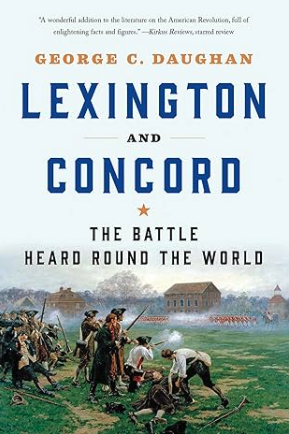
On the morning of April 19, 1775, a column of British regulars marched through the pre-dawn dark toward Concord, Massachusetts, confident this whole “rebel” business would be settled before breakfast. General Thomas Gage had been assured – by ministers in London who had never left England, by officers who confused bluster with intelligence – that the colonists would scatter the moment a proper army appeared in force. They had, in effect, never stopped to ask a simple question: what exactly were these farmers fighting for? The answer, George C. Daughan argues in his authoritative and engrossing Lexington and Concord: The Battle Heard Round the World, was far more concrete and existential than a slogan about liberty. They were fighting to keep their farms, their livelihoods, and their children out of the grinding poverty they saw destroying the king’s subjects on the other side of the Atlantic.
In 2026, with Americans arguing furiously about economic inequality, the reach of government power, and who exactly the founding documents were meant to protect, Daughan’s economic reinterpretation of the Revolution’s opening shots feels less like history and more like a live wire. This is a book about what people will do when they genuinely believe the material conditions of their lives are under assault from a distant, unaccountable power.
The Author and His Vantage Point
Daughan holds a doctorate in American history and government from Harvard, where he studied under Henry Kissinger – a detail that, whatever one makes of Kissinger’s legacy, signals a scholar trained to think about power, strategy, and the gap between political theory and geopolitical reality. He is primarily a naval historian: his earlier book – If By Sea – won the Samuel Eliot Morison Award, and his deep expertise in maritime strategy threads through this work in productive ways, reminding readers that the Atlantic Ocean – and Britain’s command of it -shaped every calculation on both sides of the conflict.
Published in 2018, Lexington and Concord arrived at an interesting moment: a period of renewed popular attention to economic grievance as a political force. Whatever Daughan’s own politics, his framing – that the militiamen of Massachusetts believed they were fighting against serfdom as much as tyranny – reads with a fresh urgency that the book’s 1990s or 2000s predecessors might not have anticipated.
The Core Argument: It Was the Economy, Too
Daughan’s central thesis challenges the prevailing narrative of the American War of Independence: it was, he argues, based as much on economic concerns as political ones. This is a significant corrective to the tradition of treating Lexington and Concord as primarily a story of ideological awakening – of enlightened men suddenly grasping that taxation without representation was philosophically untenable.
The pivot point in Daughan’s argument is Benjamin Franklin’s letters home from his travels through Britain and Ireland. Franklin witnessed the wretched living conditions of the king’s subjects: they wore rags for clothes, went barefoot, and had little to eat. They were not citizens, but serfs. In the eyes of many American colonists, Britain’s repressive measures were not seen simply as an effort to reestablish political control of the colonies, but also as a means to reduce the prosperous colonists to such serfdom.
This is what made the turnout at Lexington and Concord so staggering to British commanders. Even though the standard of living in Massachusetts was high, the militiamen were not merely comfortable gentlemen untrained in warfare. Most were veterans of the French and Indian War and well-versed in organizing an army. They were not idealists marching on principle – they were experienced men who had looked at Ireland, looked at the trajectory of British colonial policy, and decided that waiting was more dangerous than fighting.
The British Failure of Imagination
Where Daughan is perhaps most penetrating – and most original as a military historian – is in his dissection of British incompetence. The greatest failure of the king and his officials was their impatience in requiring rapid results without supplying sufficient resources. Nearly every one of General Thomas Gage’s requests was ignored. Gage, who had fought alongside colonial Americans in the brutal French and Indian War, understood something his superiors in London refused to accept: that these men knew how to fight, and that there were far more of them than anyone in Whitehall imagined.

The king was convinced that a military chastisement would cause the “loudmouth agitators to be deserted – embarrassed by the country people, who would be afraid to come out and fight.” It was a catastrophic miscalculation. The country people came out in overwhelming numbers, and they did not run.
The scorn of the British for experienced colonial fighters was another key factor. The British troops – many had never been in battle – were outnumbered and outclassed; their leaders were impervious to reason; and the fate of British rule in America was sealed. Daughan is at his most readable in these passages: the play-by-play of the running fight back to Boston, British regulars pinned down by men firing from stone walls and tree lines, dissolves the myth of the redcoat as an invincible professional and replaces it with something more human – and more damning.
Dialogue with the Series: Where Daughan Agrees, Diverges, and Deepens
Readers who have followed this series will find Lexington and Concord in productive conversation with two earlier entries. T. H. Breen’s American Insurgents, American Patriots (2010) and Kevin Phillips’s 1775: A Good Year for Revolution (2012) are both, in their different ways, attempts to wrestle the American Revolution away from the Founders and return it to the people who actually bled for it. All three authors are pushing against the same tendency in popular history: the habit of treating April 19, 1775 as a story about ideas rather than people, and about leaders rather than farmers.
The most illuminating pairing is Daughan with Breen. Where Daughan focuses on the economic fears that drove Massachusetts men into the field, Breen, in American Insurgents, emphasizes the emotional and organizational infrastructure that made their response possible. Before Lexington, Breen argues, ordinary colonists – most of them farm families in small communities – had already built what he calls “schools of revolution”: elected committees of safety that channeled popular rage, enforced boycotts, and effectively dismantled royal authority town by town, well before a single shot was fired. The militiamen at Lexington and Concord were not spontaneous; they were the product of two years of deliberate grassroots mobilization. For Breen, their tipping point was Lexington and Concord itself, whose news then spread through those same communication networks to ignite the other twelve colonies.
Daughan and Breen are looking at the same men from different angles – Daughan asking why they were willing to die, Breen asking how they had organized themselves to do it. The economic dread Daughan identifies gave the insurgency its fuel; the committee networks Breen traces gave it its form. Neither account is complete without the other.
Phillips’s 1775 stands closer to Daughan on the question of motivation. Phillips, like Daughan, is explicitly skeptical that secular ideology was the primary driver of the Revolution. His shorthand for the colonial mindset – “economic motivations, constitutional rhetoric” – could serve as a subtitle for Daughan’s book. Both authors are writing against the tradition shaped by Bernard Bailyn and Gordon Wood, which placed Enlightenment political philosophy at the center of the revolutionary dispute. For Phillips, as for Daughan, the rage militaire that swept the colonies in the spring of 1775 was grounded in something more visceral than a reading of Locke.
Where they diverge is in scope and argument. Phillips’s 1775 is an encyclopedic account – sprawling across politics, economics, religion, ethnicity, and military logistics – that insists on treating 1775, not 1776, as the Revolution’s true hinge. Daughan is far more concentrated: he wants to put you on the road to Concord, in the mind of a Massachusetts militiaman, on that specific morning. Phillips gives the forest; Daughan gives the trees. For readers who have spent time with Phillips’s sweeping reinterpretation, Daughan’s book offers the granular, human payoff that six hundred pages of structural analysis can sometimes leave wanting.
Historical Reassessment: What We’ve Learned Since 2018
Some critics noted that Daughan’s thesis about colonists fearing reduction to poverty is not especially well developed – that he thoroughly catalogs the ineptitude and hubris of the British government, but the economic argument is at times asserted more than fully demonstrated. The book is stronger as military and political narrative than as economic history, and readers looking for a rigorous analysis of colonial wealth distribution, debt, and the mechanics of British taxation policy will need to supplement Daughan with other sources.

Since the book’s publication, the broader field of Revolutionary historiography has continued to grapple with questions Daughan’s framing raises but doesn’t fully answer. How do we weigh the economic anxieties of prosperous Massachusetts farmers against the experience of the enslaved people who had no stake in the liberty being defended? Daughan does include a chapter on slavery – which some readers found jarring, as if the author drifted unexpectedly into different territory – but this is actually one of the more honest instincts in the book. The revolution that began on Lexington Green was a revolution for some people’s economic security, explicitly not for others.
More recent scholarship has also deepened our understanding of how Loyalist communities fractured under the pressure of patriot mobilization – a dynamic Daughan touches on but doesn’t fully develop. Officials in London thought the Bostonians would be on their own in confronting the king’s taxes. They couldn’t have been more wrong, as eleven of the twelve other colonies were quick to back up Massachusetts. The speed and breadth of that solidarity remains one of the most striking facts about April 1775, and it still isn’t fully explained.
Why Read This in 2026
There are two kinds of history books about the American Revolution: the kind that makes the founding feel inevitable, and the kind that restores its contingency. Daughan firmly belongs to the second category. He makes it plain that a significant outcome of the fighting that day was that the British commanders in Boston suddenly and dramatically realized that the colonials were not a rabble who would run at the sight of leveled British bayonets. It is a sad and compelling truth that King George III and his ministers and Parliament never really figured that out until the bitter end.
That gap between what powerful institutions believe about ordinary people and what those people are actually capable of – that is the book’s deepest and most enduring theme. Gage knew his assessment of the colonists was wrong; he said so, repeatedly, to London. He was ignored because he was telling superiors something they did not want to hear. The result was a catastrophe born not of villainy but of willful ignorance.
In 2026, as Americans revisit foundational questions about who the Republic is actually for, what it costs to sustain, and what ordinary people will do when they believe their material lives are under threat, Daughan’s reframing of Lexington and Concord as an economic uprising deserves wide readership. The book is accessible without being shallow, propulsive without being sensational, and honest about both the heroism and the limitations of the men who fired those first shots.
Authoritative and immersive, Lexington and Concord gives us a new understanding of a battle that became a template for colonial uprisings in later centuries. That template – prosperous but economically anxious people, convinced a distant power intends to reduce them to penury, organized against an opponent that has fundamentally misread their will to resist – has replicated itself across two and a half centuries of world history.
Understanding where it started, and why, remains as urgent as ever.
A Note on This Series
This journey through Revolutionary history is as much about the evolution of historical understanding as the Revolution itself. History isn’t static – each generation reinterprets the past through its own concerns, asking different questions and prioritizing different sources. By reading these books in dialogue across 250 years, we’ll witness how scholarship evolves, how narratives get challenged, and how forgotten stories resurface.
This isn’t about declaring one interpretation “right” and another “wrong,” but appreciating the richness that emerges when multiple perspectives illuminate the same transformative moment. These books won’t provide definitive answers – history rarely does – but they equip us to think more clearly about how real people facing genuine uncertainty chose independence, how ideas had consequences, and how the work of creating a more perfect union continues. As we mark this anniversary, we honor the Revolutionary generation by reading deeply, thinking critically, and engaging seriously with both the brilliance and blind spots of what they created.
 27gen.com