
January and February – Seeds of Rebellion Part Five
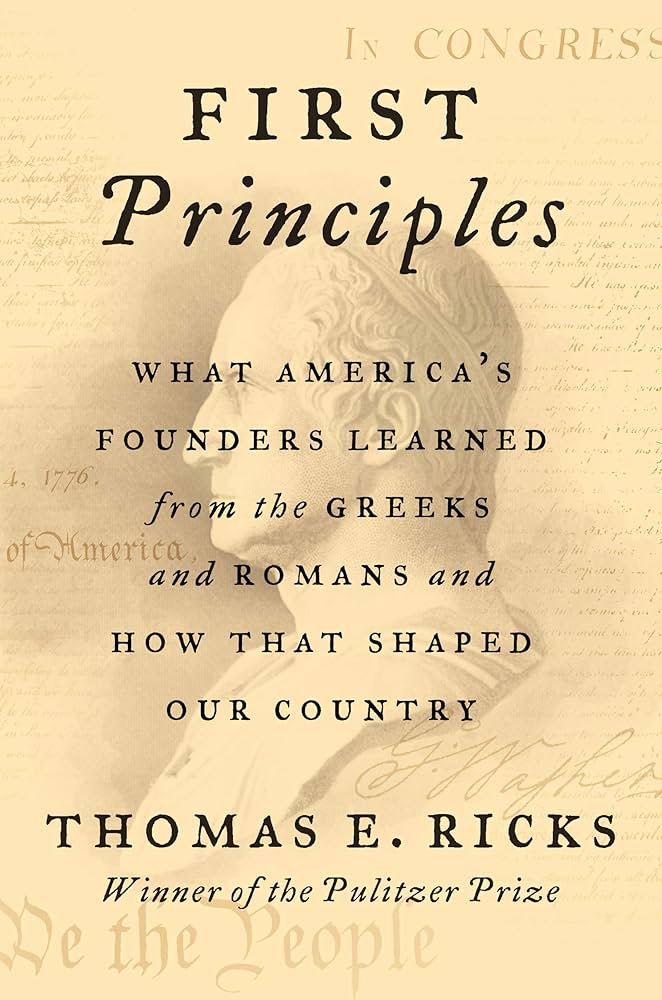
When George Washington resigned his military commission in 1783, Congress was stunned. Victorious generals didn’t surrender power – they seized it. But Washington had spent the war years rereading Plutarch’s account of Cincinnatus, the Roman general who saved the republic then returned to his plow. As Thomas E. Ricks reveals in First Principles: What America’s Founders Learned from the Greeks and Romans (2020), this wasn’t theatrical posturing. Washington, Adams, and Jefferson waged the Revolution with ancient texts as their strategic guides, making decisions based on 2,000-year-old lessons about power, tyranny, and republican survival.
The Journalist as Classical Scholar
Thomas E. Ricks brings an unusual pedigree to this subject. A Pulitzer Prize-winning military correspondent and author of definitive works on the Iraq War, Ricks might seem an unlikely guide to Plutarch and Cato. But his Pentagon reporting revealed how often generals invoke ancient precedents, leading him to ask: What did the Founders – who led an actual revolution – learn from classical texts about war and governance?
Ricks spent years retracing the classical education of Washington, Adams, and Jefferson during the revolutionary period. The result treats them not as marble statues but as serious students working through difficult questions: How do republics survive military crisis? When does resistance become justified? How do you prevent revolution from devouring itself? For answers, they turned to Greek and Roman history.
The Central Argument: Revolution as Classical Seminar
Ricks’s thesis challenges popular understanding of 1775-1784. The Revolution wasn’t primarily about Enlightenment abstraction or tax grievances – it was about applying ancient lessons to avoid the fate of failed republics. As Ricks writes, “Washington, Adams, and Jefferson saw themselves reenacting an ancient drama. They knew how it usually ended: in chaos, then tyranny. Their challenge was to write a different final act.”
Each leader engaged classical texts differently, shaping their revolutionary roles. Washington modeled himself on Roman military virtue – disciplined, self-denying, subordinate to civilian authority. Adams, immersed in Thucydides and Polybius, saw the Revolution through the lens of Greek political philosophy, obsessing over how to channel popular energy without descending into Athenian mob rule. Jefferson read Tacitus and Sallust as case studies in how republics decay, becoming convinced that British corruption mirrored Rome’s decline.
The book’s power lies in showing how revolutionary decisions emerged from classical precedents. Washington’s refusal to become military dictator despite his army’s desperate condition? A conscious rejection of Caesar’s path. Adams’s insistence on legal trials for British soldiers after the Boston Massacre? An application of Roman republican law over mob justice. Jefferson’s Declaration of Independence? Structured like a Roman Senate oration justifying war.
Memorable Passages: The Founders in Their Own Words
Ricks excels at letting primary sources speak. Here’s John Adams in 1776, explaining why he opposed immediate independence: “I have read Thucydides on the Peloponnesian War twenty times. Athens rushed to war against Sparta in democratic fervor, then collapsed into civil strife and tyranny. We must not declare independence until we have established governments capable of restraining popular passion.”
Washington’s letters reveal a man consciously performing a Roman role. Writing to Congress in 1783 after refusing calls to make himself king: “I cannot accept what Cincinnatus would have refused. The history of Rome teaches that the moment a general becomes perpetual is the moment the republic dies. I will resign this commission because Roman virtue demands it, and because I know what follows if I do not.” This wasn’t false modesty – it was strategic application of classical precedent.
Jefferson’s Summary View of the Rights of British America (1774) frames colonial grievances in explicitly Roman terms: “Our ancestors left Britain as free men, just as Roman citizens colonized distant provinces. They carried with them the rights of Romans. George III has violated these ancient liberties as Tarquin violated the Roman constitution. When kings become tyrants, citizens have the right – the duty – to expel them.” For Jefferson, 1776 was 509 BC redux.
Dialogue with Revolutionary Historiography
First Principles challenges works like Gordon Wood’s The Radicalism of the American Revolution (1991), which emphasizes democratic ideology, and Pauline Maier’s American Scripture (1997), which stresses Enlightenment influence. Ricks doesn’t deny these factors but argues they’ve overshadowed the classical framework that structured revolutionary thinking.
The book converges with Caroline Winterer’s The Culture of Classicism (2002) in documenting how Greek and Latin saturated elite education. But Ricks shows this wasn’t ornamental – when Washington, Adams, and Jefferson debated strategy in 1775-1784, they argued through classical examples. Should Congress control the army? Polybius says civilian authority preserves republics. Should states or Congress hold power? Greek confederacies failed through weakness; Rome succeeded through central military command but fell to imperial ambition.
Most provocatively, Ricks reveals how slavery shaped revolutionary classicism. Jefferson knew that both Athens and Rome were slave societies where liberty for citizens coexisted with bondage for others. His classical education didn’t challenge slavery – it rationalized it as compatible with republican virtue, a parallel that works like Annette Gordon-Reed’s The Hemingses of Monticello (2008) make deeply disturbing.
Historical Reassessment: What We’ve Learned Since 2020
Published just before January 6th, First Principles reads differently after watching crowds storm the Capitol. Ricks emphasized that Washington, Adams, and Jefferson feared demagoguery and mob violence above all – the forces that destroyed Athens and Rome. They designed American government to channel popular will through institutions specifically to prevent revolutionary fervor from becoming permanent chaos.
Recent scholarship confirms Ricks’s portrait of anxious revolutionaries. Holger Hoock’s Scars of Independence (2017) reveals how violence during 1775-1784 terrified leaders who’d read Thucydides on civil war’s brutality. They succeeded in maintaining civilian control and legal procedure partly because classical texts provided a script for avoiding revolutionary excess.
However, critics note what Ricks underplays: these three men were slaveholding Virginia planters and Massachusetts elites whose classical education reinforced their class position. Mary Beth Norton’s 1774 (2020) shows how ordinary Americans experienced revolution differently than classically-educated leaders. The Greek and Roman texts that guided Washington, Adams, and Jefferson assumed that only property-owning men could exercise citizenship – a premise they never questioned.
Why Read This in 2026?
As debates rage over executive power, states’ rights, and constitutional legitimacy, First Principles reveals that these arguments began during 1775-1784, framed by classical precedent. When Washington refused dictatorial power, when Adams insisted on institutional restraint, when Jefferson justified revolution through Roman examples, they established patterns still shaping American politics.
Ricks makes the revolutionary generation legible as intellectuals wrestling with hard problems, not demigods or hypocrites. They’d studied every republic that ever existed and knew all had failed through military coup, mob rule, or imperial ambition. Between 1775 and 1784, they tried to avoid those fates by consciously applying – and sometimes misapplying – ancient lessons.
For readers in 2026, the book’s value is both historical and urgent: it explains how three classically-educated leaders navigated the most dangerous years of the American experiment. They saw themselves as actors in an ancient drama, trying to reach the ending where the republic survives. Whether their classical education helped or hindered remains our question to answer.
A Note on This Series
This journey through Revolutionary history is as much about the evolution of historical understanding as the Revolution itself. History isn’t static – each generation reinterprets the past through its own concerns, asking different questions and prioritizing different sources. By reading these books in dialogue across 250 years, we’ll witness how scholarship evolves, how narratives get challenged, and how forgotten stories resurface.
This isn’t about declaring one interpretation “right” and another “wrong,” but appreciating the richness that emerges when multiple perspectives illuminate the same transformative moment. These books won’t provide definitive answers – history rarely does – but they equip us to think more clearly about how real people facing genuine uncertainty chose independence, how ideas had consequences, and how the work of creating a more perfect union continues. As we mark this anniversary, we honor the Revolutionary generation by reading deeply, thinking critically, and engaging seriously with both the brilliance and blind spots of what they created.
 27gen.com