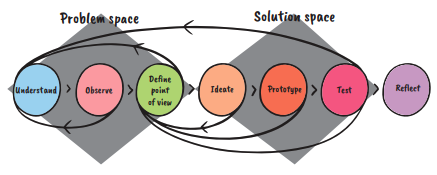
Because design thinking is actually a systematic approach to problem solving.
Find a leader who is innovative in any organization, and he has likely been practicing design thinking all along. It starts with the people we serve and the ability to create a better future for them. It acknowledges that we probably won’t get that right the first time. It does not require super powers.
It’s time for Design Thinking in your organization.
Design thinking can do for organic growth and innovation what TQM did for quality – take something we always have cared about and put tools and processes into the hands of leaders to make it happen.
Jeanne Liedtka and Tim Ogilvie, Designing for Growth
Design Thinking isn’t just choosing the right images and fonts for your next website revision. It’s not about renovating the physical spaces of your organization.
In the old days, designers and design thinking were an afterthought, the people and process at the end of the production. Engineers would hand over something that was functionally effective and have the designers make it look good. Those days are over.
Today, design is about experiences as well as products. It’s about services as much as it is hard goods.
It’s a problem-solving process that incorporates the needs of “customers,” team members, and partners in your organization’s mission. It’s a way of working that creates and refines real-world situations.
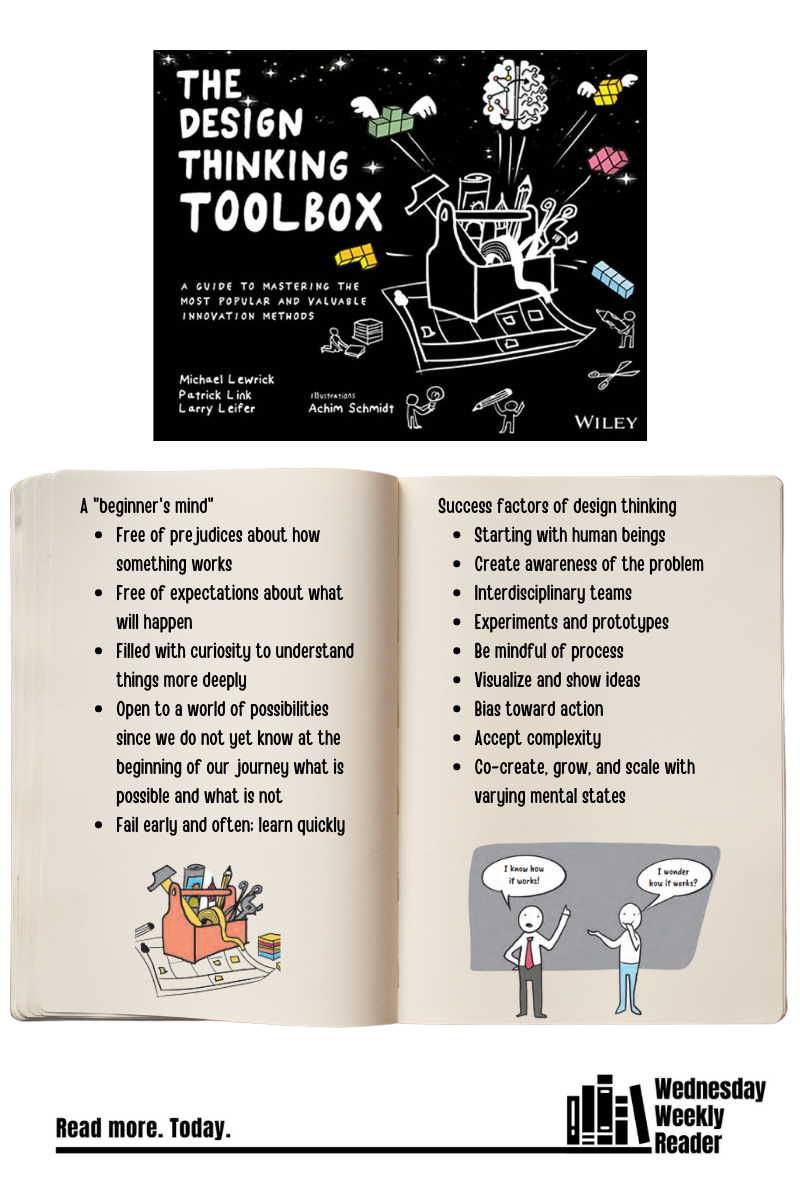
The Design Thinking Toolbox explains the most important tools and methods to put Design Thinking into action. Based on the largest international survey on the use of design thinking, the most popular methods are described in four pages each by an expert from the global Design Thinking community.
If you are involved in innovation, leadership, or design, these are tools you need. Simple instructions, expert tips, templates, and images help you implement each tool or method.
Quickly and comprehensively familiarize yourself with the best design thinking tools
Select the appropriate warm-ups, tools, and methods
Explore new avenues of thinking
Plan the agenda for different design thinking workshops
What challenge are you facing today that could use the discipline of Design Thinking?
Part of a regular series on 27gen, entitled Wednesday Weekly Reader
During my elementary school years one of the things I looked forward to the most was the delivery of “My Weekly Reader,” a weekly educational magazine designed for children and containing news-based, current events.
It became a regular part of my love for reading, and helped develop my curiosity about the world around us.
How many people do you know that approach a conversation as if it were a competition, going something like this: When I pause, you jump in with your thoughts; when you pause, I jump back in so I can top your story or hijack the conversation back to my side.
It’s a fight for control.
Your conversations will be smoother and more successful if you remember that every sentence in a conversation has a history, and you have to practice deliberate listening skills to understand that history better so you can understand the person behind it better.
There’s another way to look at it. The human brain can process somewhere between 350 and 550 words a minute, while most people usually only speak around 120 words a minute. In virtually every exchange of communication, each participating brain has room for 230-375 extra words’ worth of thought to float around. That gives our minds plenty of chance to drift and wander, whether we’re the one speaking or listening.
It’s so easy to slide into the basic communication pitfall of drifting away from the person speaking, often thinking about what we’re going to say next rather than being focused on what we’re communicating or what’s being said to us.
It’s time to challenge your brain to stay in the moment, to be fully present in listening to a conversation, not just preparing how you’re going to respond.
Leadership is the art of designing transformative conversations.
Real change is needed, now, more than ever. This change can’t happen through force, edict or persuasion. The future will be built through conversation – and Good Talk will show you how.
Good Talk is a step-by-step framework to effect change in your personal and professional conversations. With dozens of tools and interactive components, Good Talk is a handbook to navigate the conversations that matter.
What’s Inside:
How to see the structure of conversations. Life is built one messy, slippery conversation at a time. While conversations feel hard to hold onto, ebbing and flowing, back and forth and into eventual silence, they each have a structure. The first step to changing your conversations is seeing what’s going on between the silence.
What is your Conversation Operating System? Who gets invited to the conversation? Who speaks first? Where does the conversation take place? What happens if someone messes up? In every conversation, there are elements that guide the exchange. The nine elements of the Conversation OS Canvas can help you to shift the direction of your conversations.
What is your conversational range? Conversations are more than dialogue. From the conversations in your head to the complex conversation that is your organization, you need to design conversations that matter across a huge range of sizes. Learn to master conversations from the boardroom and beyond.
How to design conversations that matter. The world needs fresh, creative conversations that are alive, and that work for all the people involved. How can you design conversations that matter? Leadership means designing the conditions for these conversations to happen. Learn the patterns and principles to make change possible.
A SIMPLE SOLUTION
According to author Daniel Stillman, when two people are in a conversation, we take turns listening and speaking.
What do we do with our turns?
Do you listen, or do you just wait to talk?
Or do you take the role of listener seriously and enjoy your turn as the listener?
In conversation, we “see” speaking, whereas listening looks like “doing nothing.”
How often in conversations have you interrupted (intentionally or accidentally) the conversation, derailing the other person’s train of thought?
In your eagerness to move the conversation forward, to take your turn, you’ve stopped their turn too soon.
When two people are in a conversation, we take turns speaking and listening. Understanding your “turn-taking” patterns can dramatically shift your conversations for the better.
Daniel Stillman
Conversations can look like a sloshing sea of opinions and arguments, but there’s a pattern underlaying the seeming chaos. There are only a few distinct “moves” we can make inside a conversation, diagrammed below.
Are you someone tho prefers to take a turn? Or do you tend to wait and see which way the wind blows? The former is an “initiator” (at the base of the diamond); the latter is someone who “holds” space at waits (at the center).
Once someone has opened their mouth and opened the floor, what happens next? Some of us tend to immediately react, either positively or negatively (at the apex of the diagram). In both reactions, that move is fairly habitual. I’m sure you know someone who always has something nice to say about everything, or maybe you hang out with people who always focus on the negative.
The default reaction of listening deeply before expressing an opinion is a “reflective” response, seen on the right side of the diagram. This individual peels back layers of meaning before adding their own.
The fifth option could be to reframe the conversation. Reframing can look like “glass half full” thinking, or shifting problems into opportunities. Reframing can powerfully shift a conversation, or feel like an unwelcome erasure of a real issue on the table.
Each of these five “moves” steers the ship of the conversation.
Use the following “active listening script” from author Daniel Stillman to frame how you can deepen your connection with people.
Paraphrase what you just heard the person say in neutral terms. Start with the phrase, “I’m hearing you say…” You can also use the phrase, “Okay, wait…” to give yourself a second to get centered.
Confirm your summary, asking, “Is that right?” Or “Did I get that?”
If they say yes; ask, “Is there anything I missed?” Go deeper.
Wait. Count to three. If they confirm that there’s more, they’ll say more. If they indicate that you got it wrong, they will correct you if you give them time.
Lather, rinse, repeat. Try step 1 again, or continue with normal turn-taking if you feel comfortable doing so.
Part of a regular series on 27gen, entitled Wednesday Weekly Reader
During my elementary school years one of the things I looked forward to the most was the delivery of “My Weekly Reader,” a weekly educational magazine designed for children and containing news-based, current events.
It became a regular part of my love for reading, and helped develop my curiosity about the world around us.
We are living in an age of disruption. According to Fast Company co-founder William C. Taylor, you can’t do big things anymore if you are content with doing things a little better than everyone else, or a little differently from how you’ve done them in the past. The most effective leaders don’t just rally their teams to outrace the “competition” or outpace prior results. They strive to redefine the terms of competition by embracing one-of-a-kind ideas in a world filled with copy-cat thinking.
What sets truly innovative organizations apart often comes down to one simple question: What can we see that others cannot?
If you believe that what you see shapes how you change, then the question for change-minded leaders in times of disruption becomes: How do you look at your organization as if you are seeing it for the first time?
The question is not what you look at, but what you see.
Henry David Thoreau
When you learn to see with fresh eyes, you’re able to differentiate your organization from the competition (and your “competition” isn’t the church down the street). You’re able to change the way your organization sees all the different types of environments around it, and the way your others see your organization.
This mentality is the ability to keep shifting opinion and perception. We live in a world that is less black and white and more shades of gray world, not a black and while one. Seeing in this way means shifting your focus from objects or patterns that are in the foreground to those in the background. It means thinking of things that are usually assumed to be negative as positive, and vice versa. It can mean reversing assumptions about cause and effect, or what matters most versus least.
In a season filled with uncertainty, how can you cultivate a sense of confidence about what lies ahead?
Unprecedented access to infinite solutions has led us to realize that having all of the answers is not the answer. From innovation teams to creativity experts to crowdsourcing, we’ve turned from one source to another, spending endless cycles pursuing piecemeal solutions to each challenge we face.
What if your organization had an effective systematic approach to deal with any problem?
To find better solutions, you need to first ask better questions. The questions you ask determine which solutions you’ll see and which will remain hidden.
This compact yet powerful book contains the formulas to reframe any problem multiple ways, using 25 lenses to help you gain different perspectives. With visual examples and guidance, it contains everything you need to start mastering any challenge.
Apply just one of the lenses and you will quickly discover better solutions. Apply all of them and you will be able to solve any problem, in business and in life.
A SIMPLE SOLUTION
There is no such thing as a new idea. It is impossible. We simply take a lot of old ideas and put them into a sort of mental kaleidoscope. We give them a turn and they make new and curious combinations. We keep on turning and making new combinations indefinitely, but they are the same old pieces of colored glass that have been in use through all the ages.
Mark Twain
According to author Stephen M. Shapiro, the process for driving better results doesn’t start with great ideas – it starts with better questions.
When faced with disruption and myriad challenges, we crave answers. It’s a natural human instinct.
But having answers is not the answer.
Asking different and better questions is the key to finding better solutions.
By using “reframing lenses,” you will see your problems and opportunities more clearly, and come up with creative answers that will boggle your mind.
Reframing lenses are a powerful tool that transforms complex problems into simple and practical solutions.
By changing the questions you ask, you can uncover answers that were previously hidden from sight. And the tool to help you reframe those questions – and shine light on invisible solutions – are twenty-five lenses.
Stephen M. Shapiro
How do we systematically challenge our assumptions? Using the lens of “reframing” will help you bring your assumptions to the surface. The process of reframing requires that you systematically question the direction you are going.
To help you sift through the lenses, they are grouped into five categories, with five lenses per category:
Reduce Abstraction – Make questions more specific when they are too broad.
Leverage
Deconstruct
Reduce
Eliminate
Hyponym
Increase Abstraction – Make questions less specific if the challenge is too narrowly defined.
Analogy
Result
Concern Reframe
Stretch
Hypernym
Change Perspective – Look at the question with a fresh set of eyes.
Resequence
Reassign
Access
Emotion
Substitute
Switch Elements – Swap multiple factors to get new ideas.
Flip
Conflicts
Performance Paradox
Pain vs Gain
Bad Idea
Zero-In – Ask the best question to help solve your problem.
Use the following ideas from author Stephen Shapiro as a way to begin reframing problems through the use of the lenses listed above. Even without having access to the book and complete definitions and explanations of the lenses, you will be able to see how valuable they can be in overcoming challenges.
Identify an issue, problem, opportunity, or challenge that you want to address. As you are doing this, remember to always bring your assumptions to the surface.
Write down your challenge on a chart tablet in the form of “How can we…”
Once you develop your first iteration of your “How can we” question, you can apply lenses to help you reframe it. Review the list above to see which lenses fit best. Or, better yet, try all of the lenses and force them to fit. You will find that every lens can be applied to any challenge, although some might be more difficult.
Write down as many variations as you can. Try to do it at least six times. A half dozen variations using at least six lenses. More is better as it stretches your thinking.
There are a couple of things to look out for as you go through this process. For starters, avoid jumping to solutions. It is so tempting to fry to find answers before you have created a great list of questions: Stay in the challenge formulation phase.
Also, it is valuable to apply one lens more than one time to a given problem. It is all too easy to find a quick reframe and move on. It takes more discipline to find multiple variations from a single lens.
Recognize that questions beget more questions. Sometimes when you ask a question, you might need to answer another question in order to move forward. Although answering an insight question might not provide a solution, it should provide information that will help you further reframe your primary question.
The point is that it is important to practice reframing. As you go through this process, ask which of the reframed questions seems to create the greatest results. Different questions will create different solutions, which will result in different levels of value.
Part of a regular series on 27gen, entitled Wednesday Weekly Reader
During my elementary school years one of the things I looked forward to the most was the delivery of “My Weekly Reader,” a weekly educational magazine designed for children and containing news-based, current events.
It became a regular part of my love for reading, and helped develop my curiosity about the world around us.



 27gen.com