The Dangers of Words Getting in the Way of Your Vision

A guest post by Auxano Navigator Bryan Rose

John F. Kennedy from Rice University at the dawn of the Space Age.
Dr. Martin Luther King Junior on the steps of the Lincoln Memorial.
Ronald Reagan in front of Berlin’s Brandenburg Gate.

All three of these iconic moments share one critical ingredient: words that created worlds. A language of vision has the power to move people to reach the moon, cross racial divides and tear down political walls. But, words can also get in the way.

Auxano has more than 13 years of walking alongside hundreds of church leaders seeking clarity of identity and direction. As a part of this team, I am more aware than ever of how the right vision language, or the lack thereof, can make all of the difference in the world. Here are 3 painful ways that I have seen words get in the way:

1. When there are too few vision words to foster alignment. Your leaders are leading to a vision. If you have not invested time and team resources into articulating identity and direction for your top level of leaders, their vision leadership is siloed and not shared. Conflicting ministry vision always leads to sideways energy and wasted resources. A senior leader with too few words likely spends more time mediating staff conflict than meditating on God’s preferred future. Jesus did not hesitate to paint a clear and detailed picture of the crucifixion, fueling sacrificial alignment in each disciple’s life from Pentecost forward.

2. When the vision words are too generic to inspire hearts. Safe vision language is actually dangerous to the health of your church. We live in a world of competing messages, in which skilled marketing practitioners move your congregation to buy their latest product or vote for their latest candidate. Many leaders fail to realize that their safe, yet sound words, either fly under the radar or over the heads of busy families and distracted people. Jesus never shied away from powerful words that struck the deepest nerve in the hearts of His listeners: “From now on I will make you fishers of men” wasn’t a slick marketing tagline, it was a vibrant and specific picture of His compelling calling.

3. When there are too many vision words to create confidence. The team cannot execute if the play keeps changing. Overhauling your language and vision with every new conference method or leadership mantra leaves your leadership confused. If everything changes every six months, why should they ever be involved to begin with? The fast-following leader’s desire for “new” starts to get old very quickly. Instead, seek to emulate Jesus as He consistently deployed a simple message of faith and repentance, to the point of rejection and ultimately, death.

Vision Headwaters is a two-hour trek designed to safely start the right conversations among your leadership. This engaging tool will calibrate your vision language using challenging assessment questions and memorable church-personality profiles.If you are not sure which, if any, of the above fits your church, you can be sure that the rest of your team does! To employ an honest assessment of your vision language, download your free copy of Auxano’s latest tool for break-thru leaders: The Vision Headwaters TeamUP 

In this TeamUP tool you will:
Unpack your communication baggage in order to properly prepare for the vision journey ahead
Plot your “Trailhead Type” using key waypoints of missional language and church age
Step onto the clarity pathway with experienced trail guides cheering you onward

Don’t continue to let words get in the way of the world God is calling you to create!

Immerse Yourself in the Creativity of the Disney Imagineers

My admiration for the creative brilliance of Walt Disney and the amazing group of geniuses he gathered around him runs deep and long.

WDWQuote1

As a boy growing up in the 60s, Walt Disney’s Wonderful World of Color television show was something I looked forward to every week. My father, an owner-operator of a Gulf gasoline station, was the recipient of various advertising tie-ins involving such Disney classics as 101 Dalmatians, The Jungle Book, and the amazing nature films. I was fortunate to be part of a high school band marching in Disney on Parade in 1975, just a few years after Walt Disney World opened.

Then marriage and four children came, just in time for the rejuvenation of Disney animation of the late 80s-early 90s. That meant endless viewings of The Little Mermaid, Beauty and the Beast, and the rest of the Disney library.

By the time the 2000s had rolled around, I was beginning to accumulate different types of books on the Disney organization – biographies, behind-the-scene details, first-person accounts, and various types of business-related books. I was beginning to use them in leadership and teaching positions I held.

In 2011, the fortunate circumstances of my daughter graduating from college in three years before beginning her master’s degree and her request for a much-talked-about-but-never-fulfilled Disney trip led to a week-long adventure in Walt Disney World with a 23-year old graduate student and her two early 50’s parents.

Before that, I knew about Disney. That week, I experienced Disney.

That may seem like a small thing, but in reality it is a HUGE difference.

In the last five years, I have been to Walt Disney World at least several days each year, with the last year being the highlight: by the time this fall rolls around, I will have been on Disney property 19 days.

The experience of Disney – primarily in the theme parks, but now expanded to other resorts, retail shops, and cruise ships – can be traced back to Walt Disney. His untimely death in 1966 could have left a void in the creativity of the Disney empire.

But I believe his greatest act of genius had its origins in 1952, as he began to pull together veterans of film and animation work for a special project that came to be known as Disneyland.

That group of versatile animators and art directors was the foundation of a group that came to be called the Imagineers.

Out of this group, Disney historian Tim Hauser reflects, “came the theories, aesthetics, design, and engineering of Disneyland; the advancement of three-dimensional storytelling; the development of robotic techniques in Audio-Animatronics; and the perpetuation of an ‘architecture of reassurance’ as inspired by Walt Disney’s personal sense of optimistic futurism.”

Today Walt Disney Imagineering remains the design, development, and master-planning branch of company, with over 140 disciplines working toward the common goal of great stories and creating great places.

Walt Disney wanted Disneyland to be essentially a movie that allows you to walk in and join in the fun. Imagineers – many whom had worked with Walt Disney since the 1930s – literally brought those movies to life with their multiple disciplines. He knew from his filmmaking experience that story was everything to the audience. Disney knew he must immerse the theme park guest in living storytelling scenarios.

And for over 60 years, the Imagineers have delivered – time and time again. To date, the Imagineers have built eleven theme parks (with Shanghai Disney opening in just a few weeks); dozens of resort hotels; 4 cruise ships with two more under construction; 2 water parks; and ongoing development in existing parks.

The Imagineers deliver the experience of Disney.

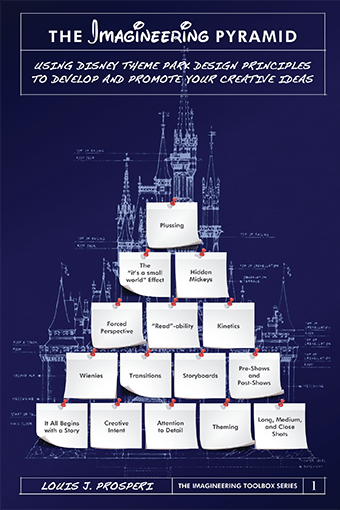
Now I want to bring you full circle by highlighting the recent work of author Louis Prosperi in The Imagineering Pyramid.

Using existing material published by Disney plus conversations with Imagineers, Prosperi weaves together an interesting thought captured in the book’s subtitle: Using Disney Theme Park Principles to Develop and Promote Your Creative Ideas.

It’s a very compelling challenge: look at the existing body of work done by the Imagineers for Disney’s theme parks and translate those principles into a “pyramid” of 15 principles grouped into 5 tiers.

Here’s an outline for an appetizer:

Tier 1: Foundations of Imagineering

  • It All Begins with a Story – Using your subject matter to inform decisions about your project.
  • Creative Intent – Staying focused on your objective.
  • Attention to Detail – Paying attention to every detail.
  • Theming – Using appropriate details to strengthen your story and support your creative intent.
  • Long, Medium, and Close Shots – Organizing your message to lead your audience from the general to the specific.

Tier 2: Wayfinding

  • Wienies – Attracting your audience’s attention and capturing their interest.
  • Transitions – Making changes as smooth and seamless as possible.
  • Storyboards – Focusing on the big picture.
  • Pre-Shows and Post-Shows – Introducing and reinforcing you r story to help your audience get and stay engaged.

Tier 3: Visual Communication

  • Forced Perspective – Using the illusion of size to help communicate your message.
  • “Read”-ability – Simplifying complex subjects.
  • Kinetics – Keeping the experience dynamic and active.

Tier 4: Making It Memorable

  • The “it’s a small world” Effect – Using repetition and reinforcement to make your audience’s experience and your message memorable.
  • Hidden Mickey’s – Involving and engaging your audience.

Tier 5: Walt’s Cardinal Rule

  • Plussing – Consistently asking, “How do I make this better?”

But instead of building an object like an attraction, Prosperi challenges the reader to do something with the principles that may be even more daunting: be creative.

Even though I was familiar with most of the principles and their origins, I enjoyed reading how Prosperi linked the ideas together into a unified whole. Especially helpful were the questions at the end of each chapter, with a general focus as well as specialized applications for game design, instructional design, and management and leadership. The questions will help anyone have a better grasp of the concept and how to apply it an almost any field.

The Imagineering Pyramid was especially beneficial to me on a recently completed 3-day “field trip” to all four theme parks at Walt Disney World. As I walked through each park, the genius of the Imagineers inspired me to fill several pages of my Disney journal with new ideas for development as well as take over 1,000 photographs of design details – exactly what I believe Louis Prosperi had in mind when writing the book.

Leaders in any capacity will benefit from The Imagineering Pyramid as a helpful tool, providing a creative framework for solving problems.

ImagineeringPyramid