
A recent experience by my wife and I highlighted the always present question when you need to go to a new place – how do I get there from here?
Going to the hospital – as a patient, family member, or even just to visit someone – is almost always guaranteed to make you uneasy when it comes to finding your way to your destination. Hospitals are typically complex, multilevel facilities – often built over a span of decades, which means they may have multiple entrances, building styles, and floor levels.

How do you help people find their way in a hospital – or in any other place – or in YOUR place?
People throughout history have gravitated to town centers, market squares, and public places to buy and sell products. Even houses of worship, once set apart as a literal sanctuary from the fray, now sit side by side with busy commercial centers, libraries, schools, restaurants, and residential complexes.
Over time, cities, spaces, complexes and buildings fill up with information, markers, and symbols. Sometimes the results are helpful, but the effect can also be ugly or chaotic, or both. The challenge is to enhance a space – public, commercial, or private – by finding order in chaos without destroying character.
Enter wayfinding.
Great wayfinding systems employ explicit signs and information as well as implicit symbols and landmarks that together communicate with accuracy and immediacy. Over the last thirty years, wayfinding design has matured to become an essential component of buildings and spaces, helping make sense of a sometimes overwhelming task: getting from here to there.
Wayfinding design provides guidance and the means to help people feel at ease in their surroundings.
David Gibson, The Wayfinding Handbook
Where am I? What can I do here? Where can I go from here? How do I get out of here?
Consciously or not, we ask such questions every day as we navigate the places and spaces of our lives.
Whether we find ourselves in a museum, hospital, airport, mall, or street in an unfamiliar city, we depend on systems of visual, audible, and tactile cues not only to lead the way, but also to keep us safe. They are the fundamental questions of wayfinding – a process that encompasses both the experience of choosing a path within a built environment and the set of design elements that aid in such a decision.
Not long ago, the professional practice of wayfinding design simply involved devising sign systems. Today, the field is much broader and continues to expand to address technological developments – kinetic media, GPS systems, web connectivity, smart materials – as well as cultural changes in areas such as branding and environmental awareness. Similarly, a cross-disciplinary familiarity with graphic, architectural, landscape, interior, industrial, and information design has become an essential requirement of twenty-first-century wayfinding design.
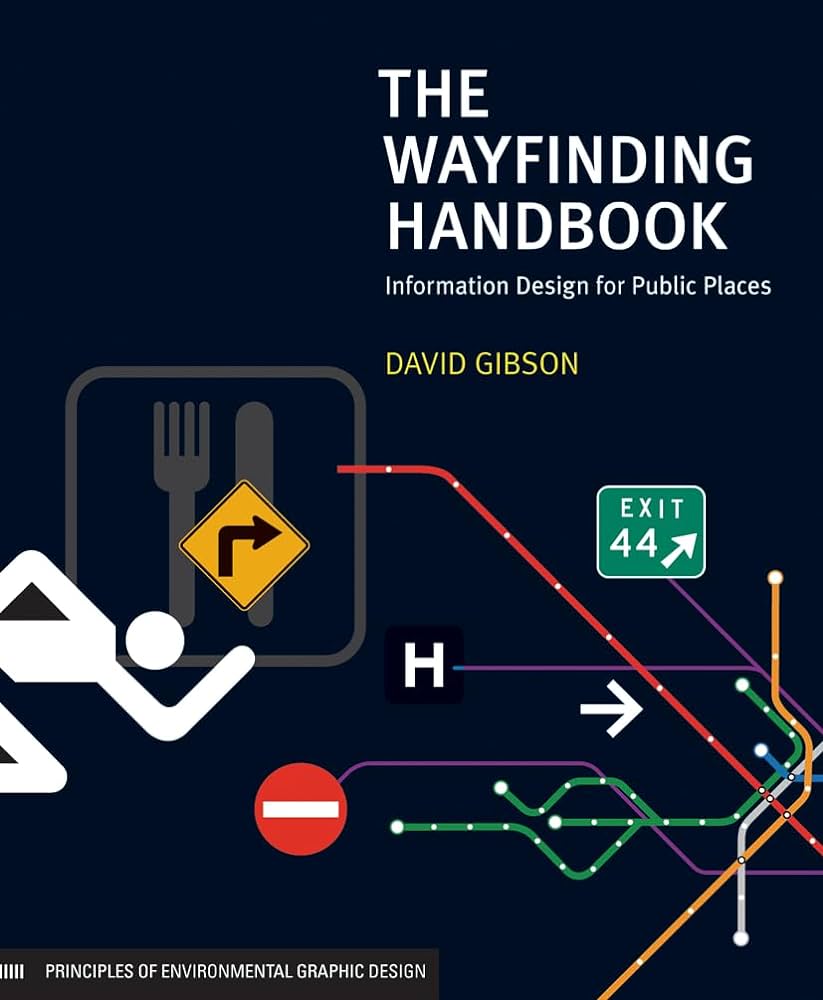
The Wayfinding Handbook by professional wayfinding designer David Gibson draws on more than thirty years of experience collaborating with architects, planners, developers, managers, and civic leaders to offer an insider’s view of this rapidly evolving discipline. Using real-life examples, Gibson illustrates the way type, color, mapmaking, dimensional forms, material selection, and new media are used to create effective wayfinding systems.
The Wayfinding Handbook is a complete guide to the discipline, from planning and design to practical considerations, such as setting up teams and managing projects. “Other Voices” sidebars, presented throughout the book, reveal the opinions of experts who plan, manage, and shape wayfinding projects. A comprehensive bibliography and gallery of resources round out what is likely to become the go-to resource for students, professionals, or anyone charged with designing peoplefriendly, universally accessible environments.
The Wayfinding Handbook by David Gibson is a comprehensive guide that delves into the intricate art of wayfinding – the science and design of helping people navigate through spaces efficiently. The book covers various aspects of this field, providing insights into signage, environmental cues, and user experience.
Gibson starts by exploring the historical evolution of wayfinding, tracing its roots and development over time. He then delves into the psychology of navigation, emphasizing the importance of understanding how individuals perceive and interpret spatial information. The author skillfully combines theory with practical applications, offering a well-rounded approach suitable for both novices and professionals in design, architecture, and urban planning.
One notable strength of the book lies in its inclusion of case studies and real-world examples, illustrating successful wayfinding solutions and analyzing their effectiveness. This practical dimension enhances the reader’s understanding and provides valuable insights for implementing similar strategies in diverse contexts.
Gibson’s writing style is accessible, making complex concepts in wayfinding easily understandable. The book is highly organized, progressing logically from foundational principles to advanced topics. Each chapter builds upon the previous, creating a cohesive learning experience.
As someone deeply interested in hospitality and the user experience, I appreciated how The Wayfinding Handbook aligned with my passion for creating welcoming environments. The book not only addresses the functional aspects of wayfinding but also recognizes its role in enhancing the overall experience of spaces, especially with respect to all things hospitality.
In conclusion, The Wayfinding Handbook by David Gibson is a valuable resource for anyone involved in the design and use of physical spaces. Its blend of theory, practical examples, and a user-centric approach makes it a recommended read for professionals and enthusiasts alike.

Part of a regular series on 27gen, entitled Wednesday Weekly Reader.
During my elementary school years one of the things I looked forward to the most was the delivery of “My Weekly Reader,” a weekly educational magazine designed for children and containing news-based, current events.
It became a regular part of my love for reading, and helped develop my curiosity about the world around us.

 27gen.com