Day One: Cultivating a Meaningful Rule of Life

As I began my job transition several months ago, and as it continues today, I am guided by a Transition Tool Kit. Consisting of 7 “tools” that were developed from the work of Bruce Feiler’s Life is in the Transitions and other noted transition guides, the Tool Kit contains concepts and action plans that I have been working through.
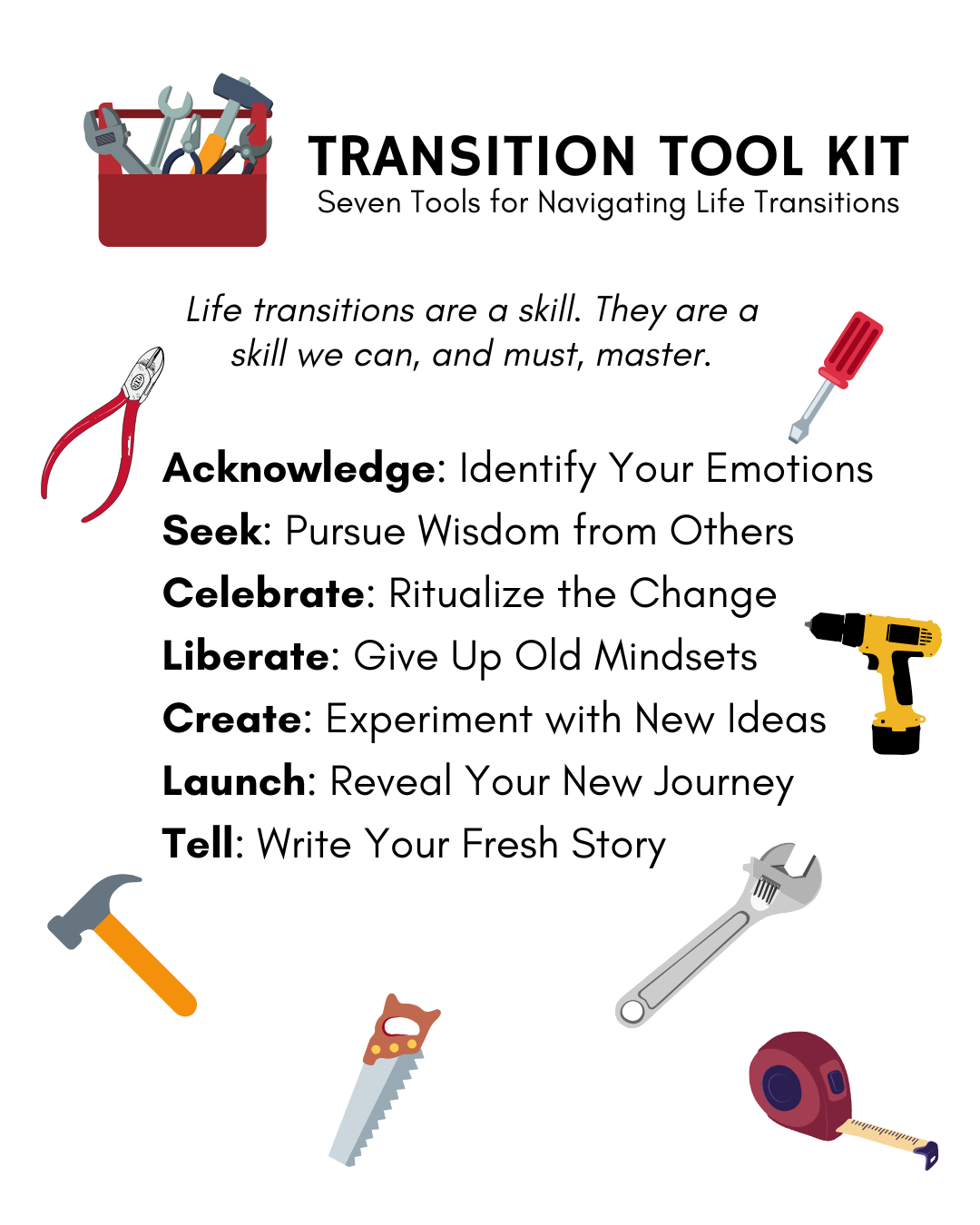
Here are first three:

  • Acknowledge: Identify Your Emotions
  • Seek: Pursue Wisdom from Others
  • Celebrate: Ritualize the Change

While the tools are not designed to be linear and can be picked up at any time, I’ve been comfortable with moving through the sequence of the three above to this date.

Now, it’s on to Liberate: Give Up Old Mindsets.

The mindsets that served me in my previous stage may no longer be useful – or even hinder me – in this next phase. Shedding outdated beliefs and self-limiting narratives requires courage, but it opens doors to growth. 

What assumptions am I carrying that no longer align with who I are or who I want to become? Moving through transition often means letting go of familiar but outdated notions of success, identity, or purpose.

The deleting of my work calendar and schedules was the first part of using this tool. But having a blank calendar is not a plan for transition – it will only lead to listless drifting. Along with this tool, it’s also time to pick up another one – Create: Experiment with New Ideas.

With old mindsets cleared, I’m giving myself permission to explore new ways of thinking and doing. I’m going to try activities, roles, or ideas that resonate with where I’m headed. This stage is about experimenting without the fear of failure. As I explore, I will stay open to discovering passions, skills, or career paths that I may not have previously considered.

And that brings me to a mindset that’s been dropping into my life in increasing measures over the last few months. It began with reading and study I had been doing related to following Jesus. It continued with the passages of Matthew we are studying in our church’s current sermon series and community group that deal with rest and the Sabbath.

So picture this: on the one hand, I’m at Day One of a new chapter in my life – one with a literal blank calendar. On the other hand, I’ve got the tools of Liberate and Create ready to use.

What’s next?

Finding Purpose Through Pattern: The Modern Rule of Life

In our fast-paced world of constant activity, many people are rediscovering an ancient wisdom practice: the rule of life. This concept, far from being a rigid set of regulations, offers a framework for intentional living that modern seekers find increasingly relevant.

Origins in Spiritual Tradition

The “rule of life” traces its origins to early spiritual leaders like St. Augustine and St. Benedict. These church fathers developed communal patterns that spiritual communities have utilized for thousands of years as formation tools. Despite the constraining connotations of the word “rule,” these frameworks were never about blind obedience but rather about establishing communal purpose.

Both Augustine and Benedict shared a singular focus: love. They meticulously designed daily patterns with the explicit goal of orienting life toward loving God and neighbor. Augustine began his rule declaring, “Before all things, most dear brothers, we must love God and after Him our neighbor; for these are the principal commands which have been given to us.” Similarly, Benedict aimed to create nothing “harsh” or “burdensome,” but instead sought to guide followers toward the “ineffable sweetness of love.”

The Latin root of “rule” – regula – reveals its true intent. Rather than restriction, it refers to a trellis or supporting structure that guides growth. Like plants that thrive with proper support, human growth benefits from thoughtful direction to prevent twisted, chaotic development.

The Scaffolding of Our Days

Our lives take shape through the cumulative effect of small, repeated actions. As Annie Dillard insightfully noted, “How we spend our days is, of course, how we spend our lives.” Our schedules serve as “scaffolding” that allow us to intentionally engage with time itself.

This scaffolding concept perfectly illustrates the rule of life’s purpose. Habits are how we interact with time, and since time is the currency of purpose, habits become the means through which we access and fulfill our deeper callings. If knowledge requires the right words, character formation requires the right habits. The rule of life provides the framework for cultivating these transformative patterns.

For centuries, monastic communities have understood this profound connection between daily practice and spiritual development. Their insight reveals that meaningful formation begins with a framework of habits – a truth that deserves wider recognition in our contemporary context.

Integrating Belief and Practice

While understanding theological truths about God and neighbor is essential, equally important is putting those truths into practice through a deliberate rule of life. Belief without practice remains incomplete, just as education without formation falls short. Knowing Jesus without following Jesus creates a dissonance that diminishes our humanity.

Only when our habits align with our worldview do we become people who truly love rather than merely understand concepts of love. This integration transforms abstract knowledge into embodied wisdom.

The Challenge of Default Formation

Many of us have unknowingly adopted what might be called “the American rule of life” – an unconscious program of habits that shapes us toward anxiety, depression, consumerism, and self-absorption. These default patterns form us in ways contrary to our stated values.

The urgency of developing an intentional, gospel-based rule of life becomes clear when we recognize how powerfully these cultural currents influence us. We need counter-formative practices to become the loving people we aspire to be.

This issue extends beyond personal well-being to our public witness. American Christianity often emphasizes the message of Jesus while neglecting his practices, creating a troubling disconnect between proclaimed faith and lived reality. How else can we explain professed followers of a radical gospel who conform so seamlessly to prevailing cultural norms?

Embracing the Trellis

The path forward requires acknowledging how habits shape the heart. Rather than viewing limitations as threats to freedom, we must recognize that thoughtful boundaries create space for meaningful growth. The trellis doesn’t restrict the vine – it enables it to flourish in its intended direction.

By crafting a common rule of life suited to our time, we can unite our intellectual understanding with our daily practices. This integration allows us to grow into the lovers of God and neighbor we were created to be, following not just the teachings but the way of Jesus.

In rediscovering this ancient wisdom, we find a surprisingly relevant answer to modern challenges – not through more information or stronger willpower, but through the patient cultivation of life-giving habits that transform us from the inside out.


Up Next: Exploring The Common Rule


Final Approach: Reframing Life’s Unexpected Transitions

In late October 2024, as dawn broke through dark skies on my daily morning walk, I listened to the night sounds turning into day. I was walking the familiar path with a mixture of nostalgia, fear, and anticipation

For over 44 years, I had served in a variety of roles with a common focus: the church, the body of Christ. As a staff member or a strategic outsider, my goal had always been as a guiding light for the organization. Independent, logical, and determined, I am known for my relentless pursuit of learning through exploration, researching, and by asking searching questions.  Outwardly quiet, reserved, and detached, inwardly I am constantly absorbed in analyzing problems or situations. Work, for me, is the process of striving towards something that matters deeply to me and is consistent with my values. It was more than just a job.

Yet here I was on the morning after the fateful call in which I had been informed that my job was being eliminated in four months’ time, at the end of February. 

On that morning, the walk was more habit than conscious decision, but not for long.

As I walked with the shock still fresh, my mind turned to the skies at the sound of a plane overhead. With the wind blowing in my face, airplanes approaching Charlotte Douglas airport were landing from the north. That meant flight after flight was lining up like a set of twinkling cafe lights from the south, flying directly overhead, and then turning to the west before one more turn to make their final approach.

In a flash, I knew that the term final approach was a perfect metaphor for what I was facing. Long enamored of airplanes and flight, and with a father who served in WWII in the Army Air Corps and a son currently a captain in the Air Force, the phrase was perfect for the situation I was facing.

The news of my job elimination had come like turbulence on a clear day, unexpected yet undeniable. While my colleagues and friends may have thought “retirement,” I felt  down to my core that I hadn’t yet reached my “final destination” (to use another flight metaphor). There was still a journey ahead – uncharted skies and yet-to-be-discovered places. And I intended to approach this moment as I had every challenge in my career: with conviction, gratitude, and the desire to finish well.

During the four months left, I set out to use each day purposefully. Reframing this period, I chose to see this as a final approach of my current job before moving into new territory with another destination in the future, rather than an ending. 

As I spent my days on the various parts of my job at hand, each task took on a new meaning as I did my daily tasks but also prepared to share not only insights about the technical aspects but also wisdom gleaned from my years in the role. Each call, every report or spreadsheet prepared, and even casual conversations in digital spaces became opportunities to create the equivalent of a pilot’s “flight bag” – aeronautical and navigation charts, route manuals, and flight checklists. Necessary for ongoing “flights,” my intention was that all the activity over the next four months would provide direction and guidance for the team, allowing them to flourish after I was gone.

My evenings and weekends became devoted to planning the next part of my adventure. I am charting out ideas that have simmered in the back of my mind for years: more writing, maybe, or mentoring/coaching opportunities where I could invest in people beyond my field. I’m even envisioning a “modern elder” initiative – a place where seasoned professionals can support rising generations, sharing both practical skills and timeless principles. 

To me, this isn’t about staying relevant or proving something; it was about answering a call I have long felt deep within, one that echoed louder than any retirement clock ticking in my ear.

Anita, always my closest source of inspiration and encouragement, has stepped up big time. Her own personal journey and recent medical battles over the past three years have provided immense support and a calm sense of peace in stormy weather.

Many more conversations followed, and continue, with my children, friends, and other individuals being sought out to provide a sound word of counsel.

After two months of the above, some unforeseen medical issues brought unexpected “interruptions” into my plans. With just enough energy to fulfill my daily role, I set aside looking to the future for a time.

As I closed out each night, I felt a growing sense of peace. I embraced this final approach with the steady focus of a seasoned pilot bringing in a plane through the night – aware of the passengers and cargo, mindful of all the external factors affecting the final approach, but confident in the landing and the subsequent journey ahead. 

My final destination? This period isn’t an exit but an opening, a new horizon where my years of experience have become a compass guiding me toward purpose and fulfillment beyond what I could have dreamed about before.

When the time comes to step away and power down my laptop for the final time in a few hours, I won’t look back with regret. Instead, I am moving toward the future with a smile, heart full of hope for the landing yet to come. 

My journey is far from over; in fact, it has just begun.


The Last Click: Erasing Calendar Blocks, Embracing Possibilities

For the last two decades, my workdays have been shaped by the rhythm of my calendar.

A carefully structured flow of time blocks dictated my tasks, my focus, and, in some ways, my identity. There were the predictable, repeating tasks that formed the backbone of my week – daily social media creation and posting, back-end administrative tasks, and engagement actions. As a part of a virtual team since 2012, there were also corporate huddles, team strategic planning sessions, client planning and deliverables, and the one-on-ones where relationships were nurtured and ideas refined. Then there were the scheduled but fluid blocks, the ones set aside for ideation, creativity, and the deep work that fueled progress. Each of these moments played a role in shaping not only my professional life but the legacy I leave behind.

Now, in my final week on the job, I find myself doing something that once would have felt unthinkable: deleting those time blocks. It is a necessary part of the transition out of my job, but also an unexpectedly emotional one. Each click of the delete button erases a piece of the framework that has defined my work for years. With every disappearing time block, I am reminded that this chapter is closing.

At first, it feels like a simple act of housekeeping – removing obligations that no longer apply. But as I scroll through my calendar, the memories attached to those meetings rise to the surface. The weekly project update on Fridays at 10 AM? That was where our team navigated challenges together, brainstorming solutions and celebrating wins. The recurring morning creative sessions for social media? That was time to connect our monthly themes to engaging images and words. Even the Monday morning planning block – once a dreaded necessity – now feels like a familiar companion, a ritual that grounded my week. The “planned spontaneity” of daily creative time? That was my sacred space to step away from the daily grind and dream about the future.

Deleting these blocks is more than clearing space on a calendar; it is acknowledging that the routines that once shaped my days will soon belong to someone else – or to no one at all. The thought is both liberating and melancholic. On one hand, there is an undeniable sense of relief. The deadlines, the obligations, the demands that once felt so urgent are dissolving. The weight of responsibility is lifting. But on the other hand, there is an ache that comes with letting go of something that has been so deeply ingrained in my life.

As the calendar empties, I recognize that I am also making space for something new. While I don’t yet know exactly what the next chapter holds, I do know that the structure I once relied on will soon be replaced by a different rhythm. And maybe that’s the beauty of it – this transition is not just about endings, but about the beginnings waiting just beyond the horizon.

So I take a deep breath, and with one final click, I delete the last remaining hold on my schedule. The time block vanishes, leaving behind an open space. A blank slate.

And in that emptiness, I choose to see possibility.


Becoming a Beginner Again: Finding New Purpose in Life’s Second Act

The journey through midlife (ages 45-65) often brings us to an unexpected crossroads – one where we’re invited to transform our relationship with success, purpose, and personal growth. While our earlier years might have been dominated by external measures of achievement (what we do, what others think, what we own, and what we control), midlife presents an opportunity for a profound shift in perspective.

Developmental psychologist Erik Erikson suggests a powerful alternative mindset: “I am what survives me.” This simple yet profound reframing encourages us to consider our legacy and impact on future generations, moving beyond immediate gratification to focus on lasting contribution.

Think of yourself as a plant that occasionally needs repotting to flourish. Throughout our careers, we accumulate valuable seeds of knowledge and wisdom. Midlife offers the perfect opportunity to transplant these seeds into new soil, allowing us to grow in different directions. With decades of experience, we’re better equipped to recognize the environments where our talents will thrive.

The modern workplace increasingly supports this evolution. The pandemic accelerated the trend toward flexible work arrangements, with more companies offering phased retirement options. This shift acknowledges that stepping back from full-time work doesn’t mean retiring completely – instead, it’s an invitation to reimagine how we can apply our skills and knowledge in new ways.

One of the most valuable contributions older professionals can make is teaching and mentoring. As Arthur C. Brooks notes, the best synthesizers and explainers of complex ideas tend to be in their mid-60s or older. This makes intuitive sense – wisdom accumulated over decades creates natural teachers. Beyond technical expertise, older professionals offer “invisible productivity” – the ability to elevate the performance of entire teams through their well-developed social skills and emotional intelligence.

The key to thriving in this new chapter lies in becoming a beginner again. While it might seem counterintuitive to start fresh when you’ve mastered certain skills, introducing novelty into your life creates distinct memories and actually slows down your perception of time. When we engage in new activities that put us in a state of flow, we temporarily lose track of time, creating a psychological pause in aging.

Curiosity plays a crucial role in this reinvention process. Like hunger or thirst, curiosity creates a dopamine-fueled motivation to seek information and learn. Particularly valuable is what author Jeff Wetzler calls “connective curiosity” – the desire to understand others’ thoughts, experiences, and feelings. This form of curiosity, rooted in the Latin word for “care,” becomes an act of genuine interest in others that deepens relationships and learning opportunities.

To maintain your curiosity, practice what Simon T. Bailey calls “vujá dé” – the opposite of déjà vu. This means seeing familiar situations with fresh eyes and understanding common experiences in new ways. It’s about finding extraordinary insights in ordinary moments through careful observation and openness to new perspectives.

I’m reminded of a quote by Alexandra Horowitz: In childhood, then, attention is brightened by two features: children’s neophilia (love of new things) and the fact that, as young people, they simply haven’t seen it all before.

Can you learn to have the curiosity of a child again?

Having rediscovered this curiosity, what does that mean for our legacy?

Most of us want to leave a legacy, even in the smallest ways. Here are five questions that could help define your legacy:

  1. Who will benefit most from what you leave behind?
  2. What invisible but valuable gifts can you offer?
  3. How will you prepare and deliver your legacy?
  4. When is the most meaningful time to share your wisdom?
  5. Why does this matter to you personally?

Here’s some wisdom from David Viscott: “The purpose of life is to discover your gift. The work of life is to develop it. The meaning of life is to give your gift away.” Midlife isn’t about retiring from life – it’s about transitioning from “human doing” to “human being.” It’s an opportunity to move beyond the pursuit of happiness to the practice of joy, finding fulfillment in sharing your accumulated wisdom and experience with others.

My journey of becoming a Modern Elder involves embracing both the wisdom I’ve gained and the beginner’s mind that keeps me growing. By maintaining my curiosity, seeking new challenges, and focusing on meaningful contribution, I am creating a second half of life that’s as rich and rewarding as the first – perhaps even more so.

This transformation doesn’t happen automatically – it requires intentional effort to see familiar situations with new eyes and remain open to learning from others. Surrounding yourself with people who challenge your thinking and illuminate your blind spots helps maintain this growth mindset. As I continue to navigate this transition, I am reminded that my greatest contribution might not be in what I do, but in how I help others grow and develop through my accumulated wisdom and experience.


Crossing the Bridge: Navigating Life’s Transitions

Bridges are more than mere structures of steel and stone. They are powerful metaphors for life’s most profound journeys – connecting what was to what could be, spanning the uncertain spaces between known and unknown landscapes.

When we stand at the beginning of a bridge, the view can be intimidating. The planks beneath our feet might feel unstable, the distance to the other side shrouded in mist. Life’s transitions often feel exactly like this – a trembling moment of uncertainty, where the past recedes behind us and the future remains undefined.

Each bridge has its own character. Some are sturdy suspension bridges, their cables providing intricate support systems. Others are simple wooden crossings, requiring careful, deliberate steps. Similarly, our personal transitions vary – some are carefully engineered transformations, others spontaneous leaps of faith.

The act of crossing requires courage. Just as a bridge walker must trust the engineering beneath their feet, we must trust our own resilience during life’s changes. The wooden boards might creak, the wind might buffet us, but forward movement is possible. Each step is an act of trust – in ourselves, in the path we’ve chosen, in the possibility of what awaits.

Bridges connect more than physical spaces; they connect states of being. Leaving a job, ending a relationship, moving to a new city – these are bridge moments. We’re suspended between what we knew and what we’re becoming. The middle of the bridge is often the most vulnerable place, where we can look back at familiar terrain or gaze forward into uncharted territory.

Some bridges are long, requiring endurance. Others are short, demanding only a moment of boldness. Some have guardrails, offering security, while others challenge us to balance with nothing but our own determination. Life’s transitions mirror these bridge experiences – some transformations are gradual and supported, others demand we leap with minimal safety nets.

Importantly, not all bridge crossings are solitary journeys. Some bridges are wide enough for companions. Friends, family, mentors – they can walk alongside us, offering encouragement, sharing the weight of uncertainty. Their presence doesn’t eliminate the challenge, but it transforms the crossing from a potentially lonely trek into a shared adventure.

When we finally reach the other side, we are changed. The bridge was never just about getting from one point to another, but about the transformation occurring with each step. We arrive different – more resilient, more knowing, with a broader perspective of the landscape we’ve traversed.

Rather then focusing on the obstacle in your path, focus on the bridge over the obstacle.

Mary Lou Retton

Life’s bridges remind us: transitions are not obstacles, but opportunities. They are not about perfect, fearless passage, but about moving forward with authenticity, courage, and hope.


If you liked this article or you like bridges, check out this post:


Making Hay While the Sun Shines

On the way to pick up a take-out lunch from my neighborhood diner yesterday, the warm sunny day found me with the sunroof open and the windows down. I came across a field that had freshly cut and baled hay in it – the old style small bales. The aroma of the hay took me back to my teenage years, when my buddies and I helped nearby farmers as they would bring in hay for their cattle. My usual job was to stack hay bales on a wagon pulled by a tractor – sometimes tossing them from the field, sometimes stacking them on the wagon. Hard work, but good exercise and fun for a bunch of teenagers.

My instantaneous trip down memory lane was shattered when I rounded the corner and saw one man, driving a tractor pulling a machine that picked up the bales, stacked them in neat rows, and when a row was complete lifting the whole thing onto a trailer. The work was quicker, neater, and in the long run more economically advantageous for the farmer.

On the way back from the diner, going down the same road, but on the other side, I saw an elderly gentleman driving a tractor cutting a small field around his house – but with an identical International Harvester tractor and mower to that I used in the early 70s. Now, the tractor I used then was old – that made this one really ancient. But it seemed to be doing the job just fine, and the farmer was moving right along in his work.

The more things change, the more they stay the same.

The season and needs of both farmers dictated their actions. Each was using tools at his disposal to accomplish a task. Each was satisfied that they were doing the right thing, and they achieved their desired result.

Change, even as regular as the seasonal changes (at least in NC) is a constant. I’ve been a student and practitioner of change for a long time. One of the best resources for understanding change is William Bridges’ Managing Transitions.

Don’t let the title fool you: the first sentence explains the premise of the rest of the book: It isn’t the changes that do you in; it’s the transitions. Bridges sees change as situational – the new job, new boss, new policy. Transition is the psychological process people go through to come to terms with the new situation.

I think Bridges would translate the old French saying above to: There can be any number of changes, but unless there are transitions, nothing will be different when the dust clears.

Situational change hinges on the new thing, but psychological transition depends on letting go of the old reality and the old identity you had before the change took place. Nothing so undermines organizational change as the failure to think through who will have to let go of what when change occurs.

Got Change, anyone?