
While Sherlock Holmes remains Arthur Conan Doyle’s most famous and enduring literary creation, the prolific author populated his stories with several other memorable recurring characters. Among them were the eccentric Professor George Edward Challenger and the boastful but courageous Brigadier Gerard, each starring in their own book series showcasing Doyle’s talent for adventure tales and historical fiction respectively.

Professor Challenger first appeared in the 1912 novel The Lost World, in which the ill-tempered but brilliant scientist acted as the combustible narrator who recounts an expedition to a remote plateau in South America where dinosaurs and other prehistoric creatures still roamed. This imaginative work not only offered thrilling accounts of discovery and survival, but engaged with early 20th century theories about the extinction of ancient species and natural selection.
If sounds familiar, author Michael Crichton’s novel The Lost World (1995) was heavily influenced by Conan Doyle. Bringing a dead character back (Ian Malcolm) was an idea Crichton got from Conan Doyle, who did the same with his character Sherlock Holmes.
Crichton later stated that the novel’s title is an homage to Doyle’s 1912 novel of the same name, as well as the 1925 film adaptation of Doyle’s novel, also titled The Lost World. Crichton’s novel also shares some story similarities with Doyle’s novel, as they both involve an expedition to an isolated Central American location where dinosaurs roam.
Challenger proved so popular that Doyle brought him back as the cantankerous hero of four more novels – The Poison Belt (1913), The Land of Mist (1926), The Disintegration Machine (1927), and When the World Screamed (1928) – as well as several short stories. These tales saw the gruff academic encounter catastrophes like a cloud of toxic gas enveloping the earth, psychic phenomena, and futuristic destructive technology, allowing Doyle to indulge his fascination with the supernatural and speculative science.
During the 10-year period between effectively “killing off” Sherlock Holmes and bringing him back in 1903, Arthur Conan Doyle dedicated much of his writing to historical fiction. His most acclaimed works from this era were the short stories recounting the exploits of Brigadier Gerard, a fictional French officer who served in Napoleon’s army up to the Battle of Waterloo.
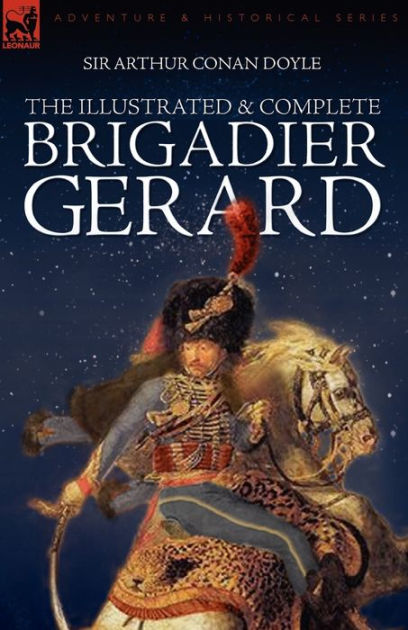
In most of these tales, Etienne Gerard himself narrates his highly implausible yet entertaining adventures. Readers are transported to feeling like they are sitting in a Parisian cafe in the mid-19th century, listening to this aging soldier’s boastful boasting and witty stories. Gerard hails from the Gascony region of southwest France, embodying the stereotypical Gascon personality of being vain, brave and crafty.
The stories showcase Doyle’s zeal for historical accuracy. While Gerard himself was an invented character, his adventures drew inspiration from the memoirs and biographies of over 20 real soldiers from that era, especially Baron de Marbot who became one of Napoleon’s aides and generals and even earned a mention in Napoleon’s will. Doyle meticulously researched to ground the fantastical tales in realism.
With his oversized ego, lust for glory, and utterly undeserved self-confidence, the Brigadier personified the stereotype of the arrogant French soldier. And yet, despite or perhaps because of his oblivious buffoonery, Gerard still managed heroic feats of courage and daring on the battlefield, creating a lovable characters that Doyle clearly relished writing about over the course of nearly two decades.
While very different in personality and the eras they occupied, both Professor Challenger and Brigadier Gerard provided Arthur Conan Doyle with wonderful vehicles to showcase his talent for adventure writing outside the Holmes mysteries. The curmudgeonly scientist and the blusteringly vain soldier allowed Doyle to transport readers to lost worlds of the prehistoric past, psychic dimensions, and the age of Napoleonic conquest through his endlessly creative literary imagination.

Part of a regular series on 27gen, entitled Wednesday Weekly Reader.
During my elementary school years one of the things I looked forward to the most was the delivery of “My Weekly Reader,” a weekly educational magazine designed for children and containing news-based current events.
It became a regular part of my love for reading, and helped develop my curiosity about the world around us.
 27gen.com