
On October 16, 2023, the Walt Disney Company will celebrate its 100th Anniversary. Today kicks off a series in recognition of this event – a series looking into the characteristics that have made the Walt Disney Company a beacon of innovation and imagination, enchanting audiences of all ages with its timeless stories, beloved characters, and groundbreaking achievements.
Some of the articles have existed before and been refreshed for this series; others are brand new. In either case, I hope you will enjoy reading about the dreamers, the believers, and the magic-makers who have brought us a century of enchantment.
To say that Walt Disney was merely a train enthusiast understates the extent to which his life was intertwined with railroading. In Walt’s case, his small-scale fascination led to a full-scale kingdom.
Michael Broggie, Walt Disney’s Railroad Story
With love of Disney history, I’m always grateful to visit Disney properties and immerse myself in the stories and culture of Walt Disney and the “kingdoms” he began. During one multi-day visit to California, I had the opportunity to visit Disneyland several days, experiencing both the familiar and new perspectives.
Take this image, for example:

In talking with current Cast Members, Tour Guides, and former Imagineers, various stories were given as to the origin of Disneyland:
- It was Walt Disney’s fascination with trains, beginning as a boy, that led him to first create a scale model railroad in his backyard. Not satisfied, he begin to develop an ever-growing park that would include a railroad. When Disneyland opened in 1955, the first object you saw approaching the park was a train station, and a 5/8 scale railroad encircled the park.
- Saturday’s were “Daddy’s Day,” and Walt often took his daughters to play in nearby parks. While sitting on a bench in Griffith Park, Walt imagined what a park would look like that would allow both parents and children to be immersed in a story-rich, safe, clean park.
- Fascinated by miniatures, Walt began a hobby of crafting extremely detailed miniature items, building entire rooms filled with objects that were not only beautiful to look at, but fully functional. He envisioned a place to display these miniatures so that people from all over the country could enjoy them.
- By the late 1940’s-early 1950’s, Walt had grown tired of making animated pictures, and even his recent venture into live-action motion pictures left him dissatisfied. He imagined a place were people could actually be a part of a story, immersed in all the rich details that a “theme park” could provide.
What is the true origin of Disneyland?
I believe that all of the above contributed to the creation of Disneyland. And the common denominator of all of them?
Passion.
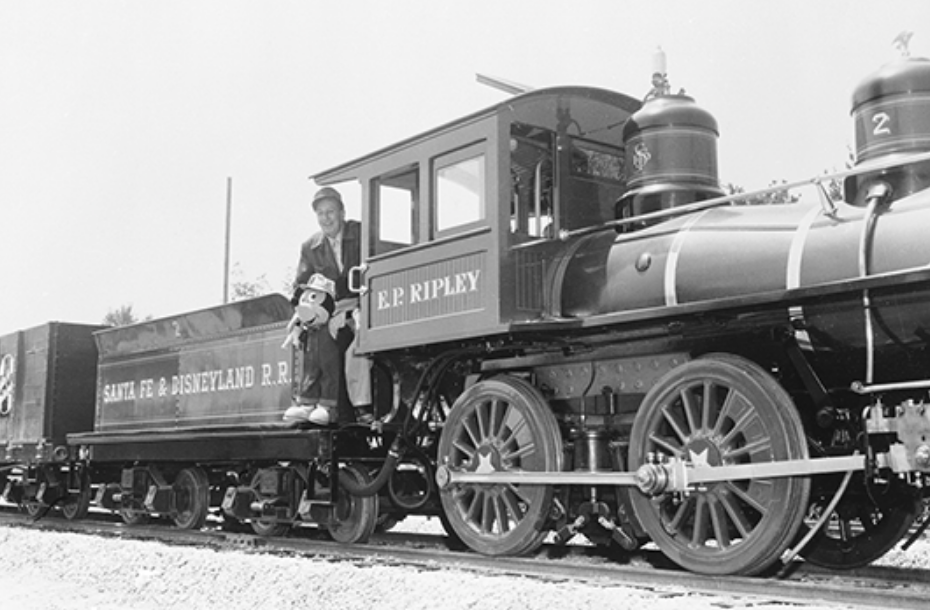
I want it to look like nothing else in the world. And it should be surrounded by a train.
Walt Disney
The creation story of Disneyland, the first “theme” park in the world and the model for all Disney parks to follow, is somewhat clouded.
Depending on who is telling it, or even when it is told, the origins of Disneyland can start with a park bench, model making, boredom, or a boyhood fascination with trains.
There is a measure of truth to all of them. It is certain is that all of these influences in the life of Walt Disney contributed to the resulting creation.
Personally, I lean toward Walt’s love of trains as the primary inspiration for Disneyland.
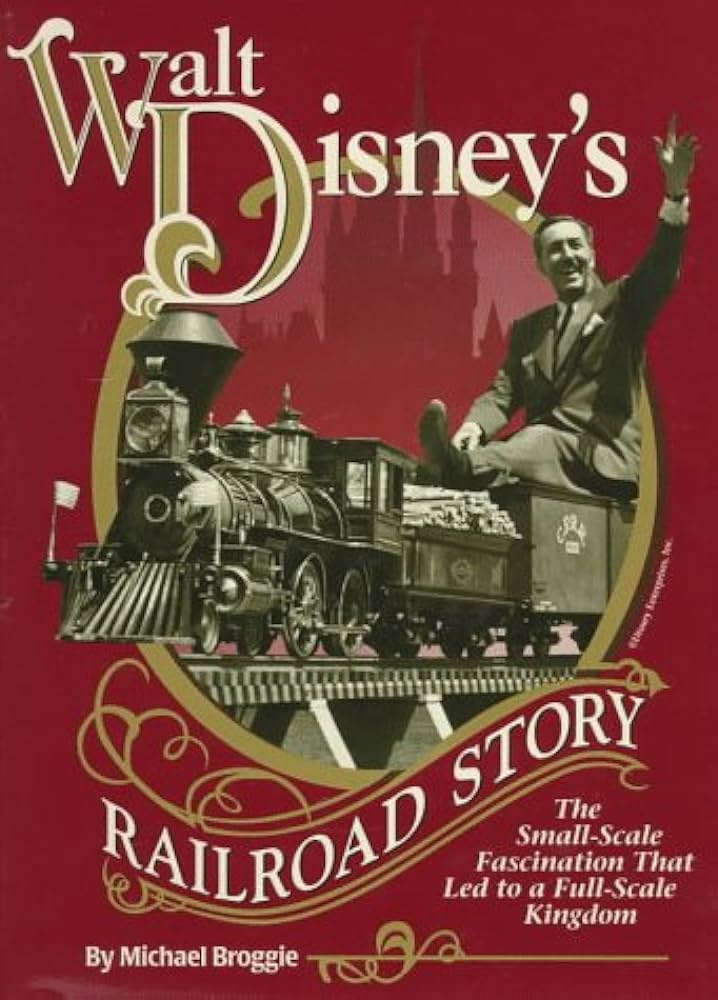
As a bona fide Disney fan, focusing on the history of the man and the company that bears his name (especially from the late 1920s to the mid-1960s), I can trace “railroad” stories from Walt (and about Walt) that reinforce this.
Those railroad stories could (and do) fill several books – the best of which is Walt Disney’s Railroad Story, by Michael Broggie.
It’s a fascinating book, and when the author knew of Walt Disney as “Uncle Walt,” and had the enviable role as a teenager to assist Walt in the operation of the Carolwood Pacific Railroad (Disney’s personal, rideable miniature railroad in the backyard of his home), you know the stories are going to be memorable, filled with detail, and a fascinating read.
You see, Michael Broggie’s father Roger E. Broggie was a precision machinist who joined the Disney Studios in 1939. Broggie’s accomplishments at the studio were wide-ranging, but in the early 1950s he was promoted to the head of the Disney Studios’ Machine Shop, where he became a transportation specialist.
And where did he fine-tune the skills needed to create all the unique transportation vehicles found at Disneyland and later at Walt Disney World?
In building Walt Disney’s backyard railroad…
On the Carolwood Pacific Railroad.

The Carolwood Pacific Railroad (CPRR) was a 7 1/4-inch gauge ridable miniature railroad run by Walt Disney in the backyard of his home in the Holmby Hills neighborhood of Los Angeles, California.
It featured the Lilly Belle, a 1:8-scale live steam locomotive named after Disney’s wife, Lillian Disney, and built by the Walt Disney Studios’ machine shop. The locomotive made its first test run on December 24, 1949. It pulled a set of freight cars, as well as a caboose that was almost entirely built by Disney himself.
It was Disney’s lifelong fascination with trains, as well as his interest in miniature models, that led to the creation of the CPRR. The railroad, which became operational in 1950, was a half-mile long and encircled his house. The backyard railroad attracted visitors to Disney’s home; he invited them to ride and occasionally drive his miniature train.
With the creation of a personal railroad, Disney’s next step could only be designing and building the real thing.
Research into the earliest development of Disney’s “park” reveals a constant: the presence of a railroad with a steam engine pulling cars that people could ride in.
So, any visit to a Disney theme park for me must include a ride on the Disney Railroad.
Unfortunately, on my last visit to Walt Disney World on the occasion of its 50th anniversary on October 1, 2021, the railroad had been out of commission since 2018 for the pandemic-delayed construction of the TRON Lightcycle Run, a new attraction coming to the Magic Kingdom. The train tracks have been rerouted through the Lightcycle attraction inside a tunnel as shown in this concept art.

I knew any surprise announcement that the train would be running on October 1 was unlikely, but it wasn’t until I rode the People Mover early that morning and saw the view of the dismantled train tracks, plainly visible where they would run through the future Lightcycle Run attraction, that the disappointment set in.
In the meantime, the train was available as the perfect backdrop for a memorable photo at different places in the park. Just before Christmas 2022, it began to run again.

For me, “the perfect backdrop” of a static display is a far cry from the swaying motion of the train as it leaves the station and begins to circle the park…

..the way Walt Disney dreamed about it from the time he was a young boy…
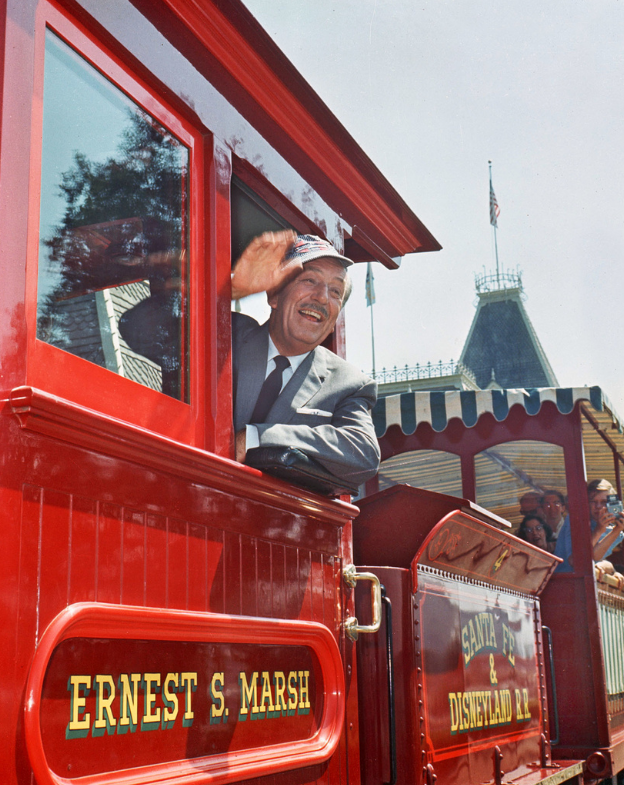
…until he made it happen.
It all begins with dreams.
Walt Disney
References
 27gen.com