How to Live a Focused Life in an Increasingly Noisy World

To stay eager, to connect, to find interests in the everyday, to noice what everybody else overlooks – these are vital skills and noble goals. They speak to the difference between looking and seeing, between hearing and listening, between accepting what the world presents and noticing what matters to you.

Rob Walker, On Noticing

In pursuit of becoming a modern elder, I’m working on the development of foundational principles that contribute to such a journey.

The first of those was Noticing.

Modern elders are encouraged to become first-class noticers in order to make the unconscious conscious. They are encouraged to become more fully aware of themselves and others. Noticing (or “awareness”) is a key wisdom skill for making personal changes, and a foundational principle of a modern elder.

Here are some posts on Noticing you can revisit:

Next up: Editing.

Modern elders are encouraged to use the previously mentioned skill of noticing/awareness for a “great midlife edit.” What could you edit out of your life so that you can edit in something more inspiring and purpose-filled?

The first step on that journey is realizing there is much that could be edited from this noisy world we live in.

Information overload.

You live it every day – Facebook, Twitter, LinkedIn, and Instagram. You’re more informed and connected than ever.

Yet, if you’re honest, you’re probably feeling more distracted than ever.

More lonely. More restless.

According to studies done by Barna Research:

  • 71% of people feel overwhelmed by the amount of information they need to stay up to date.
  • 36% of adults stop what they’re doing to check a text or message when it comes in.
  • 35% of adults think their personal electronics sometimes separate them from other people.

Being hyperlinked changes every aspect of our lives – and often, not for the better.

This trifecta of books will look at solutions that will help you begin to understand the concepts of Editing.


THE QUICK SUMMARY

Minimalism is the art of knowing how much is just enough. Digital minimalism applies this idea to our personal technology. It’s the key to living a focused life in an increasingly noisy world.

In this timely and enlightening book, the bestselling author of Deep Work introduces a philosophy for technology use that has already improved countless lives.

Digital minimalists are all around us. They’re the calm, happy people who can hold long conversations without furtive glances at their phones. They can get lost in a good book, a woodworking project, or a leisurely morning run. They can have fun with friends and family without the obsessive urge to document the experience. They stay informed about the news of the day, but don’t feel overwhelmed by it. They don’t experience “fear of missing out” because they already know which activities provide them meaning and satisfaction.

Now, Newport gives us a name for this quiet movement, and makes a persuasive case for its urgency in our tech-saturated world. Common sense tips, like turning off notifications, or occasional rituals like observing a digital Sabbath, don’t go far enough in helping us take back control of our technological lives, and attempts to unplug completely are complicated by the demands of family, friends and work. What we need instead is a thoughtful method to decide what tools to use, for what purposes, and under what conditions.

Drawing on a diverse array of real-life examples, from Amish farmers to harried parents to Silicon Valley programmers, Newport identifies the common practices of digital minimalists and the ideas that underpin them. He shows how digital minimalists are rethinking their relationship to social media, rediscovering the pleasures of the offline world, and reconnecting with their inner selves through regular periods of solitude. He then shares strategies for integrating these practices into your life, starting with a thirty-day “digital declutter” process that has already helped thousands feel less overwhelmed and more in control.

Technology is intrinsically neither good nor bad. The key is using it to support your goals and values, rather than letting it use you. Digital Minimalism shows the way.

A SIMPLE SOLUTION

While many leaders believe in the power of digital platforms, and recognize the importance of various specific applications, a growing number of those same leaders feel as though their current relationship with technology is unsustainable – to the point that if something doesn’t change soon, they will reach a breaking point.

According to author Cal Newport, people don’t succumb to screens because they’re lazy, but instead billions of dollars have been invested to make this outcome inevitable.

It seems we have stumbled backward into a digital life we didn’t sign up for.

My research on digital minimalism has revealed the existence of a loosely organized “attention resistance movement,” made up of individuals who combine high-tech tools with disciplined operating procedures to conduct surgical strikes on popular attention economy services – dropping in to extract value, and then  slipping away before the attention traps set by those companies can spring shut.

The tactics below have proved successful in shunting aside relentless efforts to capture your attention.

Delete Social Media from Your Phone The smartphone versions of social media sites are much more adept at hijacking your attention than the versions accessed through a web browser on your laptop or desktop computer. Because you always have your phone with you, every occasion becomes an opportunity to check your feeds. If you’re going to use social media, stay far away from the mobile versions of these services, as they pose a significantly bigger risk to our time and attention. This practice suggests you remove all social media apps from your phone. You don’t have to quit these services, you just have to quit accessing them on the go.

Turn Your Devices Into Single-Purpose Computers The sentiment that temporarily blocking features of a general-purpose computer reduces its potential is common for tools that do just that. It’s also flawed: it represents a misunderstanding of computation and productivity that benefits the large digital attention economy conglomerates much more than the individual users that they exploit. As many have discovered, the rapid switching between different applications tends to make the human’s interaction with the computer less productive in terms of the quality and quantity of what is produced. This practice of blocking might at first seem overly aggressive, but what it’s actually doing is bringing you back closer to the ideal of sing-purpose computing that’s much more compatible with our human attention systems.

Use Social Media Like a Professional Social media professionals approach these tools differently than the average user. They seek to extract large amounts of value for their professional and (to a lesser degree) personal lives, while avoiding much of the low-value distortion these services deploy to lure users into compulsive behavior. Their disciplined professionalism, in other words, provides a great example for any digital minimalist looking to join the attention resistance. To a social media pro, the idea of endlessly surfing your feed in search of entertainment is a trap (these platforms have been designed to take more and more of your attention) – an act of being used by these services instead of using them to your own advantage.

Embrace Slow Media To embrace news media from a mind-set of slowness requires first and foremost that you focus only on the highest-quality sources. Breaking news, for example, is almost always much lower quality than the reporting that’s possible once an event has occurred and journalists have had time to process it. Similarly, consider limiting yourself to the best of the best when it comes to selecting individual writers you follow. Another important aspect of slow news is the decisions you make regarding how and when this consumption occurs. The key to embracing Slow Media is the general commitment to maximizing the quality of what you consume and the conditions under which you consume it.

Dumb Down Your Smartphone Declaring your freedom from your smartphone is probably the most serious step you can take toward embracing the attention resistance. Dumbing down your phone, of course, is a big decision. Convincing yourself that a dumb phone can satisfy your need so that its benefits outweigh its costs is not necessarily easy. Indeed, it might require a leap of faith – a commitment to test life without a smartphone to see what it’s really like.

– Cal Newport, Digital Minimalism: Choosing a Focused Life in a Noisy World

A NEXT STEP

According to author Cal Newport, if you are exhausted by your “digital device addiction,” it’s not only possible to say, “No More,” it’s actually not that hard.

Set aside some time (without your phone!) to review the following five suggestions listed above. For each, make a Pro/Con list for what it would mean to your life if you took that action.

Review the list, and make a decision to embrace at least one of the actions for the next week.

After the week has passed, reflect on what taking that action meant to you, in terms of time gained, relationships grown, etc.

Consider another action to undertake, and follow the same suggestions.

At the end of one month’s experiments, talk with your spouse or a close colleague who would have noticed the changes in your routine and its results. What do they have to say?


THE QUICK SUMMARY

Have you bought into the lie that success constantly requires more, more, and more? To achieve success, you must do more, work more hours, take on more projects, and accept more responsibilities?

If so, you’re probably experiencing a roller coaster ride of mixed results – being on top of the world one moment and crashing to earth at lightning speed the next.

The Success Lie was written for you. You recognize the gap between where you are now and your highest potential, but don’t want to sacrifice your sanity to get there. Janelle Bruland has built a formidable bridge over that gap, proving that you can be successful in the business world and maintain balance in your personal life without constantly feeling stressed and overwhelmed.

You know that everything in life is a result of the choices you’ve made, yet you’re wondering if you’re making the right choices. The proven strategies in this book will show you how to step away from the modern world’s path to success and create a life of significance – one where you are loving your work and making a positive impact.

  • Determine what’s truly important to you and then live by those values.
  • Recognize what’s gotten in the way of your success and take transformational steps to increase mindfulness, improve your skills, and become a better (and happier) version of yourself.
  • Discover strategies to eliminate over-work, overcommitment, and overwhelm.

Take back your life! Stop allowing societal pressures to tell you what matters. Get back on the path to fulfillment and do it your way! Reduce stress, enjoy peace of mind, and create the life you have always wanted.

Don’t buy into the lie anymore. You have the choice.

A SIMPLE SOLUTION

Who doesn’t love saying “yes”? The look of gratitude or relief on the face of the person who asked lifts us up – at least in the short run.

However, the more we say “yes” to, the more we will be asked. It’s a trait of a successful person; frequent participation often brings additional asks.

High achievers are driven and want to accomplish things, and are therefore often caught up in doing more and more. However, if we aren’t careful, we will miss out on the very things that matter the most to us.

Everything you say “yes” to means saying “no” to something else.

Here are the top five items I have learned to say “no” to:

1. The opportunities that come up that I’m not completely passionate about. When we choose to participate in something, we should be excited to be involved, not doing it out of guilt or obligation.

2. The things that are not aligned with my core values and priorities. To stay true to our values, our words, behavior, and actions must be in line with our beliefs.

3. To those requests that are not in my wheelhouse. Often, we are asked to do things that truly belong on someone else’s “to do” list. Be sure to pass on those, or delegate them to a more appropriate person.

4. To the things that drain me of energy. Our time should be spent on activities that we enjoy and give us energy, not deplete it.

5. To relationships that are unhealthy. We will never be our best if we are constantly having to lift ourselves up from interactions with unsupportive or negative people. Eliminate these relationships.

– Janelle Bruland, The Success Lie

A NEXT STEP

To have the successful life you desire, you must be disciplined to say “no” more than you say “yes.”

Author Janelle Bruland developed the following exercise to challenge leaders to “Just Say No.” Set aside an hour of uninterrupted time to complete it. In order to focus on our top priorities, giving them all of our attention and energy, it is important to evaluate what we need to say “no” to. Evaluate yourself in the following areas:

  • What commitments have I made that I am not excited about? These may be things that are past their time, or that you committed to out of obligation.
  • Is there anything I am involved in that is not aligned with my core values and priorities? If so, they should be eliminated.
  • What things am I adding to my “to-do” list that are not in the area of my strengths? These items should be delegated.
  • What activities am I involved in that drain me of energy? These should be removed from my priority list.
  • Am I involved in relationships that are unhealthy? These should be carefully evaluated and repaired or eliminated.

THE QUICK SUMMARY

Are you:

• Working, working, working?

• Busy taking care of everyone but yourself?

• Wondering what to do with the rest of your life?

• Planning to do what makes you happy someday when you have more time, money, or freedom?

What if someday never happens?

Sam Horn is a woman on a mission about not waiting for SOMEDAY… and this is her manifesto. Her dad’s dream was to visit all the National Parks when he retired. He worked six to seven days a week for decades. A week into his long-delayed dream, he had a stroke.

Sam doesn’t want that to happen to you. She took her business on the road for a Year by the Water. During her travels, she asked people, “Do you like your life? Your job? If so, why? If not, why not?”

The surprising insights about what makes people happy or unhappy, what they’re doing about it (or not), and why…will inspire you to carve out time for what truly matters now, not later.

Life is much too precious to postpone. It’s time to put yourself in your own story. The good news is, there are “hacks” you can do right now to make your life more of what you want it to be. And you don’t have to be selfish, quit your job, or win the lottery to do them. Sam Horn offers actionable, practical advice in short, snappy chapters to show you how to get started on your best life now.

A SIMPLE SOLUTION

According to author Sam Horn, you don’t need to quit your job, win the lottery, or walk away from your responsibilities to make your life more of what you want it to be.

There are things you can do right here, right now, to be happier, healthier, and more fulfilled.

There are steps you can take to make your life more fulfilling.

It’s time to hack your life by tapping into proven best practices, expedite results and discover a shortcut to success.

Make your “one day” Day One.

The Ten Life Hacks are actions you can take to create a more fulfilling life, sooner, not later. Please note: These hacks are a framework, not a formula.

LIFE HACK 1: Evaluate Your Happiness History

LIFE HACK 2: Generate a Today, Not Someday Dream

LIFE HACK 3: Abdicate Outdated Beliefs and Behaviors

LIFE HACK 4: Initiate Daily Actions that Move Your Life Forward

LIFE HACK 5: Celebrate What’s Right with Life, Right Here, Right Now

LIFE HACK 6: Affiliate with People Who Have Your Back and Front

LIFE HACK 7: Integrate Your Passion and Profession

LIFE HACK 8: Negotiate for What You Want, Need, and Deserve

LIFE HACK 9: Innovate a Fresh Start

LIFE HACK 10: Relocate to Greener Pastures

– Sam Horn, Someday is Not a Day in the Week

A NEXT STEP

According to author Sam Horn, the best way to make progress in making your “Someday” is to ask probing questions that prompt you to change – for good.

Listed below are sample questions for each of the ten Life Hacks listed above. Schedule at least thirty minutes a day for the next ten days, and reflect on the questions listed.

LIFE HACK 1: Evaluate Your Happiness History

Play hooky for a day.

  1. How would you spend your free day or afternoon? What would you do if the people you’re responsible for would be taken care of, and there would be no repercussions?
  2. What are three things you would not do on your day of hooky? Why?

LIFE HACK 2: Generate a Today, Not Someday Dream

Put a date on the calendar.

  1. What would you like to experience or achieve by the end of this year? What is your Today, Not Someday dream? When will you launch it? What “do-date” did you put on your calendar?
  2. Now, start filling in the W’s … where, when, who, what, and why. Who will you discuss this with so they can help you fill in the blanks so your dream goes from vague to vividly clear?
  3. Where will you post your dream so it stays “in sight, in mind,” and you are constantly reinspired to do what you said you wanted to do?

LIFE HACK 3: Abdicate Outdated Beliefs and Behaviors

Let it go, let it go, let it go.

  1. How do you feel when you walk into your home? Where would your home rate on the “Clutter (1) to Clean (10) Scale”? How does that affect you? Do you feel guilty, stressed, or frustrated with how things have piled up? Or do you feel proud and at peace with how well-designed, organized, and beautiful your space is?
  2. How much time do you spend cleaning, repairing, buying, renovating your stuff? Is that a source of enjoyment, a burden and chore, or something in between? Explain.
  3. Are you ready to downsize your home and/or release some belongings? How will you do that? Who else does this have an impact on? How will you negotiate this with them? What could you do with the resources that would be freed up when you have less to take care of?

LIFE HACK 4: Initiate Daily Actions that Move Your Life Forward

Honor the nudges, and connect the dots.

  1. Do you make room for whims? Why or why not? When was a time you honored a nudge and acted on your intuition? What happened as a result?
  2. Do you think this is a lot of hooey? Does your intellect override your instincts? Or, do you agree that if we have a sixth sense that alerts us to what’s wrong, we also have a sixth sense that alerts us to what’s right? What are your beliefs about this?
  3. How will you honor the instincts that have your best interests at heart? How will you connect the dots, act on “coincidences” that beat the odds, and align with congruent individuals and opportunities that “feel right”?

LIFE HACK 5: Celebrate What’s Right with Life, Right Here, Right Now

Get out of your head and come to your senses.

  1. When was the last time you saw something as if for the first or last time? Describe what happened and what it felt like.
  2. Do you have a busy, stressful life? What is the ongoing impact of rushing, rushing, rushing— and always feeling “an hour late and a dollar short”?
  3. Would you say you have “juice” in your camera? Do you look at the world with fresh eyes? When, where, and how will you get out of your head and come to your senses?

LIFE HACK 6: Affiliate with People Who Have Your Back and Front

Launch your ship in public.

  1. So, what is that venture you want to launch? Who has supported you, cheered you on? What have they done to help you achieve your goal and do what’s important to you?
  2. Who has cautioned you, told you (“for your own good”) that what you want to do won’t work or isn’t a good idea? What impact has that had on you?
  3. How will you take your dream public and give others a chance to jump on your bandwagon? Will you create a vision board and/or host a Today, Not Someday party? Where did you post your vision so it stays “in sight, in mind”?

LIFE HACK 7: Integrate Your Passion and Profession

Don’t wait for work you love – create work you love.

  1. Do you love your job? Do you feel you’re adding value and contributing? How so?
  2. If you don’t find your work satisfying, why not? What talents or skills are you not having an opportunity to use or get credit for?
  3. What are your Four I’s? How could you leverage them into a paying career where you get paid to do what you’re good at? What is your next step? Will you visit crafts fairs to see how other people have turned a passion into a profession? Elaborate.

LIFE HACK 8: Negotiate for What You Want, Need, and Deserve

If you don’t ask, the answer’s always “No.”

  1. When is a time you asked for something you wanted – whether it was a promotion, project lead, or pay raise? How did you prepare? What was the result?
  2. When is a time you waited for someone to “do the right thing,” act on your behalf, or give you what you deserved? As Dr. Phil would say, “How’d that work for you?”
  3. What is a situation you’re unhappy with right now? Which of the Four A’s have you used? How will you alter the situation by using the Five P’s of Persuasion to increase the likelihood of improving this situation?

LIFE HACK 9: Innovate a Fresh Start

Quit watering dead plants.

  1. Is the majority of your life out of your control and not to your liking? How so? Does this challenging time have a timeline? Can you “make your mind a deal it can’t refuse” so you are able to keep things in perspective?
  2. What do you currently do to maintain a positive perspective, to have something to look forward to in bleak times? How do you stay focused on what you can control?
  3. Are there dead plants you can stop watering? What can you quit that is compromising your quality of life? How can you innovate a fresh start if you are going through dark times to keep the light on in your eyes?

LIFE HACK 10: Relocate to Greener Pastures

Come full circle.

  1. When was the last time you were in your hometown? What memories did it bring back? Did you reconnect with people that influenced you? Did it catalyze a new creative direction that could be a satisfying full-circle way to come home to who you truly are?
  2. What used to light you up but now feels like it might be a retreat or regression to “go back there”? Do you worry it’s thinking small instead of thinking big? Could it actually be you’re going “home” to who you are at your core, your best self?
  3. Do you agree that we can be “at home” wherever we are and that “home” is a mindset, not a location? Where do you feel most at home?

Part of a regular series on 27gen, entitled Wednesday Weekly Reader

During my elementary school years one of the things I looked forward to the most was the delivery of “My Weekly Reader,” a weekly educational magazine designed for children and containing news-based, current events.

It became a regular part of my love for reading, and helped develop my curiosity about the world around us.


The Modern Elder’s Dilemma: Balancing Lifelong Learning and Mentoring the Next Generation

My journey to becoming a modern elder is a fascinating one, characterized by a profound commitment to both personal growth and guiding the generations that follow. There is a delicate balance between being a lifelong learner and a mentor – let’s shed some light on why this equilibrium is vital in today’s rapidly evolving world.

The Lifelong Learner’s Quest – and a Current Example

Imagine history as an endless library, with each book representing a treasure trove of knowledge. As someone with an insatiable curiosity, you’ve made it your mission to explore these volumes continuously. The principle of being a lifelong learner is rooted in the idea that the pursuit of knowledge knows no age limit. 

I’ve always been an avid reader, and my passion for history knows no bounds. It’s a passion that takes me on fascinating journeys through time. I’m on one such journey now: revisiting the history of the U.S. during the Gilded Age (1877-1900) – a period roughly sandwiched between the Reconstruction Era following the Civil War and the Progressive era (1896-1917) – a period of widespread social activism and political reform across the U.S. focused on defeating corruption, monopoly waste, and inefficiency. 

I am discovering that this time period serves as both a mirror and a cautionary tale for our contemporary society. As we confront modern economic disparities, we must draw upon the lessons of history. The echoes of the past remind us that the pursuit of wealth must be tempered with compassion and a commitment to the well-being of all. In the subsequent articles, we will delve deeper into the Gilded Age’s legacy, exploring how it reverberates in today’s world of technological advancement and economic complexity.

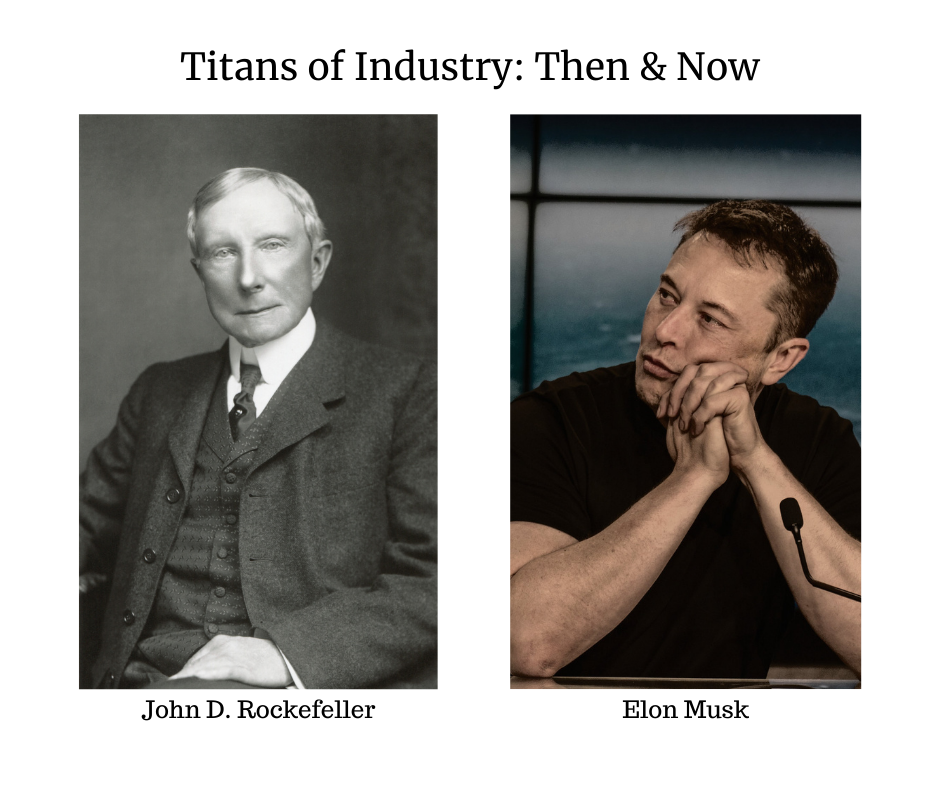
In the heart of this tumultuous era stood titans of industry like Andrew Carnegie, whose steel empire forged the very skeleton of the modern age, and John D. Rockefeller, whose Standard Oil Company oiled the wheels of progress. Their fortunes grew at a staggering pace, giving rise to the notion that the age was “gilded” in a veneer of gold.

Yet, as skyscrapers pierced the heavens and railroads stitched the nation together, countless workers toiled in oppressive conditions, their sweat and blood sustaining the grandeur above. They faced grueling hours, meager wages, and perilous workplaces. Their lives stood in stark contrast to the opulence of the industrial barons. Poverty festered in the shadows, casting a pall over the grandeur. The “gilded” surface of society hid the harsh reality of life for the many.

As we look back upon this tumultuous epoch, it’s essential to recognize the striking parallels that echo through the corridors of history and into our present day. Income inequality, which simmered beneath the surface in the Gilded Age, remains a pressing issue today. The struggle for workers’ rights and the fight against social injustices continue to shape our society, echoing the challenges of yesteryears.

The allure and paradox of the Gilded Age serve as a poignant reminder that, despite the passage of time, certain themes persist. The titans of industry today are in the information business, represented by Elon Musk. This period invites us to reflect on our own age – a time of remarkable technological advancements, where the glimmer of prosperity coexists with the shadows of inequality.

As a lifelong learner, I thrive on these sensory descriptions. They remind me that history is not just about facts and dates; it’s about stories and emotions. It’s about stepping into the shoes of those who came before us and understanding their world. The pursuit of knowledge keeps my mind sharp and open to new ideas.

Here are some key aspects of a lifelong learner to consider:

Embracing Change

Lifelong learning keeps your mind agile and adaptable. In a world where new technologies and ideas constantly emerge, being open to change is crucial.

Staying Relevant

By actively seeking new information and skills, you ensure that you remain relevant in your field and continue to contribute to your organization and society.

Personal Fulfillment

Learning is not just a means to an end but a source of personal fulfillment. It enriches your life, broadens your perspective, and keeps your passion for knowledge burning brightly.

Guiding the Next Generation

While your personal growth is paramount, you also recognize the importance of mentoring and investing in younger generations – while at the same time learning from them! This role as a guide carries immense responsibility and rewards:

Passing the Torch

By sharing your experiences, knowledge, and insights, you help prepare the next generation for the challenges they will face. You become a bridge between the past and the future.

Nurturing Talent

Guiding young individuals allows you to identify and nurture their talents, helping them unlock their full potential.

Legacy Building

Mentoring is a way to leave a lasting legacy. The impact you have on the lives of those you mentor can ripple through time, shaping the future in profound ways.

The Art of Balancing

Balancing lifelong learning with mentoring can be challenging, but it’s a dance worth mastering. Here’s how you can achieve this equilibrium:

Structured Learning

Allocate dedicated time for your own learning endeavors. Consider it an investment in your ability to mentor effectively.

Integration

Find ways to weave your newfound knowledge into your mentoring relationships. This integration makes your guidance more relevant and powerful.

Adaptive Mentorship

Recognize that the needs of the next generation are ever-evolving. Be willing to adapt your mentoring style and content to meet these changing needs.

The Ripple Effect

As a modern elder, the commitment to both learning and mentoring creates a positive ripple effect. I hope to inspire those around me to embrace lifelong learning as a path to personal growth. Simultaneously, I want to empower younger generations to navigate their journeys with wisdom and confidence. Along that journey, I plan to learn from them.

The modern elder’s journey is a testament to the beauty of balance. By relentlessly pursuing knowledge while guiding the next generation, I don’t want to be just an individual; I want to be a beacon of inspiration and wisdom. This delicate dance between personal growth and mentorship can result in the crucial role in shaping a brighter, more informed, and empowered future for all.


Winning with Insight: Game Film’s Dual Impact on Sports and Organizational Excellence

When the calendar rolls around to September, it means cool weather is not far behind, school has started, pumpkin spice is everywhere, and football – at the high school, college, and professional levels – takes center stage in the world of athletics.

Being a small “f” fan of pro football, my wife and I recently spent some time watching “Quarterback,” the Netflix series documenting the 2022 seasons of pro football quarterbacks Marcus Mariota, Kirk Cousins, and Patrick Mahomes. It was fascinating to watch on many levels, showing glimpses of both the personal and private lives of the three as well as their professional side

What I found most fascinating was the quarterback’s attention to the art and science of watching “film” of both their own performances and those of upcoming opponents. I use “film” as most players and coaches still call it film (from the days when it really was film in a projector) though today it is all video-based.

In the realm of professional sports, victory isn’t just a result of brute strength or natural talent. It’s a product of meticulous preparation, strategic analysis, and continuous adaptation. At the heart of this winning formula lies the practice of game film analysis. By studying past games, athletes and coaches dissect every play, every movement, and every decision to gain a competitive edge. Remarkably, these principles extend beyond the confines of the sports arena and offer invaluable insights for organizations striving for success in the business world.

Game Film in Professional Sports: A Deeper Dive

Breaking Down Game Footage

Game film analysis isn’t a casual viewing of highlights; it’s a comprehensive study of every nuance that unfolds on the field. Coaches and players immerse themselves in the footage, dissecting player positioning, execution of plays, and opponents’ strategies. Just as a chess player analyzes each move to anticipate their opponent’s next steps, teams scrutinize game film to uncover patterns and vulnerabilities.

This process mirrors the world of business, where keen observation is pivotal. Organizations must carefully dissect their operations, team dynamics, and market trends to identify strengths, weaknesses, and opportunities. Just as a coach studies an opponent’s tactics, businesses need to analyze their competitors’ moves to stay ahead.

Strategy Development and Adaptation

Game film isn’t just about looking backward; it’s about using insights to forge ahead strategically. Coaches derive game plans from their analysis, exploiting opponents’ weaknesses and capitalizing on their own strengths. Similarly, halftime adjustments are informed by a thorough review of the first half’s game film, allowing teams to adapt and recalibrate.

In the corporate realm, strategic decision-making is equally crucial. Organizations can develop strategies based on data-driven insights, aligning them with market trends and staying ahead of the curve. The agility to adapt strategies in real-time, as exemplified by halftime adjustments in sports, is essential for businesses facing a dynamic landscape.

Leveraging Advanced Analytics

Modern sports have embraced advanced analytics, ushering in a new era of understanding player performance and team dynamics. Metrics like player tracking data provide granular insights that shape coaching strategies. Similarly, organizations can harness the power of AI, big data, and performance analytics to make informed decisions and gain a competitive edge.

Translating Game Film Principles to Organizational Success

Observation and Analysis in Business

Just as coaches dissect game footage, organizations must keenly observe their internal processes and external environment. Identifying patterns, strengths, and weaknesses allows for more targeted strategies and effective decision-making.

Strategic Decision-Making

The correlation between game plans in sports and business strategies is undeniable. Data-driven decisions, informed by careful analysis, are the cornerstone of success. Adapting strategies based on real-time insights, as done in sports during halftime, is paramount in the corporate world.

Technology’s Role in Organizational Analysis

The integration of technology and data analytics has revolutionized sports, providing insights that were once unimaginable. In the same vein, businesses can leverage AI, big data, and advanced analytics to gain deeper insights into their operations, customers, and market trends.

Fostering a Culture of Continuous Improvement

Sports teams embrace the concept of continuous improvement, learning from both victories and losses. This approach is equally vital in business, where organizations must embrace feedback, learn from setbacks, and cultivate a culture that thrives on growth.

Winning Beyond the Scoreboard

Game film analysis is more than a practice; it’s a mindset that leads to victory. The principles of dissecting game footage, developing strategies, leveraging technology, and fostering a culture of improvement are transferable to organizations seeking success. As businesses adopt the “game film” approach, they can unlock the potential to observe, strategize, adapt, and learn – propelling themselves toward victory on and off the field.


Watching the pros watching game film reminded me of a great article by Dan and Chip Heath (authors of Made to Stick, Switch, and Decisive). Published in Fast Company magazine, it’s entitled “Watch the Game Film.” You really need to check out the whole article, but here’s a quick summary:

  • Football coaches use game film to spot things they’d never see in real time. They have an entire week to review a 60-minute game.
  • In the business world, every day is game day, and leaders don’t take the time to “study the film” of their activities. It’s unfortunate, because studying game film can yield unexpected results.
  • Doug Lemov, a consultant to school districts, utilized film of top-tier teachers in the classroom to train other teachers – resulting in raising students a grade level and a half in one year.
  • It doesn’t have to be film – Jump Associates, a strategy consulting firm, uses trained observers to record client meetings. After the meeting, the Jump staff holds a debriefing, modeled on the Army’s after-action reviews.

In the grand theater of football, game film isn’t just about reliving past moments; it’s a strategic treasure trove. The principles of observation, analysis, adaptation, and technology utilization that are at play in dissecting game film can be seamlessly applied to organizational consulting. The organizational consultant, akin to a coach, guides teams towards excellence by leveraging insights and strategies gleaned from the “game film” of business operations.

Just as a football team’s commitment to reviewing game film elevates their performance, organizations that integrate these principles into their approach can unlock the strategic power needed for sustained success. By embracing the wisdom of the gridiron, the path to peak organizational performance becomes clearer and more achievable than ever before.

What insights might your team be overlooking because no one is observing carefully enough?

Maybe it’s time to press the PAUSE button and start screening some game film.

There are some things you’ll never see unless you look.


The Perennial Paradigm: Shaping the Future Beyond Age

In today’s world, the acceleration of megatrends – increasing longevity and the explosion of technology among many others – are transforming life as we now know it.

In The Perennials, bestselling author of 2030 Mauro Guillén unpacks a sweeping societal shift triggered by demographic and technological transformation. Guillén argues that outmoded terms like Boomers, Gen X, Millennials, and Gen Z have long been used to pigeonhole us into rigid categories and life stages, artificially preventing people from reaching their full potential. A new postgenerational workforce known as “perennials” – individuals who are not pitted against each other either by their age or experience – makes it possible to liberate scores of people from the constraints of the sequential model of life and level the playing field so that everyone has a chance at living a rewarding life. Guillén unveils how this generational revolution will impact young people just entering the workforce as well as those who are living and working longer.

This multigenerational revolution is already happening and Mauro Guillén identifies the specific cultural, organizational and policy changes that need to be made in order to switch to a new template and usher in a new era of innovation powered by the perennials.

The Future Belongs to Perennials: Perennials – individuals defying age stereotypes – are shaping the future across various aspects of life. The aging population, with longer life expectancies, is gaining prominence in the workforce, consumption, and social influence. Retirement is evolving into a period of learning, freelancing, and flexible employment. Technology and a perennial mindset are opening new opportunities for active seniors.

Reducing Intergenerational Friction: Breaking away from the traditional sequential model of life reduces conflicts between generations. More elderly people working lessens the tax burden on the young and fosters intergenerational collaboration. Lifelong learning also promotes better understanding between age groups.

Transforming the Global Economy: Multi-generational households and workplaces are revolutionizing society. They reduce poverty, revolutionize real estate, aid childcare and elderly care, and boost productivity through mentorship and diversity. This shift can address pension financing issues and enhance GDP growth potential.

Leveling the Playing Field: A post-generational society with perennial values can combat ageism and provide equal access to essentials like education, healthcare, employment, and housing. It offers opportunities for those who face setbacks in the traditional life model.

Evolving Work and Careers: The future of work includes multi-generational environments, multiple careers, and lifelong learning. Technology assists in managing work-life balance. Adapting to this change requires developing skills for effective collaboration with technology and enhancing social, negotiation, teamwork, and emotional intelligence skills.


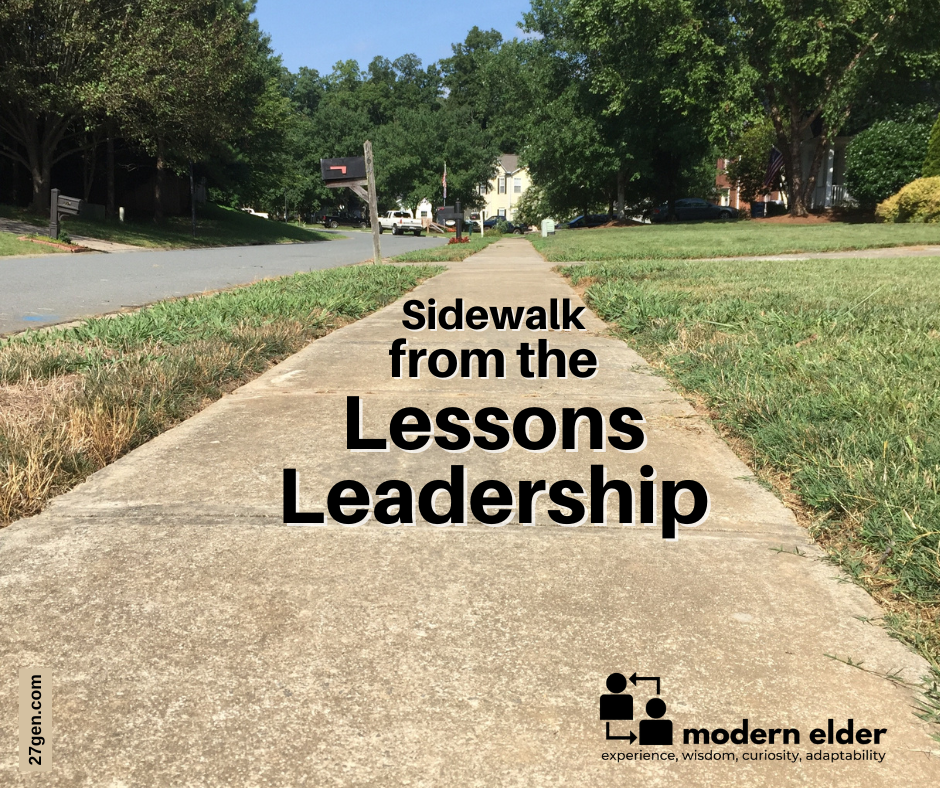
Leadership Lessons from the Sidewalk

In a recent post on walking unplugged, I mentioned that I would be walking the next day with my feet.

I wasn’t trying to be flippant – I was merely stating that your feet can tell you a lot about where you’re walking, and what you’re walking on, and in the process, you can learn a lot.

With that going through my head, I began my walk – and it wasn’t long before I realized Leadership Lessons the sidewalk could teach me.

In a short walk through my neighborhood, I felt and observed the following:

  • Raised Sidewalk – visible, growing tree roots: Leaders should always be looking for obscure things that may trip them up.
  • Sunken Sidewalk – hidden sources of erosion: Leaders should be cautious of unseen things that will bring them down and stunt their capabilities.
  • New Sidewalk Section – replacing to make it functional again: As your leadership grows and matures, you can count on learning new ways to do some things better.
  • Clean Sidewalk – appearances matter: Leaders must present themselves in the best manner possible, which instills confidence.
  • Dirty, Stained Sidewalk – see above: Conversely, sloppy appearances give others pause.
  • Cracked Sidewalk – too heavy a load: Leaders aren’t super heroes, and must balance the “load” they carry.
  • Grass in Sidewalk – maybe lazy, but at least distracted: Leaders who allow interruptions won’t be able to focus.
  • Grass growing over the Sidewalk – know your boundaries: Leaders know that boundaries help focus attention and align teams.
  • Sidewalks – take you somewhere: Leaders don’t fly solo; they must take others with them.
  • Sidewalks – make your journey easier: Well-prepared leaders are in a better position to help others on the journey.
  • Sidewalks – make your journey safer: Leaders watch out for the safety and welfare of others.
  • Sidewalks – lift you above the road: Leaders must rise above their surroundings.

In their civic role, sidewalks play a vital purpose in city, town, and suburban life. As conduits for pedestrian movement and access, they enhance connectivity and promote walking.  Safe, accessible, and well-maintained sidewalks are a fundamental and necessary investment.

But for me, they provide great leadership lessons.

And of course, I couldn’t resist sharing Shel Silverstein’s most appropriate poem:

“There is a place where the sidewalk ends
And before the street begins,
And there the grass grows soft and white,
And there the sun burns crimson bright,
And there the moon-bird rests from his flight
To cool in the peppermint wind.

Let us leave this place where the smoke blows black
And the dark street winds and bends.
Past the pits where the asphalt flowers grow
We shall walk with a walk that is measured and slow,
And watch where the chalk-white arrows go
To the place where the sidewalk ends.

Yes we’ll walk with a walk that is measured and slow,
And we’ll go where the chalk-white arrows go,
For the children, they mark, and the children, they know
The place where the sidewalk ends.”

― Shel Silverstein, Where the Sidewalk Ends


How to Take a Walk With All Your Senses

Welcome to the age of white noise.

We live our lives in a constant tether to phones, to apps, and to social media – mostly acquiescing to FOMO.

In this age of distraction, the ability to experience and be present is often lost, as is our capacity to think and to see and to listen.

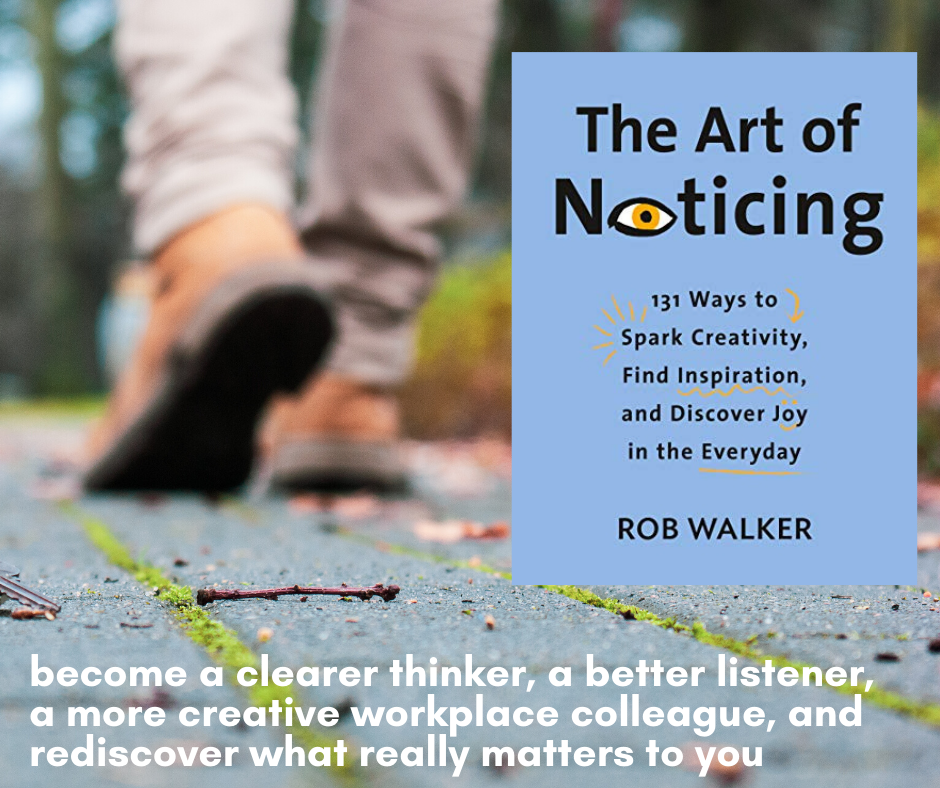
Rob Walker, The Art of Noticing

In an effort to battle this, I’m inviting you to join me in taking a walk – with all your senses.

In short, I want you to pay attention.

At a basic level, paying attention is simply making a selection among all the stimuli bombarding you at any moment.

Even if we ignore most of what is going on around us, we can only take in so much of the world at a time. Our sensory system has a limited capacity, both in range and in speed of processing.

The sensory system I’m referring to are your five classical senses: sight, sound, touch, taste, and smell.

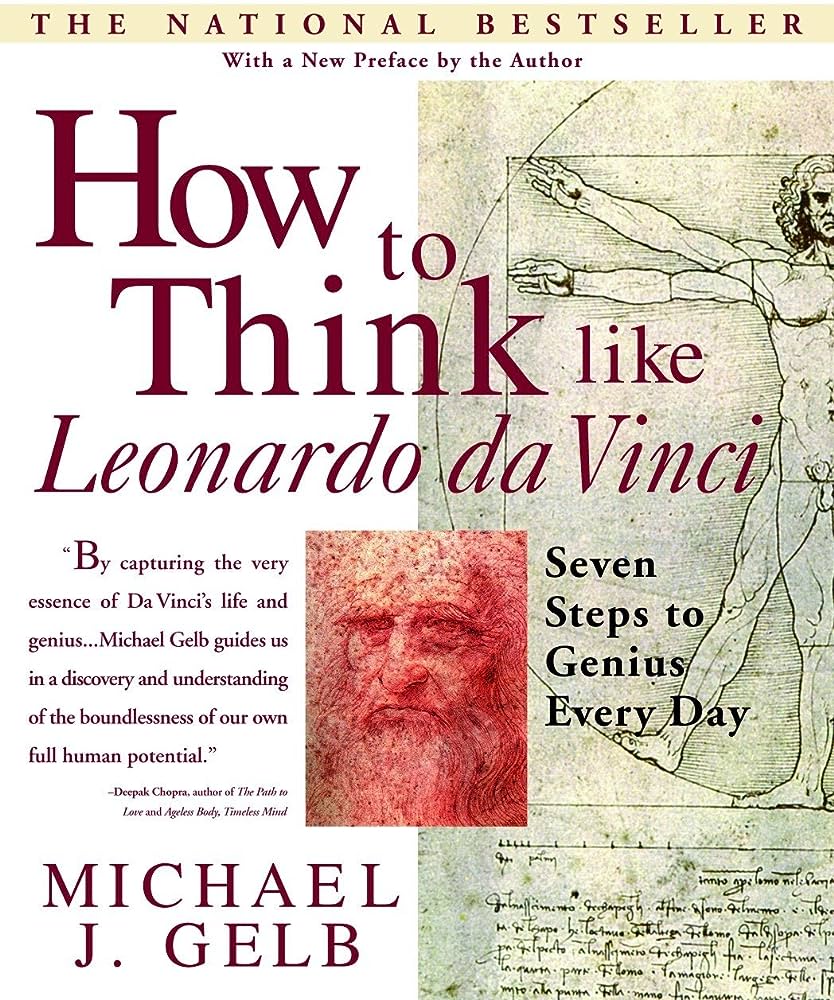
Limited capacity aside, many times we unfortunately ignore the parts that are available to us. Leonardo da Vinci reflected sadly that the average human:

“looks without seeing, listens without hearing, touches without feeling, eats without tasting, moves without physical awareness, inhales without awareness of odor or fragrance, and talks without thinking.”

A Brief Primer on How Our Senses Work

Sound The outer ear catches and channels sound waves to the middle ear, which contains three tiny bones. These bones vibrate, transmitting the sound the inner ear, where thousands of hair cells are stimulated by the movement of the fluid within the inner ear. An electrical impulse is transmitted along the hearing nerve to the brain creating the sensation of hearing.

Sight The experience of sight begins when photons from the world hit the lens of our eye, and get focused onto over 130 million receptor cells on the retina. These receptor cells convert incoming light into electrical signals to be sent to the brain, making sight possible.

Smell Every day we are confronted with a smorgasbord of smells. Our five million olfactory cells can sniff out one molecule of odor-causing substance in one part per trillion of air. We take about 23,000 breaths per day processing about 440 cubic feet of scent-laden air.

Touch Our bodies have more than 500,000 touch detectors and 200,000 temperature sensors. Each of these sensors gathers sensory information and relay it through specific nerve bundles back to the central nervous system for processing and possible reaction

Taste The complex process of tasting begins when tiny molecules released by the substances around us stimulate special cells in the nose, mouth, or throat. These special sensory cells transmit messages through nerves to the brain, where specific tastes are identified.

Enough of the science lab! God designed our bodies to sense, interpret, and react to the millions of stimuli that occur around us every day.

What do you miss, every day, right in front of you, while walking around the block?

I was paying so little attention to most of what was right before me that I had become a sleepwalker on the sidewalk. What I saw and attended to was exactly what I expected to see. That attention invited attention’s companion: inattention to everything else.

Alexandra Horowitz, On Looking

inspired by Alexandra Horowitz’s On Looking

and Rob Walker’s The Art of Noticing

and Michael J. Gelb’s How to Think Like Leonardo da Vinci


Part of a regular series on 27gen, entitled Wednesday Weekly Reader

During my elementary school years one of the things I looked forward to the most was the delivery of “My Weekly Reader,” a weekly educational magazine designed for children and containing news-based, current events.

It became a regular part of my love for reading, and helped develop my curiosity about the world around us.

How to Find Something You Aren’t Looking For

Over the coming century, the most vital human resource in need of conservation and protection is likely to be our own consciousness and mental space.

Tim Wu, The Attention Merchants

A runner I have never been, and not likely to ever be.

A road biker (bicycle) I once was (150+ miles per week), and hope to be again one day.

Active sports participation (first as a player on various teams, and then as an active soccer coach for 14 years) is long past.

My exercise, health permitting, is walking.

A few years ago, it was three-four miles a day. Now, not a lot – some days I struggle to make a half-mile; others, a little more.

For the longest time, I listened to podcasts during these walks. I would have time to listen to at least two or three, and often came back from those walks with eight-ten voice memos on my phone.

Then one day, I walked unplugged from my phone…

Pay attention to what you pay attention to. That’s pretty much all the information you need.

Amy Krouse Rosenthal

While I will always be a learner, both by genetics and environment (vocation), I think that hour a day might be better put to use paying attention, and seeking to grow wiser, not just smarter.

The stimulation of modern life, philosopher Georg Simmel complained in 1903, wears down the senses, leaving us dull, indifferent, and unable to focus on what really matters.

In the 1950s, writer William Whyte lamented in Life magazine that “billboards, neon signs,” and obnoxious advertising were converting the American landscape into one long roadside distraction.

“A wealth of information creates a poverty of attention,” economist Herb Simon warned in 1971.

The sense that external forces seek to seize our attention isn’t new – but it feels particularly acute today. Billboards, shop windows, addictive video games, endless news cycles, and commercial appeals tantalize us from all directions. We contend with the myriad distractions flowing through the pocket-sized screens we carry with us everywhere. By various estimates, a typical smartphone owner checks a device 150 times per day – every six minutes – and touches, swipes, or taps it more than 2,500 times.

The Art of Noticing, Rob Walker

And so I walk, unplugged.

Yesterday, I watched for American flags. In my neighborhood, I’m never out of sight of one. Some are bright and relatively new, since we are not too far removed from the Independence Day period. The American flag has always been more than a piece of cloth to me. A symbol for sure, but one rich with history, sacrifice, and uncommon wisdom. No matter the season outside, the vivid red, white, and blue always speak to me in different ways.

I’ve also listened to the late summer sounds of a mid-morning North Carolina symphony of insects and birds. The insects I’m guessing are mostly cicadas and katydids – first one, then the another, then a whole chorus. And then quiet. And then it starts over.

With one section of my walk bordering a park and the streets and yards filled with trees, I can always hear birds – robins, blue jays, cardinals, sparrows, blue birds, mockingbirds, crows, hawks, and more – including a nighttime hair-raising screech owl.

I listened for sounds I didn’t hear – cars up and down the street. Most people have gone to work if they’re going, and lunchtime hasn’t yet arrived. No planes on approach to CLT – that means the winds have shifted direction, and the landing pattern, often overhead, is further to the west. About a mile away, I-77 traffic is no doubt busy – but I didn’t hear it, again thanks to the wind direction.

Tomorrow I’m walking with my feet. Well, of course I will. But I’m going to “listen” to what my feet are saying about the path I choose, and see what I can learn.

When you actively notice new things, that puts you in the present…As you’re noticing new things, it’s engaging, and it turns out…it’s literally, not just figuratively, enlivening.

Ellen J. Langer

inspired by The Art of Noticing, by Rob Walker

How to See the Spectacle of the Ordinary

Recently my wife and I had the great privilege to host the 2023 version of Nina and GrandBob’s Summer Camp – that time when we are able to host our grandchildren at our house or keep grandkids at their parent’s house for an extended time.

For a period of two weeks, we had an amazing time with our nine grandchildren, in two groups as noted in the image above. We laughed, ate ice cream, played games, took walks, and much more. We’re already looking ahead to repeating the camps in 2024!

In reflecting back on those two weeks, I was reminded of the first time we attempted such a thing. It wasn’t hosting our grandkids, their parents were with us, and it wasn’t at our house. But it remains a powerful lesson years later.


A few years ago, my wife and I had the wonderful opportunity to plan and deliver The Adams Family Adventure – a week-long trip to Walt Disney World for our immediate family of fifteen at the time: six children and nine adults.

All week long I had the most fun watching the rest of the family as they experienced Walt Disney World, most for the first time. We captured that trip in over 3,000 images, to bring up stories in the future from our memory from those images.

As we departed from four different cities on the first day of our trip, we were texting and FaceTiming about our various experiences. It was the first airplane flight for four of the grandchildren (they did great). They left their homes early in the morning, took long flights, got on a big “magical” bus, and arrived at our resort.

To our grandchildren, it must have been a little strange. From the time they came running off the bus, throughout all of the fun adventures of the week, to the goodbyes at the end of the week, they were a little overwhelmed, maybe even overstimulated about the whole process – and I began to see all over again what it means to be curious.

You can, and must, regain your lost curiosity. Learn to see again with eyes undimmed by precedent.   – Gary Hamel

My grandchildren’s curiosity was brought sharply into focus when I recently read the following:

In childhood, then, attention is brightened by two features: children’s neophilia (love of new things) and the fact that, as young people, they simply haven’t seen it all before.   – Alexandra Horowitz

Alexandra Horowitz’s brilliant On Looking: Eleven Walks with Expert Eyes shows us how to see the spectacle of the ordinary – to practice, as Sir Arthur Conan Doyle puts it, “the observation of trifles.”

On Looking is structured around a series of eleven walks the author takes, mostly in her Manhattan neighborhood, with experts on a diverse range of subjects, including an urban sociologist, a geologist, a physician, and a sound designer. She also walks with a child and a dog to see the world as they perceive it. What they see, how they see it, and why most of us do not see the same things reveal the startling power of human attention and the cognitive aspects of what it means to be an expert observer.

Here’s an illustrative example as Horowitz walks around the block with a naturalist who informs her she has missed seeing three different groups of birds in the last few minutes of their walk:

How had I missed these birds? It had to do with how I was looking. Part of what restricts us seeing things is that we have an expectation about what we will see, and we are actually perceptually restricted by that perception. In a sense, perception is a lost cousin of attention: both serve to reduce what we need to process of the world “out there.” Attention is the more charismatic member, packaged and sold more effectively, but expectation is also a crucial part of what we see. Together they allow us to be functional, reducing the sensory chaos of the world into unbothersome and understandable units.

Attention and expectation also work together to oblige our missing things right in front of our noses. There is a term for this: inattentional blindness. It is the missing of the literal elephant in the room, despite the overturned armchairs and plate-sized footprints. 

Horowitz’s On Looking should be required reading for those wanting to become modern elders. How often do we fly past the fascinating world around us? A world, mind you, that we have been called to serve.

How can we serve others if we aren’t paying attention to the world around us?

To a surprising extent, time spent going to and fro – walking down the street, traveling to work, heading to the store or a child’s school – is unremembered. It is forgotten not because nothing of interest happens. It is forgotten because we failed to pay attention to the journey to begin with.

On Looking, Alexandra Horowitz

The consulting firm I work for uses a thought process called “The Kingdom Concept,” with references to artist Andrew Wyeth:

 Most artists look for something fresh to paint; frankly, I find that quite boring. For me it is much more exciting to find fresh meaning in something familiar.   – Andrew Wyeth

This reminds me of the concept of vujá dé.

No, that’s not a misspelling – it really is vujá déVujá Dé implies seeing everything as if for the first time or better still, seeing everything everyone else sees, but understanding it differently. (Simon T. Bailey)

You might even say the journey to being a modern elder starts with paying attention – with a healthy dose of vujá dé.

Questions to Ponder

  • How do you observe the all-too-familiar in order to discover new meaning and discern the activity of God that others miss?
  • What do you look for?
  • How can you learn to scrutinize the obvious?
  • What does it mean to look for the extraordinary in the ordinary?

A good place to start is paying attention…


Exploring Curiosity: The Socratic Method vs. a Three-Year-Old’s “Why?”

In the latest version of “Nina and GrandBob’s Summer Camp,” Anita and I recently spent a week in VA keeping our 3-year old grandson and 3-month old granddaughter while their daycare was closed for a couple of weeks. Our kids had planned one of the weeks as a vacation, but needed help for the other week – and of course we were very happy to do it!

Among many observations we made that week, one stands out:

Socrates and his method of questioning has nothing on a three-year old’s ability to ask “why.”

Each day began with me taking my grandson on a wagon ride/walk of about a mile or so, looping through all the streets in their neighborhood. The birds were out and about, pets greeted us with tail wags, cars and trucks needed explaining, and other neighbors out walking greeted us warmly.

All of the above, and much more, demonstrated the curiosity capacity of a three-year old. At the same time, it was a reminder that we’re never to old to ask “why” and learn more about what is going on around us.

Curiosity is a fundamental aspect of human nature, driving our pursuit of knowledge and understanding. Two notable expressions of curiosity are the Socratic Method and a three-year-old’s incessant questioning of “why.” While seemingly distinct, these two forms of inquiry share surprising similarities in their ability to ignite intellectual exploration and enhance learning. This article delves into the world of curiosity, comparing and contrasting the Socratic Method with a three-year-old’s relentless pursuit of “why.”

The Socratic Method: An Ancient Art of Inquiry

The Socratic Method, dating back to ancient Greece, is a philosophical approach that seeks to uncover truth through questioning. Inspired by the famous philosopher Socrates, this method involves a skilled interlocutor leading a discussion by asking thought-provoking questions. Through these inquiries, participants are encouraged to critically examine their beliefs, assumptions, and reasoning, arriving at deeper insights and understanding.

A Three-Year-Old’s “Why”: Unfiltered Curiosity

If you’ve ever spent time with a three-year-old, you’re likely familiar with their unyielding tendency to ask “why” about nearly everything they encounter. From mundane tasks to complex concepts, this simple question serves as their gateway to understanding the world around them. For a child at this age, “why” represents their innate curiosity and thirst for knowledge as they seek explanations and connections.

Comparing Curiosity in the Socratic Method and a Three-Year-Old

The Power of Inquiry

Both the Socratic Method and a three-year-old’s “why” share a profound reliance on inquiry to stimulate intellectual exploration. Both approaches aim to unearth deeper truths and insights, either within oneself (in the case of the Socratic Method) or about the external world (in the case of a child’s “why”). They demonstrate the inherent human desire to seek answers and understand the reasons behind various phenomena.

Cultivating Critical Thinking

Both the Socratic Method and a three-year-old’s “why” contribute to the development of critical thinking skills. The Socratic Method encourages individuals to question their assumptions, consider various perspectives, and evaluate the logic of their beliefs. Similarly, when a child asks “why,” they engage in basic critical thinking by seeking explanations and connections, fostering their cognitive development.

Contrasting Curiosity in the Socratic Method and a Three-Year-Old

Guided vs. Unstructured Inquiry

The Socratic Method involves a guided and intentional approach to questioning, with an interlocutor leading the dialogue strategically. On the other hand, a three-year-old’s “why” is often unstructured and free-flowing, following their natural inquisitiveness without any predefined agenda. This distinction highlights the difference in purpose between adult-led and child-driven curiosity.

Complexity of Questions

The Socratic Method typically involves complex and profound questions designed to provoke thoughtful responses and insights. In contrast, a three-year-old’s “why” often involves simple and straightforward questions driven by their immediate curiosity about their environment and experiences.

Social Context

The Socratic Method usually occurs in formal settings like educational institutions or philosophical discussions, involving adults or intellectually developed peers. In contrast, a three-year-old’s “why” is predominantly a social interaction between the child and their caregivers, teachers, or peers, occurring in informal daily settings.

Harnessing the Power of Curiosity

The Socratic Method and a three-year-old’s “why” demonstrate the inherent human drive to seek understanding and knowledge. While they differ in structure and complexity, both approaches showcase the power of curiosity as a catalyst for learning and growth.

For educators and leaders, understanding the significance of curiosity is essential in fostering a culture of inquiry and intellectual development. Encouraging critical thinking and open dialogue, inspired by the principles of the Socratic Method, can lead to profound insights and transformative learning experiences, not just for adults but also for the young minds who constantly ask “why.”


Curiosity is a timeless force that transcends age and time. The Socratic Method, with its guided approach to questioning, and a three-year-old’s relentless “why,” exemplify the power of inquiry in stimulating intellectual exploration and fostering critical thinking. By embracing curiosity and promoting thoughtful questioning, we can create a culture that values learning, encourages open dialogue, and nurtures intellectual curiosity in both adults and children alike. As we harness the potential of curiosity, we unlock the door to a world of knowledge and understanding, propelling us on an endless journey of discovery and growth.


The Path to Wisdom: Cultivating the Heart and Mind

In a world driven by instant gratification and quick fixes, the pursuit of wisdom often takes a backseat. We are drawn to dramatic turnarounds and immediate results, neglecting the transformative power of patience, discipline, and inner growth. As the quote below by Tim Keller wisely reminds us, true wisdom is not found in shortcuts but in the enduring journey of long training and discipline. However, he emphasizes that the heart, not just the mind and will, must be trained to embark on this enlightening path.

The Power of Patience and Discipline

Wisdom is not a destination; it is a lifelong pursuit. It requires the cultivation of patience and discipline, qualities that enable us to navigate the complexities of life with grace and insight. Like a skilled craftsman honing their craft over years of dedicated practice, the path to wisdom necessitates consistent effort, perseverance, and a willingness to learn from both successes and failures.

Training the Mind and Will

Intellectual knowledge and strong determination are fundamental pillars of wisdom. Training the mind involves acquiring knowledge, critical thinking, and the ability to discern between truth and falsehood. It is through the continuous expansion of our intellectual capacities that we develop a deeper understanding of the world and gain the tools to make informed decisions.

Equally important is the training of the will—the ability to harness our inner strength, exercise self-control, and align our actions with our values. Willpower empowers us to resist temptations, overcome obstacles, and persevere in the face of challenges on our journey toward wisdom.

The Heart: The Seat of Wisdom

While training the mind and will is crucial, the quote reminds us that the heart must not be overlooked. The heart represents our emotional intelligence, compassion, empathy, and the capacity to connect with others and ourselves on a deeper level. It is through cultivating the heart that wisdom truly blossoms.

Training the heart involves developing qualities such as kindness, gratitude, forgiveness, and love. These virtues foster harmonious relationships, promote understanding, and allow us to navigate conflicts with empathy and compassion. By nurturing the heart, we become more attuned to our inner voice and the needs of others, enabling us to make choices that align with our values and benefit the greater good.

Integrating Mind, Will, and Heart

Wisdom flourishes when the mind, will, and heart are integrated and work in harmony. It is the synergy of these elements that allows us to approach challenges and decisions with clarity, balance, and a profound understanding of ourselves and the world around us.

To embark on the path of wisdom, we must engage in practices that train all aspects of our being. This may include reading and seeking knowledge, engaging in reflective practices such as meditation and journaling, embracing self-discipline, and nurturing our emotional intelligence through acts of kindness and self-care.


Modern Elders realize that the pursuit of wisdom is not a quick-fix solution but rather a lifelong journey that requires patience, discipline, and a holistic approach. By training the mind, will, and heart, we unlock the true potential for growth, understanding, and compassion within ourselves. 

Embrace the wisdom in the quote and commit to cultivating all aspects of our being, for it is through this integration that we can truly embody the transformative power of wisdom in our lives and positively impact the world around us.