
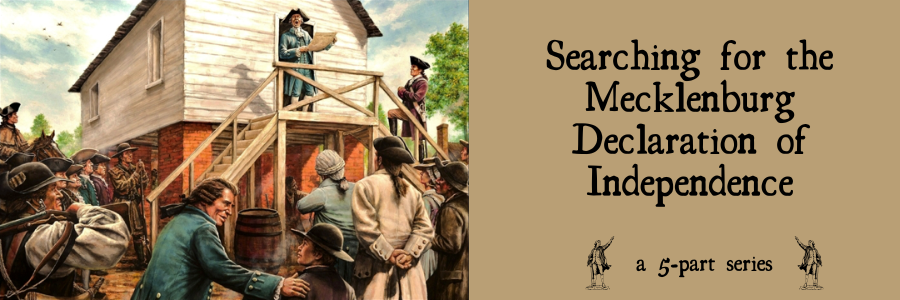
As a resident of Mecklenburg County in a town next to Charlotte, North Carolina, when the Fourth of July rolls around, sure, I’ll join in the fireworks and BBQ like everyone else. But there’s always a little wink and a nod happening here, especially when you see our state flag with “May 20, 1775” proudly displayed, or our license plates boasting “First in Freedom.” Or maybe it’s the statue of Captain Jack, the “Paul Revere of the South” who journeyed over 500 miles to deliver his news to the Continental Congress in Philadelphia.
Over the years, five U.S. Presidents – Taft, Wilson, Eisenhower, Ford, and George H.W. Bush – have traveled to Charlotte to honor the city’s historic claim as the first to break from British rule. Historical artifacts like the Mecklenburg Resolves, preserved in museums and archives throughout the state, offer compelling documentary support that continues to bolster the credibility of this revolutionary moment.
Last May there were multiple events in Charlotte marking the 250th anniversary – semiquincentennial – of the Mecklenburg Declaration. From the annual ceremony at the intersection of Trade and Tryon Streets (known as Independence Square) in the center of Charlotte to a “History Hops, and the MeckDec” panel and tasting to a new exhibit at the Charlotte Museum of History examining the legend, legacy, and lasting debates around MeckDec, Charlotte was “buzzing” about the 250th anniversary of the first declaration of independence in America.
Wait, what?
You see, while the rest of the country gears up to celebrate the traditional Declaration of Independence, folks around here know there might be a much earlier story, one that David Fleming dives into headfirst with his absolutely wild and wonderfully engaging book, Who’s Your Founding Father?: One Man’s Epic Quest to Uncover the First, True Declaration of Independence. Prepare to have your historical world rocked, because this isn’t your grandma’s dry history lesson.

Let’s talk about Fleming’s book. If you’re anything like me, your high school history classes probably painted a pretty clear picture of how America kicked off: pilgrims, Boston Tea Party, brave revolutionaries, and then BAM! Thomas Jefferson pens the Declaration of Independence that we celebrate on July 4th, 1776, and everyone lives happily ever after. Well, Fleming’s here to mess with that neat little narrative, and he does it in the most entertaining, slightly unhinged way possible.
Imagine if National Treasure met a really sarcastic history professor who also loves Dunkin’ Donuts and isn’t afraid to call out historical figures for their possible shenanigans. That’s pretty much the vibe of this book. Fleming, a long-time ESPN writer, brings his investigative journalism chops and a seriously witty voice to a historical mystery that’s been bubbling under the surface for centuries: the Mecklenburg Declaration of Independence, or “MecDec” for short.
So, What’s the Big Deal? The MecDec Unpacked
The core of Fleming’s argument revolves around this wild idea that 14 months before Jefferson put quill to parchment, a group of Scots-Irish patriots, some brainy Princeton scholars, and a fiery preacher in a rather remote corner of Charlotte, North Carolina, actually drafted and signed their own declaration of independence on May 20, 1775. Yes, you read that right. A full year and change before the big one. This isn’t just some local legend, either; the date “May 20, 1775” is literally on North Carolina’s state flag and license plates. So, why isn’t this taught in every textbook? That’s the million-dollar question, and Fleming dives headfirst into the rabbit hole to find answers.
The book kicks off with a fascinating anecdote about John Adams himself, who stumbled upon a news article in 1819 detailing this “Mecklenburg Declaration.” Adams was utterly flabbergasted, writing to his old frenemy Thomas Jefferson about this “greatest curiosities and one of the deepest mysteries.” And this is where Fleming lights the fuse: he suggests that Jefferson, that celebrated wordsmith, might have…borrowed heavily, or dare we say, plagiarized, from the MecDec. And then, being the clever politician he was, possibly covered it up. Gasp!
Fleming’s journey to uncover the truth takes him far and wide. He’s not just sitting in dusty archives (though he does that too); he’s crisscrossing the globe, visiting cemeteries, tracking down obscure clues, and meeting a whole cast of eccentric characters who are either champions or vehement deniers of the MecDec’s authenticity. He doesn’t shy away from the controversial aspects, the academic squabbles, or even his own growing disdain for certain aspects of Thomas Jefferson’s character. It’s less a dry academic treatise and more a historical detective story, with Fleming as our slightly irreverent, donut-fueled guide.
Why You Should Read It (Even if History Isn’t Your Jam)
One of the greatest strengths of Who’s Your Founding Father? is Fleming’s writing style. It’s genuinely hilarious. He weaves in pop culture references, personal musings, and a healthy dose of self-deprecating humor, making what could be a dense historical topic incredibly accessible and, dare I say, fun. You’ll laugh, you’ll learn, and you’ll definitely start looking at those classic portraits of the Founding Fathers a little differently.
He manages to explain the historical context, the various arguments for and against the MecDec, and the reasons why it might have been suppressed, all while keeping the narrative zipping along like a good mystery novel. As a Charlotte-area resident, I felt like I was right there with him, digging through old documents, experiencing his “aha!” moments, and sharing his frustrations.
Now, it’s worth noting that some academic historians might quibble with Fleming’s “gonzo journalism” approach or his strong opinions on Jefferson. He’s certainly not aiming for a dry, objective historical account. But that’s precisely its charm. This isn’t meant to be the definitive academic text on the MecDec; it’s a passionate, personal quest to shed light on a fascinating, overlooked piece of American history.

The Verdict
If you’re looking for a book that challenges what you thought you knew about America’s origins, delivers history with a healthy dose of humor, and reads like a true-crime caper, then Who’s Your Founding Father? is absolutely for you. It’s a thought-provoking, entertaining, and utterly unforgettable dive into a piece of the past that might just rewrite a small, but significant, chapter in the story of American independence. You might even find yourself rooting for a different “founding father” by the end! Highly recommended, especially if you’re from North Carolina or just love a good historical conspiracy.

Part of a regular series on 27gen, entitled Wednesday Weekly Reader.
During my elementary school years one of the things I looked forward to the most was the delivery of “My Weekly Reader,” a weekly educational magazine designed for children and containing news-based current events.
It became a regular part of my love for reading, and helped develop my curiosity about the world around us.
Note: Header art ©Dan Nance
 27gen.com