Nick Groom’s Tolkien in the Twenty-First Century is a great read at just the right time. The world today looks nothing like it did when J.R.R. Tolkien first dreamed up Middle-earth, but Groom’s book makes a compelling case that Tolkien’s stories still have a lot to say. Rather than just praising the author, Groom dives deep into how Tolkien’s work continues to evolve and speak to us today – especially in a world shaped by social change, digital technology, and global uncertainty.
This isn’t just a book for hardcore Tolkien fans (though they’ll love it); it’s also great for anyone who’s curious about how classic stories can remain so relevant in our modern lives.
A Myth That Bends Without Breaking
At the heart of Groom’s analysis is the idea that Tolkien’s world is surprisingly flexible. Over the years, The Hobbit and The Lord of the Rings have been reinterpreted in all sorts of ways – sometimes in ways that Tolkien himself might not have anticipated or even approved of. Groom digs into how people have taken Tolkien’s stories and run with them: in pop culture, politics, online communities, and even in extremist ideologies. Some of that’s uncomfortable, but Groom doesn’t shy away from it. He balances the darker misuses with the universal themes that keep people coming back: friendship, bravery, hope in the face of darkness.
Enter the Age of the Internet
One of the freshest parts of the book looks at how Tolkien has exploded in the digital age. Groom takes a thoughtful look at online fandoms, fan fiction, streaming series, and video games. He argues that today’s fans aren’t just consuming Tolkien – they’re actively shaping how his stories are understood. This two-way relationship between creator and community makes Middle-earth more alive than ever. According to Groom, it’s this new level of participation – powered by the internet – that has transformed Tolkien’s legacy into something communal and constantly evolving.
Middle-earth and Modern Issues
But Groom doesn’t stop at fandom. He takes a hard look at how Tolkien’s work interacts with today’s big debates – things like environmental destruction, nationalism, identity, and the abuse of power. Groom handles these topics with care, pointing out how Tolkien’s deep love for nature, for example, resonates in today’s climate crisis. He also tackles the tricky subject of race and “otherness” in Tolkien’s portrayal of creatures like the Orcs, asking important questions without offering oversimplified answers.
Allegory: It’s Complicated
Tolkien always said he didn’t write allegories, but Groom revisits this with a nuanced take. Instead of trying to prove whether Tolkien meant to create allegories, Groom focuses on how readers naturally find meaning in myths. People see themselves – and their world – in these stories, whether Tolkien intended it or not. That’s part of what makes Middle-earth so timeless: it invites us to find new layers of meaning as the world around us changes.
Why This Book Matters
In the end, Tolkien in the Twenty-First Century is a powerful reminder that good stories never go out of style. Groom’s writing is smart and deeply researched, but it’s also passionate and clear. He shows that Tolkien’s work is more than a nostalgic trip to a fantasy world. It’s a living, breathing myth that continues to shape how we think, feel, and dream – especially in a world that often feels as chaotic and perilous as Mordor.
This book doesn’t just celebrate Tolkien; it challenges us to look closer, ask better questions, and embrace the ways stories can help us navigate our modern lives. Whether you’re a scholar, a fan, or just someone who loves a good tale, Groom’s work is a must-read.
Part of a regular series on 27gen, entitled Wednesday Weekly Reader.
During my elementary school years one of the things I looked forward to the most was the delivery of “My Weekly Reader,” a weekly educational magazine designed for children and containing news-based current events.
It became a regular part of my love for reading, and helped develop my curiosity about the world around us.
Christopher Snyder’s The Making of Middle-earth: A New Look Inside the World of J.R.R. Tolkien offers readers a richly detailed exploration of the inspirations, influences, and intellectual foundations that shaped J.R.R. Tolkien’s legendary fictional world. This scholarly yet accessible work (revised edition 2022) stands as an essential companion for anyone seeking to understand the complex tapestry of mythological, linguistic, and historical threads that Tolkien masterfully wove into his literary creation.
The Scholar Behind the Story
Snyder, a medieval historian and professor at Mississippi State University, brings impressive academic credentials to his analysis of Tolkien’s world-building. Unlike many Tolkien scholars who approach the material primarily through literary criticism, Snyder’s background allows him to contextualize Tolkien’s creation within the historical and mythological traditions that influenced it. This perspective proves invaluable throughout the book, as Snyder meticulously connects Tolkien’s fictional elements to their real-world inspirations.
Structure and Content
The book is thoughtfully organized into thematic chapters that methodically examine different aspects of Tolkien’s creative process and influences. Beginning with biographical context, Snyder traces Tolkien’s early life, academic career, and the formative experiences that would later shape his fictional world. Particular attention is given to Tolkien’s traumatic experiences during World War I and how they informed his depiction of good versus evil in Middle-earth.
From there, Snyder delves into the linguistic foundations of Tolkien’s world – arguably the primary building block from which all other elements developed. As a philologist, Tolkien’s creation of Elvish languages preceded much of his mythology, and Snyder effectively demonstrates how these invented languages shaped the cultures, histories, and even geographies of Middle-earth. For Tolkien, language was not merely a tool for storytelling but the very essence from which his stories emerged.
The heart of the book explores the mythological, literary, and historical influences that informed Tolkien’s world-building. Snyder expertly analyzes connections between Middle-earth and Nordic mythology, Celtic legends, Arthurian romance, and Anglo-Saxon literature. Particularly strong is his examination of how “Beowulf” – a text Tolkien studied extensively throughout his academic career – provided crucial inspiration for elements ranging from Smaug the dragon to the cultures of Rohan.
What distinguishes Snyder’s analysis is his refusal to oversimplify. While identifying clear parallels between Tolkien’s creation and its influences, he also acknowledges the transformative nature of Tolkien’s imagination. Middle-earth was not merely a pastiche of borrowed elements but a cohesive secondary world that transcended its inspirations to create something genuinely original.
Visual Enrichment
The book is enhanced by thoughtful visual elements that complement the text. Maps, illustrations, and photographs help readers visualize both Tolkien’s world and its real-world inspirations. Particularly effective are comparisons of Middle-earth locations with their potential real-world counterparts, and illustrations of mythological figures that may have influenced Tolkien’s characters.
Scholarly Yet Accessible
One of the book’s greatest strengths is its balance between academic rigor and readability. Snyder writes with scholarly precision, grounding his analysis in thorough research and careful consideration of evidence. Yet his prose remains engaging and clear, making complex concepts accessible to general readers. This delicate balance allows the book to serve both as an introduction for newcomers to Tolkien scholarship and as a valuable resource for more experienced readers.
Snyder is careful to distinguish between documented influences and speculative connections, maintaining intellectual honesty throughout. When suggesting potential influences without direct evidence from Tolkien’s writings, he clearly frames these as possibilities rather than certainties – a refreshing approach in a field sometimes prone to overstatement.
Beyond the Movies
For readers whose primary experience with Middle-earth comes through Peter Jackson’s film adaptations, Snyder’s book offers a valuable broadening of perspective. While acknowledging the films’ importance in popularizing Tolkien’s work, Snyder maintains focus on the literary creation and its deeper meanings. This approach encourages readers to engage directly with Tolkien’s texts and the rich cultural traditions they draw upon.
Minor Shortcomings
If the book has a weakness, it lies in occasional repetition of certain themes across chapters. Some connections between Tolkien’s work and its inspirations are revisited multiple times, which can feel redundant to attentive readers. Additionally, while Snyder thoroughly examines the influences on Tolkien’s work, he devotes somewhat less attention to Tolkien’s own influence on subsequent fantasy literature and popular culture – an aspect that might have provided valuable context for understanding Middle-earth’s lasting significance.
Theological Dimensions
One particularly insightful aspect of Snyder’s analysis is his treatment of the religious and theological dimensions of Tolkien’s work. As a devout Catholic, Tolkien incorporated Christian themes into his mythology in subtle but profound ways. Snyder examines how Tolkien’s faith informed his conception of good and evil, his views on mortality and immortality, and his understanding of creation itself. This analysis helps explain the moral depth that distinguishes Tolkien’s work from many of its imitators.
The Making of Middle-earthstands as an essential contribution to Tolkien scholarship that simultaneously serves as an accessible entry point for general readers. Snyder’s expertise as a medieval historian brings fresh perspective to familiar material, illuminating connections that might escape notice in more narrowly literary analyses.
For serious Tolkien enthusiasts, the book provides a deeper understanding of the vast cultural heritage that informed Middle-earth’s creation. For casual fans, it offers an engaging introduction to the complex foundations underlying a beloved fictional world. And for those interested in creative processes more generally, it demonstrates how a singular imagination can transform diverse influences into something entirely new.
At a time when fantasy literature and media continue to dominate popular culture, Snyder’s book reminds us of the exceptional depth and thoughtfulness behind Tolkien’s pioneering work. By revealing the scholarly foundations of Middle-earth, Snyder helps us appreciate anew the remarkable achievement that continues to captivate readers nearly a century after Bilbo Baggins first stepped out of his comfortable hobbit-hole and into adventure.
Whether you’re a longtime Tolkien scholar or simply curious about how Middle-earth came to be, Snyder’s illuminating study deserves a place on your bookshelf – ideally right beside the dog-eared copies of The Hobbit and The Lord of the Rings that inspired your journey into Tolkien’s world in the first place.
Part of a regular series on 27gen, entitled Wednesday Weekly Reader.
During my elementary school years one of the things I looked forward to the most was the delivery of “My Weekly Reader,” a weekly educational magazine designed for children and containing news-based current events.
It became a regular part of my love for reading, and helped develop my curiosity about the world around us.
Embarking on the journey to becoming a modern elder is akin to setting sail on a voyage of self-discovery, one where the maps are drawn not just from personal experience but also from the timeless wisdom embedded in the stories we read.
Just as ancient mariners navigated by celestial bodies, those seeking to embrace this evolving role can find guidance in the enduring patterns of human character and experience captured in literary archetypes. From the sage advisor to the resilient hero, these recurring figures offer profound insights into the qualities, challenges, and ultimate contributions of those who embrace the mantle of elderhood in a contemporary world.
By exploring these archetypal representations, we can better understand the multifaceted nature of this transformative journey and glean valuable perspectives on how to navigate its unique terrain.
Previous individual posts and series have taken a more contemporary view of the journey to my becoming a modern elder. In addition, Nehemiah provides an excellent source of characteristics a modern elder should emulate. While those approaches are certainly valuable, over the past few months I have come to realize that journey can draw from many different sources. They even all don’t have to be contemporary.
All we have to decide is what to do with the time that is given us.
Gandalf, from J.R.R. Tolkien’s “Lord of the Rings”
In an era often captivated by the allure of youth and the relentless pursuit of innovation, the concept of the “modern elder” emerges as a vital counter-narrative. It champions the enduring significance of accumulated wisdom, seasoned experience, and the profound impact of mentorship in navigating the ever-increasing complexities of contemporary life. While the term itself is relatively new, the archetype of the wise elder resonates across cultures and throughout the annals of storytelling. Within the rich tapestry of literature, perhaps no character embodies this archetype more compellingly than Gandalf, the enigmatic and powerful wizard from J.R.R. Tolkien’s monumental 3-volume work, The Lord of the Rings, and his earlier book, The Hobbit.
For reference, I have long been a fan of Tolkien’s work – I first acquired and read the LOTR paperback versions around 1970, as I was beginning junior high. In the many years since then, I have reread both The Hobbit and LOTR several times, and have been working through the rest of Tolkien’s works. In addition, there are many scholars and serious students of Tolkien who have written about his works; there’s certainly no shortage of source material!
Earlier this year, I began a Tolkien quest of my own: reading through the 12-volume History of Middle-earth. The History of Middle-earth dives deep into the creation of the myths, languages, and histories behind Tolkien’s classics – The Hobbit, The Lord of the Rings, and The Silmarillion – all thanks to Tolkien’s son Christopher’s thorough documentation and insightful commentary.
As I jumped around the different volumes, it struck me that there was one character who stood out in terms of a modern elder – even though this was a fictional character! At first glance, drawing a parallel between a figure of high fantasy and a contemporary social concept might seem like a whimsical exercise.
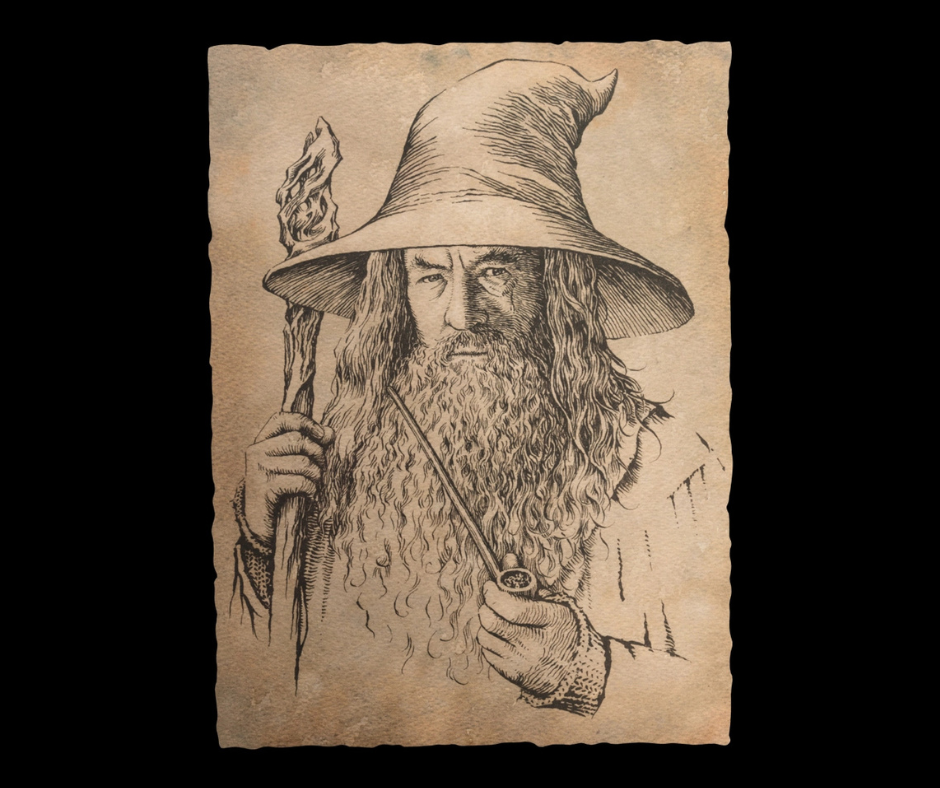
Gandalf, with his iconic flowing grey beard, his pointed hat that speaks of ancient lore, and the staff that serves as both a tool and a symbol of his authority, inhabits a world of magic and mythical creatures. Yet, beneath this fantastical veneer lies a core of qualities, a fundamental essence, that aligns remarkably with the defining principles of a modern elder. By delving deeper into Gandalf’s actions and his counsel throughout LOTR (and the Hobbit), we uncover a timeless model for those seeking to embrace the profound and evolving role of elderhood in our own world.
A Deep Wellspring of Hard-Earned Experience
One of the foundational tenets of the modern elder is not simply the accumulation of years, but the depth and breadth of life experiences that have shaped their understanding of the world. They are individuals who have weathered personal and societal storms, celebrated moments of profound joy, and, most importantly, extracted invaluable lessons from both triumph and tribulation. Gandalf, as one of the Istari – angelic beings sent to Middle-earth in human form millennia prior to the events of The Lord of the Rings – possesses an almost incomprehensible reservoir of experience. He has witnessed the ebb and flow of ages, the rise and fall of civilizations both great and small, and has engaged in battles against ancient evils that predate recorded history in the Tolkien timeline. This vast tapestry of lived history profoundly informs his judgment, allowing him to offer perspectives and insights that younger, less seasoned characters within Middle-earth simply cannot grasp. Consider his strategic counsel to the Fellowship of the Ring, advice drawn not just from tactical acumen but from centuries of understanding the insidious nature of darkness and the enduring power of hope, even in the face of overwhelming despair. His knowledge of ancient lore, forgotten languages, and the intricate web of Middle-earth’s history provides a crucial foundation for the Fellowship’s perilous quest.
The Transformative Power of Intentional Mentorship
A central and defining role of the modern elder is that of a mentor – an individual who consciously and compassionately guides, supports, and empowers others to discover their own potential and navigate their unique paths. Gandalf stands as the quintessential mentor figure throughout The Lord of the Rings. He recognizes the inherent courage within Frodo Baggins, nurturing his nascent bravery and guiding him through the daunting responsibility of bearing the One Ring. He patiently steers Aragorn towards embracing his rightful destiny as the king, offering both encouragement and challenging him to rise to the occasion. His interactions with the entire Fellowship are marked by timely and insightful advice, often delivered in cryptic yet ultimately illuminating ways. Crucially, Gandalf does not dictate or impose his will; instead, he illuminates possibilities, encourages critical thinking, and fosters self-reliance. His famous and oft-quoted line, “All we have to decide is what to do with the time that is given us,” perfectly encapsulates this empowering approach, emphasizing individual agency and the importance of choice rather than blind obedience to authority. He sees the potential in each member of the Fellowship, even the seemingly insignificant hobbits, and helps them recognize their own strengths.
Navigating the Inevitable Currents of Change with Grace and Adaptability
The modern world is characterized by a relentless and often disorienting pace of change. Modern elders, having witnessed numerous societal and personal transformations throughout their lives, possess a unique ability to navigate these shifting currents with a sense of perspective, resilience, and adaptability. Gandalf, despite his ancient origins and deep understanding of tradition, remains remarkably relevant and influential in a rapidly evolving Middle-earth. He recognizes the shifting tides of power, the emergence of new threats, and the need for unconventional alliances. His dramatic return as Gandalf the White after his battle with the Balrog in the Mines of Moria signifies not a nostalgic clinging to the past, but a powerful evolution. He embraces new responsibilities and wields a greater authority, demonstrating an ability to adapt and grow in the face of profound personal and external challenges. This transformation underscores the idea that true elderhood is not about stagnation, but about continued growth and relevance.
An Unwavering Anchor of Enduring Values
In a world often swayed by fleeting trends and shifting moral landscapes, modern elders often serve as vital anchors of enduring values. They embody principles such as integrity, compassion, resilience, and a deep-seated commitment to ethical conduct. Gandalf consistently demonstrates these fundamental qualities throughout his interactions. He exhibits unwavering loyalty to his friends and allies, remains steadfast in his commitment to the forces of good, and possesses a profound empathy for the struggles and vulnerabilities of others, especially the seemingly small and unassuming hobbits. His moral compass remains true and unwavering, providing a vital ethical framework for the other characters as they navigate the treacherous path towards Mordor and confront the seductive power of the Ring. His wisdom is not merely intellectual; it is deeply intertwined with a strong sense of justice and a profound understanding of the importance of compassion.
Influence Beyond Brute Force– The Power of Wisdom and Connection
While Gandalf undoubtedly possesses considerable magical power, his true and lasting strength lies not solely in his ability to wield spells and command the elements, but in his wisdom, his profound understanding of people and their motivations, and his remarkable ability to inspire hope and foster unity. Modern elders understand that true influence transcends physical capabilities or material wealth. Their power resides in their accumulated insights, their extensive networks of connections, and their capacity to see the larger, interconnected picture. Gandalf’s impact on the War of the Ring is not solely through his direct magical interventions, but perhaps more significantly through his strategic guidance, his ability to forge alliances between disparate factions (Elves, Men, Dwarves, and Hobbits), and his unwavering belief in the inherent capacity for good to triumph over evil, even when all seems lost. He understands the power of collaboration and the importance of recognizing the unique strengths that each individual and group brings to a common cause.
While Gandalf is undeniably a figure of fantasy, a powerful wizard inhabiting a richly imagined world, his essence resonates deeply with the core principles of the modern elder. He embodies the profound wisdom gained through millennia of experience, the transformative power of intentional mentorship, the crucial ability to navigate change with grace and adaptability, and the steadfastness of enduring core values. By thoughtfully examining his character, his actions, and his interactions with the world around him, we gain a richer and more nuanced understanding of the vital role that elders – both fictional and real – play in guiding, inspiring, and ultimately shaping the course of our journeys through life. Gandalf serves as a timeless reminder that true strength lies not just in overt power, but in the enduring wisdom of a life lived with purpose, integrity, and a generous spirit of guidance. His legacy extends far beyond the realm of fantasy, offering profound insights into the enduring value of elderhood in our own modern world.




 27gen.com