Transformation Hurts

If you are comfortable where you are, or if things are okay as they are, you wouldn’t go through transformation.

Only when the pain of changing things overcomes the pain of status quo would you ever consider transformation.

That’s where Starbucks found itself in early 2008. Chronicled in CEO Howard Schultz’s 2011 book Onward, Starbucks – at the apparent height of its success – was declining inwardly, and on the edge of declining outwardly. Onward details the transformation Starbucks went through in 2008-2010, utilizing a Transformation Agenda developed by the senior leadership team at Starbucks as the primary guide.

The Transformation Agenda featured 7 “Big Moves” – innovations and advancements designed to return Starbucks to its core practices. The Big Moves also contained one final, painful set of actions designed to reverse sales trends and bolster stock value.

600 stores closed.

12,000 partner positions eliminated in these stores.

1,000 non-store positions eliminated.

Schultz called it the most painful decision he has ever made. Only the certainty that closing the stores would keep Starbucks operational in the long run allowed him to make the decision. He understood the reasoning, but it was impossible to take the emotion out of the equation:

For all the flak about Starbucks’ ubiquity, almost every store maintained a devoted following inside and out. A soul. With each closing, we would be erasing a fingerprint, and that was a reality I could not possibly ignore.

Fast forward to the fall of 2010: Starbucks regained a healthy balance with a culture that celebrates creativity and discipline, entrepreneurship and process, as well as rigorous innovation. Their fiscal 2010 operating margin was the highest consolidated one in their 40-year history. The transformation worked.

But according to Schultz,

…perhaps the most valuable thing that came out of the two-year transformation was the confidence we gained knowing that we could preserve our values despite the hardships we faced. Holding fast to those values steadied us throughout the tumultuous journey, and the ways in which we conduct our business will continue to bring our partners pride and fuel their engagement as we continue to grow.

Success is not sustainable if it’s defined by how big you become. Large numbers are not what matter. The only number that matters is “one.”

brewed coffee in cup

One cup.

SB customer

One customer.

barista handing drink over counter

One partner.

SB interior

One experience at a time.


Question for ChurchWorld leaders:

What’s your “one”?

an updated post from a series reviewing Onward, by Howard Shultz

Onward

preparation for a new series coming soon on Leading the Starbucks Way, by Joseph Michelli

Print

Transformation Initiatives at Starbucks

A previous post was a brief look at the bold Transformation Agenda that Starbucks put into place early in 2008 to overcome their decline. The Agenda contained a mission statement and 7 Big Moves designed to return Starbucks to success.

Within a few months, at their April 2008 shareholders meeting, Starbucks rolled out the following six transformation initiatives:

  • The Mastrena – a finely crafted, Swiss made espresso machine that would provide baristas with the ability to give customers a high-quality consistent shot of espresso second to none, transforming the espresso experience in their stores. By the end of 2008 the machine was in 30% of stores, and by 2010 a majority of Starbucks had the Mastrena.
  • Conservation International – a partnership with CI, begun in 1998, was expanded so that Starbucks could buy fair-trade coffee, produced in shade-grown conditions with fair compensation and safe working conditions for coffee farm workers. By 2009, all Starbucks espresso beans and espresso-based products would qualify for a new marking designed to articulate their practices: Responsibly Grown. Ethically Traded. Proudly Served.
  • The Rewards Card – designed to recognize their most loyal customers with freebies, the Card addressed an emerging need for value. Existing Starbucks Card holders could register their cards online, instantly turning it into a Rewards Card.
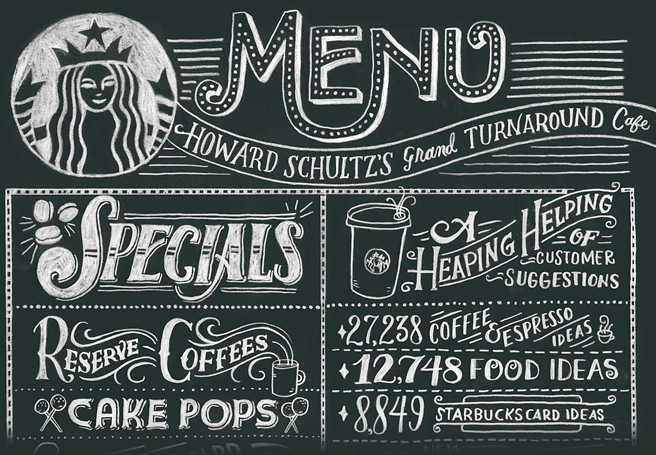
  • MyStarbucksIdea.com – an interactive website designed to listen to customers suggestions, rants, and comments. Moderated by 50 veteran Starbucks employees, the website was launched live by uploading ideas submitted by shareholders that morning. Within minutes, more ideas came streaming in from people listening to the meeting’s broadcast or following rolling blog posts. In the next 24 hours, over 7,000 ideas were posted.
  • Pike Place Roast – announcing that Starbucks would once again grind whole beans in their stores, two master baristas introduced Pike Place Roast, a smooth, well-balanced, lighter blend of coffee, designed to give full flavor while not being as bold as traditional blends.
  • Clover – a commercially viable way to replicate the benefits of the French Press method of brewed coffee, Clover was a local invention acquired by Starbucks early in 2008. It created a fantastic cup of coffee at a pace designed to keep up with the demand of most Starbucks stores.

SB turnaround menu fastcompany.com

Seven Big Moves.

Six Transformation Initiatives.

All of these engaging tools that helped Starbucks navigate through a very unpredictable journey, one milestone at a time.

The initiatives introduced at that meeting each heralded a return to the core values of Starbucks – coffee, customers, innovation, and values – but they weren’t enough by themselves to bring the company back from the brink.

Painfully personal decisions were the final step in the transformation.

Lessons for ChurchWorld

  • Take a look at the initiatives above, and translate them into your world. What actions can you dream up – and then put into action – that would help you accomplish your transformation agenda?
  • Are you secure enough in your core values to put anything – and everything – on the table?
  • Transformation is not just about nuts and bolts, about systems and processes. Is your vision lived out in the lives of your people?

an updated post from a series reviewing Onward, by Howard Shultz

Onward

preparation for a new series coming soon on Leading the Starbucks Way, by Joseph Michelli

Print


Ones Add Up

Starbucks’ CEO Howard Schultz’s 2011 book Onward details the amazing comeback story of Starbucks: after more than three decades of success, in 2008 they found themselves with sales sliding at a distressing rate, a falling stock value, and relentless competition. Compounding the problem, the world’s economy was in a tailspin.

With aggressive, sometimes painful moves and a powerful transformation agenda to guide them, they were able to reverse their decline, and by the end of 2010 were once again on top of their game.

What happened?

Here’s an excerpt from the book that gives you a big clue:

Like a doctor who measures a patient’s height and weight every year without checking blood pressure or heart rate, Starbucks was not diagnosing itself at a level of detail that would help ensure its long-term health. We predicated future success on how many stores we opened during a quarter instead of taking the time to determine whether each of those stores, would, in fact, be profitable. We though in terms of millions of customers and thousands of stores instead of one customer, one partner, and one cup of coffee at a time.

With such a mind-set, many little things dangerously slipped by unnoticed, or at least went unacknowledged. How could one imperfect cup of coffee, one unqualified manager, or one poorly located store matter when millions of cups of coffee were being served in tens of thousands of stores?

We forgot that “ones” add up.

courtesy freemarketmediagroup.com

courtesy freemarketmediagroup.com

Lessons for ChurchWorld:

  1. What “business” are you in?
  2. What are the roots of that business?
  3. It’s okay to have a 30,000 foot view, but eventually you’ve got to land the plane.
  4. You’ve got to produce results.
  5. You may see the crowds, but never forget the “ones“.

an updated post from a series reviewing Onward, by Howard Shultz

Onward

preparation for a new series coming soon on Leading the Starbucks Way, by Joseph Michelli

Print


Change Lessons from Starbucks

Readers know of my fondness of using Starbucks as a model for excellence in Guest Experiences. Over the past several years I have probably referred to them a couple of dozen times or more. One of my most requested presentations on an introduction to Guest Experiences uses Starbucks as a model. When something works well, and can serve as a model for what churches can do, why not use it?

There’s a flip side to Starbucks as well. In late 2007, the company was not doing well, and the future looked bleak. To address the emerging problems, former CEO Howard Schultz, who had stepped aside almost eight years earlier to become chairman of the board, did something unexpected: he returned as CEO to oversee day-to-day operations.

Schultz came back to Starbucks with a passion and a plan, and over the next two years, Starbucks returned to sustainable, profitable growth.

Schultz has recounted this story in Onward, released in 2011. It is a fascinating and extraordinarily intimate look at Schultz’s leadership – one that I think church leaders would find appropriate for their own journey.

Onward also serves as a great refresher and prelude to a brand new book on Starbucks: Leading the Starbucks Way, by Joseph Michelli. It was just released and I am currently working through it, preparing a new series of leadership principles demonstrated by your friendly neighborhood baristas at Starbucks.

So, for the next few days, I want to dive back into Onward and pull out some lessons for ChurchWorld leaders. What’s the best place to start?

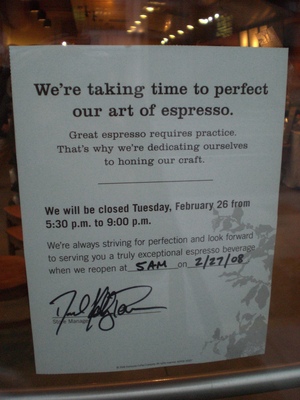
A closed sign.

On February 26, 2008 – the following sign appeared on all 7,100 Starbucks stores in the US as they closed for three hours:

SB barista training store closed

That’s right – Starbucks closed the doors early and spent three hours retraining the baristas to make sure they were doing their best. Touted by some as a marketing stunt, taken advantage of by the competitors, losing over $6 million dollars – what was up with Starbucks?

It was a symbolic act – three hours of education would not solve the huge problems Starbucks was facing.

But it worked.

Over the next year and a half, Starbucks followed a “Transformation Agenda” that provided some great leadership principles that leaders in ChurchWorld will find helpful. Here is a summary from Schultz listing those leadership lessons:

  • Grow with discipline.
  • Balance intuition with rigor.
  • Innovate around the core.
  • Don’t embrace the status quo.
  • Find new ways to see.
  • Never expect a silver bullet.
  • Get your hands dirty.
  • Listen with empathy and over communicate with transparency.
  • Tell your story, refuse to let others define you.
  • Use authentic experiences to inspire.
  • Stick to your values, they are your foundation.
  • Hold people accountable but give them the tools to succeed.
  • Make the tough choices; it’s how you execute that counts.
  • Be decisive in times of crisis.
  • Be nimble.
  • Find truth in trials and lessons in mistakes.
  • Be responsible for what you see, hear and do.
  • Believe.

Ready to learn from Starbucks’ painful journey of transformation?

an updated post from a series reviewing Onward, by Howard Shultz

Onward 

preparation for a new series coming soon on Leading the Starbucks Way, by Joseph Michelli

Print

Zappos: Where Customer Service Means Action and People

Customers will say “wow” in response to service in two basic circumstances:

  1. When you exceed their expectations
  2. When you make a personal emotional connections with them

Zappos excels at exceeding expectations.

Today is the fifth session of Summer Term II of the 2013 GsD program with Applied Guestology 201, a review of some of the leading organizations who deliver exemplary Guest Experiences with application to ChurchWorld.

Zappos

Zappos. The name has come to stand for a new standard of customer service, and amazing online shopping experience, a great place to work, and one of the most amazing transformational business success stories you will ever hear.

And it all started in 1999 when founder Nick Swinmurn could not find a specific pair of shoes at his local mall. That same year, Swinmurn approached friends Tony Hsieh and Alfred Lin with the idea of selling shoes online. Hsieh was initially skeptical, and almost deleted Swinmurn’s voice mail. Fortunately he didn’t, and his venture capital firm invested $2 million in the idea. Soon Hsieh was having so much fun he bought out the other partners and became CEO of the company.

In the beginning, Zappos struggled, but their intense focus on culture soon paid dividends as the company reached the $1 billion gross sales annual mark in 2008. In 2009 Zappos was acquired by Amazon, but allowed to remain operating as an independent company.

How important is customer service to Hsieh?

We want to be the best in customer service. We are a customer service company that sells shoes.

And that is achieved by exceeding expectations.

The double-edged sword of exceeding customer expectations is that once you deliver extraordinary service, extraordinary can become ordinary and expected. Zappos has created a legion of raving fans that use social media to talk incessantly to their families, friends, colleagues, and neighbors about the service excellence of the brand. That, coupled with significant media attention about service speed at Zappos as well as free upgrades, has produced high expectations for service delivery.

Some leaders might see the ever-escalating nature of customer expectations as an exercise in futility. What’s the point of delivering great service if it will soon just become good service? The immediate answer is that if you don’t keep reaching, your average service will soon become poor.

Truthfully, providing great service is never-ending and, at times, frustrating. Whether you compare yourself to world-class service providers, constantly adjust to customers’ increasing expectations, or simply try to be better than you were the day before, service excellence is a dynamic, challenging, and rewarding journey.

When your service delivery becomes predictable, it is probably time to recalibrate and look for additional ways to exceed customer expectation. Zappos is always looking for avenues to positively surprise customers and meet the “predictability challenge.”

Zappos diligently looks for effective ways to improve its operational excellence, increase personal service delivery, and go beyond the predictability challenge to exceed expectations and surprise customers.

Here is how CEO Tony Hsieh encourages organizations in the area of customer service:

10 Ways to Instill Customer Service Into Your Company

  1. Make customer service a priority for the whole company, not just a department. A customer service attitude needs to come from the top.
  2. Make WOW a verb that is part of your company’s everyday vocabulary.
  3. Empower and trust your customer service reps. Trust that they want to provide great service…because they actually do. Escalations to a supervisor should be rare.
  4. Realize that it’s okay to fire customers who are insatiable or abuse your employees.
  5. Don’t measure call times, don’t force employees to upsell, and don’t use scripts.
  6. Don’t hide your 1-800 number. It’s a message not just to your customers, but to your employees as well.
  7. View each call as an investment in building a customer service brand, not as an expense you’re seeking to minimize.
  8. Have the entire company celebrate great service. Tell stories of WOW experiences to everyone in the company.
  9. Find and hire people who are already passionate about customer service.
  10. Give great service to everyone: customers, employees, and vendors.

Application for ChurchWorld

Could you apply some of the same principles that Zappos does in the Guest Services Team at your church?

  • How much do you know about your Guests’ wants, needs, and desires?
  • What have you done to design a Guest experience that not only responds to Guest needs but also anticipates them?
  • Have you mapped your Guest journey across all contact points?
  • What are the small and epic acts that make up your Guest service story?
  • What do people remember about the way contact with your organization made them feel?
  • What are the stories circulating about your organization’s Guest services practices?
  • How are you capturing and retelling large and small WOWS delivered by your team?

It works for Zappos; it can work at your church, too.

Recommended Reading for this session:

Delivering Happiness, Tony Hsieh

The Zappos Experience, Joseph A. Michelli

(for a complete reading list, see The Essential Guest Experience Library)

Guestology – the art and science of knowing and understanding your guests – is a term originated by Bruce Laval of the Walt Disney Company. The use of GsD is a tongue-in-cheek acknowledgment that organizations that really want to understand and deliver a WOW Guest Experience need to study the best practices and principles in use today, and then adapt them to the context of their own environment.

 the GsD (Doctor of Guestology) journey: 2nd Term Summer 2013

Puttin on The Ritz…

When it comes to refined service and exquisite hospitality, one name stands high above the rest: The Ritz-Carlton Hotel Company. With ceaseless attention to every luxurious detail, the company has set the bar for creating memorable customer experiences in world-class setting.

With unprecedented access to the company’s executives and staff, best-selling author and business consultant Joseph Michelli obtained the leadership secrets behind the company’s extraordinary success. In “The New Gold Standard,” Michelli takes an exclusive tour behind the scenes of The Ritz-Carlton and comes away with great reference work for church Guest Services Teams who want to learn and apply principles of a WOW! Experience to their own practices.

Michelli develops “5 Leadership Principles for Creating a Legendary Customer Experience” that you can explore in the book. I’ll take a look at those principles in a later post. First, here’s a quick look behind the brass lion that symbolizes excellence at the Ritz:

The Credo

  • The Ritz-Carlton is a place where the genuine care and comfort of our guests is our highest mission
  • We pledge to provide the finest personal service and facilities for our guest who will always enjoy a warm, relaxed, yet refined ambiance
  • The Ritz-Carlton experience enlivens the senses, instills well-being, and fulfills even the unexpressed wished and needs of our guests

The Three Steps of Service

  • A warm and sincere greeting, using the guest’s name
  • Anticipation and fulfillment of each guest’s needs
  • A fond farewell, giving a warm goodbye, and using the guest’s name

Service Values of Ritz-Carlton Staff

  • I build strong relationships and create Ritz-Carlton guests for life
  • I am always responsive to the expressed and unexpressed wishes and needs of our guests
  • I am empowered to create unique, memorable, and personal experiences for our guests
  • I understand my role in achieving the Key Success Factors, embracing community footprints, and creating the Ritz-Carlton mystique
  • I continually seek opportunities to innovate and improve the Ritz-Carlton experience
  • I own and immediately resolve guest problems
  • I create a work environment of teamwork and lateral service so that the needs of our guests and each other are met
  • I have to opportunity to continuously learn and grow
  • I am involved in the planning of the work that affects me
  • I am proud of my professional appearance, language, and behavior
  • I protect the privacy and security of our guests, my fellow employees, and the company’s confidential information and assets
  • I am responsible for uncompromising levels of cleanliness and creating a safe and accident-free environment

Gold standard indeed! These are priceless nuggets of truth that you can mine and put into practice in your Guest Services team immediately…

Why not start this week?

Utilizing the Power of the Lineup with Your Guest Services Team

It’s one thing to have a Credo, Three Steps of Service, and 12 Service Values like the Ritz-Carlton (see the post here for more details on these Gold Standards). Many businesses go through the exercise of defining key values or composing mission statements. They might even display them in their literature, or in imposing art displays on the corporate walls.

But how many business leaders understand the importance of regular and repetitive presentation of these core aspects of their business – not only to management, but also to their front-line staff?

Enter the “lineup” at Ritz-Carlton.

To truly appreciate the Ritz-Carlton leadership approach to repeated dissemination of the “Gold Standards” mentioned above, you would have to drop in on a section of the housekeeping staff as they prepare for their days work – or at the corporate headquarters – or in the kitchen of the fine restaurants that serve the hotel chain – or anywhere, and everywhere, throughout the entire organization.

You would observe that a meeting is taking place at the beginning of each shift. Not just any meeting, though: the leader in each group starts by sharing the Credo and talking about the importance of creating a unique guest experience. Another team member might share a guest story from a Ritz-Carlton hotel in another country. Another team member shares how what they do in their department helps create memorable guest experiences. Then a few quick announcements, special recognitions are given, and another team member closes the meeting with a motivational quote.

All in about 20 minutes.

Every day.

On every shift.

In every Ritz-Carlton hotel and office around the world.

The magic of the lineup involves the following:

  • Repetition of values – the core belief that values need to be discussed daily, and that values can’t be discussed enough
  • Common language – shared phrases across all tasks binds the team together
  • Visual symbols – The Credo is printed on a card that all team members carry at all times
  • Oral traditions – Personal, direct, and face-to-face communication makes a huge impact in a world increasingly dominated by e-mail, text, and voice messages
  • Positive storytelling – stories communicate life in a powerful and memorable way
  • Modeling by leaders – the active, daily presence of the leaders communicates the importance of the time together

What would “lineup” for each of your Guest Services teams do to preserve the core values, communicate the importance of everyone on the team, and provide momentum for the day’s activities?

Or how about this word for the process?

Alignment.

Speed Reading Week, Day 3

The Zappos Experience: 5 Principles to Inspire, Engage, and WOW, by Joseph Michelli

Zappos – the name has come to stand for a new standard of customer experience, and amazing online shopping experience, and the most impressive transformational business success story of our time. Simply put, Zappos is revolutionizing business and changing lives.

 CEO Tony Hsieh documented the Zappos story in his excellent book Delivering Happiness. I encourage you to read it to get Hsieh’s personal insights on the evolution of Zappos.

Michelli’s book The Zappos Experience takes you through – and beyond – the playful, off-beat company culture Zappos has become famous for. Michelli reveals what occurs behind the scenes at Zappos, showing how employees at all levels operate on a day-to-day basis while providing the “big picture” leadership methods.

Michelli breaks the approach down into five key elements:

Serve a Perfect Fit – create bedrock company values

Make it Effortlessly Swift – deliver a customer experience with ease

Step into the Personal – connect with customers authentically

S T R E T C H – grow people and products

Play to Win – play hard, work harder

When you enhance the customer experience, increase employee engagement, and create an energetic culture, you can’t help but succeed. Zappos has woven these five key components into a seamless strategy that’s the envy of business leaders.

The Zappos Experience is much too detailed to adequately treat in this short post.  Applications for ChurchWorld abound. Here’s one example for you to think about:

Zappos’ customer service is legendary for how it handles the huge volume of merchandise shipments. Members of the Customer Loyalty Team take a huge amount of pride in their customer interactions.

Could you apply the same principles in the Guest Services Team at your church?

  • What are the small and epic acts that make up your service story?
  • What do people remember about the way contact with your organization made them feel?
  • What are the stories circulating about your organization’s guest services practices?
  • How are you capturing and retelling large and small WOWS delivered by your team?

It works for Zappos; it can work at your church, too.