
The COVID-19 pandemic, increasingly frequent climate disasters, a new war – events we might have called “unimaginable” or “unthinkable” in the past are now reality. Today it feels more challenging than ever to feel unafraid, hopeful, and equipped to face the future with optimism. How do we map out our lives when it seems impossible to predict what the world will be like next week, let alone next year or next decade? What we need now are strategies to help us recover our confidence and creativity in facing uncertain futures.
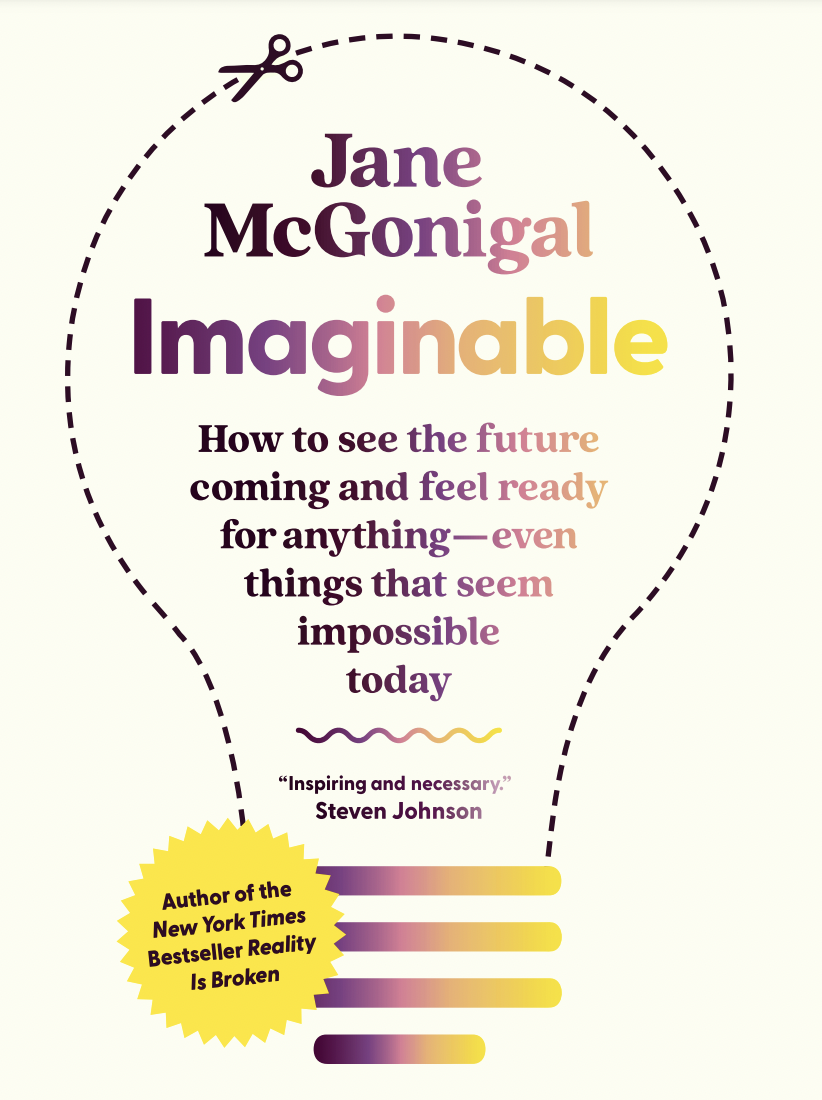
In Imaginable, Jane McGonigal draws on the latest scientific research in psychology and neuroscience to show us how to train our minds to think the unthinkable and imagine the unimaginable. She invites us to play with the provocative thought experiments and future simulations she’s designed exclusively for this book, with the goal to:
- Build our collective imagination so that we can dive into the future and envision, in surprising detail, what our lives will look like ten years from now
- Develop the courage and vision to solve problems creatively
- Take actions and make decisions that will help shape the future we desire
- Access “urgent optimism,” an unstoppable force within each of us that activates our sense of agency
Imaginable teaches us to be fearless, resilient, and bold in realizing a world with possibilities we cannot yet imagine—until reading this transformative, inspiring, and necessary book.
In Imaginable: How to See the Future Coming and Feel Ready for Anything―Even Things That Seem Impossible Today, futurist and game designer Jane McGonigal presents a compelling case for the power of imagination in preparing for and shaping the future. Published in 2022, the book draws on McGonigal’s extensive experience in future forecasting and game design to offer readers practical tools and strategies for envisioning and adapting to potential future scenarios.
McGonigal’s central argument is that by actively imagining various future possibilities, we can better prepare ourselves mentally and emotionally for change, increase our resilience, and even influence the direction of future events. She contends that many seemingly “unimaginable” events are actually quite predictable if we learn to look for the right signals and think more expansively about potential outcomes.
The book is divided into three main sections:
- Why we need to imagine the unimaginable
- How to imagine the unimaginable
- What to do with our imagination
Throughout these sections, McGonigal introduces readers to various futuring techniques, including scenario planning, signal spotting, and her own “urgent optimism” approach. She also shares numerous examples of how these techniques have been applied in real-world situations, from pandemic preparedness to climate change adaptation.
Key Concepts and Takeaways
Urgent Optimism: McGonigal introduces this concept as a mindset that combines a sense of agency with hope for the future. By imagining potential challenges and opportunities, we can feel more motivated and capable of taking action in the present.
10-year Future Thinking: The author emphasizes the importance of thinking on a 10-year time scale, arguing that this timeframe is long enough to envision significant changes but short enough to feel personally relevant.
Scenario Planning: McGonigal details various methods for creating and exploring future scenarios, encouraging readers to consider both positive and negative possibilities.
Signal Spotting: The book teaches readers how to identify early indicators of future trends and potential disruptions, enhancing their ability to anticipate and prepare for change.
Collective Intelligence: McGonigal highlights the value of diverse perspectives and collaborative imagination in futuring exercises.
Simulations and Games: Drawing on her background in game design, the author illustrates how simulations and games can be powerful tools for exploring future scenarios and building adaptive skills.
Strengths of the Book
- Accessibility: McGonigal’s writing style is engaging and accessible, making complex futuring concepts approachable for a general audience.
- Practical Exercises: The book includes numerous exercises and thought experiments that readers can use to develop their own futuring skills.
- Real-World Examples: McGonigal provides a wealth of case studies and examples that illustrate the practical applications of futuring techniques.
- Interdisciplinary Approach: The author draws on insights from psychology, sociology, economics, and other fields to provide a well-rounded perspective on future thinking.
- Optimistic Outlook: While acknowledging potential challenges and risks, the book maintains an overall optimistic tone that empowers readers to take an active role in shaping the future.
Potential Weaknesses
- Bias Towards Technological Solutions: Some critics may argue that the book places too much emphasis on technological solutions to future challenges, potentially overlooking other important factors.
- Western-Centric Perspective: While McGonigal does include some global examples, the book’s perspective is primarily rooted in Western, developed-world contexts.
- Overwhelm Factor: The sheer number of potential future scenarios and techniques presented may be overwhelming for some readers, potentially leading to analysis paralysis rather than action.

Imaginable is a thought-provoking and empowering book that challenges readers to expand their thinking about the future. Jane McGonigal successfully demystifies the process of future forecasting and provides practical tools for individuals and organizations to enhance their adaptive capacity.
The book’s strengths lie in its accessible presentation of complex ideas, its wealth of practical exercises, and its optimistic yet grounded approach to future thinking. McGonigal’s expertise in game design and simulations adds a unique perspective to the field of futurism, offering innovative ways to engage with potential future scenarios.
While the book may at times feel overwhelmingly comprehensive or skew towards technological solutions, these minor drawbacks are outweighed by the valuable insights and actionable strategies it provides. “Imaginable” is particularly relevant in our rapidly changing world, where the ability to anticipate and adapt to new challenges is increasingly crucial.
For readers interested in personal development, organizational strategy, or simply expanding their cognitive horizons, Imaginable offers a compelling roadmap for navigating an uncertain future. By encouraging us to exercise our “imagination muscles,” McGonigal ultimately empowers us to become active participants in shaping the world of tomorrow.
Whether you’re a business leader, policy maker, educator, or simply an individual curious about what the future might hold, Imaginable provides valuable tools and perspectives for envisioning and preparing for the challenges and opportunities that lie ahead. In a world where change is the only constant, McGonigal’s work serves as a guide to not just surviving, but thriving in the face of uncertainty.

Part of a regular series on 27gen, entitled Wednesday Weekly Reader.
During my elementary school years one of the things I looked forward to the most was the delivery of “My Weekly Reader,” a weekly educational magazine designed for children and containing news-based current events.
It became a regular part of my love for reading, and helped develop my curiosity about the world around us.
 27gen.com