
Porch Revival: How an Architectural Classic Reclaimed Its Place in Modern Living
The porch, a quintessential element of American residential architecture, underwent significant transformations in the latter half of the 20th century and into the 21st century. Once a ubiquitous feature of homes across the country, the porch experienced a decline in popularity during the post-World War II era, only to experience a resurgence in recent decades.
The Mid-20th Century Decline
In the 1950s and 1960s, the rise of suburban living and the prevalence of air conditioning contributed to the diminishing role of porches. As families embraced a more private, indoor lifestyle, porches were often seen as unnecessary appendages or relics of a bygone era. Ranch-style homes, which were popular during this period, frequently lacked prominent porch spaces, favoring a sleek, minimalist aesthetic.
The Return of the Porch: 1970s-1990s
By the 1970s and 1980s, a renewed appreciation for traditional architectural styles and a growing interest in outdoor living began to revive the porch’s popularity. The resurgence of Victorian and Craftsman-style homes brought back the iconic wraparound porch, while contemporary designs incorporated more modest porch elements.
During this period, porches evolved to serve multiple functions beyond their traditional role as social gathering spaces. They became extensions of indoor living areas, offering additional seating and entertaining spaces for homeowners. The porch also emerged as a transitional zone between the home’s interior and the outdoors, blurring the boundaries between private and public spaces.
The Modern Porch: 2000-Present
In the 21st century, porches have continued to evolve, reflecting changing lifestyles and architectural trends. Here are some notable developments:
Outdoor Living Spaces: Porches have become integrated into larger outdoor living areas, featuring comfortable seating, outdoor kitchens, and entertainment systems. This trend has blurred the lines between indoor and outdoor spaces, creating seamless transitions between the two.
Sustainable Design: With an increased emphasis on environmental sustainability, porches have been designed to incorporate eco-friendly features such as natural ventilation, shading devices, and energy-efficient lighting. These elements contribute to the overall energy efficiency of the home while providing comfortable outdoor spaces.
Versatile Functionality: Contemporary porches often serve as multifunctional spaces, accommodating a variety of activities. From outdoor dining areas to home offices or exercise spaces, porches have become adaptable extensions of the home’s interior.
Aesthetic Diversity: While traditional porch styles like wraparounds and covered entries remain popular, architects and designers have also explored more modern interpretations. These include minimalist designs with clean lines, cantilevered structures, and the integration of innovative materials like glass and steel.
As societal values and architectural trends continue to evolve, the porch remains a beloved and adaptable element of American residential design. Its ability to seamlessly blend indoor and outdoor living, while reflecting changing lifestyles and sustainability goals, ensures its enduring relevance in the 21st century and beyond.
If you want to build community and attachment to where you live, scientists and neighbors agree: a front porch is just the ticket.
After more than a hundred years of inordinate fondness, Americans at the middle of the twentieth century discarded the porch as old-fashioned, obsolete, and valueless – until a blend of conservation and revival began to restore it to a place of honor and utility. The porch will never be what it once was, but neither will it vanish. Instead, after 150 years of yawing from ubiquity to rejection, the porch will hold its place as a standard element of domestic American architecture, and we will all be the better for that.
Michael Dolan

During the last decades of the Twentieth Century, outdoor life shifted away from the fronts of the houses. Before WW II, even fairly humble houses had front porches where people spent part of their free time. Upper-middle-class houses frequently had side porches. In the half-century after the war, family leisure gravitated to back yards, which are now routinely equipped with decks or patios. In other words, private areas behind the houses have been upgraded, while public areas facing the streets and sidewalks have surrendered much of their social importance.
Philip Langdon
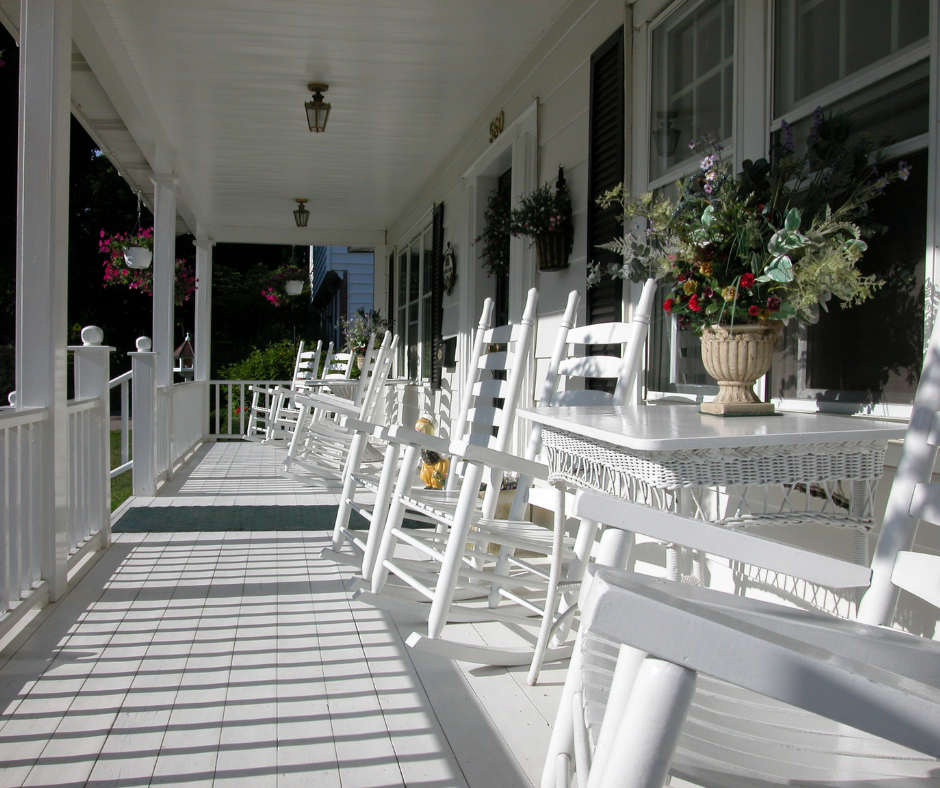
We thought that the point of requiring porches on the fronts of houses was for environmental reasons – to cool the air doing into the house. We realized after the houses were up that everybody saw the social component of the porch – it status as the important in-between space separating the pubic realm from the private realm.
Elizabeth Plater-Zyberk
People like the image of a porch; it takes them back to simplicity, it conjures up the symbol of ‘I want to go there,’ and the porch takes them there.
Niedra North
For author Michael Dolan, if an American porch is really to be an American porch, it has to have some Americans on it. Latter-day porches often honor that principle in the breach. Instead of serving as community-oriented centers of conviviality and welcome, these porches stand, with their perfectly-placed rockers and adroitly-arranged tchotchkes, as illustrations of the hospitality folks would extend if only they weren’t so busy being busy, and if only being sociable didn’t intrude so much on their private lives.
He believes that if more houses had porches more people will have the chance to sit on them.
It that were the case, he continued, in time, as it had been for him with his older neighbors when he moved to the neighborhood, the first names would come, and then the friendships – and if not friendship, then neighborhood cordiality, that pleasant state in which you and the guy next door know one another well enough to say hello from the porch or to invite one another up to sit in a rocker or the glider.

Bringing Hospitality Back to Your Porch
Simply put, the front porch is too good an idea to be allowed to slip away, even if the hospitality we display is more theoretical than real.
– Michael Dolan
The good ol’ American front porch seems to stand for positivity and openness; a platform from which to welcome or wave farewell; a place where things of significance could happen.
– Dan Stevens
Make your front porch a part of your home, and it will make you a part of the world.
– John Sarris
My porch represents what I want my house to be: sheltering and communal, private and welcoming, a quiet vantage point from which to greet the whole world.
– Melody Warnick
Inspired by these books:

The American Porch, by Michael Dolan
This Is Where You Belong, by Melody Warnick
A Better Place to Live, by Philip Langdon


 27gen.com