
Ernest Shackleton, a name synonymous with courage, perseverance, and leadership, embarked on one of the most perilous expeditions in history: the Imperial Trans-Antarctic Expedition. Aboard the ship Endurance, he and his crew set sail in 1914, aiming to traverse the Antarctic continent from Weddell Sea to Ross Sea. While the expedition ultimately failed to reach its goal, Shackleton’s leadership during the subsequent ordeal has become a legendary tale of human endurance and resilience.
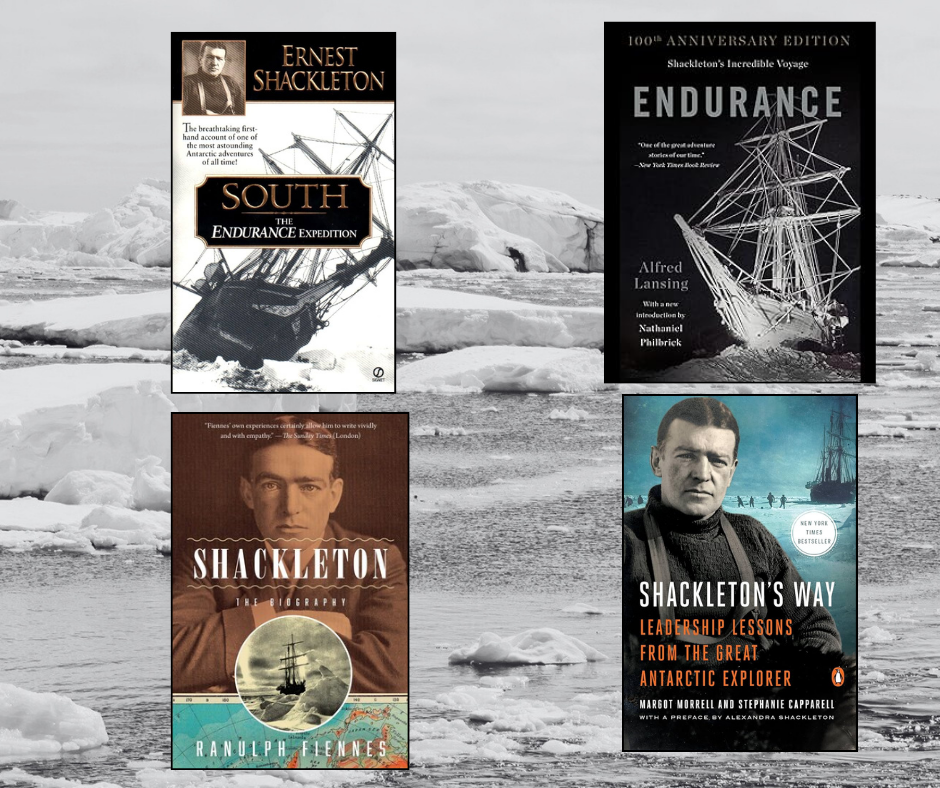
South is Ernest Shackleton’s account of the Imperial Trans-Antarctic Expedition, which took place from 1914 to 1917. This was an attempt to cross the South Pole from sea to sea. Disaster struck this expedition when its ship, Endurance, became trapped in pack ice and was slowly crushed before the shore parties could be landed. The crew escaped by camping on the sea ice until it disintegrated, then by launching the lifeboats to reach Elephant Island and ultimately South Georgia Island, a stormy ocean voyage of 720 nautical miles. Shackleton’s most famous exploit brought him praise for his leadership abilities in saving all the men.
Endurance is the definitive account of Ernest Shackleton’s fateful trip. Alfred Lansing brilliantly narrates the harrowing and miraculous voyage that has defined heroism for the modern age.
Shackleton:The Biography is an engaging account of the adventurer, his life and his incredible leadership under the most extreme of circumstances. Written by polar adventurer Sir Ranulph Fiennes who followed in Shackleton’s footsteps, he brings his own unique insights to bear on these infamous expeditions. Shackleton is both re-appraisal and a valediction, separating the man from the myth he has become.
Sir Ernest Shackleton has been called “the greatest leader that ever came on God’s earth, bar none” for saving the lives of the twenty-seven men stranded with him in the Antarctic for almost two years. Because of his courageous actions, he remains to this day a model for great leadership and masterful crisis management. Now, through anecdotes, the diaries of the men in his crew, and Shackleton’s own writing, Shackleton’s leadership style and time-honored principles are translated for the modern business world. Written by two veteran business observers and illustrated with ship photographer Frank Hurley’s masterpieces and other rarely seen photos, Shackleton’s Way helps today’s leaders follow Shackleton’s triumphant example.
Shackleton’s expedition faced numerous challenges from the outset. The Endurance became trapped in the Weddell Sea ice and was eventually crushed and sunk. Stranded in Antarctica with no hope of rescue, Shackleton and his crew faced the prospect of a slow, agonizing death. Yet, under Shackleton’s unwavering leadership, they survived.
Shackleton’s leadership during this ordeal was remarkable. He demonstrated a series of qualities that would be invaluable to modern leaders.
1. Resilience and Adaptability: When faced with the seemingly insurmountable challenge of the Endurance’s destruction, Shackleton did not despair. Instead, he adapted to the new circumstances and formulated a plan to survive. He understood that rigidity was a luxury they could not afford and that flexibility was essential for their survival.
2. Empathy and Compassion: Shackleton’s concern for the well-being of his crew was paramount. He recognized that their physical and mental health was crucial to their survival. He created a sense of camaraderie and unity among the men, ensuring that they supported one another through the hardships.
3. Strategic Thinking: Shackleton’s decision to abandon the Endurance and make a perilous journey in small boats to South Georgia Island was a bold and strategic one. He recognized that their chances of survival were better if they could reach a populated area. His ability to think critically and make tough decisions in the face of uncertainty was essential to their success.
4. Hope and Optimism: In the darkest of times, Shackleton maintained a positive outlook. He instilled hope in his crew, believing that they would eventually be rescued. His optimism served as a beacon of light, guiding them through the trials and tribulations they faced.
5. Courage and Determination: Shackleton’s courage and determination were unwavering. He never gave up, even when the odds were against him. His perseverance inspired his crew to push their limits and endure the unimaginable.
Shackleton’s leadership during the Endurance expedition provides valuable lessons for modern leaders. His resilience, empathy, strategic thinking, hope, and courage are qualities that are essential for success in any challenging environment. By studying his example, we can gain insights into how to navigate adversity, inspire others, and achieve our goals.
Ernest Shackleton’s leadership during the Endurance expedition is a testament to the power of human spirit. His unwavering determination, empathy, and strategic thinking allowed him to lead his crew to safety, even in the face of overwhelming odds. His legacy continues to inspire and motivate people around the world, serving as a reminder of the importance of resilience, hope, and the human capacity for survival.

Part of a regular series on 27gen, entitled Wednesday Weekly Reader.
During my elementary school years one of the things I looked forward to the most was the delivery of “My Weekly Reader,” a weekly educational magazine designed for children and containing news-based current events.
It became a regular part of my love for reading, and helped develop my curiosity about the world around us.
 27gen.com