
The origins of today’s “Wednesday Weekly Reader” began in 1989, continued over the years, culminating (to date) in the fall of 2025 – making it the longest time frame discussed. Today’s article also differs in that it covers multiple books (19) by the same author, but connected through 6 generations of family. Finally, these books are fiction, though they often reference historical fact.
While I do read a great deal of fiction, I don’t typically write about it. Exceptions include when there are some really good books ABOUT fiction (as in works about the writings of J.R.R. Tolkien and Arthur Conan Doyle) and when I discover an exceptional author who excels at his craft.
That author would be Stephen Hunter, and the books referenced revolve around the person of Bob Lee Swagger and his ancestors (going back to the 1780s) and his descents (one son and two daughters, with potential stories to come).
In 1993, a new kind of American hero burst onto the literary scene, a weary veteran haunted by his past, possessing a lethal skill that few could match. That year, Stephen Hunter published Point of Impact, introducing the world to Bob Lee Swagger, “the Nailer,” a retired Marine Corps sniper drawn back into a shadowy world of conspiracy and assassination. Little did readers know, this gripping thriller was merely the first shot in what would become a sprawling, multi-generational saga, one that meticulously built a family legacy of marksmen, lawmen, and warriors stretching back over two hundred years.
Stephen Hunter: The Architect of the Swaggerverse
Before he became the architect of the Swaggerverse, Stephen Hunter was already a celebrated voice. A Pulitzer Prize-winning film critic for The Baltimore Sun and later The Washington Post, Hunter brought a keen eye for action, character, and historical detail to his fiction. His early standalone thrillers like The Master Sniper (1980) showcased his ability to craft taut narratives with complex protagonists. However, it was with Point of Impact that Hunter found his definitive voice and character, setting the stage for an ambitious exploration of American history, military prowess, and the complicated ethics of violence.
The Genesis: Bob Lee Swagger and the Weight of the Past

Point of Impact introduced Bob Lee Swagger, a Vietnam veteran living in self-imposed exile in the Arkansas wilderness. His exceptional talent with a rifle, honed in the jungles of Southeast Asia, made him a legend, but also a target. Framed for a presidential assassination plot, Bob Lee is forced to confront the forces that shaped him and the corrupt powers that seek to exploit his skills. The novel’s success was immediate, captivating readers with its intricate plotting, authentic ballistic detail, and a hero who was both deadly and deeply human. Hunter continued weaving stories of Bob Lee into national events over the years, with 12 books to date.
What truly elevated the Swagger series beyond a typical thriller franchise was Hunter’s decision to delve into Bob Lee’s lineage. Early books hinted at a formidable father, Earl Swagger, a Medal of Honor recipient from Iwo Jima. This seed of curiosity blossomed into a full-fledged prequel series, beginning with Hot Springs in 2000.
Earl Swagger: Unearthing the Father’s Legend

The Earl Swagger novels – Hot Springs (2000), Pale Horse Coming (2001), Havana (2003), and later The Bullet Garden (2023) – transport readers to the mid-20th century. Earl is a man forged in the brutal fires of World War II and Korea, a Marine First Sergeant who returns to his native Arkansas to become a lawman. His stories explore a different kind of American violence, set against the backdrop of post-war corruption, the rise of organized crime in places like Hot Springs, and the racial tensions of the Jim Crow South.
Earl is a man of his time, driven by a rigid moral code and an almost primitive sense of justice. His adventures reveal the deep roots of the Swagger family’s values: a fierce independence, an unwavering commitment to truth, and an unparalleled proficiency with firearms. Through Earl, Hunter began to show how the “Swagger gift” – that uncanny ability to shoot with pinpoint accuracy – was a generational inheritance, not merely a skill acquired through training.
Ray Cruz: The Sniper’s Unknown Son

After authoring six books with Bob Lee Swagger as the main character, and another three showcasing his father Earl Swagger, in 2010 Hunter delivered Dead Zero, a high-stakes thriller that plunges into the shadow world of modern warfare and national security. When elite Marine sniper team Whiskey 2-2 is ambushed, only Gunnery Sergeant Ray Cruz survives, driven to complete his mission against a brutal warlord. Presumed dead after a catastrophic explosion, Cruz seems to return months later. As his target is reborn as a prized U.S. intelligence asset, the question becomes not only whether Cruz is alive – but who now deserves to be hunted.
Enter Bob Lee Swagger, recruited by the FBI to stop Cruz before Washington becomes the next battlefield. As Swagger uncovers what really happened his loyalties blur and his sympathies shift toward the man he’s meant to stop, even as the CIA, FBI, and ruthless professionals close in. Dead Zero combines Hunter’s trademark technical precision with blistering action, razor-sharp dialogue, and unsettling political and highly personal revelations – and when the smoke clears, a Swagger has once again saved the day.
Charles Swagger: The G-Man Grandfather
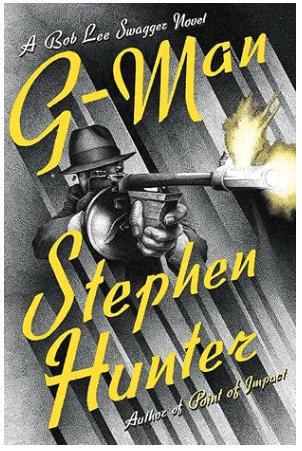
The historical excavation continued with G-Man (2017), which delved even further back to introduce Charles Fitzgerald Swagger, Bob Lee’s grandfather. Charles’s story takes us to the 1930s, an era of dust bowls, economic depression, and notorious gangsters. A World War I veteran and former sheriff of Polk County, Arkansas (the fictional “Blue Eye” where the Swaggers made their home), Charles is recruited by J. Edgar Hoover himself to join the nascent FBI.
G-Man explores Charles’s adventures as a federal agent, battling figures reminiscent of John Dillinger and “Pretty Boy” Floyd. This novel not only showcases another generation of Swagger marksmanship, but also delves into the complex relationship between law enforcement, justice, and the shifting social landscape of America. Charles embodies the family’s transition from frontier justice to institutional law, yet he carries the same unyielding integrity that defines his descendants.
Jackson Swagger: The Gun Man of the Old West
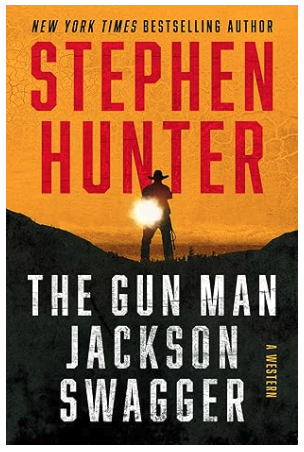
With his latest book The Gun Man Jackson Swagger (2025), Hunter makes his most ambitious leap yet, transporting readers to the 1890s and introducing Jackson Swagger, Bob Lee’s great-great-grandfather. Jackson is a Civil War veteran and a drifter in the Arizona Territory, a master of the Winchester rifle and Colt revolver. His story is set to explore the origins of the Swagger legend in the crucible of the American Old West, a time of vast open spaces, harsh justice, and the raw power of the firearm.
Jackson represents the frontier spirit, the embodiment of a man whose survival depends entirely on his skill and his code. He bridges the gap between the modern-day sniper and the early American gunfighter, solidifying the idea that the “Swagger gift” is an inherent trait, passed down through generations from a turning point moment in the American revolution.
Patrick Ferguson: The Ancestral Marksman
Hunter’s ultimate stroke of genius in establishing the Swagger lineage is the inclusion of Major Patrick Ferguson (1744–1780) as the “spiritual and genetic fountainhead” of the family. Ferguson was a real historical figure, a Scottish officer in the British Army and the inventor of the first breech-loading rifle. He famously refused to shoot an unaware George Washington at the Battle of Brandywine due to a code of honor – a decision that echoes the moral quandaries faced by every Swagger man.
Ferguson’s significance in my eyes is heightened by the fact that he was the only British officer, leading a Loyalist militia against multiple Patriot militias in the Battle of Kings Mountain on October 7, 1780. Achieving a complete surprise, the Patriot militiamen attacked and surrounded the Loyalists, resulting in 157 killed, 163 wounded, and 698 taken prisoner. The Battle of Kings Mountain was a pivotal event in the southern campaign of the Revolutionary War, causing British General Lord Cornwallis to move his armies from South Carolina through North Carolina into Virginia in a year-long campaign of attrition. Cornwallis and the British and Loyalist forces came to Yorktown, Va, and surrendered to American and French forces on October 19, 1781, after a three-week siege.
Though not a direct, named character in the primary novels, Ferguson is referenced in afterwords and historical contexts as the distant ancestor who first possessed the “cold, clear eye” and the mathematical intuition for ballistics that would define his descendants. This link elevates the Swagger saga from mere thrilling entertainment to a meditation on inherited talent, the evolution of weaponry, and the enduring human struggle between violence and honor across centuries.
The Enduring Legacy: What’s Next for the Swaggers?
From the colonial battlefields where Ferguson wielded his revolutionary rifle, through Jackson’s Old West justice, Charles’s G-man exploits, Earl’s post-war policing, and Bob Lee’s modern-day battles, Stephen Hunter has meticulously crafted a compelling and consistent family history. The “Swagger gift” is not just a plot device; it’s a testament to the idea that skill, character, and a certain moral compass can be passed down through generations, shaping the destiny of a lineage.
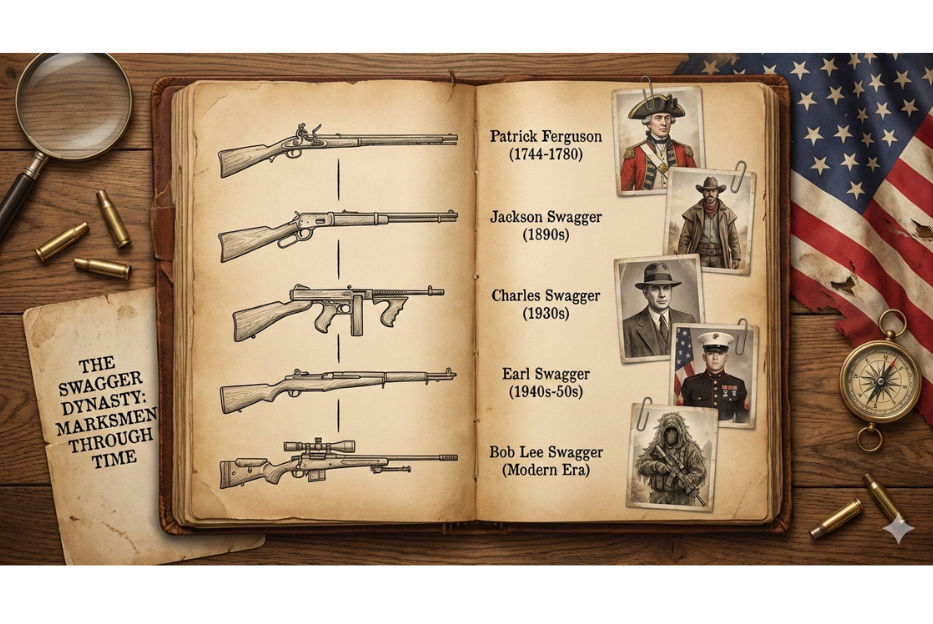
As Hunter continues to explore new corners of American history through the eyes of his Swagger protagonists, the question remains: will we see the “lost generations” between Ferguson and Jackson brought to life? Will the modern-day adventures of Bob Lee’s son, Ray Cruz, continue the saga into the 21st century?
Readers keep coming back to the Swaggerverse because it treats skill seriously, violence honestly, power skeptically, and time as irreversible – allowing a pulp premise to mature into something approaching modern American myth.
Stephen Hunter’s Swaggerverse endures because it operates simultaneously as technical mastery, moral inquiry, and generational saga – a rare combination that has aged with its readers rather than chasing trends.
One thing is certain: the Swaggerverse, built on a foundation of meticulously researched history and explosive action, shows no signs of running out of ammunition. The legacy of the gun man continues, etched into the very fabric of American lore, one precise shot at a time.
image created by Gemini

Part of a regular series on 27gen, entitled Wednesday Weekly Reader.
During my elementary school years one of the things I looked forward to the most was the delivery of “My Weekly Reader,” a weekly educational magazine designed for children and containing news-based current events.
It became a regular part of my love for reading, and helped develop my curiosity about the world around us.
 27gen.com