
Organizations around the world are plagued by staff burnout, high turnover, and low morale.
How do you turn this around? How do you make things better?
Changing how we work can feel overwhelming. Like trying to budge an enormous boulder, we’re stifled by the gravity of the way we’ve always done things. And we spend so much time fighting fires -and fighting colleagues – that we lack the energy to shift direction.
But with the right strategy, we can move the boulder.
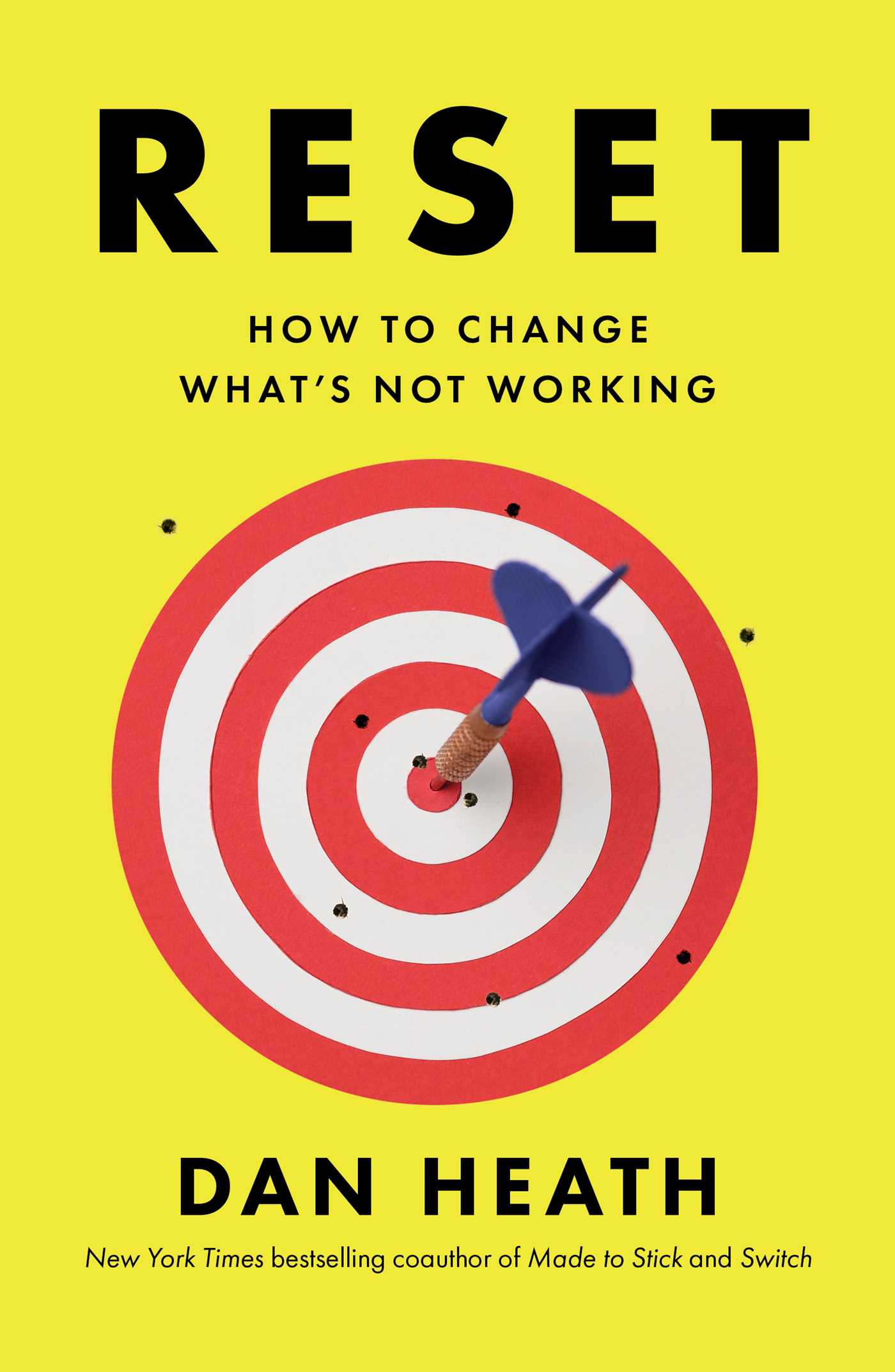
In Reset, Dan Heath explores a framework for getting unstuck and making the changes that matter. The secret is to find “leverage points”: places where a little bit of effort can yield a disproportionate return. Then, we can thoughtfully rearrange our resources to push on those points.
Heath weaves together fascinating examples, ranging from a freakishly effective fast-food drive-thru to a simple trick from couples therapy to an inspirational campaign that saved a million cats.
In Reset, you’ll learn:
-Why the feeling of progress can be your secret weapon in accelerating change
-How leaders can uncover and stop wasteful activities
-Why your team’s motivation is often squandered—and how to avoid that mistake
-How you can jumpstart your change efforts by beginning with a “burst”
The book investigates mysteries: Why the middle is the roughest part of a change effort. Why inefficiency can sometimes accelerate progress. Why getting “buy-in” is the wrong way to think about change.
What if we could unlock forward movement – achieving progress on what matters most – without the need for more resources? The same people, the same assets…but dramatically better results. Yesterday, we were stuck. Today, we reset.
When organizations and individuals find themselves stuck in unsatisfactory situations, the natural instinct is often to push harder or work longer hours. However, as revealed in Reset from Heath’s extensive research spanning over two and a half years, meaningful change requires a more nuanced approach than simply applying more force to existing problems.
Through 240 interviews across various industries, combined with insights from psychology and successful transformation methodologies, Heath developed a clear framework for breaking free from stagnation. The key lies not in working harder, but in working smarter through strategic intervention points.
Think of being stuck as facing a massive boulder blocking your path. No amount of direct force will move it – you need leverage. This metaphor captures the essence of the reset process: identifying precise points where minimal effort can yield maximum results, known as Leverage Points.
However, finding these Leverage Points requires methodical investigation. There are five primary methods for uncovering them.
- Direct observation of work processes can reveal inefficiencies that aren’t apparent from a distance.
- Examining alternative routes to your ultimate goal might uncover easier paths forward.
- Studying your own success stories can highlight replicable winning strategies.
- Identifying the primary constraint holding you back helps focus efforts where they matter most.
- Taking a holistic view of the system often reveals unexpected opportunities for intervention.
But identifying Leverage Points is only half the battle. The other crucial element is Restacking Resources – redirecting your existing assets, time, and energy toward these strategic pressure points. This process isn’t about finding additional resources; it’s about making smart trade-offs with what you already have.
The challenge lies in the fact that most resources are already committed to ongoing operations. No team member believes their current work is pointless, making it difficult to redirect efforts elsewhere.
This is where six specific strategies come into play:
- Beginning with an intense focused burst of effort.
- Eliminating wasteful activities.
- Shifting resources from low-value to high-value work.
- Tapping into intrinsic motivation.
- Empowering team members to lead change.
- Accelerating feedback loops for faster learning.
What makes this approach particularly powerful is its alignment with human psychology. Research by Teresa Amabile and Steven Kramer, involving over 12,000 diary entries from 238 employees across seven companies, revealed a fascinating insight: the single most powerful motivator in the workplace is making progress on meaningful work. On employees’ best days, 76% involved achieving progress, while only 13% involved setbacks. Surprisingly, only 5% of managers recognized progress as a primary motivator, ranking it last among potential motivational factors.
This “progress principle” becomes a powerful ally in the reset process. Once you start moving the boulder – even slightly – the psychological boost from that progress creates positive momentum that can help sustain the change effort. It transforms the daunting task of organizational change from an exhausting push against resistance into a more natural flow of continuous improvement.
As with his previous books (see here, here, and here), Heath uses real-world examples to demonstrate the effectiveness of this approach across diverse situations: from turning around struggling libraries and companies to revitalizing hospital operations and even improving personal relationships. The framework has proven adaptable to various contexts, whether addressing operational inefficiencies, customer satisfaction, employee engagement, or strategic direction.
The process challenges several common assumptions about organizational change. It suggests that seeking “buy-in” might be the wrong approach to change management. It reveals that inefficiency can sometimes accelerate progress, and that people often overestimate their understanding of the systems they work within. Perhaps most importantly, it demonstrates that the middle phase of any change effort is typically the most challenging – a insight that helps teams prepare for and push through the inevitable rough patches.
The beauty of this Reset framework lies in its simplicity: find the right leverage points and realign resources to apply pressure there. While the concept is straightforward, the execution requires careful analysis, strategic thinking, and willingness to make difficult trade-offs. However, the rewards are worth the effort: breaking free from unproductive patterns, experiencing forward momentum where there was once stagnation, and regaining a sense of agency over seemingly intractable situations.
This approach offers hope to anyone feeling stuck in a rut, whether personally or professionally. It provides a practical pathway to change that doesn’t rely on heroic efforts or unlimited resources, but rather on smart targeting of effort and strategic reallocation of existing assets. By understanding and applying these principles, individuals and organizations can transform themselves from spinning their wheels to moving purposefully toward their goals.
In a future post, I will be unpacking Reset in terms of how I am applying it in my personal life. Stay tuned!

Part of a regular series on 27gen, entitled Wednesday Weekly Reader.
During my elementary school years one of the things I looked forward to the most was the delivery of “My Weekly Reader,” a weekly educational magazine designed for children and containing news-based current events.
It became a regular part of my love for reading, and helped develop my curiosity about the world around us.




 27gen.com