Breaking Free from Stagnation: The Art of Strategic Reset

Organizations around the world are plagued by staff burnout, high turnover, and low morale.

How do you turn this around? How do you make things better?

Changing how we work can feel overwhelming. Like trying to budge an enormous boulder, we’re stifled by the gravity of the way we’ve always done things. And we spend so much time fighting fires -and fighting colleagues – that we lack the energy to shift direction.

But with the right strategy, we can move the boulder.
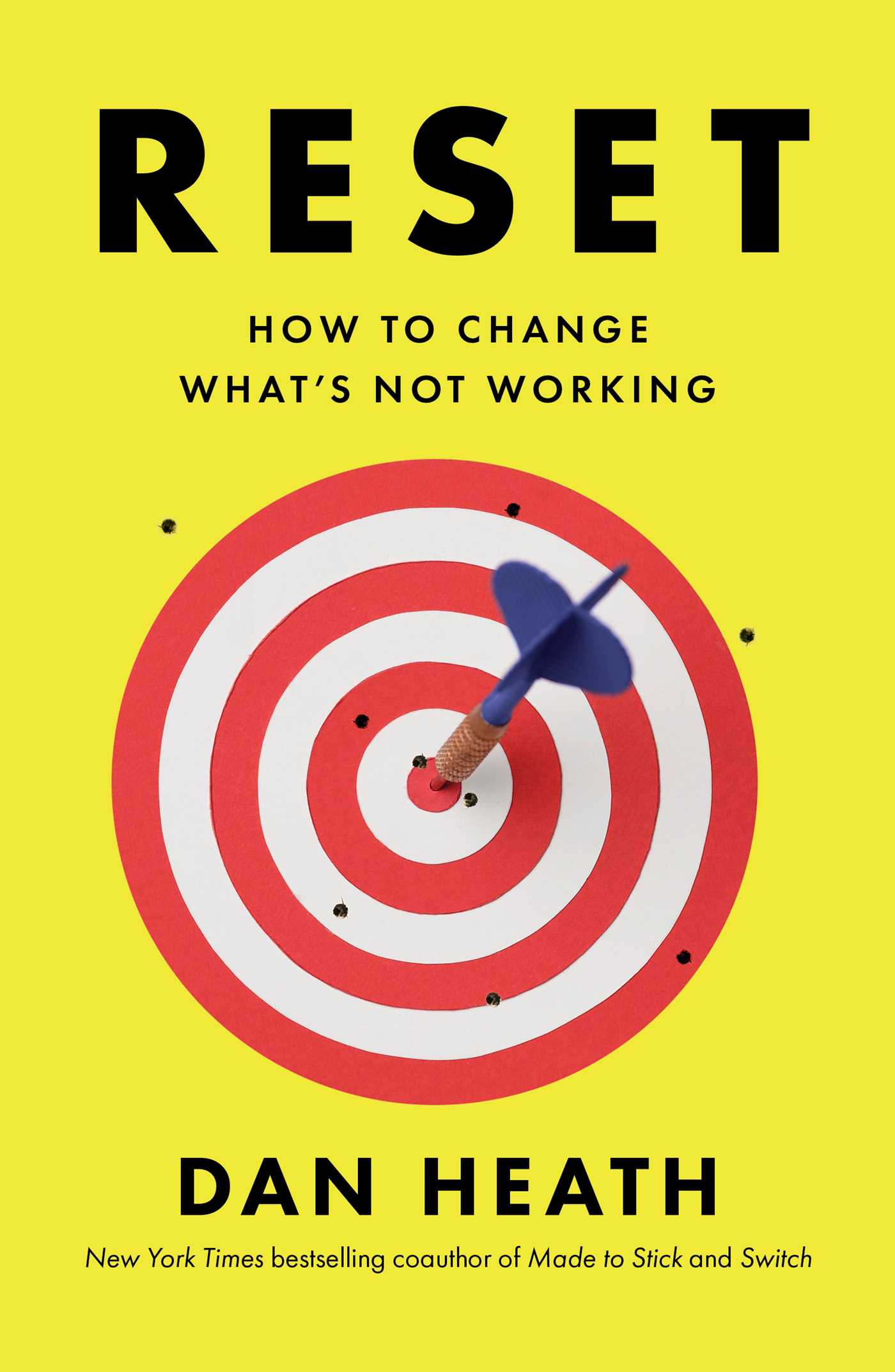
In Reset, Dan Heath explores a framework for getting unstuck and making the changes that matter. The secret is to find “leverage points”: places where a little bit of effort can yield a disproportionate return. Then, we can thoughtfully rearrange our resources to push on those points.

Heath weaves together fascinating examples, ranging from a freakishly effective fast-food drive-thru to a simple trick from couples therapy to an inspirational campaign that saved a million cats.

In Reset, you’ll learn:

-Why the feeling of progress can be your secret weapon in accelerating change

-How leaders can uncover and stop wasteful activities

-Why your team’s motivation is often squandered—and how to avoid that mistake

-How you can jumpstart your change efforts by beginning with a “burst”

The book investigates mysteries: Why the middle is the roughest part of a change effort. Why inefficiency can sometimes accelerate progress. Why getting “buy-in” is the wrong way to think about change.

What if we could unlock forward movement – achieving progress on what matters most – without the need for more resources? The same people, the same assets…but dramatically better results. Yesterday, we were stuck. Today, we reset.


When organizations and individuals find themselves stuck in unsatisfactory situations, the natural instinct is often to push harder or work longer hours. However, as revealed in Reset from Heath’s extensive research spanning over two and a half years, meaningful change requires a more nuanced approach than simply applying more force to existing problems.

Through 240 interviews across various industries, combined with insights from psychology and successful transformation methodologies, Heath developed a clear framework for breaking free from stagnation. The key lies not in working harder, but in working smarter through strategic intervention points.

Think of being stuck as facing a massive boulder blocking your path. No amount of direct force will move it – you need leverage. This metaphor captures the essence of the reset process: identifying precise points where minimal effort can yield maximum results, known as Leverage Points.

However, finding these Leverage Points requires methodical investigation. There are five primary methods for uncovering them

  1. Direct observation of work processes can reveal inefficiencies that aren’t apparent from a distance. 
  2. Examining alternative routes to your ultimate goal might uncover easier paths forward.
  3. Studying your own success stories can highlight replicable winning strategies.
  4. Identifying the primary constraint holding you back helps focus efforts where they matter most. 
  5. Taking a holistic view of the system often reveals unexpected opportunities for intervention.

But identifying Leverage Points is only half the battle. The other crucial element is Restacking Resources – redirecting your existing assets, time, and energy toward these strategic pressure points. This process isn’t about finding additional resources; it’s about making smart trade-offs with what you already have.

The challenge lies in the fact that most resources are already committed to ongoing operations. No team member believes their current work is pointless, making it difficult to redirect efforts elsewhere. 

This is where six specific strategies come into play

  1. Beginning with an intense focused burst of effort.
  2. Eliminating wasteful activities.
  3. Shifting resources from low-value to high-value work.
  4. Tapping into intrinsic motivation.
  5. Empowering team members to lead change.
  6. Accelerating feedback loops for faster learning.

What makes this approach particularly powerful is its alignment with human psychology. Research by Teresa Amabile and Steven Kramer, involving over 12,000 diary entries from 238 employees across seven companies, revealed a fascinating insight: the single most powerful motivator in the workplace is making progress on meaningful work. On employees’ best days, 76% involved achieving progress, while only 13% involved setbacks. Surprisingly, only 5% of managers recognized progress as a primary motivator, ranking it last among potential motivational factors.

This “progress principle” becomes a powerful ally in the reset process. Once you start moving the boulder – even slightly – the psychological boost from that progress creates positive momentum that can help sustain the change effort. It transforms the daunting task of organizational change from an exhausting push against resistance into a more natural flow of continuous improvement.

As with his previous books (see here, here, and here), Heath uses real-world examples to demonstrate the effectiveness of this approach across diverse situations: from turning around struggling libraries and companies to revitalizing hospital operations and even improving personal relationships. The framework has proven adaptable to various contexts, whether addressing operational inefficiencies, customer satisfaction, employee engagement, or strategic direction.

The process challenges several common assumptions about organizational change. It suggests that seeking “buy-in” might be the wrong approach to change management. It reveals that inefficiency can sometimes accelerate progress, and that people often overestimate their understanding of the systems they work within. Perhaps most importantly, it demonstrates that the middle phase of any change effort is typically the most challenging – a insight that helps teams prepare for and push through the inevitable rough patches.

The beauty of this Reset framework lies in its simplicity: find the right leverage points and realign resources to apply pressure there. While the concept is straightforward, the execution requires careful analysis, strategic thinking, and willingness to make difficult trade-offs. However, the rewards are worth the effort: breaking free from unproductive patterns, experiencing forward momentum where there was once stagnation, and regaining a sense of agency over seemingly intractable situations.

This approach offers hope to anyone feeling stuck in a rut, whether personally or professionally. It provides a practical pathway to change that doesn’t rely on heroic efforts or unlimited resources, but rather on smart targeting of effort and strategic reallocation of existing assets. By understanding and applying these principles, individuals and organizations can transform themselves from spinning their wheels to moving purposefully toward their goals.


In a future post, I will be unpacking Reset in terms of how I am applying it in my personal life. Stay tuned!


Part of a regular series on 27gen, entitled Wednesday Weekly Reader.

During my elementary school years one of the things I looked forward to the most was the delivery of “My Weekly Reader,” a weekly educational magazine designed for children and containing news-based current events.

It became a regular part of my love for reading, and helped develop my curiosity about the world around us.

Beyond Change: Mastering the Psychological Journey of Transition

Often when you think you’re at the end of something, you’re at the beginning of something else.

Fred Rogers

It has become almost a cliché that the only constant today is change.

What moves it from a cliché to a truism is that the Greek philosopher Heraclitus said the same thing – 2,500 years ago.

In spite of that historical background, we all feel that change is different today: it is without end, and increasingly complex. We talk not of a single change, but of change as an ongoing phenomenon. It’s a collage, not a single simple image; one change overlaps with another, and it’s all change as far as the eye can see.

To some degree, the downside of change is inevitable. Whenever human communities are forced to adjust to shifting conditions, pain is ever present. But a significant amount of the waste and anguish we’ve witnessed in change management is avoidable.

The typical organization – or person – has not operated well in a rapidly changing environment. Structure, systems, and culture have often been a drag on change rather than a facilitator.

The failure to sustain significant change recurs again and again despite substantial resources committed to the change effort, talented and committed people “driving the change,” and high stakes. In fact, leaders feeling an urgent need for change end up right: organizations that fail to sustain significant change end up facing crises.

This isn’t the sort of challenge you take on because it sounds good.

Adapting to and mastering change is not a choice. A significant part of a leader’s responsibility deals with being a change agent in the organization’s culture. In a time when changes come so fast and from so many unexpected angles, change is no longer a luxury but an imperative.

Even though change is a must, the “how-to’s” can often prove a problem. Many people lunge into change with no idea of its rules, its guiding principles, its nuances – and its dangers. Quite often disaster is the result. The only thing worse than ignoring change is leaping into it willy-nilly.


THE QUICK SUMMARY – Managing Transitions by William Bridges

The business world is constantly transforming. When restructures, mergers, bankruptcies, and layoffs hit the workplace, employees and managers naturally find the resulting situational shifts to be challenging. But the psychological transitions that accompany them are even more stressful. Organizational transitions affect people; it is always people, rather than a company, who have to embrace a new situation and carry out the corresponding change.

As veteran business consultant William Bridges explains, transition is successful when employees have a purpose, a plan, and a part to play. This indispensable guide is now updated to reflect the challenges of today’s ever-changing, always-on, and globally connected workplaces. Directed at managers on all rungs of the corporate ladder, this expanded edition of the classic bestseller provides practical, step-by-step strategies for minimizing disruptions and navigating uncertain times.

A SIMPLE SOLUTION

If you were to gather a group of 10 to 20 people together, and ask them to discuss changes they are going through (or have recently gone through), before long you will notice all different types of change provide people with the same basic experience.

Three main similarities begin to present themselves:

  1. An ending, followed by
  2. A period of confusion and distress, leading to
  3. A new beginning.

However you deal with them, endings are the first phase of transition. The second phase is a time of lostness and emptiness before “life” resumes an intelligible pattern and direction, while the third phase is that of beginning anew.

That is the order of things in nature. Leaves fall in autumn, winter sets in, and then the green emerges again from the dry brown wood in the spring. Human affairs flow along similar channels, or they would if we were better able to stay in that current.

But endings are fearful. They break our connections with the setting in which we have come to know ourselves, and they awaken old memories of hurt and shame. Growing frightened, we are likely to abort the three-phase process of ending, lostness, and beginning.

Sometimes, we even twist the pattern around so that beginnings come first, then endings, and then…then what? Nothing.

It is when we turn things around in that way that transition becomes so unintelligible and frightening.

It isn’t the change that will do you in – it’s the transitions. Getting people through the transition is essential if the change is actually to work as planned.

The Three Phases of Transition

Endings – Letting go of the old ways and the old identity people had. This first phase of transition is an ending and the time when you need to help people deal with their losses.

Neutral Zone – Going through and in-between time when the old is gone but the new isn’t fully operational. Called the “neutral zone,” it’s when the critical psychological realignments and repatternings are taking place.

New Beginnings – Coming out of the transition and making a new beginning. This is when people develop the new identity, experience the new energy, and discover the new sense of purpose that make the change begin to work.

William Bridges, Managing Transitions

A NEXT STEP

On the top of a chart tablet, list a change in your organizational life that you have been considering.

Underneath this, divide the rest of the chart tablet into three columns, and write the headings “Endings,” “Neutral Zone,” and “New Beginnings” at the top of the columns.

Before you move forward, ask yourselves these three questions developed by the William Bridges Associates team:

  1. What is changing? Until any vagueness you have about change can be clarified and until the leaders of the change can explain it clearly, in a statement lasting no longer than one minute, there is no way that they are going to be able to get other people to buy into the change. Longer explanations and justifications will also have to be made but it is the one-minute statement that will be the core of people’s understanding.
  2. What will actually be different because of the change? Many change projects are designed and launched at such a high level in the organization that all the planning is unrelated to the everyday, operational details that make up the lives of most workers. In such cases, the decision-makers often have no idea how changes will actually make anyone’s life or job, or even the function of a whole department, different. Yet that is all that people need to know before they can embrace and support a change.
  3. Who’s going to lose what? There must be a hundred other versions of objections to dealing with endings and losses, but they are all variations on a single theme: the mistaken idea that the best way to get people through a transition is to deny that they are even in a transition. In fact many internal communications projects are based on this central misconception that you can (and should) talk people out of their reactions to the change.

Transition management is based on another idea: that the best way to get people through transition is to affirm their experience and to help them to deal with it. It is simply a question of understanding how the world looks to them and using that as the starting point in your dealings with them.

With an understanding of the dynamics covered in these three questions, spend at least one hour working through the three phases of transition, writing down words or phrases under each heading.


Part of a regular series on 27gen, entitled Wednesday Weekly Reader.

During my elementary school years one of the things I looked forward to the most was the delivery of “My Weekly Reader,” a weekly educational magazine designed for children and containing news-based current events.

It became a regular part of my love for reading, and helped develop my curiosity about the world around us.

Catalyst Strategies: Transforming Challenges into Change Opportunities

Modern elders initiate something new. How do we best start something? What are the things that have traditionally held us back from new learning, new exploration, and new adventure? What can we change to make better?


We all harbor desires for change. Sales and marketing professionals aspire to reshape their prospects’ perspectives, employees yearn to influence their bosses, business leaders strive to transform their organizations, and parents seek to mold their children’s behavior. Yet, the formidable challenge of change often stems from inertia – a force that leads families to revisit the same vacation spot annually and compels companies to cling to established practices while resisting new initiatives.

Renowned author Jonah Berger, writing in The Catalyst, sheds light on our natural inclination to combat inertia aggressively. When met with resistance, individuals tend to inundate clients or superiors with facts and lengthy explanations. However, negotiators at the FBI, exemplified by figures like Greg Vecchi, adopt a more effective strategy – one that focuses on dismantling barriers rather than battling against them.

Embark on a brief journey and delve into the art of instigating change by embracing the role of a Catalyst – a superior approach inspired by the world of chemistry. Chemists employ specific substances to catalyze transformations, expediting processes that might otherwise take years. Similarly, becoming a catalyst in human interactions involves removing roadblocks and lowering barriers to initiate change.

In The Catalyst, author Jonah Berger employs the metaphor of catalysis throughout the entire book, emphasizing that the most efficient way to induce change in any scenario is by adopting the role of a catalyst. By identifying and eliminating the obstacles preventing individuals from taking action, meaningful change is achievable.

The approach begins with a fundamental question: What impediments hinder the person from changing? Understanding these barriers is key to the success of the catalyst method. For example, success in negotiating with criminals without violence hinges on this principle – sometimes, all that is needed is to locate and release the metaphorical parking brake.

Our exploration will unfold through Berger’s five strategies encapsulated in the acronym REDUCE: reduce Reactance, ease Endowment, shrink Distance, alleviate Uncertainty, and find Corroborating Evidence. These tactics serve as a guide to becoming a catalyst, facilitating positive and transformative change in various situations.

Have something you want to change? Want to change someone’s mind or how an organization works? It’s not about pushing harder, or being more persuasive, it’s about removing the barriers to change. REDUCE these five key roadblocks and you can change anything.

Reactance

When pushed, people push back. So rather than telling people what to do, or trying to persuade, catalysts allow for agency and encourage people to convince themselves. How can we allow for agency, provide a menu, or highlight a gap?

Endowment

People are wedded to what they’re already doing. The status quo. To ease endowment, we need to surface the costs of inaction, burn the ships, and frame new things as regaining a loss.

Distance

Perspectives that are too far away fall in the region of rejection and get discounted. So start by asking for less. Find an unsticking point and use it to switch the field.

Uncertainty

Change almost always involves uncertainty, and this ambiguity makes people hit the pause button, stemming action. To get people to un-pause, increase trialability. Harness freemium, reduce upfront costs, and drive discovery.

Corroborating Evidence

Sometimes one person, isn’t enough. Some things need more proof. So find reinforcement. Use multiple sources, concentrate them close in time, and figure out whether you need a firehose or a sprinkler.

Creating change is hard, but it’s possible. The key, Jonah Berger teaches us, is to become a catalyst and remove barriers to action rather than trying to create it by force.

More often than not, things don’t budge. And by focusing so much on ourselves and what we want, we forget the most important part of change: Understanding our audience.

Jonah Berger

You can do that by remembering and utilizing the five ways you can become a catalyst, forming the handy acronym REDUCE: reduce Reactance, ease Endowment, shrink Distance, alleviate Uncertainty, and find Corroborating Evidence.


Just in case you were wondering…

From time to time I get asked about the name of this blog. 

The quick answer? When I started this website in 2008, there were four generations of Adams boys alive, with an average of 27 years between them. 

Thus, 27gen – energized by the steady, deliberate journey in generational learning.

Our “history” spans the first transatlantic telephone call (from NYC to London) the year my father was born to smartphones now that connect the world in an instant.

In other words, there is a lot of history in play: things that have happened, things that are happening, and things that will happen.

And it is all connected.

Here’s a better explanation:

This is my son Jonathan, at two years of age, obviously having a good time at my parent’s house.

He’s now 41.

This is my grandson Jack (Jonathan’s son) at two years of age, obviously having a good time playing at his house.

He’s now 14.

Some things never change…

Some things are always changing…

I want to make sure I understand the difference.

Old School Thinking – Translating New Testament Principles into Present Day Practices

It’s been awhile since I’ve had the opportunity to browse through used bookstores – a regular pre-pandemic practice, not only in the Charlotte region where I live but also a regular part of business trips. The second step of my business trip planning – after securing a flight, rental, and hotel – would be to search the area for used bookstores. The third step – looking for local, one-of-a-kind restaurants – I’ll save for another day!

In lieu of bookstore visits, over the past year I have upped my game in online searches as well as going back to my shelves to revisit books I haven’t read in some time.

I can’t imagine someone really enjoying a book and reading it only once.

C.S. Lewis

I was recently rereading the treasure of a book, “Building Better Churches” by Gaines S. Dobbins, prominent Southern Baptist educator from the 1920s-1950s.

He asks some great questions:

  • What sort of church would it be that undertook intelligently and fearlessly to fashion itself according to the basic principles of the New Testament?
  • On what vital functions would it major?
  • What would be revealed to be its strengths and weaknesses?
  • What would it give up as encumbrances inherited from a traditional past but clearly of doubtful value in the living present?

His answers? He thought the church should be a:

  • Regenerate body – an inward change growing out of a personal experience in which the shift of life’s center has been from self to Christ
  • Beloved community – sacrifice for the common good is the essence of true community; love cannot flourish in an atmosphere where some assume an attitude of superiority over others as their inferiors
  • Company of worshippers – the object of worship is the God of the Lord Jesus Christ made real through the presence of the Holy Spirit. The practice of worship is in spirit and truth; the purpose of worship is to maintain vital unity between the worshiper and God through the mediator, Jesus Christ, and the illuminator the Holy Spirit. A church may do much else besides worship, but it will do little else of consequence without worship
  • Winner of believers – the process of intelligent persuasion began with Christ’s invitation to “come and see.” It continued throughout His ministry and Paul expanded it. There is no mistaking the proposal of the New Testament that believers be won to saving faith through persuasion
  • Teacher of disciples – preaching and teaching are indispensable means of leading toward Christ, to Christ, and into the service and likeness of Christ. A church is essentially a school with Christ as the Great Teacher; the Holy Spirit as His interpreter; the Bible the chief textbook; the minister the chief officer of the school with other leaders gathered around him as teachers and staff; every believer an enrolled student; and all others who can be reached are sought as learners to be led toward Christ
  • Server of humanity – the early Christians caught the spirit of Christ and like Him, “went about doing good.” It must send regenerate men and women out into an immoral society to transform evil into good, wrong into right, injustice into justice, not so much by political measures as by the leavening process of Christian influence
  • Agency of the Kingdom – the Kingdom of God is a present and future reality. It is not an organization to be promoted, nor a movement to be advanced, nor a social ideal to be realized, but a relationship to be entered and a spiritual order into which others are to be brought through persuasive witnessing

Dobbins, after a lifetime of service to the church, but writing this in 1947, had this final thought which I leave for you to consider:

courtesy the Southern Baptist Theological Seminary

Christianity is a religion of change. Jesus’ call in Mark 1:15 (the kingdom of God is at hand) was a call to change – change of mind and heart, of conduct and character, of self and society. By its very nature Christianity is a religion for a changing world and has always had its greatest opportunity during times of upheaval.

The Christian leader has no option; he must face a changing world. If the leader is to render maximum service, he must both adjust himself to the phenomena of change and address himself passionately to the business of producing and guiding change. 

Ours is an age of revolution. Inevitably the churches are undergoing change. Why not seize on this opportunity to make changes back to the New Testament rather than farther away from it?

Even though this was written almost 75 years ago, it is so relevant today.

Leaders of churches – your church is changing whether or not you “want” it to. Will you lead changes back to the New Testament rather than farther away from it?

Making Hay While the Sun Shines

On the way to pick up a take-out lunch from my neighborhood diner yesterday, the warm sunny day found me with the sunroof open and the windows down. I came across a field that had freshly cut and baled hay in it – the old style small bales. The aroma of the hay took me back to my teenage years, when my buddies and I helped nearby farmers as they would bring in hay for their cattle. My usual job was to stack hay bales on a wagon pulled by a tractor – sometimes tossing them from the field, sometimes stacking them on the wagon. Hard work, but good exercise and fun for a bunch of teenagers.

My instantaneous trip down memory lane was shattered when I rounded the corner and saw one man, driving a tractor pulling a machine that picked up the bales, stacked them in neat rows, and when a row was complete lifting the whole thing onto a trailer. The work was quicker, neater, and in the long run more economically advantageous for the farmer.

On the way back from the diner, going down the same road, but on the other side, I saw an elderly gentleman driving a tractor cutting a small field around his house – but with an identical International Harvester tractor and mower to that I used in the early 70s. Now, the tractor I used then was old – that made this one really ancient. But it seemed to be doing the job just fine, and the farmer was moving right along in his work.

The more things change, the more they stay the same.

The season and needs of both farmers dictated their actions. Each was using tools at his disposal to accomplish a task. Each was satisfied that they were doing the right thing, and they achieved their desired result.

Change, even as regular as the seasonal changes (at least in NC) is a constant. I’ve been a student and practitioner of change for a long time. One of the best resources for understanding change is William Bridges’ Managing Transitions.

Don’t let the title fool you: the first sentence explains the premise of the rest of the book: It isn’t the changes that do you in; it’s the transitions. Bridges sees change as situational – the new job, new boss, new policy. Transition is the psychological process people go through to come to terms with the new situation.

I think Bridges would translate the old French saying above to: There can be any number of changes, but unless there are transitions, nothing will be different when the dust clears.

Situational change hinges on the new thing, but psychological transition depends on letting go of the old reality and the old identity you had before the change took place. Nothing so undermines organizational change as the failure to think through who will have to let go of what when change occurs.

Got Change, anyone?


How to Thrive in Turbulent Times

Note: During the current “stay-at-home” mandates and other restrictions in place across the country, I am diving back into 11 years of posts, articles, and reviews across my different websites to bring back timely information for today.


In the first and second centuries, the Christian church was communal, organic, and unstructured – a lot like the Internet today. Within the Roman Empire, the Christian church grew from a handful of believers in AD 40 to over 31 million adherents by AD 350, making it the world’s first viral organization. By contrast, today’s mainline churches are institutionally powerful, but spiritually weak.

What’s true for churches is true for other institutions: the more “organized” and tightly “managed” they are, the less adaptable they are. Not surprisingly, the most resilient thing on the planet, the Internet, is loosely organized and lightly managed, and so was the first century Christian Church. The lesson here? To thrive in turbulent times, organizations must become more disorganized and unmanaged – less structural, less hierarchical, and less routinized.

As institutions mature, the positive thrust of missions diminishes and the pull of habit strengthens – until one day, the organization can no longer escape the gravitational field of its own legacy.

No pastor would ever tell you that the goal of his or her church is to create a place where members can gather each week to be expertly entertained while congratulating themselves on their moral superiority. And yet this often seems to be the case.

Speaking to the Willow Creek Global Leadership Summit a few years ago, Hamel asked the crowd “Is there a difference between ‘doing church’ and ‘doing Jesus’?”

Following a positive response, he then asked, “So where do your loyalties lie? Is it with the mission of redemption and reconciliation, or with the traditional programs and policies of your church? And if it’s the first, how would people know? What would be the evidence? Wouldn’t it be your willingness to sacrifice some of these familiar practices on the altar of a bigger purpose?”

Silence.

I’ve never met a leader who swears allegiance to the status quo, and yet few organizations seem capable of proactive change.

Gary Hamel

It’s impossible to build adaptable organizations without adaptable people – individuals who are humble, honest, and inspired.

Are you adaptable?


inspired and adapted by What Matters Now, by Gary Hamel

Change Without Trauma

Note: During the current “stay-at-home” mandates and other restrictions in place across the country, I am diving back into 11 years of posts, articles, and reviews across my different websites to bring back timely information for today.


As noted in yesterday’s post, change often comes in only two varieties: the trivial and the traumatic. Frantic, crisis-driven change is a poor substitute for timely transformation. There must be a better way.

We need look no further that our body’s automatic systems for some useful metaphors.

When you jump on a treadmill or pick up some weights, your heart starts to pump more blood, automatically. When you stand in front of a large audience to speak, your adrenal glands ramp us the production of adrenaline, spontaneously. When you walk from shade to bright sunlight, your pupils contract reflexively. Automatically, spontaneously, reflexively – these aren’t the words we use to describe how our organizations change, but they should be. That should be our goal: change without trauma.

In the mind flipping, VUCA world we live in, what matters is not merely an organization’s success at a point in time, but its evolutionary success over time. I recently remarked that being a part of my church’s rapid growth was like a “rocket ride” – and then a friend reminded me that rockets follow a parabolic path, and that most of the rocket sections ultimately come back to earth in a flaming shower of debris. Ouch!

How do you keep an organization – like your church – in “orbit?” Building a truly adaptable organization is a lot of work. It requires a shift in aspirations, behaviors, and operating systems.

  • An adaptable organization rethinks its strategy without having to walk through the valley of the shadow of death; it reinvents itself before getting mugged by the future.
  • An adaptable organization is one that captures more than its fair share of new opportunities. It’s always redefining itself, always pioneering the new.
  • An adaptable organization is more successful in attracting and retaining talent; it will have team members who are more engaged, more excited to show up every day, and are enthusiastic about their work.
  • An adaptable organization will be more productive in responding to emerging “customer” needs. It will take the lead in redefining customer expectations in positive ways.

Building a church that is as resilient as it is efficient may be the most fundamental organizational challenge facing today’s ChurchWorld leaders.

Adaptability really matters now.


Inspired by Gary Hamel’s What Matters Now as part of my research for a presentation at WFX Atlanta 9/19/12

It’s Time to Change the Way We Change

Note: During the current “stay-at-home” mandates and other restrictions in place across the country, I am diving back into 11 years of posts, articles, and reviews across my different websites to bring back timely information for today.


In our generation, the rate of change has gone hypercritical.

Change has changed.

Other centuries were convulsed by famine, disease, and war, but never before have so many things been changing so rapidly. We live in a world that seems to be all punctuation and no equilibrium, where the future is less and less and extrapolation of the past. Change is multifaceted, relentless, seditious, and occasionally shocking. In this maelstrom, long-lived political dynasties, venerable institutions, and hundred year old business models are all at risk.

Today the most important question for any organization is this: Are we changing as fast as the world around us? In industry after industry, it’s the insurgents, not the incumbents, who’ve been surfing the waves of change. But they, too, are just as vulnerable to change as their victims. Success has never been more fleeting.

Given all this, the only thing that can be safely predicted is that sometime soon your organization will be challenged to change in ways for which it has no precedent. Your organization will either adapt or falter, rethink its core assumptions or fumble the future – and to be honest, a fumble is the most likely outcome.

Of course, change brings both promise and peril, but the proportion facing any particular organization depends on its capacity to adapt. And therein lies the problem: our organizations were never built to be adaptable.

Especially the church.

Honest leaders will look at the Church, and more importantly their church, and see the words above lived out all too often. Churches are built as organizations of discipline, not resiliency. Efficient ministry comes from routinizing the nonroutine, adapting a management philosophy to the real life of people. As the old saying goes, the 7 words of a dying church are “We’ve always done it that way before.”

Adaptability, on the other hand, requires a willingness to occasionally abandon those routines – but in the church, there are precious few incentives to do so. So especially in ChurchWorld, change tends to come in only two varieties: the trivial and the traumatic. A review of the average church’s history will produce long periods of incremental fiddling punctuated by occasional bouts of frantic, crisis-driven change.

It’s time to change the way we change.

Inspired by Gary Hamel’s What Matters Now as part of my research for a presentation at WFX Atlanta 9/19/12

How’s Your Delivery Model Doing Now?

Note: During the current “stay-at-home” mandates and other restrictions in place across the country, I am diving back into 11 years of posts, articles, and reviews across my different websites to bring back timely information for today.


An interesting observation of the church by noted business thinker and strategist Gary Hamel:

It is worth noting that many churches adhere to the same “delivery model” for “spiritual services” and that the standard template is less the product of Biblical injunction than of habit. Unchallenged assumptions include:

  • Church happens in church
  • Preaching is the most effective way of imparting religious wisdom
  • Clergy lead while lay people follow
  • More programs equal more impact
  • The church service follows a typical order: greet, sing, read, pray, preach, bless, dismiss (repeat weekly)
  • Believers, rather than curious skeptics, are the church’s primary constituency
  • Going to church is the primary manifestation of a spiritual life
  • Church is a lecture, not a discussion
  • The primary mission of a church is to serve its members, rather than those outside the church who are searching for a spiritual connection
  • The best way to grow the Christian community is to plant little churches that are replicas of big churches
  • To bring people to faith, churchgoers need to market their beliefs more professionally rather than live them out more convincingly

What could you add to this list of things that mindlessly perpetuate the past in your organization?

If organized religion has become less relevant, it’s not because churches have held fast to their creedal beliefs; it’s because they’ve held fast to their conventional rituals, roles, and routines.

The problem with organized religion isn’t the “religion” bit, but the “organized” bit. Today’s mainline churches are institutionally powerful but spiritually weak


Inspired by Gary Hamel’s What Matters Now as a part of ongoing research in preparation for a presentation on change at WFX Atlanta 09/19/12