Two Mary Poppins: The Book(s) vs. The Movie(s)

I was six years old in the summer of 1964 when my mother took me to see my first movie in a theater. The lights dimmed, the curtains parted, and there she was – Mary Poppins, floating down from the clouds with her parrot-headed umbrella, about to change the Banks family forever. That experience imprinted itself on my memory: Julie Andrews’s crisp British accent, the animated penguins, the magic of it all. For decades, that was Mary Poppins to me. It wasn’t until much later that I discovered P.L. Travers’s original books and realized I’d only met half the story.

For most people, this is the definitive Mary Poppins – cheerful, warm, and practically perfect in every way. But P.L. Travers, who created the character in 1934, had a very different vision in mind.

Of course, it was necessary to pop back into my Mary Poppins library to refresh my memory in preparation for writing about a newly-released book, Making Mary Poppins (article coming soon).

The Mary Poppins of the Books

P.L. Travers introduced Mary Poppins to the world in her first novel, simply titled Mary Poppins, and continued her story across seven more books spanning over five decades, concluding with Mary Poppins and the House Next Door in 1988. In these pages lives a Mary Poppins who would likely terrify the children who grew up watching the Disney film.

Travers’s Mary Poppins is vain, brusque, and often downright rude. She is obsessed with her appearance, constantly admiring herself in shop windows and mirrors. When the children ask her questions, she frequently responds with a sharp “I never explain anything” or denies that magical events ever happened, even when the children witnessed them firsthand. She is enigmatic and unknowable, maintaining an emotional distance that keeps everyone – including the reader – perpetually off-balance.

This Mary Poppins doesn’t coddle. She expects immediate obedience and has little patience for nonsense. Her severity is palpable; she can silence a room with a glance. Yet despite her stern demeanor, the Banks children adore her with an intensity that borders on desperation. They fear her departure more than anything, knowing instinctively that she appears and disappears according to her own mysterious rules, carried on the East Wind and departing on the West.

The magic in Travers’s books is strange and often unsettling. Mary Poppins takes the children to visit her uncle who floats helplessly near the ceiling when seized by laughter. They meet the Bird Woman, communicate with infants who still remember the language of sunlight and wind, and journey to the edges of the world where mythological figures reside. These adventures feel ancient and mythic, drawing from folklore and fairy tale traditions where magic is powerful, capricious, and not necessarily kind.

Travers, who studied mythology and mysticism throughout her life, imbued her nanny with archetypal power. Mary Poppins is less a caregiver than a liminal figure – a bridge between the mundane world and realms of wonder, part governess and part goddess. She belongs to no one, answers to no one, and her true nature remains forever just out of reach.

The Mary Poppins of Disney

When Walt Disney released his film adaptation in 1964, he created something entirely different – a Mary Poppins designed to charm American audiences and become a beloved family classic. Julie Andrews’ portrayal transformed the character into someone warmer, gentler, and far more accessible.

Disney’s Mary Poppins still has high standards and maintains a certain formality, but she’s fundamentally kind. She smiles readily, shows genuine affection for Jane and Michael Banks, and clearly enjoys their company. When she arrives at 17 Cherry Tree Lane, she brings not just magic but joy. Her adventures – jumping into chalk pavement drawings, having tea parties on the ceiling, and visiting Uncle Albert’s laugh-filled floating sessions – are whimsical and delightful rather than mysterious and slightly dangerous.

This Mary Poppins teaches lessons explicitly rather than through enigmatic experiences. She sings about staying positive (“A Spoonful of Sugar”), seeing potential in everyone (“Sister Suffragette” notwithstanding), and the importance of finding wonder in ordinary life. The film adds the subplot of Mr. Banks’s redemption, making Mary Poppins instrumental in healing the entire family, not just entertaining the children.

Perhaps most significantly, Disney’s version explains her magic and makes her motivations clear. She comes to fix the Banks family, and once her work is complete, she leaves – sad to go, but satisfied. The film gives her emotional transparency that Travers’s character never possesses. Julie Andrews plays her with twinkling eyes and barely suppressed delight in her own cleverness, making the audience feel they’re in on the joke.

The musical score by the Sherman Brothers became inseparable from the character. Songs like “Supercalifragilisticexpialidocious” and “Chim Chim Cher-ee” are now cultural touchstones, their melodies instantly recognizable decades later. This Mary Poppins is Technicolor optimism incarnate, a nanny who makes everything better through a combination of magic, music, and good old-fashioned love.

Disney’s commitment to their version of Mary Poppins has only deepened over time. The 2013 film Saving Mr. Banks dramatized the contentious relationship between Walt Disney and P.L. Travers during the original film’s development, revealing how fiercely Travers fought against Disney’s softening of her character – a battle she ultimately lost but never accepted. More recently, Mary Poppins Returns (2018) brought Emily Blunt to Cherry Tree Lane as an older Mary Poppins returning to help the next generation of Banks children. While Blunt’s portrayal incorporated slightly more of Travers’s tartness than Andrews’s version, the film remained firmly in Disney’s magical, musical tradition, proving that their interpretation has become the definitive one in popular culture.

Why She Endures

So why has Mary Poppins – in both her incarnations – captivated audiences for over ninety years? The answer lies in what both versions share despite their differences.

At her core, Mary Poppins represents something children desperately need and adults nostalgically remember: the presence of someone utterly competent and unflappable who makes life extraordinary. Whether stern or sweet, she possesses absolute confidence and capability. In a chaotic world, she is certain. She knows exactly what to do in every situation, and she does it.

Both versions offer escape into wonder. Whether through Travers’s mythic strangeness or Disney’s musical whimsy, Mary Poppins proves that magic exists alongside the ordinary. She validates children’s intuition that the world contains more than what adults acknowledge—that truth and wonder aren’t opposites but companions.

Additionally, Mary Poppins serves as a bridge between childhood and adulthood. She respects children’s experiences and emotions while maintaining adult authority. She takes their concerns seriously without diminishing her own power. This balance is rare in children’s literature and film, and it resonates deeply.

Finally, there’s the bittersweet element of her departure. Mary Poppins never stays. This temporary quality makes her precious – a golden season that must end, teaching children about impermanence while giving them something beautiful to remember. She proves that endings don’t negate meaning; rather, they concentrate it.

Whether you prefer the mysterious, mythic nanny of the books or the singing, smiling governess of screen and stage, Mary Poppins endures because she embodies a timeless promise: that somewhere, somehow, there exists someone who can make everything better, at least for a while. And in that promise lies a magic more powerful than flying umbrellas or enchanted carpetbags – the magic of hope itself.


In August 2016, during a month-long, daily teaser to my children and grandchildren prior to our week-long Walt Disney World Trip, here was the image and text 17 days prior:

In 1964 Walt Disney combined unforgettable performances, memorable songs, and wonderful special effects into one of Hollywood’s biggest hits, “Mary Poppins.”

Mary Poppins is a proper British nanny who is “practically perfect in every way” and can do almost anything. Flying via umbrella into the Banks household at No. 17 Cherry Tree Lane, Mary Poppins arrives to help put the household back in order. Along the way, we are introduced to a wonderful cast of characters including Bert, Constable Jones, Admiral Boom, the Banks household staff, Uncle Albert, the directors of the Dawes, Tomes, Mousely, Grubbs Fidelity Fiduciary Bank, and a host of animated characters.

Those special effects work on “Mary Poppins” was the most challenging Disney Studios had ever attempted. With live-action characters popping into chalk drawings, amazing musical and choreography, and a heart-tugging story, “Mary Poppins” remains one of Disney’s most beloved family films.

At Walt Disney World Mary Poppins can be found in Town Square at the Magic Kingdom and in England at Epcot.

On a personal note, “Mary Poppins” is GrandBob’s favorite Disney live-action movie, and he has been known to turn the family room into a theater reminiscent of the movie’s premier at Grauman’s Chinese Theater. 

With facsimile tickets

Really.

What I Did On My Christmas Vacation


A Tale of Two Experiences

There’s something undeniably nostalgic about the phrase, What I Did on My Christmas Vacation. For many of us, it immediately conjures up memories of childhood – returning to school in January, bundled up in our winter coats, and being handed the inevitable post-holiday writing assignment. The topic was always the same: share your holiday experience in the form of a story, complete with a beginning, middle, and end. Back then, it was an exercise in creativity, structure, and self-expression. Now, as adults, we’re still asked the same question – though the audience has changed. Instead of teachers grading our grammar and imagination, we find ourselves recounting our holiday stories to work colleagues, catching up with friends, or even reflecting on it for ourselves.

This simple question has endured because it’s more than just small talk; it’s a way to connect, to share a piece of ourselves with others. Whether we’re reminiscing about the holidays of childhood, giving a polished version to coworkers, or swapping heartfelt moments with close friends, the answer allows us to revisit our experiences and build connections. With this throwback memory to those early school days, let me tell you about my Christmas vacation…

The #AdamsFamilyExperience at Christmas

As you can read here, this was to be no ordinary Christmas holiday at our house – for the first time in several years, everyone was coming home. 

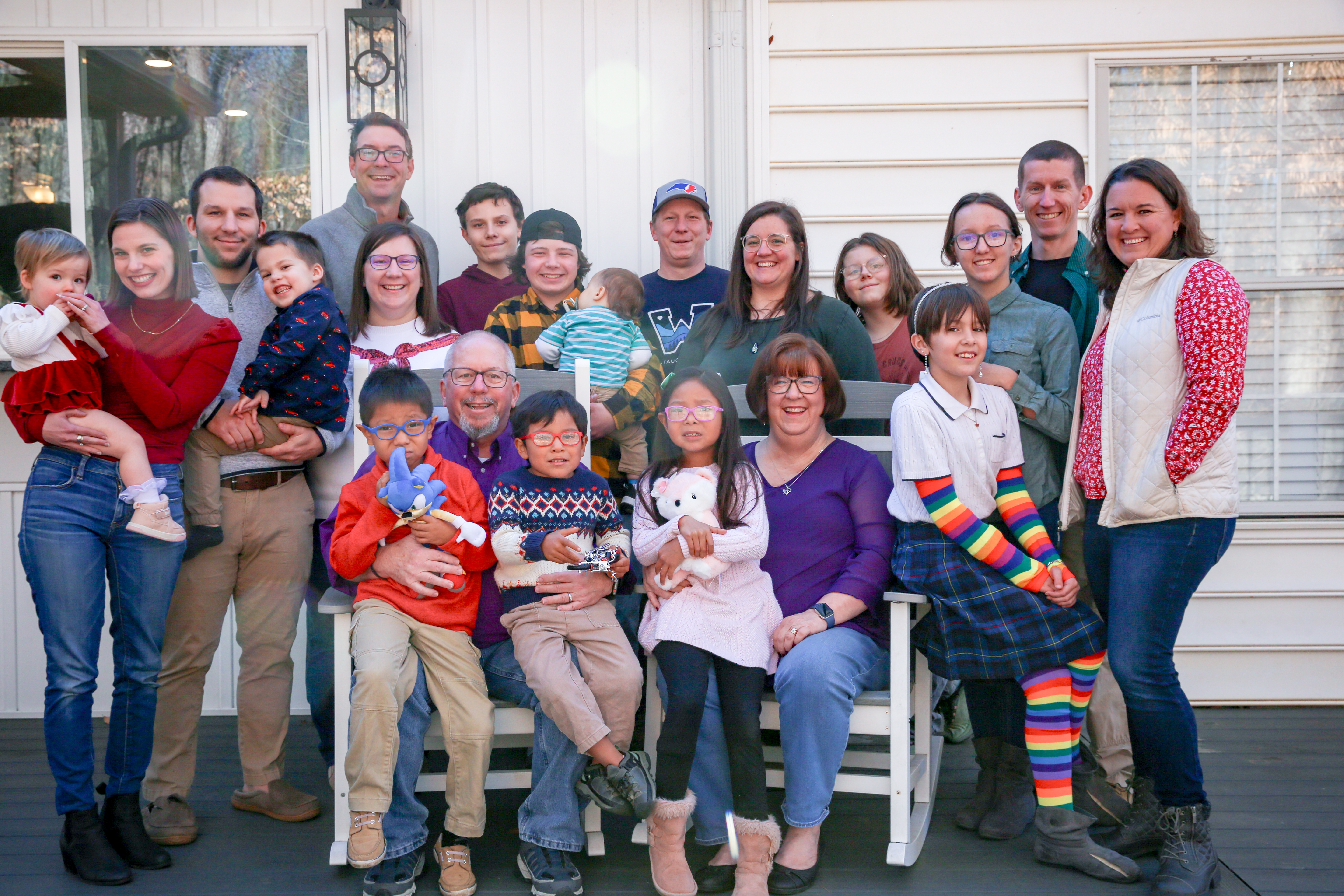
All 21 of us!

Things unfolded as planned – everyone arrived pretty much on time, everyone was healthy, and everyone was happy to see siblings and cousins.

We had already designated Monday 12/23 as our “Christmas” – and on the night of the 22nd, all four of our kids and their spouses dove in after their kids, nieces, and nephews were in bed to create the first ever #AdamsFamilyExperience Christmas train:

It actually took less time that I anticipated; in some of Anita and my past experiences, I remember Christmas Eve assembly and wrapping sessions that lasted until the early hours of the morning! Of course, ten sets of hands helped!

The result speaks for itself – an engine with 11 cars, one for each grandchild!

The next fews days were mostly a blur as we unwrapped gifts, ate wonderful meals, played with new toys (grandkids) and games (adults), and just generally enjoyed the wonderful chaos called family.

We even had time to gather for a family photo:

When Christmas Day rolled around, it was time to begin saying goodbye as three of the families headed back home to continue their own Christmas traditions. Our NM tribe had planned to stay with us until the 30th.

…and then some other stuff happened.

The day after Christmas I was not feeling well, and took it easy most of the day. By 12/27 I was in quite a bit of pain, so Dr. Mom, AKA Anita, took me to urgent care where they promptly sent me off the the Emergency Department – where I spent the day into the next morning waiting for a hospital room so I could be transferred.

The diagnosis leaving the ED was surgery for a perforated ulcer, and the surgical team at Atrium Cabarrus was anticipating that as well. However, that’s not what God had planned.

Because of the delay in getting a room, then a delay in having an imaging test that would pinpoint the problem, it was actually Sunday 12/29 when the surgical team took a conservative approach – no surgery at the moment, but complete rest and IV fluids only for up to a week.

It seems my body had encapsulated the ulcer, and was in the process of healing itself. A fews days later I was able to observe first-hand the amazing view of swallowing a radioactive dye going down my throat and into and through the various organs – with no signs of a leak this time.

With vitals where they wanted them, I was discharged on Thursday 1/2 – only to be readmitted 12 hours later with intense pain in my chest. Focused on signs of cardiac distress, the triage team was not as fast as getting me in a room as I would have liked – but at least I got an ED room instead of the dozen or so patients who were lined up in the hallways (including the sheriff’s deputies and a patient in handcuffs)! Imaging revealed an inflamed gallbladder, likely as a result of what was going on next door with my ulcer.

After a few hours in the ED, I was transferred back to PSC-3 – the same post surgical wing with the same nursing staff I had just spent a week with. This group of dedicated nurses were simply the best in caregiving I have ever experienced. To a person they were gentle and efficient as they went beyond fulfilling what they had to do to actually caring about me as a person. Over my 10-day stay, they were amazing in looking out for me in every way imaginable. We even got to laugh over “losing” me during one of the procedures!

On Sunday 1/12 I heard the words from my surgical team I was anticipating: “Do you want to go home today?” With a genuinely fond farewell from the nursing team, Anita brought me home that evening, where I crashed for the next 14 hours.

My prognosis is good, with additional tests and imaging scheduled in about a month to see where my body is at in the healing process.

The boyhood me, receiving a post-holiday assignment, would have quite a tale to tell.

The adult me, reflecting on what happened over the past couple of weeks, has no less of a tale to tell.

Whether it’s an essay for a teacher, small talk with coworkers, or a heartfelt chat with friends, What I Did on My Christmas Vacation is a question that evolves with us. It’s a chance to reflect, share, and connect in ways that go beyond the surface. So the next time you hear it, embrace the opportunity to tell your story – and to learn a little more about the people asking the question. After all, the magic of the holidays lives on in the stories we share.


What did you do on your Christmas vacation?

Mastering the Adams Family Experience Christmas: A Tactical Guide

The Christmas season is upon us, and in our household, this means only one thing: The Adams Family Experience Christmas is gearing up for another legendary chapter! 

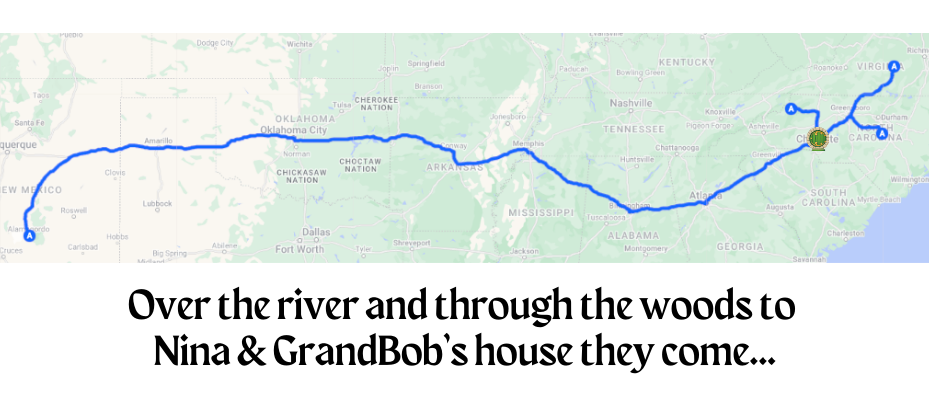
With 21 people from five families descending upon Huntersville, NC over three travel days from four locations, coordinating this event is less like planning a holiday gathering and more like executing a military campaign. In the spirit of strategic brilliance, I’ve turned to Sun Tzu’s The Art of War for guidance. After all, if Sun Tzu can conquer kingdoms, surely he can help me conquer Christmas chaos.

Step 1: Know Thy Enemy — The Guest List

Sun Tzu wisely said, “If you know the enemy and know yourself, you need not fear the result of a hundred battles.” Our “enemy” is not the need for lactose-free eggnog or gluten-free stuffing demands – it’s the sheer logistics of hosting this crew:

  • From Alamogordo, NM: The desert-dwelling faction arrives with tales of tumbleweeds and an 3-year old whose energy rivals that of the Energizer Bunny.
  • From Farmville, VA: A group of refined Southern charmers who always bring a new (and weird) game that everyone enjoys. Accompanying them is the newest granddog, a lovable golden retriever with the biggest feet we’ve ever seen.
  • From Boone, NC: Our rugged mountain kin, eager to discuss “what real cold feels like” while chasing down the 18-month old “party animal”.
  • From Fuquay-Varina, NC: The suburbanites are bringing diva dog (a beagle who doesn’t know she is a dog) and endless enthusiasm for games of all kinds – as long as they win.

The ages of our crew range from precocious toddlers to the youngest “elders” you’ve ever seen in their mid-60s. That’s five generational cohorts in one house!

Step 2: Every Battle is Won Before It is Fought — Sleeping Arrangements

With a full house and a rented Airbnb 4 houses down the street, the sleeping strategy must be airtight. Here’s the tactical breakdown:

Our House: Reserved for the early risers, light sleepers, and those who require direct proximity to coffee and tea. It’s essentially triage by caffeine dependence.

  • Main Bedroom – The VA crew will be ensconced in the primary bedroom suite with kids, dog, and parents scattered around the space.
  • Front Bedroom – The NM parents will ride herd on their kids scattered upstairs and downstairs.
  • Disney Bedroom – The younger boys will be immersed in LEGO to their heart’s delight
  • Upstairs Bedroom – All the older girl cousins will be stacked up in double-decker cots.

The Airbnb: This fortress houses the night owls and party animals. The teenage boys, armed with iPhones and headphones, are banished to a makeshift barracks in the family room. 

  • Bedroom 1: Nina and GrandBob (the generals of this campaign) will run the whole multi-day event from this hideaway.
  • Bedroom 2 – The Boonie parents, accompanied by the youngest member of the family, will retreat here.
  • Bedroom 3 – The diva dog will be snoozing away at least 20 hours a day here, and has graciously consented to allow her people to stay and take care of her.

Step 3: Feed Your Troops — Meal Planning

“The line between disorder and order lies in logistics,” said Sun Tzu. Feeding 21 people, including gluten-free, lactose-intolerant, and diabetic contingents, is a logistical Everest. As you will see, we like to eat! Luckily, we have a lot of good cooks in the family! Here’s the plan:

Day 1: Reconnaissance Fare

As the crews begin arriving throughout the day, a light breakfast, followed by a visit to a great CLT restaurant, and ending with soup and chili is the plan. It’s versatile and scalable as our numbers increase during the day, and easily accommodates dietary needs.

Day 2: Full Crew Offensive

With almost the full #AdamsFamilyExperience tribe gathered, it’s time for a North Carolina staple at lunch: BBQ and all the fixings. When evening rolls around, it’s time for a Taco Bar, with specialties added in: Gluten-free tortillas, lactose-free sour cream, and enough of Uncle Aaron’s guac to fill a kiddie pool.

Day 3: Middle Earth Feast

A strategic masterpiece featuring the full seven meals of a hobbit’s day:

Everyone (well, maybe not the toddlers) is contributing to the feast courtesy of a shared Google doc and lots of research over the last month. At least half the fun will be the pandemonium of everyone working on their dishes throughout the day. It’s a good thing we will have two kitchens!

Day 4: Christmas Eve

Assuming we wake up from the previous day’s food coma, we will turn back to more traditional fare: breakfast goodies, Jimmy John’s sandwiches for lunch, and Mississippi Pot Roast for supper.

Day 5: Christmas Day

Pancakes! Fruit! Ham rolls! A Caprese Christmas Tree! Cranberry Orange Chicken! Roasted Root Vegetables! Winter Salad! Dessert! Oh. My.

Day 6: The Leftover Buffet

 As the crews begin to depart one by one, we will throw open the fridge and let the troops forage. Survivors will head to our favorite restaurant, La Unica, and the best server in the world, Nancy.

Day 7: Pizza Peace Talks

We’re down to one family besides Nina and GrandBob, but it’s the biggest with 5 kids! Time to roll out a family favorite: Pizza and a Movie!

Step 4: All Warfare is Based on Deception — Managing the Dogs

Two dogs present a unique challenge. Sun Tzu might suggest deploying decoys, but we’re going with containment zones:

  • The Retriever – Assigned to the main house, complete with chew toys and a toddler-proof deck for plenty of space to roam as needed.
  • The Beagle – Indoors at the main house, but nights at the Airbnb with the world’s softest dog bed to prevent territorial skirmishes.

From prior experience, there will be separate food/water bowls set up in different rooms in the house. Both dogs will be strategically kept away from the dining tables – a critical neutral zone.

Step 5: Let Your Plans Be Dark and Impenetrable — Entertainment Strategy

To maintain peace among 21 people, the entertainment schedule must be flawless. Sun Tzu reminds us, “Opportunities multiply as they are seized,” so we’ll seize opportunities for fun:

  • Board games for the adults and teenagers; LEGO, kid games, and Disney movies for the children, and a Christmas craft activity with Nina
  • The traditional Christmas LEGO project, drawing from a collection 40 years in the making
  • Morning and afternoon walks with the dogs
  • Outside fun on the playset or in the park, weather permitting
  • Fire pit and deck heater for after-hours conversations 
  • Christmas Eve service at our church
  • Family gift exchange, courtesy of a holiday Gift Train, with 11 “cars” (apparently, adults don’t count)
  • A family photo session that will be considered a success if it only takes 17 attempts
  • Planned spontaneity

Step 6: In the Midst of Chaos, There is Also Opportunity

Let’s face it: no amount of planning will prevent every toddler meltdown, burnt pie crust, or game argument. But as Sun Tzu might say, victory isn’t perfection – it’s managing the mayhem with grace and the occasional adult beverage.

This year, the #AdamsFamilyExperience Christmas will be a masterpiece of strategic planning, creative problem-solving, and good humor. And if all else fails, there’s always the peace treaty of Netflix, Disney+,  and all-day pajamas.

Happy holidays from the “battlefield” – AKA the AdamsFamilyExperience. May your Christmas be as merry and well-planned as ours is striving to be!

It’s Good to Be Home: Creating First Place Hospitality

In what may seem to be direct opposition to my thoughts about front porches here and here, my wife and I have just completed a series of home renovations over the last three years that did not change our somewhat smallish front porch, but nevertheless, have increased our neighborhood connections.

It’s all about loving where you live!

Here’s the story…

My wife Anita and I have been married for 44+ years. We have three sons, (with three amazing daughters-in-law) and a daughter (married to a great son-in-law). These amazing kids and their spouses have been blessed with eleven children!

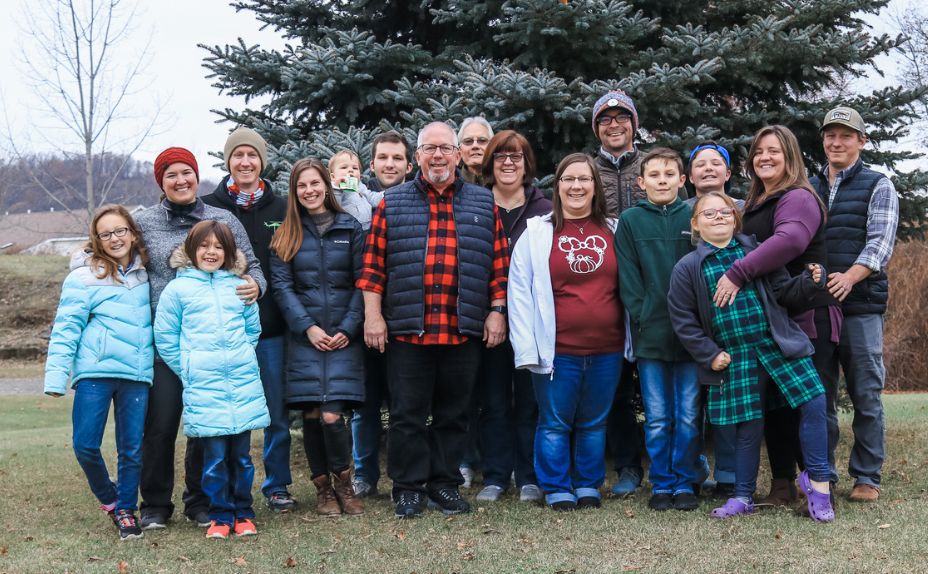
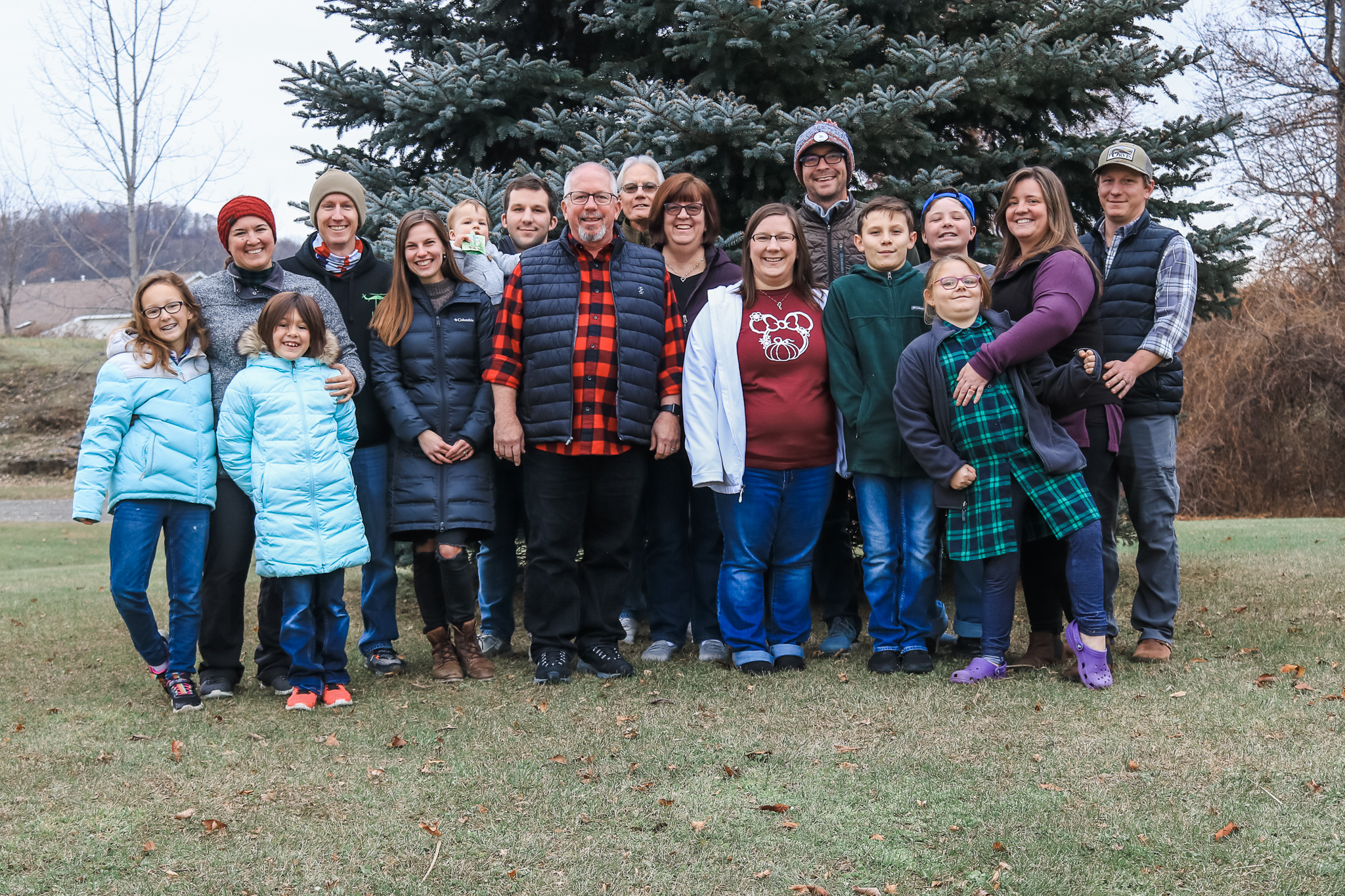
The image below represents the last time we were all together: Thanksgiving 2021 in Greenwich, NY. Since then we’ve added three little ones – all this year! Collectively, we are the #AdamsFamilyExperience!

About three years ago my wife and I, as empty nesters, made the decision to stay in our long-time home (29+ years) where our kids grew up – even as they moved away to establish homes of their own from one end of the country (New Mexico) to the other (New York, then Virginia), along with two who have settled in opposite ends of North Carolina. With one family in the military and moving about every three years, we decided to stay put.

With eleven grandchildren grouped into 2 ages (five age 3 and under, and six ages 10-16), we knew we needed space for lots of different activities.

What that means IRL:

  • With 11 grandchildren, our family numbers 21 when we all gather together (plus up to four dogs). We don’t get to do that as often as we would like, but we want to be prepared when we do! Thus…
  • Our renovations, although with different purposes, were all guided by the primary intention of creating more gathering space. Functionally, that meant keeping all four bedrooms useable, but with a different purpose: each of three bedrooms formerly used by our kids became (respectively) an office for my wife, an office for myself, and a Disney room for the grandchildren. Each of those rooms can sleep two or more.
  • With three bathrooms, we had no reservations about removing the garden tub in the master bath, and creating a walk-in shower. Need to bathe infants? No problem; we’ve still got two tubs.
  • In our family room, we were satisfied with the layout, but decided to mount a large screen TV on the wall to free up space below for additional seating. The fireplace, though adequate, seemed a little lonely on the tallest wall in the house, so Anita and I designed a feature wall that our contractor built to perfection.
  • Our biggest renovation, aka “The Project” was just completed and involved adding square footage to our house footprint, totally renovating the kitchen, removing a wall between the kitchen and dining room, and adding a full-width deck across the back of our house.
  • With the interior complete, up next is the final exterior project: some work on our backyard, freshening up outdoor play space for the younger four of our grandkids who are 3 and younger; correcting drainage flow due to the new roof and deck; and adding cafe lights to a portion of our deck.

Even when our family can’t visit as often as we would love to have them, our home is dedicated to hospitality for friends, neighbors, and those we haven’t met yet. In just the first month, we:

  • Kicked off the newest space with a Mexican fiesta luncheon for our church community group
  • Invited our neighbors on one side to a impromptu family dinner as a treat for all the hard work they’ve been doing on a pool install this summer
  • Hosted two of our kids’ families for the long Independence Day weekend: four extra adults, three grandchildren, and one large dog
  • Planned a neighborhood event that had to be postponed (but will be rescheduled)
  • Made our deck and kitchen available for our neighbor’s 12-year old daughter’s birthday party – even when we weren’t at home for the weekend.

In August, our NM kids and grandkids (two adults, three children) will be staying for five days as part of a two-week vacation.

…and we’ve got lots more planned for the late summer and fall!

My wife and I share a passion: creating hospitality culture lifestyles where ordinary people demonstrate extraordinary love.

In order to help make that possible in a physical space, here’s the dedication pledge my wife and I made over our renovations:

When we understand God’s welcome to us, we can better pass it on to someone else.

When we use our lives exactly as they are, desiring only to create a sacred space for our guests, we turn entertaining upside down and it becomes radical hospitality.

We don’t need to be who we used to be; God sees who we’re becoming – and we’re becoming love.

We can’t love people we don’t know. Saying we love our neighbors is simple. But guess what? Doing it is too. We think Jesus’ command to “love your neighbor” means we’re actually supposed to love our neighbors. Engage them. Delight in them. Throw a party for them.

Jesus wants us to show people who He is by what we do, not just tell them what we think.

It’s time to bring back the table to our homes.

If we really want to learn someone’s story, sitting down at the table and breaking bread together is the best way to start. The table is the place where our identity is born – the place were the story of our lives is retold, reminded, and relived.

(Special thanks to the writings of Bob Goff and Len Sweet)

The solution is to get back to the basics of what Jesus commanded:

Love God and love your neighbors.

Think of it as First Place Hospitality – building bridges to your neighbors in your “First Place,” your home.


Next Time: Images and Acknowledgments for The Project

Beyond 65: How a 3D View Makes a Powerful Difference

  • According to actuarial statistics, a male born in 1958 has a life expectancy of 74.5 years.
  • According to updated longevity tables prior to 2020, male life expectancy is 83 years.
  • According to the CDC, COVID reduced the average life span of an adult to 76.1 years.
  • According to family genetics, my father and mother lived to be 85 and 91, respectively.
  • According to Job 14:5, my next breath could be my last.

So, on the occasion of my 65th birthday, where does that leave me?


“3D vision” refers to the effect of our brains merging the two dimensional images from both our eyes to interpret depth, thus “seeing” in 3 dimensions: length, width, and depth. 

I’d like to borrow that definition and create a new metaphor: Vision that utilizes 3 representations of time: past, present, and future

As a newly-minted 65-year old, I want to recognize the importance of all three.

  • Past is history
  • Present is reality
  • Future is opportunity

History – Every past success and failure in your life can be a source of information and wisdom – if you allow it to be. The wise 65 year-old has learned both from success and failure, and realizes there will be more of both. Don’t be satisfied with your successes, and don’t be dismayed by your failures. History is important: it is not a rock to weigh you down, but a bridge to build the future.

Reality – No matter what we learn from the past, it will never tell you all you need to know for the present. The wise 65 year-old is constantly gathering information from many sources about what’s going on in the here and now – because that’s where we are at. They ask others on their team, they talk with their family and friends; they look to other wise people of all ages for insight. Though formal schooling may be long in the past, it’s always important to continually be students of the people surrounding you.

Opportunity – Wise 65 year-olds should strive to see tomorrow before it arrives. They have a vision for a preferable future, they understand what it will take to get there, they know who they will need to become in order to be successful, and they recognize obstacles long before they become apparent to others.

Wise 65-year olds will understand the three dimensions of past, present, and future, and realize they are not an illusion, but a powerful force that will help them reach their real depth and dimension, and in doing so, help others do the same.

Therefore, as much as it is in my health, resources, and capacity, I resolve to:

#AdamsFamilyExperience

This is the last time we were all together – Thanksgiving 2021, in Greenwich, NY

My 5-Generational Cohort Family is a Microcosm of Society

The legions of ancient Rome were composed of ten cohorts each: cohesive units of 300-600 men who trained, ate, slept, fought, won, lost, lived, and died together. The strength was their ability to think, act, and react as a unit. Though composed of individuals, training and socialization equipped them to behave as if of a single mind when called to battle. Social demographers, students of the effects of population on society, use the term cohort to refer to people born in the same general time span who share key life experiences – from setting out for school for the first time together through reaching puberty at the same time, to entering the workforce or university or marriage or middle age or their dotage at the same time.

The six primary generations of today’s American lifestyle span a remarkable slice of American and world history. Three major wars, countless minor (?) ones, economic booms and busts, social upheavals, rocketing technological achievement, and even stepping beyond our planet are among the milestones that have directly and indirectly shaped the times.

I count myself fortunate to have a direct connection to all six generations. To me, understanding more about how each of them think, feel, and act is not just a mental exercise – it’s a necessary part of life.

  • Builder Generation (1922-1945) My father and mother were born into the early part of this cohort. He entered military service just as WWII was ending; she was in college and then taught school; they were part of what some call “The Greatest Generation”. Think “American values” and you’ve got their number: civic pride, loyalty, respect for authority, and apple pie. My father passed away in 2012, and my mother in 2018. They may not be physically present with me, but who I am was shaped by their influence, and they impact me every day. Additionally, this cohort, as their generation moves into their twilight years, still controls a significant part of the economy and will continue to be influential in the years ahead outside of their numbers.
  • Baby Boomers (1946-1964) My wife and I are late Baby Boomers. Born in the latter 50s, we are a part of what was until recently the largest cohort in US history. For over thirty years, the sheer size of the Boomer generation defined the organization’s social landscape in a majority-rules cultural takeover. We were the civil rights, empowerment, and diversity generation. Never content with the status quo, we are always redefining what it means to be old and cool and important and successful.
  • Generation X (1965-1982) My oldest son and one of my daughters-in-law are Xers, even though they sometimes exhibit characteristics of the next cohort as well. Technologically adept, clever, and resourceful, the Xers are a deeply segmented, fragmented cohort. Their need for feed back and flexibility, coupled with the dislike of close supervision is but one of the many complex nuances of this generation. They are all about change- they’ve changed cities, homes, and even parents all their lives. Often seen as pessimistic with an edgy skepticism, many Xers are more positive about their personal future than the group as a whole.
  • Millennials (1983-2000) My other three children, two daughters-in-law, and a son-in-law all fall into this cohort. They are the children of the soccer moms and little League dads, and endless rounds of swim meets, karate classes, dancing lessons, computer camp and … you get the picture. They consider themselves the smartest, cleverest, healthiest and most-wanted group to have ever lived. Born into the technology boom times, barriers of time and space have little absolute meaning to them. They are willing to work and learn. By sheer numbers (their total births eclipsed the Boomers by several million) they are going to dominate history in new ways. They are the hyper-connected: constantly connected to multiple devices in order to know what and whom they need to know.
  • Generation Z (2001-2015) As the generation of the first six of my grandchildren, it is important to me to try to fully understand them. Technology is the hallmark of this group, which is the first generation to be raised in the era of smartphones and social media as a daily part of life. They’re growing up amid the promise of technological innovation – but also in the environment of economic uncertainty, a sharp decrease in well-defined and reliable career paths, increasing political divides, and the effect of decades of repressed racial tensions. The preeminent event of this cohort is the 9/11 attacks and the rise of terrorism around the world (and the U.S. response to it). Consequently, when compared to their predecessors, this group is both more cautious and more anxious.
  • Alpha Generation (2016-TBD) I have two grandchildren in this cohort, and there is one more on the way! While it is too early to define the characteristics of this cohort in any meaningful way, consider the early memories of children born since 2016: They will assuredly recall adult populations that were divided, diseased, and depressed. Their early years were launched alongside the large differences of the Trump and Biden administrations; their memories will be forever marked by the pandemic, ongoing political polarization, and increasing international unrest on a scale not seen since WWII.

There are some indications that generational cohorts repeat every four generations, so we’ll just have to see. Led by the thoughts of William Strauss and Neil Howe published in the late 1990s, this idea of “cycles” is getting more attention now that their predictions of today’s Millennial cohort are proving to be on target more often than not. That will definitely be my radar in the future!

An interesting fact, and the origin of the title of this website: there are 27 years between each of the first born in the above first three generations of my family, thus 27gen.

Here’s the last time all of #TheAdamsFamilyExperience was together in one place: Thanksgiving 2021, in Greenwich, NY.

The next five years are going to be very interesting as each of these five generations exert influence on each other. I will be actively watching my own microcosm of society.


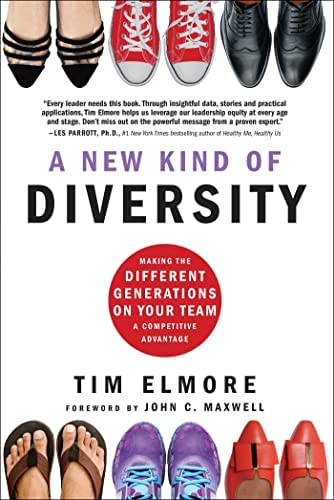
My latest reading on generations: The release of A New Kind of Diversity by Tim Elmore was much-anticipated. Elmore brings his decades of research and leadership experience to bear on what might be the biggest, most dramatic, and most disruptive shift the American workforce has ever seen: the vast diversity of several generations living—and working—together. 

For the first time in history, up to five generations find themselves working alongside each other in a typical company. The result? There can be division. Interactions between people from different generations can resemble a cross-cultural relationship. Both usually possess different values and customs. At times, each generation is literally speaking a different language!