Day One: Cultivating a Meaningful Rule of Life

As I began my job transition several months ago, and as it continues today, I am guided by a Transition Tool Kit. Consisting of 7 “tools” that were developed from the work of Bruce Feiler’s Life is in the Transitions and other noted transition guides, the Tool Kit contains concepts and action plans that I have been working through.
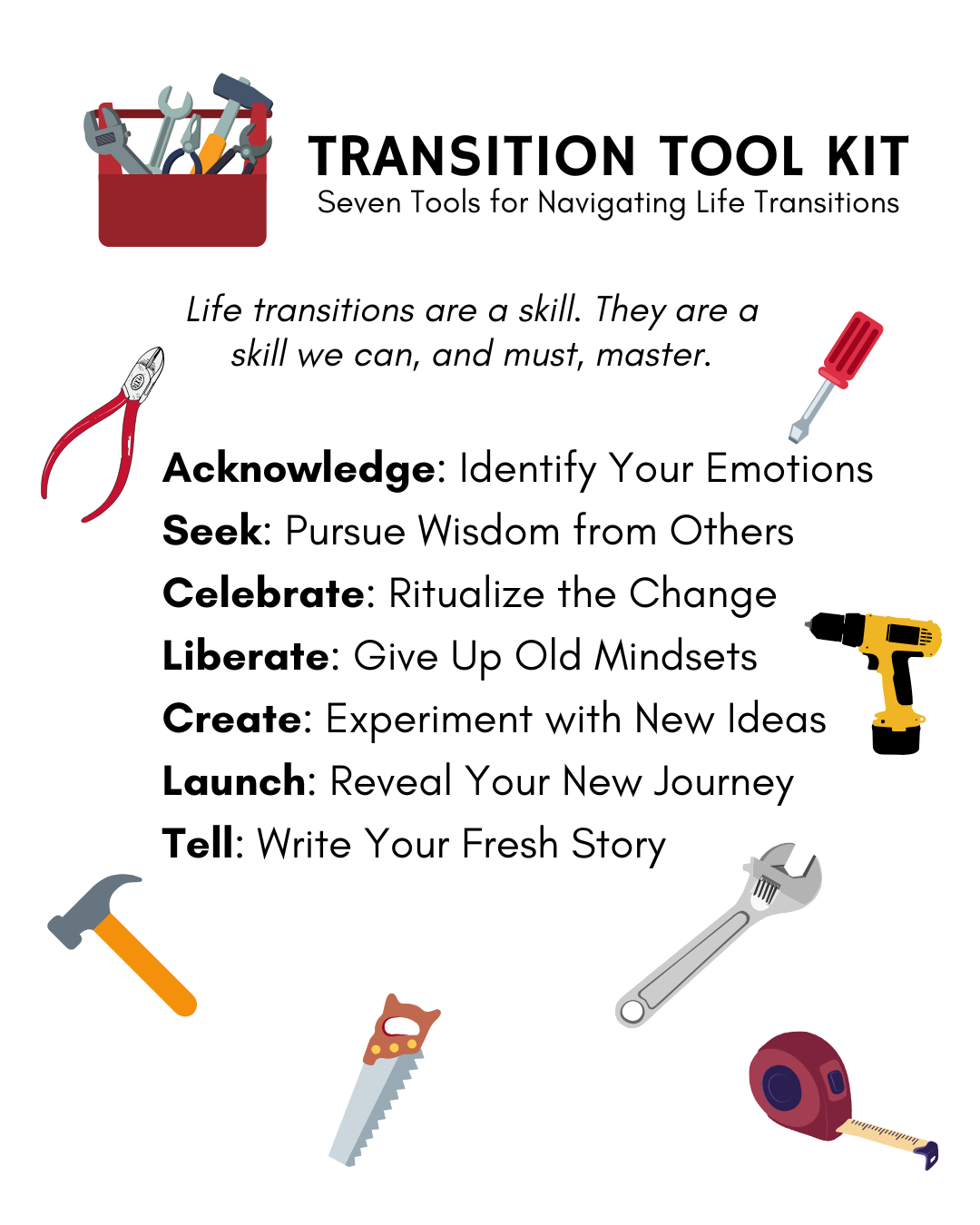
Here are first three:

  • Acknowledge: Identify Your Emotions
  • Seek: Pursue Wisdom from Others
  • Celebrate: Ritualize the Change

While the tools are not designed to be linear and can be picked up at any time, I’ve been comfortable with moving through the sequence of the three above to this date.

Now, it’s on to Liberate: Give Up Old Mindsets.

The mindsets that served me in my previous stage may no longer be useful – or even hinder me – in this next phase. Shedding outdated beliefs and self-limiting narratives requires courage, but it opens doors to growth. 

What assumptions am I carrying that no longer align with who I are or who I want to become? Moving through transition often means letting go of familiar but outdated notions of success, identity, or purpose.

The deleting of my work calendar and schedules was the first part of using this tool. But having a blank calendar is not a plan for transition – it will only lead to listless drifting. Along with this tool, it’s also time to pick up another one – Create: Experiment with New Ideas.

With old mindsets cleared, I’m giving myself permission to explore new ways of thinking and doing. I’m going to try activities, roles, or ideas that resonate with where I’m headed. This stage is about experimenting without the fear of failure. As I explore, I will stay open to discovering passions, skills, or career paths that I may not have previously considered.

And that brings me to a mindset that’s been dropping into my life in increasing measures over the last few months. It began with reading and study I had been doing related to following Jesus. It continued with the passages of Matthew we are studying in our church’s current sermon series and community group that deal with rest and the Sabbath.

So picture this: on the one hand, I’m at Day One of a new chapter in my life – one with a literal blank calendar. On the other hand, I’ve got the tools of Liberate and Create ready to use.

What’s next?

Finding Purpose Through Pattern: The Modern Rule of Life

In our fast-paced world of constant activity, many people are rediscovering an ancient wisdom practice: the rule of life. This concept, far from being a rigid set of regulations, offers a framework for intentional living that modern seekers find increasingly relevant.

Origins in Spiritual Tradition

The “rule of life” traces its origins to early spiritual leaders like St. Augustine and St. Benedict. These church fathers developed communal patterns that spiritual communities have utilized for thousands of years as formation tools. Despite the constraining connotations of the word “rule,” these frameworks were never about blind obedience but rather about establishing communal purpose.

Both Augustine and Benedict shared a singular focus: love. They meticulously designed daily patterns with the explicit goal of orienting life toward loving God and neighbor. Augustine began his rule declaring, “Before all things, most dear brothers, we must love God and after Him our neighbor; for these are the principal commands which have been given to us.” Similarly, Benedict aimed to create nothing “harsh” or “burdensome,” but instead sought to guide followers toward the “ineffable sweetness of love.”

The Latin root of “rule” – regula – reveals its true intent. Rather than restriction, it refers to a trellis or supporting structure that guides growth. Like plants that thrive with proper support, human growth benefits from thoughtful direction to prevent twisted, chaotic development.

The Scaffolding of Our Days

Our lives take shape through the cumulative effect of small, repeated actions. As Annie Dillard insightfully noted, “How we spend our days is, of course, how we spend our lives.” Our schedules serve as “scaffolding” that allow us to intentionally engage with time itself.

This scaffolding concept perfectly illustrates the rule of life’s purpose. Habits are how we interact with time, and since time is the currency of purpose, habits become the means through which we access and fulfill our deeper callings. If knowledge requires the right words, character formation requires the right habits. The rule of life provides the framework for cultivating these transformative patterns.

For centuries, monastic communities have understood this profound connection between daily practice and spiritual development. Their insight reveals that meaningful formation begins with a framework of habits – a truth that deserves wider recognition in our contemporary context.

Integrating Belief and Practice

While understanding theological truths about God and neighbor is essential, equally important is putting those truths into practice through a deliberate rule of life. Belief without practice remains incomplete, just as education without formation falls short. Knowing Jesus without following Jesus creates a dissonance that diminishes our humanity.

Only when our habits align with our worldview do we become people who truly love rather than merely understand concepts of love. This integration transforms abstract knowledge into embodied wisdom.

The Challenge of Default Formation

Many of us have unknowingly adopted what might be called “the American rule of life” – an unconscious program of habits that shapes us toward anxiety, depression, consumerism, and self-absorption. These default patterns form us in ways contrary to our stated values.

The urgency of developing an intentional, gospel-based rule of life becomes clear when we recognize how powerfully these cultural currents influence us. We need counter-formative practices to become the loving people we aspire to be.

This issue extends beyond personal well-being to our public witness. American Christianity often emphasizes the message of Jesus while neglecting his practices, creating a troubling disconnect between proclaimed faith and lived reality. How else can we explain professed followers of a radical gospel who conform so seamlessly to prevailing cultural norms?

Embracing the Trellis

The path forward requires acknowledging how habits shape the heart. Rather than viewing limitations as threats to freedom, we must recognize that thoughtful boundaries create space for meaningful growth. The trellis doesn’t restrict the vine – it enables it to flourish in its intended direction.

By crafting a common rule of life suited to our time, we can unite our intellectual understanding with our daily practices. This integration allows us to grow into the lovers of God and neighbor we were created to be, following not just the teachings but the way of Jesus.

In rediscovering this ancient wisdom, we find a surprisingly relevant answer to modern challenges – not through more information or stronger willpower, but through the patient cultivation of life-giving habits that transform us from the inside out.


Up Next: Exploring The Common Rule


Crossing the Bridge: Navigating Life’s Transitions

Bridges are more than mere structures of steel and stone. They are powerful metaphors for life’s most profound journeys – connecting what was to what could be, spanning the uncertain spaces between known and unknown landscapes.

When we stand at the beginning of a bridge, the view can be intimidating. The planks beneath our feet might feel unstable, the distance to the other side shrouded in mist. Life’s transitions often feel exactly like this – a trembling moment of uncertainty, where the past recedes behind us and the future remains undefined.

Each bridge has its own character. Some are sturdy suspension bridges, their cables providing intricate support systems. Others are simple wooden crossings, requiring careful, deliberate steps. Similarly, our personal transitions vary – some are carefully engineered transformations, others spontaneous leaps of faith.

The act of crossing requires courage. Just as a bridge walker must trust the engineering beneath their feet, we must trust our own resilience during life’s changes. The wooden boards might creak, the wind might buffet us, but forward movement is possible. Each step is an act of trust – in ourselves, in the path we’ve chosen, in the possibility of what awaits.

Bridges connect more than physical spaces; they connect states of being. Leaving a job, ending a relationship, moving to a new city – these are bridge moments. We’re suspended between what we knew and what we’re becoming. The middle of the bridge is often the most vulnerable place, where we can look back at familiar terrain or gaze forward into uncharted territory.

Some bridges are long, requiring endurance. Others are short, demanding only a moment of boldness. Some have guardrails, offering security, while others challenge us to balance with nothing but our own determination. Life’s transitions mirror these bridge experiences – some transformations are gradual and supported, others demand we leap with minimal safety nets.

Importantly, not all bridge crossings are solitary journeys. Some bridges are wide enough for companions. Friends, family, mentors – they can walk alongside us, offering encouragement, sharing the weight of uncertainty. Their presence doesn’t eliminate the challenge, but it transforms the crossing from a potentially lonely trek into a shared adventure.

When we finally reach the other side, we are changed. The bridge was never just about getting from one point to another, but about the transformation occurring with each step. We arrive different – more resilient, more knowing, with a broader perspective of the landscape we’ve traversed.

Rather then focusing on the obstacle in your path, focus on the bridge over the obstacle.

Mary Lou Retton

Life’s bridges remind us: transitions are not obstacles, but opportunities. They are not about perfect, fearless passage, but about moving forward with authenticity, courage, and hope.


If you liked this article or you like bridges, check out this post:


Rembrandt’s Masterpiece: Weathering the Storm with Faith

Rembrandt van Rijn’s iconic painting “The Storm on the Sea of Galilee” is a captivating masterpiece that transports the viewer into the midst of a tumultuous biblical scene. Inspired by the gospel accounts in Matthew, Mark, and Luke, this work of art powerfully conveys the themes of faith, fear, and the sovereignty of God in the face of life’s storms.

The biblical narrative that serves as the foundation for Rembrandt’s painting is found in the Synoptic Gospels. In each account, Jesus and his disciples find themselves caught in a violent storm while crossing the Sea of Galilee. As the waves crash against the boat and the winds howl, the disciples are gripped by terror, certain that they will perish. Yet, while they struggle to keep the vessel afloat, Jesus remains asleep, undisturbed by the raging tempest.

Rembrandt’s masterful depiction captures the intensity of this pivotal moment. The canvas is filled with a sense of tumult and chaos – the towering waves, the straining sails, the panicked expressions of the disciples. Yet, at the center of the painting, the figure of Jesus rests calmly, seemingly unaffected by the fury of the storm. This stark contrast between the human fear and the divine tranquility lies at the heart of the biblical message.

When the disciples finally rouse Jesus, their cries of desperation echo the words recorded in the Gospels: “Teacher, do you not care that we are perishing?” (Mark 4:38). In their moment of greatest need, they turn to the one who has the power to calm the storm. And as Jesus rises, he rebukes the wind and the waves, commanding them to be still. Suddenly, the chaos gives way to a profound hush, as the sea obeys the voice of its Creator.

Rembrandt’s painting powerfully translates this profound spiritual truth into a visual representation. The disciples, tossed about by the storm, represent the human experience of being overwhelmed by life’s difficulties and challenges. Their fear and desperation echo the struggles that we all face when confronted by the seemingly uncontrollable forces of the world. Yet, in the midst of this turmoil, the figure of Christ stands as a reminder of the divine presence and the power of faith to weather any storm.

The biblical accounts make clear that Jesus’ miraculous act of stilling the storm was not merely a display of power, but a means of deepening the disciples’ trust in him. As they witness the elements submit to his command, their fear is transformed into awe and wonder. “Who then is this,” they ask, “that even the wind and the sea obey him?” (Mark 4:41). Afraid in the storm, they were terrified at the power Jesus displayed.

Rembrandt’s painting invites the viewer to ponder this same question, to consider the nature of the one who can command the forces of nature with a single word. In doing so, it challenges us to reflect on our own relationship with the divine, to examine the depth of our faith in the face of life’s storms.

The power of “The Storm on the Sea of Galilee” lies in its ability to transcend the boundaries of time and culture, speaking to the universal human experience of struggle and the need for divine intervention. Rembrandt’s masterful rendering draws us into the biblical narrative, allowing us to vicariously experience the fear and uncertainty of the disciples, while also offering a glimpse of the transformative power of faith.

As we gaze upon this painting, we are reminded that even in the midst of the fiercest storms, we need not face them alone. The One who calmed the raging sea is the same One who promises to be with us always, providing refuge, strength, and the assurance that no matter how dark the night, the dawn will come.

Worry in our lives comes from either a) forgetting the power of Jesus over the storm or b) doubting his commitment to us in the storm.
There is something more important than God keeping you from all storms, and that is God teaching you his faithfulness in the storm.
The storm in your life is to wake you up to His power.

J.D. Greear

These passages, reflected in the brilliant work by Rembrandt, remind us that Jesus has power over any storm we face. However, the focus is not on our problems, but on Christ’s greatness.

The more we see His power, the less our troubles seem significant.