Good Cooking is Simply a Series of Problems Solved

The title of this post is actually a quote from one of the instructor chefs at the CIA’s cooking school. Author Michael Ruhlman, in “The Making of a Chef,” chronicles his time at the legendary cooking school, the oldest and most influential in America.
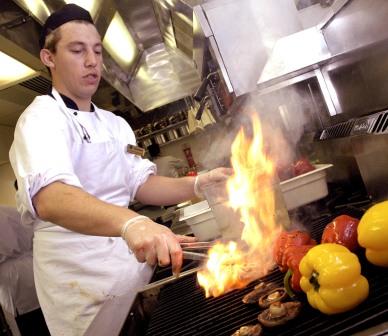
The comment came in response to a student’s unique suggestion of how to keep hollandaise sauce at just the right temperature to keep it from “breaking”. The chef had never thought of his idea, and encouraged him (and the rest of the class) to approach a problem from a unique angle (outside the box” thinking?).

This line of thought falls right into a post by Seth Godin entitled “Sell the Problem.” He noted that many business to business marketers tend to jump right into features and benefits, without taking the time to understand if the person on the other end of the conversation/call/letter believes they even have a problem.

The challenge is this: if your organization doesn’t think it has a  problem, you won’t be looking for a solution. You won’t wake up in the morning dreaming about how to solve it, or go to bed wondering how much it’s costing you to ignore it.

And so the marketing challenge is to sell the problem.

I’m passionate about helping churches thrive by turning challenges (problems) into opportunities. It’s very personal with me – I want to understand prospective clients so well that I know their situation almost as well as a leader or staff member. In fact, that statement, made a couple of years ago by a pastor, is one of the highlights of my career!

It’s my job to understand their problems.

When a prospect comes to the table and says, “we have a problem,” then you’re both on the same side of the table when it comes time to solve it.

All I have to do now is follow the recipe – a series of problems solved.

Leadership is an Art: Tapestry

If leadership is an art, then one of its most amazing forms has to be the tapestry.

Tapestry is a form of textile art, woven by hand on a loom. The vertical threads are hidden in the completed work; they are flexible in order to be drawn over and under the horizontal threads. The horizontal threads are visible, and thus have a finer quality. Because they are spun with a twist in opposite directions, they exist in tension. Together, the two types of threads create a beautiful image. Intricate, detailed images were created by artists which were then given to craftsmen to produce the finished artwork. Tapestries often contain symbolic emblems, mottoes, or a coat of arms. They were used by kings as a symbol of authority, able to be rolled up and carried to wherever the king was to be. The church used tapestries for displays on special occasions. They also served as a functional item, useful for insulation in drafty castles.

History lesson aside, a tapestry is a perfect metaphor for leaders God uses in His work:

  • God is the master Artist, creating the design of our lives; we are craftsmen who weave individual threads following His pattern
  • Leaders should not have a one-dimensional outlook on life; they need to be vertically connected to God while horizontally connected to people
  • Our connection to God should be constant, weaving over and under throughout life
  • Our connections with people are highly visible even though under some tension
  • Our leadership qualities should represent something; they are a symbol that others see and recognize what they stand for
  • As leaders, we represent authority – the question is how will you represent it?
  • Leaders are certainly visible for all to see, but they must always remember that leadership is not an end unto itself, but a function of “leading” others
  • Leadership is not fixed to a place; true leaders cannot help but lead, whether in the corporate office, the church meeting room, or the family kitchen table.

How are you weaving the threads of life into the beautiful masterpiece God has created for you?

Play the Way You’re Facing

As the father of four children, I suppose it was inevitable that they would become involved in sports, and therefore I would be involved in coaching their teams.

My initial adventure in coaching was with my oldest son in pee wee basketball, coaching a coed team of first-third graders. After three years of that, he migrated to soccer and I began a ten-year soccer coaching career with all four kids: team manager, assistant coach, and coach, with teams ranging from a preschool beginning team to a senior high classic team – and everything in-between. From 5-year-old “herd” ball to 16-year-old girl’s recreation to 18-year-old classic, I’ve pretty much seen it all. Not growing up with soccer, it was pretty much on-the-job training for me.

I read the books, watched the CDs, went to training classes, and got the coaching certifications. Practices for my teams were all the same: learn the game, learn to play together, and have fun doing it. In spite of the practices, hard work, and game plans, when game day rolled around and the first whistle blew, it was like a blank canvas for a painter: where do you go from here?

Sometime along that coaching journey, I picked up a saying that became my favorite instruction as a coach, whether on the practice field or in a game situation:

Play the way you’re facing

In soccer you must be prepared for instant action no matter what the situation. Your opponent may be driving down the field, heading toward your goal; you may be set to defend them one way but a sudden pass finds a whole new situation confronting you. You don’t have time to call a timeout, put in new players, and start a new play. The situation calls upon your instincts and training and awareness of your surroundings. You have to play the way you’re facing, and make the best out of it.

Isn’t it like that in ChurchWorld too? We have our long-range plans and strategic actions and bold initiatives and so on. More often than not, the world doesn’t work like that. New challenges can arise overnight. A crisis doesn’t wait on us; we have to meet it head-on. At that point, your leadership team can’t call a time out to let you regroup and develop a new action plan.

Church leadership is at its very best when the skills and characteristics instilled in the normal everyday learnings of a disciple are allowed to mature and be put into practice when the situation demands it. We don’t know what tomorrow is going to bring, but we know the Creator and Lord of the days. If we are obedient to Him, He will see us through any circumstance, all the way to the other side.


Beaches Aren’t the Only Place for Summer Reading

It’s July – the middle of the summer. Many people are heading out on vacation – to the beach, to the mountains, to a family gathering. I hope your vacation is a safe, relaxing time for you and your family.

Oh, and by the way, take a book – or two.

Summer is a great time for reading – even if you’re not on vacation. Admittedly, I’m biased. I’m a voracious reader – to the tune of 3-5 books per week. For me, reading is a discipline – but it’s also a gift.

You should be a reader, too, because leaders are readers. To explore that thought, click here. Need some recommendations? Here are my favorite books from the past couple of years:

2009    2010

And if you’re really curious, follow this link to my Leader’s Library – a Google Books listing of my library, including books I own, books I’ve checked out of the library this year, books I’m reading now, and books I’m looking forward to reading. Look for an interesting book title – and “check it out” at your local library.

Want to know more about reading, or any of the books mentioned above or in my library? Leave a comment or email me!

So – what are you reading this summer?