Until a Problem Occurs, the Guest Doesn’t Get to See You Fully Strut Your Service

Does your approach to Guest Experiences include an effective problem resolution process?

Service breakdowns and other problems experienced by Guests are crucial moments in an organization’s attempt to establish a relationship with someone. It only stands to reason, then, that solving these problems will have a potentially outsized impact on your organization’s success. That’s why you need an effective problem resolution process.

There’s no better way to illustrate this than a personal experience that just happened with my wife:

guest service bell

A Positive Disappointment

My wife travels often in her business, mostly to the same cities, staying in the same hotels, and eating in a lot of the same restaurants. This week she was out of town most of the week – including her birthday.

While I had made special birthday plans for her later (it will be very evident what those are!), I also wanted to make her birthday a little special. I had hidden cards, snacks, and magazines she likes but never gets to read in her suitcase and briefcase; she enjoyed finding them.

She stays at the same hotel for several days each month, and has for several years, always talking about how good they are when it comes to guest services. I thought I would talk to the staff there to see what kind of special birthday treat they could arrange. I was not asking for a freebie, just their help in arranging it.

Tuesday, the morning of her birthday, while she was flying to her destination, I called the hotel staff and talked to the Guest Services director. She recognized my wife as a regular guest and seemed to know who she was. We agreed on an appropriate surprise, and I was assured it would be delivered to my wife upon her arrival after a full day of meetings and site inspections. And, by the way, it was compliments of the hotel.

In the mid-afternoon, someone from the food/beverage staff called, confirming the arrangements. Everything was ready to go.

Except the birthday treat wasn’t delivered on her birthday.

Or the next day.

Or the next day.

At the end of the second day, unable to contain my curiosity, I asked her if she had received anything unusual in her room. “No,” she replied, adding, “As a matter of fact, my room had not been serviced so I called down to ask for more towels and bath supplies, and they didn’t deliver them as promised. I had to go down and ask for them in person. And they never cleaned my room while I was here.”

Strike One, Two, and Three all in one swing.

While my wife doesn’t share my Guest Experience passion with quite the same enthusiasm as I do, she is very attuned to it and decided to wait until checkout to bring the matter up.

At checkout, she brought up all the misses with the front desk: the failed birthday treat, the missing supplies, and the lack of cleaning of the room. With an apology, the front desk clerk said she would let the manager know.

On the way to the airport, my wife received a very polite and apologetic email from the General Manager of the property, with the following actions:

  • Thanks for being a regular guest
  • Acknowledging my wife’s status in their rewards program
  • Acknowledging the plans their staff had worked out with me in advance
  • Detailing, by position, where they dropped the ball on the treat
  • Acknowledging that the failure to clean was inexcusable
  • Acknowledging that having to come down in person was inexcusable
  • Apologizing for the three misses
  • Stating that she had addressed, personally, the misses with the staff and supervisors involved
  • Acknowledging how valuable my wife’s business and loyalty to their hotel was
  • Applying a generous rewards bonus to my wife’s account
  • Stating the hotel chain’s and her pride in delivering great service to guests
  • Apologizing again for the three misses
  • Requesting that my wife notify her personally the next time she is a guest so the GM can make sure the experience is 100%
  • Thanking my wife again for her business and wishing her a good weekend

I would call those actions an effective problem resolution process.

Effective, in this case, is measured by whether Guest satisfaction has been restored. In my wife’s case, it was. She’s looking forward to returning to the hotel next month.

Effective Problem Resolution can be challenging, but is well worth the effort. Hospitality studies have shown that when you resolve a service problem effectively, the Guest is more likely to become loyal than if she had never run into a problem in the first place.

Because until a problem occurs, the Guest doesn’t really get to see you fully strut your service.

(effective problem resolution process inspired by Leonardo Inghilleri and Micah Solomon’s book Exceptional Service, Execptional Profit: The Secrets of Building a Five Star Customer Organization)

The Language of Success: Creating a Culture of Happiness

Throughout my career, I had found that most people want to be involved in something greater than just being paid for a job. My basic story is about the two men laying bricks. When asked what he is doing, one man says, ‘I’m laying bricks.’ The other man performing the same task says, ‘I’m building a cathedral.’ – Van France, Disney University founder

Beginning with the original orientation at Disneyland in 1955, Van’s goal always remained the same: instill a sense of pride among cast members about where they work and the jobs they perform. Van was determined to make Disneyland a place where customers and cast members experienced second-to-none service.

photo by glassslipperconcierge.com

photo by glassslipperconcierge.com

One of his strategies involved creating a whole new language that would reinforce the dignity of every job in the park.

What’s the difference between treating someone like a customer, and treating someone like a Guest?

The obvious analogy is that we do things differently when we bring Guests into our home. We spruce up the house. We dress up. We prepare something special to eat. We host them. We take care of their real needs.

Disneyland is a huge stage, so Van leveraged this by introducing show-business term. He reasoned that a new vocabulary, coupled with strong organizational values, could bring pride and energy to the job.

  • Employees became cast members, hosts, and hostesses
  • Customers became Guests
  • Good show was a job well-done
  • Uniforms were costumes
  • On-stage are actions visible to Guests
  • Backstage are the actions taken out of sight of the Guests.

However, merely changing nouns or verbs won’t ensure world-class customer service or create a motivated and engaged workforce – in any organization. Catchy words for Guests and team members have no value without leadership support.

The values instilled by Walt Disney and perpetuated by Van France at the Disney University are reflected in the daily actions of cast members at every organizational level.

What you do here and how you act is very important to our entire organization. We have a worldwide reputation for family entertainment. Here at Disneyland, we meet our world public on a person-to-person basis for the first time. Your every action (and mine also) is a direct reflection of our entire organization. – Walt Disney

Applying Van France’s Four Circumstances to ChurchWorld Guest Experience Teams

Innovate – Support – Educate – Entertain

 Putting People First

  • What is the culture of your organization?
  • How is respect conveyed to team members?
  • Do they know they are valued?
  • How are Van’s Four Circumstances (Innovate, Support, Educate, Entertain) used to communicate your culture?

Words Reflect Culture

  • Does your organization use unique words to identify team members and Guests?
  • Does the culture of your organization support those words?
  • How are organizational values reflected in words and actions?

Inspired by and adapted from Disney U by Doug Lipp

Disney U

Get the book TODAY to learn invaluable lessons for your Guest Experience Teams

Book     Kindle

Disney U is one of the most significant resources related to the Disney organization, leadership, team development, and Guest Experiences available. In honor of the one year anniversary of the release of Disney U, this is a look back at a series from the book that originally ran last year.

Beyond Orientation: Executive Team Development – Moving from Silos to Synergy

Walt was very firm in stating that Disneyland – the dream – was the star. It was his way of controlling the people with their outsized egos who thought that they or their divisions, departments, or functions were responsible for our success – Van France

The entrepreneurial and highly innovative culture created by the Disney organization had an unintended consequence: divisional and communication silos.

People were so focused on their areas of responsibility that they didn’t consider their impact on other divisions and departments.  Executives lost sight of the big picture, and as a result, lost some opportunities for synergy.

To counter that, the Disney University team created an experience for the executives that borrowed from Van France’s timeless model for any training program:

  • Make it simple, not simplistic
  • Make it enjoyable
  • Design experiential activities that make it memorable

The result: Disney Dimensions, a training program for 25 senior leaders throughout Disney. It was designed to give them a full-immersion, 7-day experience of the California and Florida theme parks, as well as Disney Studios and Imagineering (the design geniuses behind the parks).

Essentially, the executives were exposed to every business unit in the company and had them solving each other’s problems.

Disney Dimensions captured the essence of a Van-France inspired educational event. It informed. It engaged. It was fun. It accomplished its business goals. The leadership program also enjoyed each of the Four Circumstances Van identified as crucial to the success of the Disney University:

  • Innovate – the multiday, multivenue design exposed the participants to every area of the company. Until then, most executives hadn’t ventured beyond their own area of expertise.
  • Support – Disney Dimensions received the overt, enthusiastic support of top management, who had a hand in choosing the participants and didn’t hesitate to sing its praises.
  • Educate – combining executive-level attendees from each operating division in the unique and interactive environment created a forum in which participants educated one another.
  • Entertain – every training event is an opportunity to be creative and interesting rather than the opposite: dull and academic.

The living laboratory experiential activities that led to advanced levels of cross-functional collaboration and creative problem solving are worthwhile goals for any organization.

Applying Van France’s Four Circumstances to ChurchWorld Guest Experience Teams

Innovate – Support – Educate – Entertain

 How is executive development handled in your organization?

  • What is being done to fully engage executives in organizational collaboration? Who does it and how frequently?
  • How could this strategy improve?
  • How are real-time ministry issues used in training and development programs?
  • Are there examples of ministry hits and misses that can be transformed into case studies for senior leadership team development?
  • Does the senior leadership team in our organization openly assess ministry successes and failures?
  • How can leaders in your organization lend their support to training initiatives?
  • In your organization, what needs to be done to promote and perpetuate senior leadership team development?

Inspired by and adapted from Disney U by Doug Lipp

Disney U

Get the book TODAY to learn invaluable lessons for your Guest Experience Teams

Book     Kindle

Conclude the Disney U experience on 4/24/14 with The Language of Success

Disney U is one of the most significant resources related to the Disney organization, leadership, team development, and Guest Experiences available. In honor of the one year anniversary of the release of Disney U, this is a look back at a series from the book that originally ran last year.


Keep Plussing the Show: No Room for Excuses

We have to keep plussing our show. If we ever lose our Guests, it will take us ten years to get them back.

Walt Disney

Sometime during the 1940s, Walt Disney coined the term “plussing.” Walt used the word as a verb – an action word. To “plus” something is to improve it. “Plussing” means giving your customers more than they paid for, more than they expect, more than you have to give them. Disney historian Les Perkins recalls an incident at Disneyland during the early years of the park. Walt had decided to hold a Christmas parade at the park – a $350,000 extravagance.

Upon hearing of the parade plans, the accountants approached Walt and said, ‘Why spend money on a Christmas parade? It won’t draw people to the park; they will already be here. It’s an expense we can do without. No one will complain if we dispense with the parade, because nobody’s expecting it.

courtesy matterhorn1959

courtesy matterhorn1959

Walt said, ‘That’s just the point. We should do the parade precisely because no one is expecting it. Our goal at Disneyland is to always give people more than they expect.’

Walt spent the last decade of his life plussing the Disneyland experience. He would continually tell cast members, “Every cast member is responsible for the impression we make,” and “take five minutes a day to make a magical memory for one of our Guests.” Disney would walk around the park with a roll of five dollar bills in his pocket to tip any cast member who worked extra-hard to plus the experience for the Guest.

During the decade after Walt Disney’s death in 1966, and as the excitement of Disneyland and Disney World began to wane with new entertainment options, Van France, founder of Disney University, was determined to reignite the can-do culture of Disney. With Walt Disney’s admonition to “keep plussing the show” in mind, France prepared a refresher course for park management entitled “Gentlemen, This is a Guest!”

Through these sessions, he identified a need to reignite the passion and can-do attitude among managers. Using nothing more than a 15-page memo and a series of short, open forum-style meetings with park management, Van helped a discouraged team reconnect with its roots by emphasizing Disney’s bottom line: a happy Guest. He reminded the managers of their roles by encouraging them to do the following:

  • Think teamwork – thinking “we” is much more powerful than thinking “they,” “them,” etc. Blaming is a bottomless pit.
  • Think audience and Guest – Guests are the audience, paying money to be entertained and find happiness. Guests aren’t “units” or “per capita”; they are human beings.
  • Think happiness for others – Guests come to Disney parks seeking happiness; it is their brief escape from daily frustrations. Walt Disney’s dream of separating the frustrating outside world from the Disney world ensures Guest Happiness. Maintaining an environment of fantasy is the cast member’s job.
  • Practice being friendly – smile and be friendly with each other. Say good morning to other cast members backstage will transfer to friendliness on-stage.
  • Think quality and pride – both are essential in Guest courtesy and showmanship, throughout our backstage activities as well as those on-stage.

Plussing the show is as much about attitude as it is about budget.

France was ardent in challenging excuses for not conducting training for all cast members. He believed that training didn’t have to be a big-budget extravaganza or be limited to activities in a training room. Some of the best training in the world occurs during on-the-job-training sessions conducted by mentors, not trainers. Mentoring, OJT, and role modeling were much more useful and significantly less expensive than classroom training. Jim Cora, retired chairman of Disney International, sums up the training rationale he successfully used during his 43-year career at Disney:

Marketing is the time and money you spend to get people in the door. Training is the investment you make to get Guests to come back and cast members to stay; it creates loyalty.

Plussing the show calls for a keen eye, the ability to focus on the root issues, and a refusal to accept mediocrity. No matter what business you are in, your success depends on your commitment to excellence and attention to detail. If you deliver more than people expect, you will turn Guests into fans. If you go out of your way to make people feel special, they will go out of their way to buy your product or service.

Applying Van France’s Four Circumstances to ChurchWorld Guest Experience Teams

Innovate – Support – Educate – Entertain

Plussing the Show How is plussing the show handled in your organization? How are Van’s Four Circumstances used to differentiate your organization from the “competition” through improved Guest experiences and leadership effectiveness? How are you addressing each of the following five challenges?

  • Doing more with less
  • Keeping team members engaged and motivated
  • Reducing team member turnover
  • Improving Guest experiences
  • Differentiating from the competition

How creative is your organization in taking training out of the classroom? How can you reignite the flagging spirits of your team? Can you create a similarly effective low-budget program that helps plus your Guest Experience?   Disney U

Inspired by and adapted from Disney U by Doug Lipp

Get the book TODAY to learn invaluable lessons for your Guest Experience Teams

 Book     Kindle

Continue the Disney U experience on 4/22/14 with Beyond Orientation


Disney U is one of the most significant resources related to the Disney organization, leadership, team development, and Guest Experiences available. In honor of the one year anniversary of the release of Disney U, this is a look back at a series from the book that originally ran last year.


Simplify the Complex; or What to Do When A Guest Drops a Mickey Bar

Providing the happiest Place on Earth means that cast members must manage a delicate balance of priorities; without clarity, the task becomes overwhelming. Van France and Dick Nunis recognized the challenge. In response, they simplified this inherently complex environment by providing every cast member with crystal-clear marching orders during his or her Disney University orientation.

Dick Nunis came up with a program which, at the time, was a totally new concept for operations. The four elements of theme park operations were listed in order of their importance.

Van France

Simple service standards can be powerful tools in any organization.

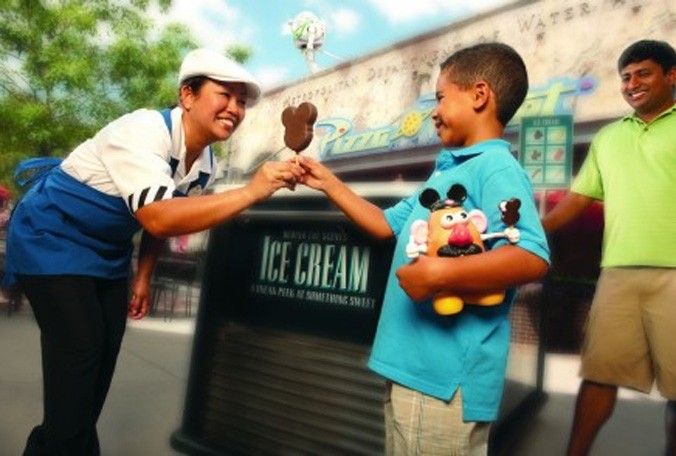
ice cream

What happens when a child drops a Mickey ice cream bar?

  • Is it tough luck for the unhappy child?
  • What about the sticky mess on the busy sidewalk?
  • How would you handle a tired, irate parent?
  • What’s the impact on the bottom line?

There’s not an easy answer for the situation above – or for the tens of thousands of other daily occurrences that happen in a Disney theme park.

How do you train cast members to handle whatever may come up in a normal – or not so normal – day in the park?

The recipe for creating the magical environment at Disneyland involved boiling down park operations into four priorities that represent the values driving every decision:

  • Safety – The most important priority for Guests and cast members. Cast members must often protect Guests from themselves! Guests distracted by the beautiful architecture may walk into lampposts and walls. Every operations and design decision must first address safety.
  • Courtesy – The second most important priority after safety is courtesy. Cast members know the value of the smiles on their faces and in their voices and the importance of engaging Guests. A lack of cast member courtesy will poison the safest and most interesting environment.
  • Show – Once safety and courtesy are assured, attention turns to show. Well-maintained attractions and facilities populated by well-groomed cast members ensure good show, a condition Walt Disney passionately promoted.
  • Efficiency – This last priority refers to the number of Guests enjoying the attractions, restaurants, and retail shops. This is the “hard numbers” portion of a business. By placing numbers last, the SCSE model makes a clear, somewhat paradoxical statement: accomplishing the first three priorities ensures that this fourth one is sustainable in the form of happy and loyal cast members and Guests.

The image of shrinking the massive and complex operations at Disneyland – a pot of soup – into a smaller, more manageable package – a bouillon cube – via the SCSE priority model is powerful.

Disney’s Four Keys serve as a compass for creating happiness and serving others. More than five decades after they were created by Dick Nunis, these Four Keys continue to serve as the foundation for everything Disney does. Any organization would be envious to have several key standards stand that test of time. It is at the heart of what has made Disney the powerful name it is today.

About that Mickey ice cream bar…

Applying Van France’s Four Circumstances to ChurchWorld Guest Experience Teams

Innovate – Support – Educate – Entertain

> Simplify the Complex

How are complex operations and processes communicated in your organization? Are priorities succinct and memorable? How are Van’s Four Circumstances used to convey complex and vital procedures and priorities?

> It’s All about the Basics

  • How do you help team members understand standard operating procedures and priorities?
  • Are team members actively involved as change agents, or do they wait for direction?
  • Are policies followed? If not, why not?

> Great Trainers Transfer Knowledge

  • How does your training staff leverage experience from one area to another?
  • What do you do to encourage interactions with Guests and attendees?

> From Pot of Soup to Bouillon Cube

  • What is your organization’s equivalent of SCSE?
  • Can your team member manual be simplified?
  • What are your priorities? Can you summarize your standard operating procedures and priorities, regardless of complexity, with memorable phrases or acronyms?

Inspired by and adapted from Disney U by Doug Lipp

Disney U

Get the book TODAY to learn invaluable lessons for your Guest Experience Teams

Book     Kindle

Continue the Disney U experience on 4/15 with The Honeymoon Will End

Disney U is one of the most significant resources related to the Disney organization, leadership, team development, and Guest Experiences available. In honor of the one year anniversary of the release of Disney U, this is a look back at a series from the book that originally ran last year.


Planning Is Not The Same As Dreaming

Here are some great initial processing thoughts about GENE 2014 from my friend Danny Franks, Connections Pastor at Summit RDU.

Danny's avatarConnective Tissue

Somebody's gotta launch Lego Church. Might as well be us. Somebody’s gotta launch Lego Church. Might as well be us.

I spent the last few days in a guest services geek’s dreamland: I was fortunate enough to sit around a table with seventeen of the sharpest church hospitality minds in the country. We came from churches of different backgrounds (from maybe-sorta-traditional to hey-wow-you’re-not-traditional-at-all), churches of different sizes (from really big to good-glory-are-you-a-church-or-the-population-of-Montana), and churches with varying philosophies and approaches to how we do just about everything.

But one thing united us all, and that’s our vision that churches nationwide must step up to reach those who are far from Jesus. In addition to being missional communities who send people out, we have to be attractional communities that welcome people in. It’s not either/or, it’s both/and.

By the time the first sixty minutes of our conversation had elapsed, my brain was full. I picked off enough ideas and “aha!” moments…

View original post 507 more words

GENE 2014 – First Look

Over the last three days, 18 of the top leaders in church Guest Experiences gathered to answer this question:

What would the DNA of the ultimate Guest Experience look like?

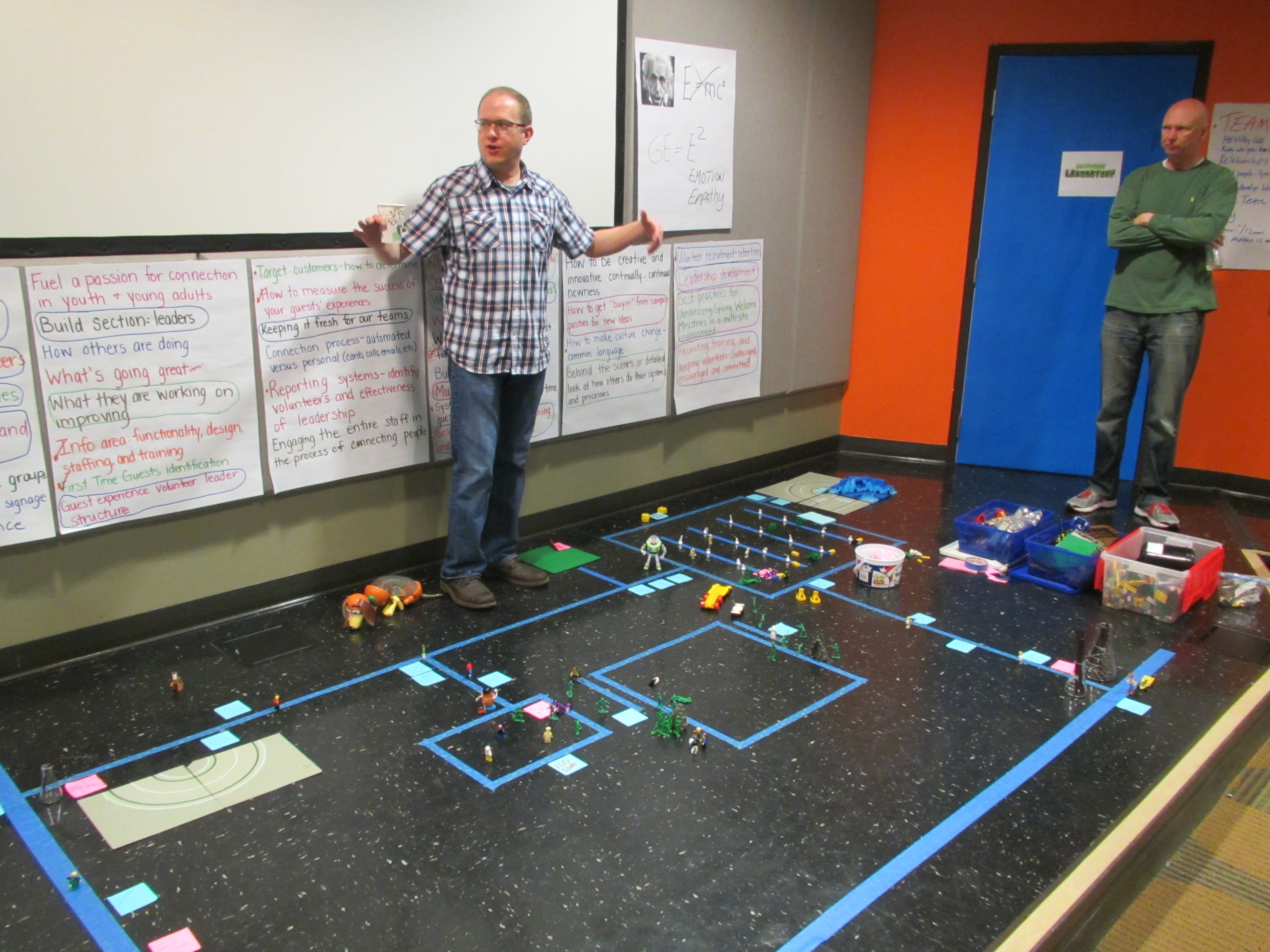
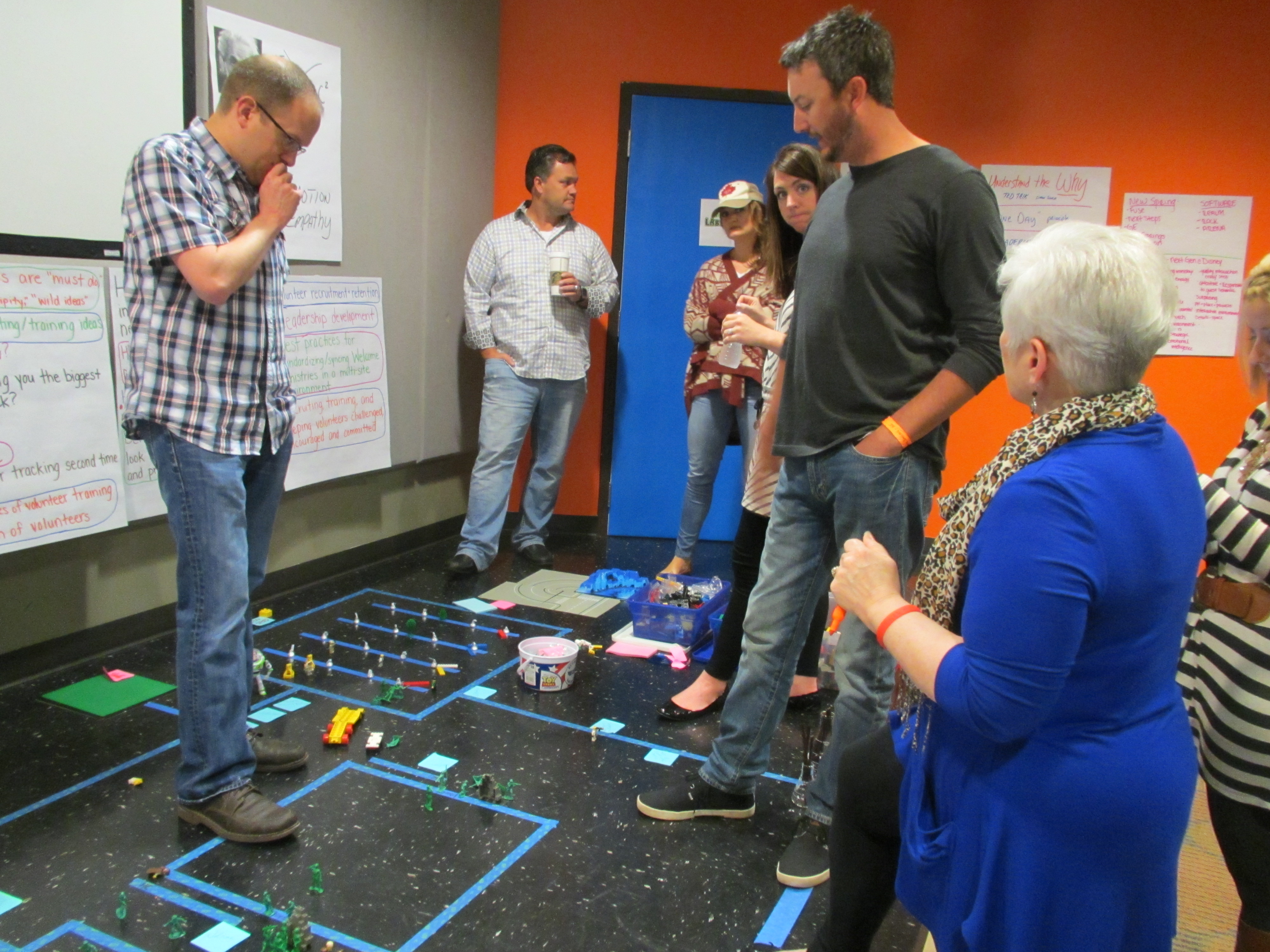
Details will follow, but I wanted to share a few representative photos:

IMG_6936

Participants in the Guest Experience Networking Event 2014 at work creating a Guest Journey Map.


IMG_6979

Danny Franks describes his team’s work in creating the ultimate parking experience for their “church.”


IMG_6898

Pondering the best ideas for vehicle and pedestrian traffic flow.


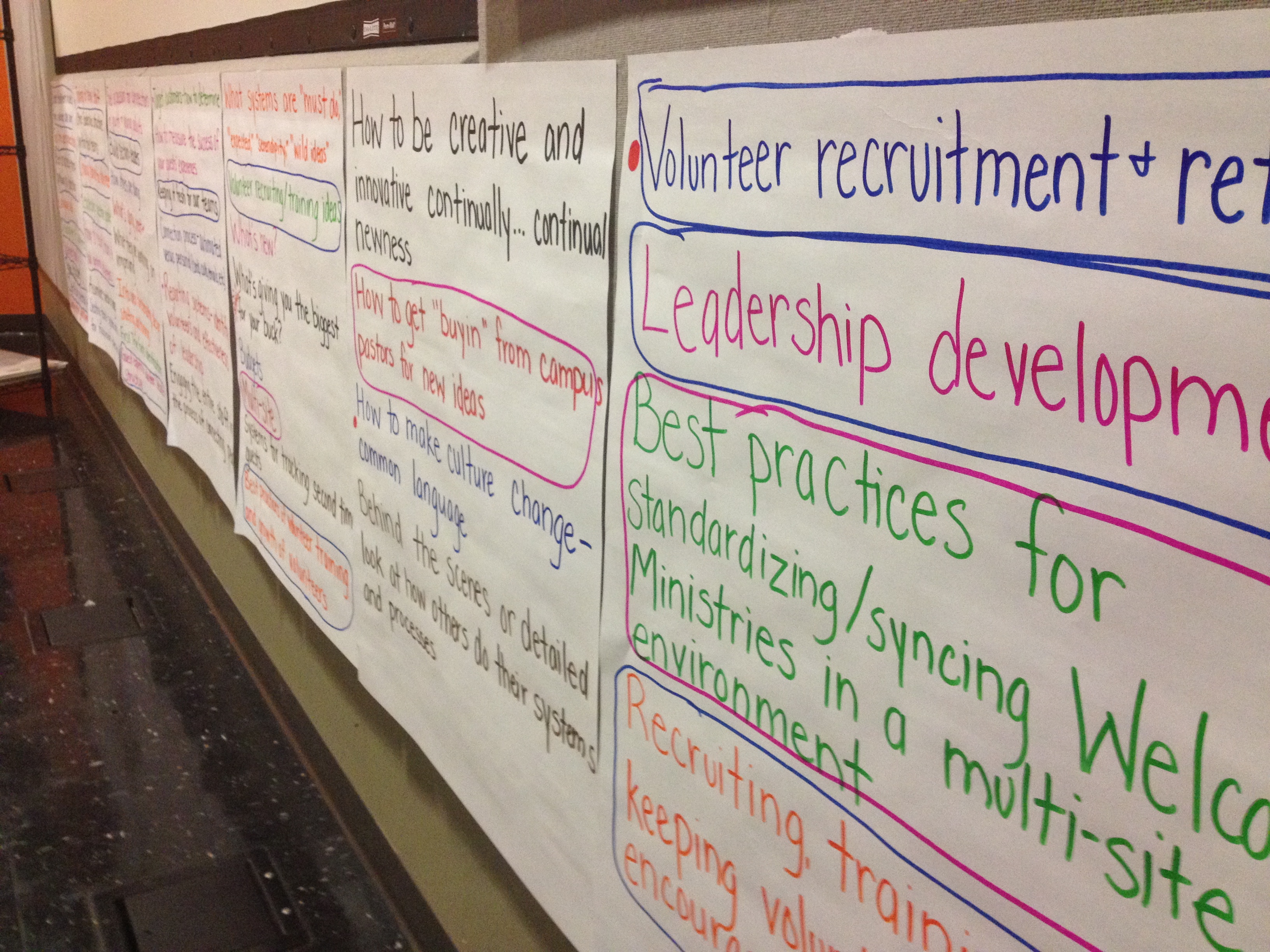
Charting problems solved...

Charting problems solved…

Table writing...

Table writing…

One-upping Einstein.

One-upping Einstein.

Designing the DNA of the Ultimate Guest Experience for Churches

What happens when 18 of the best church Guest Experience minds in the country get together to design the DNA of the Ultimate Guest Experience for churches?


DNA1

I don’t know…

…but it’s happening over the next 4 days, so I’ll let you know next week!

Guest Experience Networking Event

Imagine a laboratory filled with 18 of the most creative church Guest Experience practitioners from around the country…


…a lab with blank walls and lots of chart tablets and markers.
…a lab surrounded by the energy and vibe of creatives at work.
…a lab stocked with snacks of every kind imaginable.
…a non-scheduled framework guided by a host but driven by participant interaction.
…a lab where Guest Experience leaders share their best practices with others.
…a collaborative learning opportunity with no limits.


GENE Therapy


Be Willing to Change or Be Willing to Perish: The Birth of Disney University

One jarring element can undermine a host of favorable impressions.

That’s why street cleaners at Disney World are given extra training at Disney University to ensure that they respond in a positive and helpful fashion to questions from departing Guests.

It might seem strange to train street cleaners in customer service, but Disney learned years ago that these cast members receive the greatest number of unstructured questions from park Guests.

courtesy billbergh.com

courtesy billbergh.com

To make sure that a Guest’s last – and lasting – impression after a wonderful day in the park isn’t ruined by a don’t-ask-me-it’s-not-my-job attitude, Disney provides three extra days of interpersonal skills training for the cleanup crew. Disney believes in a proactive approach to head off potentially damaging situations.

That wasn’t always the case.

Walking in Disneyland and interacting with the large number of cast members in 1962 exposed Van France to the inadequacies of the existing organization and training process. He found:

  • Outdated training materials
  • Trainers who were out of touch with the realities of park operations
  • Temporary summer jobs that had become careers
  • Hard work and long hours on weekends, nights, and holidays
  • Exhausted cast members that were becoming burned-out

Van also saw the need to expand beyond the simple orientation program of 1955 into a more complete sequence that included a consistently applied on-the-job training component.

The Disney University was created 7 years after the 1955 grand opening of Disneyland in response to the demands of a rapidly maturing organization.

Our theme of “happiness” was great for the first years, and we still use the basic elements of that program. But now we needed something new, something that would impose responsibility and self-discipline on all of our key people.

Van France

Walking the park also reinforced in Van’s mind the requisite elements for ensuring “substance” in the Disney University.

  • Training staff had to have credibility
  • Trainers with frontline experience were a must
  • Program content had to reflect the reality of the workplace and still convey corporate values, standards, and expectations

The Disney University should be a pioneering force, the world’s first and foremost corporate institution for training in the art, skills, and knowledge required in outdoor show business.

Van France

With this in mind, Van proposed that the Disney University develop employees into “Disneyland specialists,” with emphasis on four areas:

Leaders: We need to develop leaders who have an overall understanding of the complex combination of skills and professions that have made the Disneyland show the world’s greatest entertainment attraction.

People specialists: We need men and women who are professionally qualified to deal with people and their many demands.

Trade Specialists: WE need to develop those skilled in the various unique technical phases of the operations, but they must also have an overall knowledge of the total operation.

History and traditions: Most importantly, we sorely need training in the Disneyland organization and the history and traditions of Walt and his company.

With all the changes to the Disney organizations over the years since the opening of Disneyland, Van knew that it was more important than ever for the University to create programs that would carry on the traditions, philosophies, and dreams that Walt Disney had left for the organization.

Applying Van France’s Four Circumstances to ChurchWorld Guest Experience Teams

Innovate – Support – Educate – Entertain

Be Willing to Change or Be Willing to Perish

In your organization, can you identify the equivalent of Van’s Four Circumstances that support “Be willing to change or be willing to perish,” balancing tradition with innovation? Can those things be applied to ensure that training and team development programs are credible?

  • How does training in your organization remain relevant and credible?
  • How could training processes, programs, and staff improve “substance”?
  • To what extent are the history and traditions of your organization perpetuated and built upon?
  • What traditions should be maintained in your organization?
  • What traditions are impeding progress and innovation?
  • Who in your organization has the influence and desire to implement change?

Inspired by and adapted from Disney U by Doug Lipp

Get the book TODAY to learn invaluable lessons for your Guest Experience Teams

Disney U

Book     Kindle


Continue the Disney U experience Thursday 4/10/14 with Simplify the Complex


Disney U is one of the most significant resources related to the Disney organization, leadership, team development, and Guest Experiences available. In honor of the one year anniversary of the release of Disney U, this is a look back at a series from the book that originally ran last year.

Gather Facts and Feelings – Walk the Park for a Fresh Perspective

He didn’t have a particular schedule, but his agenda was always the same: connect with and interact with as many guests and cast members as possible.

 Walt would regularly walk through the Park, looking for problems or things to improve. He was good at it and always welcomed suggestions. I copied his routine. I continually walked through the Park, looking for different things, people problems. Facts are easy to identify; I was looking for feelings that were bothering Cast Members.

Van France, founder of Disney University

Walt Disney knew the value of learning as much as possible about the front lines by spending time on the front lines.

courtesy of designingdisney.com

courtesy of designingdisney.com

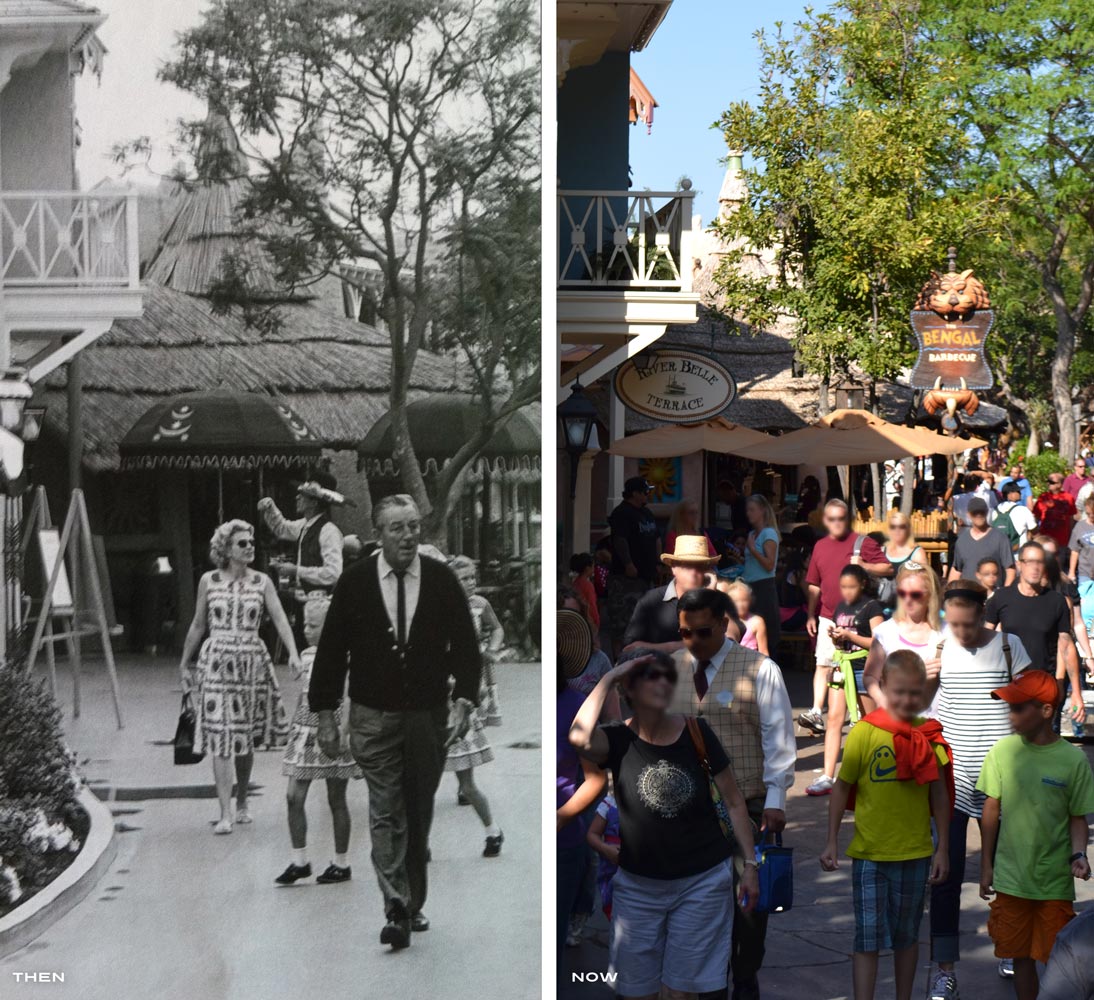
His strategy of walking the park dates back to the construction of Disneyland. He regularly visited the construction site to assess the proportion or size of buildings. A common site was Walt squatting down and then looking up at a building from a lower angle. His determination to view the storefronts and buildings from the vantage point of children ensured that the needs of this large population of guests – an often overlooked but very influential group – were addressed.

courtesy of Disney Imagineering

courtesy of Disney Imagineering

Walt Disney never stopped looking at Disneyland from the perspective of the guest, even years after the park opened.

Van France, like Walt, favored walking the park to gather information. Often armed with his camera, Van tirelessly sought the opinions and thoughts of cast members and guests.

Bill Ross, a former manager of Disney University, says, “More than anyone I’ve ever known, Van put his ear to the ground to get ideas. He had a wide circle of friends and a strong network. If Van were with us today, he would love using social media.”

Walking the park helped Van clarify the problems and then visualize a process by which to bridge the gaps.

After the park had been open for seven years, Van realized the 1955 model of orientation and cast member training that had been so successful during Disneyland’s early years was no longer sufficient. He faced a paradox: preserving the past while preparing for the future.

Van knew that he needed to identify and preserve the components of orientation and training that had led to such heady success during Disneyland’s first seven years:

  • Friendly environment
  • Creative presentations
  • Useful content

He had to balance these fundamentals while preparing cast members – including managers – for a much more complex future, driven by the following factors:

  • Consistency – everyone must attend the new-hire orientation program
  • Systems – specific on-the-job training must follow the orientation program
  • Continuing education – supervisors and managers needed leadership and communication-skills training

The time was right for Van to build a bridge to the future of training for Disneyland. The time was right for the Disney University.


Applying Van France’s Four Circumstances to ChurchWorld Guest Experience Teams

Innovate – Support – Educate – Entertain

Gather Facts and Feelings

In your organization, can you identify the equivalent of Van’s Four Circumstances that support walking the park and keeping in touch with the front lines? How do you apply those circumstances to gather facts and feelings from team members and Guests?

Walk the Park

  • What is the equivalent of walking the park in your organization? Who does it, and how frequently?
  • How could this strategy be improved? More people involved? More frequently?
  • If leaders aren’t walking the park, what is the excuse?
  • Walt Disney could carve time out of his day to walk the park. Why can’t every leader do that?

Mind the Gap

  • Is there a reality gap between the ideals espoused in your organization and training programs and the realities of the job?
  • How is the effectiveness of your training assessed? With what frequency?

One Foot in the Past, One Foot in the Future

  • How is the history of your organization kept alive? How could this be improved?
  • How does your organization balance history and legacy with current and future needs? Who supports this?

Inspired by and adapted from Disney U by Doug Lipp

Disney U

Get the book TODAY to learn invaluable lessons for your Guest Experience Teams

 Book     Kindle

Continue the Disney U experience Thursday 4/3/14 with Be Willing to Change or Be Willing to Perish: The Birth of the Disney University

Disney U is one of the most significant resources related to the Disney organization, leadership, team development, and Guest Experiences available. In honor of the one year anniversary of the release of Disney U, this is a look back at a series from the book that originally ran last year. 


Want to know more about learning from the front line?