Beyond the Front Door: Building Bridges in Every Neighborhood

As Christians, how should we interact with the place and people around us?

I’ve become thoroughly convinced through God’s Word that we are all beautifully created, explicitly called, and graciously reminded to pursue the common good right where we live. And I’ve been genuinely inspired by stories of Christians in much harsher times than our own doing just that in ways that were beautiful, rewarding, and intriguing to the world around them.
The truth is, after all this study and research and introspection, most of my doubts are simply gone. They are being replaced by a “living hope,” as Peter put it in that letter to believers in Asia Minor. I see this beautiful, ancient path in front of me.

Don Everts

Are you tired of hearing people dismiss the church as an irrelevant relic? (Do you secretly wonder if they are right?) Don Everts explores an exciting reality that is revealed in Scripture, shown throughout history, and confirmed in the latest research: when Christians pursue the common good of the neighborhood, the world stands up and notices. It turns out this is exactly what we’re called to do. When Christians make good things, we bring blessings and hope to our local community.

With original research from the Barna Group and Lutheran Hour Ministries on how Christians relate to our neighborhoods, The Hopeful Neighborhood is filled with constructive, practical ways that Christians and churches can bless those around us. As Christians join together for the common good, we bring hope to the world, credibility to the church, and glory to God.


Author Don Everts believes that we all tread the same journey: from division to unity, from insignificance to relevance. This path leads to a more interconnected and harmonious way of life, to a gentler and more considerate manner of impacting the world, to a Christian presence in our nation that is more compelling and appealing, to a fuller utilization of the talents bestowed upon us by God, and to deeper connections with those who may not share our faith. 

This journey begins right at our doorsteps and, guided by God’s grace, extends to encompass the places and people in our immediate surroundings.

Though this path may seem unfamiliar in an era marked by division, self-preservation, and indifference towards our neighbors, it is, in fact, an ancient and well-trodden route. Its simplicity lies in the transition from oneself to the community one resides in. Regardless of our location, we are part of a neighborhood, and perhaps God is urging us to be more mindful of this fact.

As Everts and his wife entered into the empty nest stage of life and contemplated whether to relocate to a new neighborhood or stay in their existing one, they found themselves in no hurry to make a decision. What they did know is that wherever they end up, they want to truly inhabit that place, no longer wishing to merely exist in a location. Rather, they seek to fully engage with it.

Regardless of their eventual neighborhood, their desire is for it to be a beacon of hope. They aspire to extend hospitality by welcoming others into their home for meals and fostering a sense of community among their neighbors. They aim to collaborate with those around them, utilizing their collective talents for the betterment of their shared environment and the people within it. Above all, they want to strive to ensure that no one in their neighborhood ever goes unnoticed or unacknowledged for decades on end.

That’s what The Hopeful Neighborhood Project is all about.

Find out more here.


FROM RUINS TO RESILIENCE: Leadership in Times of Adversity

Glance through newsfeeds on your device and it won’t take long to find another story of an organizational or leadership breakdown. Although things may appear smooth and stable on the surface, beneath an often thin veneer it is not unusual to find internal strife or organizational confusion.

Guess what – that’s nothing new.

It’s been around for thousands of years…

Every leader faces problems. But should we solve them by using strategies found in best-selling leadership books?

Or is there another way?

It would be the dream of today’s content creators to write promotional materials for the memoirs of Nehemiah, the governor of Judah in the latter part of the fifth century B.C. They would almost be salivating at the opportunity to mine this amazing text from the Bible which speaks directly to contemporary concerns and offers such practical guidance in so many areas of life.

Here’s a glimpse of what that copy might look like:

Become a Leader and Discover How to:

  • Strategize and execute actionable plans
  • Influence others positively and foster a culture of cooperation
  • Navigate challenging authority figures
  • Inspire and empower team members
  • Unlock eight essential strategies for overcoming obstacles
  • Achieve success where others have faltered
  • Attain victory through collaboration rather than coercion

While each of these insights (and more) are gleaned from Nehemiah, it would be remiss to overlook its most crucial aspect: Nehemiah’s deep devotion to God. His intimate connection with God through prayer and personal piety enabled him to tap into divine wisdom, patience, skill, and perseverance, essential for accomplishing his monumental task.

And what a task it was! In 445 B.C., Nehemiah journeyed from the Persian capital of Susa to the ancient Jewish hub of Jerusalem to oversee its reconstruction. Devastated 141 years earlier by Nebuchadnezzar, the Babylonian king, Jerusalem lay in ruins, its once-majestic walls reduced to rubble. Despite the daunting circumstances and the discouragement of previous failed attempts at reconstruction by returning exiles, Nehemiah orchestrated a remarkable turnaround. In just fifty-two days, amidst fierce opposition, he oversaw the completion of the city’s formidable defenses, commencing work on August 1st and concluding on September 21st.

How did he achieve the seemingly impossible? Nehemiah attributes the success not to his own prowess but to the divine intervention of God. When granted permission by King Artaxerxes, Nehemiah acknowledged God’s favor, stating, “The king granted by requests, for the gracious hand of my God was on me.” (Nehemiah 2:8). Confronted by formidable adversaries such as Sanballat and Tobiah, Nehemiah remained steadfast, affirming, “The God of the heavens is the one who will grant us success” (v. 20). Upon completion, Nehemiah attributed the feat to divine assistance, declaring, ” …this task had been accomplished by our God” (Nehemiah 6:16).

Nehemiah exemplifies exceptional leadership qualities, offering timeless lessons. Yet, beyond his leadership acumen lies his profound reliance on God – a lesson equally vital for us today.

May God raise up leaders like Nehemiah in our time of need.


Inspired by Nehemiah: Learning to Lead, by James Montgomery Boice


The Ripple Effect of Generosity: Transforming Individuals, Communities, and Beyond

Let’s face it: Recent years have been tough on optimists.

Hopes that the Internet might bring people together have been crushed by the ills of social media. Is there a way back?

As head of TED, Chris Anderson has had a ringside view of the world’s boldest thinkers sharing their most uplifting ideas. Inspired by them, he believes that it’s within our grasp to turn outrage back into optimism. It all comes down to reimagining one of the most fundamental human virtues: generosity.

What if generosity could become infectious generosity? Consider:

• how a London barber began offering haircuts to people experiencing homelessness—and catalyzed a movement

• how two anonymous donors gave $10,000 each to two hundred strangers and discovered that most recipients wanted to “pay it forward” with their own generous acts

• how TED itself transformed from a niche annual summit into a global beacon of ideas by giving away talks online, allowing millions access to free learning

In telling these inspiring stories in his book Infectious Generosity, Anderson has given us “the first page-turner ever written about human generosity” (Elizabeth Dunn). More important, he offers a playbook for how to embark on our own generous acts – whether gifts of money, time, talent, connection, or kindness – and to prime them, thanks to the Internet, to have self-replicating, even world-changing, impact.

Imagine if we cracked the code on making generosity contagious. It could shift the balance away from the rising divisions in our world, ushering in a fresh era of optimism.

Generosity? Seriously?!

It’s an unusual concept, no doubt. Maybe even a bit outdated. At first glance, it might seem too gentle to confront the formidable challenges we’re up against. You, as an individual, could be as generous as you want, but can your well-meaning gestures and sacrifices really make a difference?

Yet, therein lies the crux. They can. Every act of generosity, no matter how small, has the potential for extraordinary impact if it can spread from isolated incidents to becoming infectious. By tweaking their form just a bit, acts of generosity can become immensely powerful. Infectious Generosity is dedicated to unveiling how.

The infectious potential of generosity stems from two main factors: human nature and the interconnectedness of our modern world. In the book, Anderson delves into how overlooked qualities innate to every human can combine to set off cascades of generous behavior. Moreover, he explains how these ripple effects can be amplified by the Internet for monumental, world-changing effects.

The Internet is renowned for facilitating various contagions, from social media trends to viral marketing. Similar to a virus, humans serve as carriers for the Internet’s contagiousness. Instead of replicating in our respiratory systems, ideas and visuals spark in our minds, prompting us to hit “Like” or “Share.”

Regrettably, many of the contagions proliferating online are harmful.

Driven by advertisement-based revenue models that aim to keep users glued to their screens, social media platforms have morphed the web into a machine for generating outrage. Instead of showcasing the best in each other, we often encounter the worst, driving us further apart.

This book revolves around two intertwined themes: The Internet can supercharge generosity, and Generosity can revolutionize the Internet. Each theme fuels the other. If we view the Internet as a daunting, impersonal realm teeming with strangers poised to judge and exploit us, it becomes challenging to trust it with our altruistic intentions. However, without individuals endeavoring to engage with others online in a spirit of generosity, the Internet cannot fulfill its potential as a force for good. It’s tempting to dismiss the Internet as a cesspool of toxicity. What we urgently need is to initiate an upward spiral wherein the growing visibility of a more generous humanity inspires individuals to contribute to the greater good.

Anderson feels a pressing sense of urgency about this because we are witnessing the early stages of our world being reshaped by artificial intelligence.

And guess what fuels the power of AI? The Internet. Essentially, the most potent AI systems are designed to process the vast expanse of human online activity and formulate predictive models. Do we want to rely on AI trained with today’s Internet? Absolutely not. It poses the risk of amplifying many dangers. If we can steer the Internet toward a kinder, more generous, and more positive direction, it could have an immeasurable impact on our future, both directly and by providing a healthier basis for AI.

It might seem far-fetched to envision us, imperfect humans, overcoming the Internet’s issues: polarization, misinformation, data surveillance, addiction, social media-induced insecurity, and more. Anderson understands that skepticism, but encourages the reader to withhold judgment, at least temporarily. Beneath the surface, remarkable developments are underway.

They’re worth exploring.

Infectious Generosity comprises three sections: “Why,” “How,” and “What If?”

Part 1 delves into why the time is ripe for infectious generosity. Anderson recounts the extraordinary events at TED that convinced him of the Internet’s profound impact on generosity, along with three fundamental principles derived from those events. Subsequently, he delves into newfound insights into human nature and how the call of generosity can yield surprising outcomes and deep happiness. Anderson also unveils the inner workings of the “Mystery Experiment,” the largest social science study to date demonstrating how kindness begets kindness.

Part 2 explores how to translate this theory into action. Anderson examines what it entails to cultivate a generous mindset, the various forms of giving that can snowball into something greater, and how we can share stories of generosity with one another. An essential chapter focuses on financial giving, including strategies to leverage resources to significantly magnify the impact of our contributions.

Part 3 contemplates what would happen if generosity were more deeply ingrained in our world. Anderson envisions reclaiming the Internet to fulfill the dream many people once held: aiding humanity in being both humane and kind. He examines how companies and organizations might be reshaped by generosity and ponders ways to empower our most influential change makers to embark on ambitious plans for transformation. He also explores the case for a global pledge that could unite us all on a journey of generosity. The section closes with a reflection on how we might instill a mindset of generosity in our future selves.

Wherever you are and whoever you may be, Anderson invites you to join him on this journey. There’s a good chance you’ll be touched by something profound, something capable of influencing how you allocate your future time, resources, and creativity. And this something might just end up inspiring others.

But this is a positive infection. A beautiful, hopeful, positive infection.

You may find yourself hoping you never recover.

Every human has the potential to give. The urge to do this is built deep inside each of us, and can be stirred just by our being open to the needs of others. When we share our time, our money, or our creativity, those acts can spark responses in kind.
So, once it gets started, generosity can spread like wildfire. As it passes from one person to the next, many lives can be touched. And our collective witnessing of what humans are capable of can overcome today’s prevailing cynicism, bringing people together in common causes.
And for you personally, this is all about that most elusive, inspiring, and beautiful thing: the quest for meaning. We were born to be connected. So give in any way that you feel able. Give creatively. Give courageously. Give collaboratively. And let the magic of generosity ripple out into the universe.
If you do that, don’t be surprised if one day you wake up and hear a whisper from inside: “I have never felt so happy.”

Chris Anderson, Infectious Generosity

Part of a regular series on 27gen, entitled Wednesday Weekly Reader.

During my elementary school years one of the things I looked forward to the most was the delivery of “My Weekly Reader,” a weekly educational magazine designed for children and containing news-based, current events.

It became a regular part of my love for reading, and helped develop my curiosity about the world around us.

Transforming Lives Through Authentic Connections in Your Home

40 Days to Opening Your Heart and Home

May the people in our lives observe our set-apart and sanctified ways not as us being better and more righteous in a holier-than-thou way. Instead, when they see us taking interest in them, may they desire to know more about the one true God we serve.

Karen Ehman

Like many, you want to open up your home and connect with others. But you don’t think you have the time or ability. Along comes Reach Out, Gather In.

Through devotionals and practical tips, New York Times bestselling author Karen Ehman will inspire you to put love into action in this 40-day journey of hospitality. Karen will help you with the how to and why of reaching out to others in meaningful ways. This book – part devotional, part practical handbook – will help you find loving ways to feed both the bodies and souls of the people whom God has placed in your life.

In Reach Out, Gather In, Karen shares some of her favorite recipes and hospitality traditions:

  • ideas for menu planning and themed gatherings
  • sorta-from-scratch shortcuts for busy days when you need something delicious in a snap
  • motivating stories and biblical inspiration
  • space for answering reflective questions so you can journal your own 40-day excursion
  • sidebars on decluttering and cleaning strategies

This beautiful book highlights the why of hospitality, so that your home and life will grow to be a place where the gospel is displayed, drawing others closer to Christ and making a difference for eternity.

According to author Karen Ehman, the biblical concept of hospitality is strait-forward in its definition. The original word is philoxenos. It is a combination of two other words: philos and xenos. Philos means love, and xenos means stranger. Hospitality is simply loving strangers and continuing to love them until the strangers become friends. There is no mention of a menu, no talk of home design.

Ehman adds that stranger love isn’t the only aspect of hospitality. Scripture also tethers this topic to loving fellow believers in passages such as Romans 12:13 and Romans 16:23. Hospitality is a tool we use to serve those we barely know or to minster to our closest friends. And it can be a powerful means of building up those in our local church as we offer our homes as venues where our spiritual community can flourish and care for each other.

Ehman observes that the Lord frequently utilizes everyday connections to advance his kingdom. In an anecdote, she recounts polling members of her Bible study group on their paths to faith, discovering that nearly all had initially embraced Christianity due to personal relationships rather than merely encountering the Gospel message. These relationships ranged from familiar faces like neighbors or colleagues to unexpected friendships with individuals who welcomed them into their lives and shared their Christian journey in an authentic manner. This intimate exposure to God’s presence in ordinary life sparked a desire for a similar connection with Him.

Drawing from the New Testament passage of 1 Thessalonians 2:7-8, Ehman emphasizes the importance of not only sharing the Gospel verbally but also sharing one’s life. She highlights the Greek term “psuché,” which conveys not just daily occurrences but the essence of one’s soul or personality. This soul sharing involves creating a space where individuals can connect deeply, allowing the Gospel to be exemplified through genuine relationships.

Contrary to common misconceptions, soul sharing doesn’t require extravagance or complexity but rather entails caring for others on a profound level, offering both material support and time while directing them towards Jesus. It mirrors the hospitality of the family of God and honors the legacy of those who have embraced the Gospel before us. This simple yet profound practice holds the potential to impact lives for eternity, inviting us to eagerly anticipate the divine encounters that await us.

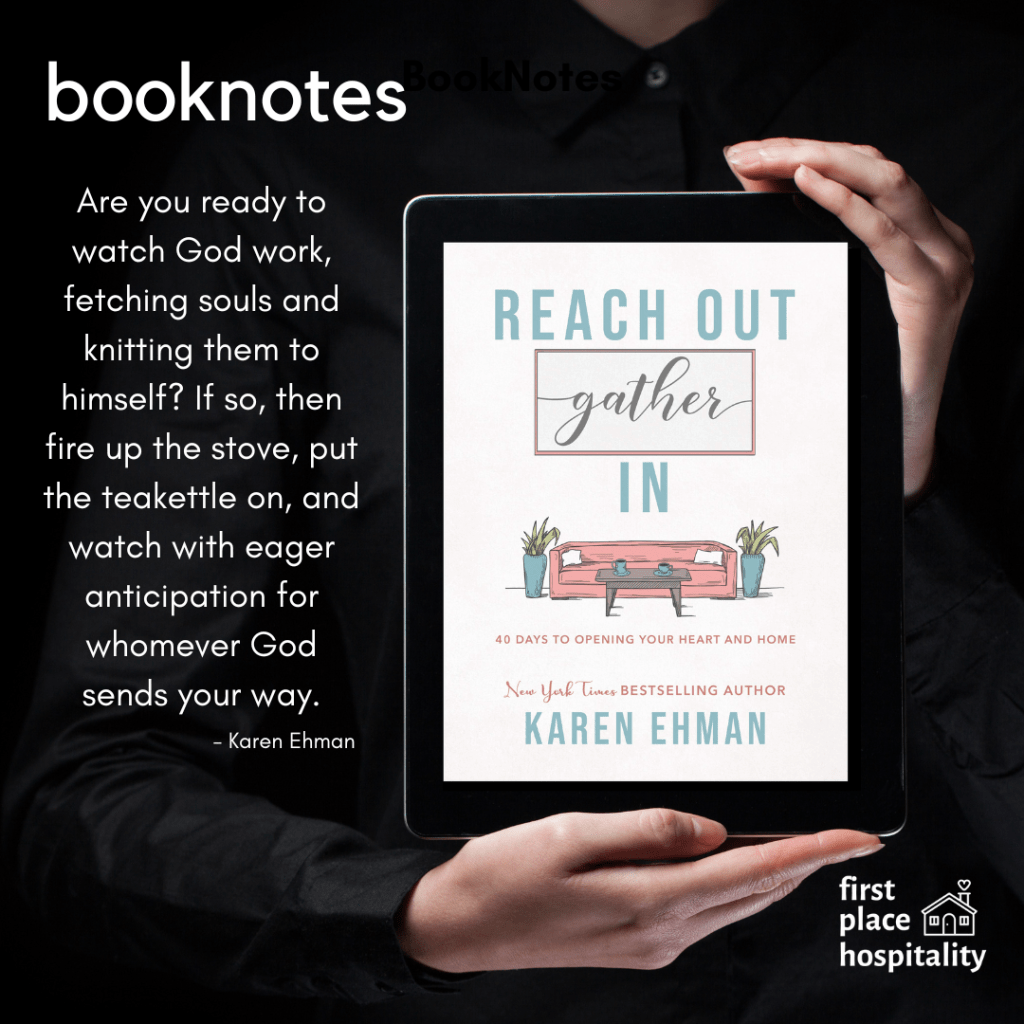
Are you ready to watch God work, fetching souls and knitting them to himself? If so, then fire up the stove, put the coffee pot on, and watch with eager anticipation for whomever God sends your way.


inspired and adapted from Reach Out Gather In by Karen Ehman.


Nehemiah’s Blueprint: A Biblical Model for Problem Solving

Short deadlines.

Not enough staff.

Tight budgets.

Personal attacks.

External opposition.

Internal conflicts.

A huge task.

Sound like your organization?

Hopefully not, but that was the situation that Nehemiah faced as he stood at the broken down walls of Jerusalem and wept. Fortunately, Nehemiah had a unique ability to solve the complex problems that faced him. His methods illustrate two powerful elements of systems thinking that every leader should possess. As you begin to understand these elements, they will help you solve the problems you face as a leader.

Nehemiah’s ability to solve complex problems grew out of his manner of seeing the problems – as a systems thinker. Peter Senge, one of the early proponents of systems thinking, said “Systems thinking is a discipline for seeing wholes. It is a framework for seeing interrelationships rather than things, for seeing patterns of change rather than static ‘snapshots’ “.

Two elements of systems thinking made a difference for Nehemiah. He saw what Senge labeled “the subtle interconnectedness that gives living systems their unique character,” and he saw the ‘structures’ that underlie complex situations”.

The result? He was so successful in his work that, when people saw it, “they realized that this work had been done with the help of God” (Nehemiah 6:16). Each step of the way, Nehemiah had sought the Lord for direction. God answered those prayers by providing favor, strength, and wisdom.

How will you use systems thinking to “rebuild the walls” you encounter?

Nehemiah’s approach to rebuilding the walls of Jerusalem serves as a prime example of problem-solving in the Bible. 

He grasped the problem’s scope by carefully considering the report he received, understanding its importance in shaping subsequent actions. This involved not just hearing the report but also probing the messengers for additional details.

He empathized with the suffering of his people, feeling deeply for them and for the honor of God. This compassionate stance underpinned his entire plan.

Nehemiah turned to prayer, petitioning the “God of heaven” fervently and humbly. His prayer was marked by reverence, confession, and a plea for divine favor, recognizing the need for God’s intervention in his interactions with King Artaxerxes.

He waited for the right moment to approach the king, having spent months in prayerful preparation. Even when the opportunity arose, Nehemiah continued to seek God’s guidance through prayer.

Upon reaching Jerusalem, Nehemiah quietly assessed the situation, taking time to understand the condition of the wall before revealing his plan. This thoughtful approach mirrored that of a skilled physician diagnosing a patient’s ailment.

Nehemiah involved the community in the solution, recognizing that the problem was a collective concern. With a rallying cry, he gathered support for the rebuilding effort, instilling confidence in the people by reminding them of God’s favor.

Nehemiah’s example highlights the importance of prayer, empathy, careful planning, and community involvement in problem-solving. Leaders can glean valuable insights from his actions by studying this narrative closely.


Learn How to Use the Power of Mise-en-place in Your Place

Despite how it may feel, competition for the spiritual attention and Sunday attendance of today’s family is not with the growing church down the road. Church leadership must redirect energy from being “bigger and better” than other churches, and instead see those places that provide “WOW! Experiences” as the real points of comparison among first time guests.

While that may seem impossible to achieve, this present reality can also be turned into a positive. Churches must start LEARNING from those top-notch places and their leaders.

Eating out at one-of-a-kind experiences has never been more popular or accessible. Celebrity chefs and buzz-creating restaurants are literally popping up in cities across the country, large and small. In the world of hospitality, the culinary segment has unique applications to the Guest Experience ministries of a church. The dining experience at a four-star restaurant provides excellent lessons for welcoming ministries in your church.

With input from one son who began making pizzas in high school working his way up to general manager and regional trainer of a national fast casual franchise location and another with a culinary and food service degree who is now an events planner at a university, today’s post explores what leaders can learn from the food industry.

Develop the art of mise-en-place.

THE QUICK SUMMARYWork Clean, by Dan Charnas

The first organizational book inspired by the culinary world, taking mise-en-place outside the kitchen.

Every day, chefs across the globe churn out enormous amounts of high-quality work with efficiency using a system called mise-en-place―a French culinary term that means “putting in place” and signifies an entire lifestyle of readiness and engagement. In “Work Clean,” Dan Charnas reveals how to apply mise-en-place outside the kitchen, in any kind of work.

Culled from dozens of interviews with culinary professionals and executives, including world-renowned chefs like Thomas Keller and Alfred Portale, this essential guide offers a simple system to focus your actions and accomplish your work. Charnas spells out the 10 major principles of mise-en-place for chefs and non chefs alike: (1) planning is prime; (2) arranging spaces and perfecting movements; (3) cleaning as you go; (4) making first moves; (5) finishing actions; (6) slowing down to speed up; (7) call and callback; (8) open ears and eyes; (9) inspect and correct; (10) total utilization.

This journey into the world of chefs and cooks shows you how each principle works in the kitchen, office, home, and virtually any other setting.

A SIMPLE SOLUTION

Every day, chefs across the globe put out enormous amounts of high quality work with efficiency using a system called mise-en-place – a French culinary term that means “putting in place” and signifies an entire lifestyle of readiness and engagement.

For the culinary student, it is usually the beginning point of their career. But it is a beginning point that is repeated every day of their career – it’s the first thing they will do at the start of each day’s work.

Mise-en-place means far more than simply assembling all the ingredients, pots and pans, plates, and serving pieces needed for a particular period. Mise-en-place is also a state of mind. Someone who has truly grasped the concept is able to keep many tasks in mind simultaneously, weighing and assigning each its proper value and priority. This assures that the chef has anticipated and prepared for every situation that could logically occur during a service period.

Mise-en-place as a simple guide to focusing your actions and accomplishing your work is a necessary first step on the way to an exceptional guest experience.

Mise-en-place comprises three central values: preparation, process, and presence. When practiced by great chefs, these three mundane words become profound. The byproduct of these values may be wealth or productivity, but the true goal is excellence.

Preparation Chefs commit to a life where preparation is central, not an add-on or an afterthought. To become a chef is to accept the fact that you will always have to think ahead, and to be a chef means that thinking and preparation are as integral to the job as cooking. For the chef, cooking comes second. Cooking can’t happen without prep coming first. Embracing preparation also means jettisoning the notion that prep work is somehow menial, beneath us. Your preparation – and its intellectual cousin, planning – thus becomes a kind of spiritual practice: humble, tireless, and nonnegotiable.

Process Preparation and planning along are not enough to create excellence. Chefs must also execute that prepared plan in an excellent way. S they ensure excellent execution by tenacious pursuit of the bet process to do just about everything. A commitment to process doesn’t mean following tedious procedures and guidelines for their own sake. It’s not about turning humans into hyper-efficient robots. Process is, quite the contrary, about becoming a high-functioning human being and being happier for it. Excellence arises from refining good process – how can I do this better or easier, or with less waste? It’s a job, like preparation, that never ends.

Presence Chefs commit to being present in ways from the mundane to the sublime. After months and years of repeated prep and process, the cook acquires a deeper kind of presence – becoming one with the work, and the work becoming kind of meditation. “Kitchen awareness” demands that one not only be “with” the work, but also “with” your comrades and their work at the same time. This kind of awareness isn’t scatteredness. It is, quite the contrary, something closer to what the Eastern traditions call mindfulness. Presence in all its forms – getting there, staying there, being focused, being open, and cultivating boundaries – helps us adjust our preparation and process as the circumstances shift around us.

Dan Charnas, Work Clean – What Great Chefs Can Teach Us About Organization

A NEXT STEP

The three values listed above – preparation, process, and presence– aren’t ideals to admire and applaud. They must be practiced – and can be, by anyone, anywhere.

To apply the values listed above to your hospitality ministry, begin by creating three chart tablets, writing the values above, one word per page.

Read the descriptions listed for each value.

In a discussion with your team, walk through your Guest Experience from beginning to end, and list each action on the appropriate page. If it fits on more than one page, put it on the page it makes most sense, or is strongest.

Review the lists with your team.

  • What’s missing? Write it in, and assign it to a leader, along with a timeline, for development.
  • What needs to be made stronger? Write it in, and assign it to a leader, along with a timeline, for strengthening.
  • What’s unnecessary? Remove it from the list, and your regular activities.

A Field Guide to Methodist Fresh Expressions

Jesus is Lord of Neighborhoods and Networks

We need vintage forms of church to engage our neighborhoods and fresh forms of church to engage the networks all around us. Further, one professional clergy person growing his or her flock is a bankrupt concept. The new missional frontier requires the whole people of God, the “priesthood of all believers.” Every Christian may invite others in their relational sphere to live under the Lordship of Jesus.

Michael Adam Beck and Jorge Acevedo

As consultants who work nationwide and as innovative pastors, authors Michael Adam Beck and Jorge Acevedo awaken congregational leaders and ministry teams to a distinctive Wesleyan approach for the Fresh Expressions movement. In A Field Guide to Methodist Fresh Expressions, they show congregations how to cultivate and customize fresh expressions that fit their local context. They motivate ministry teams to take risks, experiment, and when necessary, fail well.

According to authors Beck and Acevedo, in the emerging Industrial Revolution of the eighteenth century, John Wesley was leveraging the power of first, second, and third places (home, work, and public places). Not only did he understand the importance of embodying the gospel in the places where people lived, he also had the contextual intelligence to adapt to the rhythms of their lives.

Through relationships with real people in the “nodes” (physical places) we spread the Christian faith like a good virus in the entry points that spreads through the “flows” (digital channels of connectivity).

The authors encourage us to prayerfully seek what and where the Spirit is leading us. Ask what the Spirit is up to in the places where people do life. What are the rhythms of people’s lives in our contexts? How are we engaging the neighborhoods of our communities? How are we engaging the complex system of networks? In what ways are we utilizing the flow that connect people across geographies?

Fresh Expressions epitomize a form of church suited to our evolving culture:

1. Missional: Inspired by the Spirit to reach those who aren’t yet part of the Christian community.

2. Contextual: Tailored to fit the needs and characteristics of the local community.

3. Formational: Centered on the formation of disciples.

4. Ecclesial: A complete expression of “church” rather than a transitional phase leading to an established congregation.

There’s no idealized past to return to. The existing system falls short in reaching the majority of people. We’ve transitioned beyond the information age into an era of globalization, where interconnectedness prevails. For individuals under 30, online communities are integral to daily life, blurring the lines between virtual and physical reality. Shared interests, not geographic proximity, unite people. The prevalent wound of our time is isolation.

The Fresh Expressions movement mirrors the early Methodist reliance on the Holy Spirit’s guidance. To adapt to the new reality, we must be missional in engaging people in their spaces—be it home, work, school, or communal settings like cafes, pubs, or parks. Traditional methods like door-to-door evangelism are ineffective. Instead, we should gather with others in places where they naturally congregate, identifying potential “Holy Spirit Hot Spots.”

Disruption isn’t about creating a product but a process aimed at reaching marginalized segments of society. Examples from companies like Netflix and Amazon illustrate this approach. Failure is to be anticipated, and a bold vision is necessary to engage those who wouldn’t typically step foot in a church. The church must transition from passive observers in seats to active participants in the streets.

People bond over shared interests and activities. Establishing new expressions of the church within these communities can transform practices profoundly. It goes beyond merely mimicking church rituals in trendy locations; God’s grace works through these interactions with non-Christians.

The Methodist Revival, spearheaded by John Wesley, arose amidst immense societal challenges, including high child mortality rates and rampant exploitation in cities like London. Wesley deliberately engaged with the marginalized and suffering, claiming to experience God’s presence amid their struggles.

To engage non-Christians, the unaffiliated, or those disenchanted with organized religion, questions about scripture can serve as entry points for meaningful conversations. Objects with symbolic significance within the church can also spark dialogue with those outside the faith.


inspired and adapted from A Field Guide to Methodist Fresh Expressions, by Michael Adam Beck and Jorge Acevedo

Your Hospitality Personality

How to Confidently Create Connection and Community

You have a hospitality personality, and it impacts how you approach hosting.

Morgan Tyree

Does the thought of hosting a dinner send you into spasms of delight or spirals of dismay? Do you love opening your home to others? Or do you dread even the planning it takes to get a group of friends to arrive at the same restaurant at the same time?

We each have our own unique hospitality personality. And when you tap into yours, you’ll find a lot more blessing with a lot less stressing.

With personal assessments, encouraging stories, and plenty of practical ideas, in Your Hospitality Personality, author Morgan Tyree shows you how to identify and embrace your hospitality personality so you can stop worrying and start enjoying yourself and your guests. She helps you understand your hospitality habits, hurdles, and hang-ups, then offers real-life solutions that fit you.

According to author Morgan Tyree, you have a unique and God-given way of interacting with others; don’t fight against your tendencies. If you do, you’ll only be limiting your potential reach, and wouldn’t that be a disservice?

Tyree also believes that you were specifically and individually created to effectively impact your circles of influence. Press into this truth. Seek out all the possibilities around you, and make sure to let your hospitality personality shine!

Do not waste any moment wishing for a different wiring. The world eagerly awaits your unique and invaluable gifts of hospitality.

Embrace your distinct, God-given manner of engaging with others; don’t resist your inclinations. Suppressing them would only curtail your potential impact, which would be a disservice, wouldn’t it?

You were meticulously crafted to make a significant difference within your spheres of influence. Embrace this reality. Explore the myriad opportunities around you and allow your hospitable nature to radiate!

Understanding your identity and aligning your actions with your hospitality traits will enable you to thrive as a host. Whether in your home or elsewhere, adhere to healthy hospitality practices. Commit to discerning which hospitality habits to retain and which to refine. Approach each aspect of hosting thoughtfully and tactfully, considering the who, what, where, when, and why. Design hosting experiences that alleviate any reservations you may have by purposefully arranging details in a manner that puts you most at ease. Make it your goal to enhance blessings while reducing stress.

Author Tyree outlines four primary hospitality personalities in her book:

  • Leaders: “The Director”
  • Entertainers: “The Socializer”
  • Includers: “The Supporter”
  • Organizers: “The Planner”

Regardless of your type, embrace the people placed in your life by God. Each of your circles craves your presence and attention – they need YOU. Plan your hospitality endeavors, and remember to sprinkle in spontaneous acts of kindness – it’s rewarding!

In her book Daring to Be Yourself, Alexandra Stoddard wisely states, “When you give your presence, you are giving the most. Ultimately, time is all you have. When you pay attention to someone else, you honor that person and the other person can honor you. You act not out of duty, but because you want to.”

Remember – your hospitality personality is a giftthe present of being present. Make sure to give it away!


inspired & adapted from Your Hospitality Personality: How to Confidently Create Connection and Community by Morgan Tyree


Pursue Clarity in Your Daily Life

God crafted you with unparalleled potential and positioned you on this planet for a distinct purpose. Amidst the hustle and bustle of everyday life, you may have yet to unearth your unique calling in a manner that provides profound clarity.

This dilemma is common; akin to a faint echo, the prospect of a vision-driven existence often remains elusive, overshadowed by the demands of daily existence.

However, your divine blueprint – God’s intended plan for your life – is more accessible than you might imagine. You are a masterpiece crafted by God in Christ Jesus to undertake good deeds, which He has already laid out in advance for you to fulfill (Ephesians 2:10).

Equipped with the appropriate tools, you can uncover your life’s vision and synchronize it with your vocational path. It is both feasible and imperative to grasp your God-given identity and the dreams instilled by Him within you. Most significantly, you can discern and map out the practical steps needed to reach these aspirations.

Everybody ends up somewhere in life.

Wouldn’t you like to end up somewhere on purpose?

  • What breaks your heart?
  • What keeps you up at night?
  • What could be that should be?

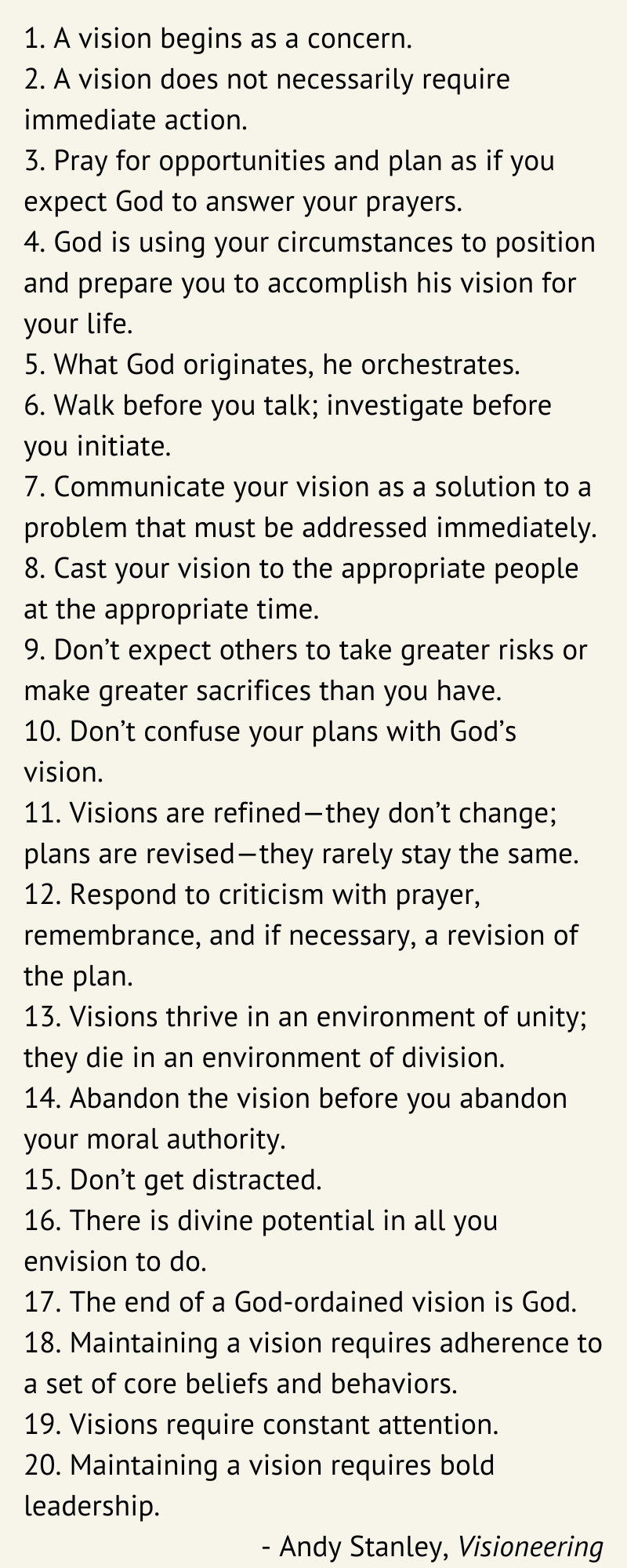
Andy Stanley believes these questions are breadcrumbs that lead to the discovery of personal vision. With down-to-earth practicality, Stanley extracts principles from the story of Nehemiah to help you discover your purpose in life.

Visioneering includes helpful exercises and time-tested ideas for visionary decision-making, personal growth, and leadership at home and at work. Catch a glimpse of God’s incredible vision for your life, relationships, and business—and discover the passion to follow it.

What is clarity really about? How can pursuing clarity help us discover our purpose in life?

The concept of clarity means being free from anything that obscures, blocks, pollutes, or darkens. If you have clarity, you see things simply in an understandable and precise way.

Clarity will help you make your life direction unquestionable.

Honoring God involves discovering His picture or vision of what our lives could and should be. Glorifying God involves discovering what we could and should accomplish.

We were created and re-created with his purposes in mind. And until we discover his purpose – and follow through – there will always be a hole in our soul.

As Christians, we do not have the right to take our talents, abilities, experiences, opportunities, and education and run off in any direction we please. We lost that right at Calvary. But then, why would we dream of such a thing? God has a vision for your life. What could possibly be more fulfilling than that?

At the same time, we have no right to live visionless lives either. If God – think about it – if God has a vision for what you are to do with your allotment of years, you had better get on with it. What a tragedy to miss it. Missing out on God’s plan for our lives must be the greatest tragedy this side of eternity.

Your uniqueness and individuality will reach its pinnacle in the context of your pursuit of God’s plan for your life. Manmade visions all begin to look alike after a while. Unless you discover God’s unique vision for your future, your life may very well be a rerun.

– Andy Stanley, Visioneering

Andy Stanley, in Visioneering, says that “Vision gives significance to the otherwise meaningless details of our lives.” To further develop this thought, he wants you to realize how vision weaves four things into the fabric of our daily lives.

Reflect on each of the areas below:

Passion – vision is always accompanied by strong emotion; the clearer the vision, the stronger the emotion. How is your vision being expressed in powerful and compelling emotions?

Motivation – vision provides motivation. In what areas of your life is vision providing motivation on a regular basis?

Direction – vision sets a direction for our lives. How is your vision prioritizing your values and providing direction to your life?

Purpose – vision gives you a reason to get up and show up. How is your vision providing purpose in your daily life?

Connect with 2-3 colleagues or friends, and ask them these questions around their calling and process together how God might call you into greater collaboration together to reach your potential and impact the world.


Discovering the Joy of Reading: Insights from “Why We Read”

Most weeks on Wednesday you’ll find posts about books here, part of an ongoing series entitled Wednesday Weekly Reader.

I often post about books on Instagram, and from time to time I will write on the topic of books about reading and books. For example:

Here’s a view of my “books about books” bookshelf:

You are probably getting the picture that books and reading are not just pastimes for me – they are my passion.

Today’s post is about a book that beautifully captures the passion of reading.

We read to escape, to learn, to find love, to feel seen. We read to encounter new worlds, to discover new recipes, to find connection across difference, or simply to pass a rainy afternoon. No matter the reason, books have the power to keep us safe, to challenge us, and perhaps most importantly, to make us more fully human.

Shannon Reed, a longtime teacher, lifelong reader, and New Yorker contributor, gets it. With one simple goal in mind, she makes the case that we should read for pleasure above all else.

In this whip-smart, laugh-out-loud-funny collection entitled Why We Read, Reed shares surprising stories from her life as a reader and the poignant ways in which books have impacted her students. From the varied novels she cherishes (Gone GirlTheir Eyes Were Watching God) to the ones she didn’t (Tess of the d’Urbervilles), Reed takes us on a rollicking tour through the comforting world of literature, celebrating the books we love, the readers who love them, and the ways in which literature can transform us for the better.

Listen to Reed’s passion for reading:

I have never lost my affection for and dependency on books. This is where I pull away from the pack of fellow bookworms, I sense. Much as I like videos and reels and whatever new thing has been invented by the time this goes to print, I’m always reaching back to the OG form, the book, looking for what I can read to help me understand.

Reading a book is quiet, clear, and organized. It’s not hard.

It waits until I am ready, pauses when I need a break, and is still happy to repeat. Reading absolutely never says “Just forget it” when I need clarification. It doesn’t care how I pronounce the words in my head (or aloud, for that matter). It never makes me feel worse and rarely makes me feel lonely.

Reading gives me the world.

And that, friends, is why I read.

If you are fortunate to be inspired to buy and read Shannon’s book, you will enjoy the closing chapter as she pays homage to the amazing literary journey she is on. I won’t spoil your reading pleasure by quoting any of it – except the last two sentences:

Without ever really experiencing any of it, I know it all.

Because books taught me.


Part of a regular series on 27gen, entitled Wednesday Weekly Reader.

During my elementary school years one of the things I looked forward to the most was the delivery of “My Weekly Reader,” a weekly educational magazine designed for children and containing news-based, current events.

It became a regular part of my love for reading, and helped develop my curiosity about the world around us.