
From the humble beginnings of a whistling steamboat to the sprawling, immersive worlds of modern theme parks, the Walt Disney Company has masterfully woven music into the very fabric of its storytelling. As an amateur Disney historian dedicated to understanding all the many facets of the enduring legacy of Walt Disney as well as a music lover, I can attest that music has been far more than a mere accompaniment; it’s the very heartbeat of the Disney brand, a powerful tool for emotional connection and brand building that has resonated across generations.
My personal connection to Walt Disney and music go back to Mary Poppins, the first Walt Disney movie I can remember seeing in a theater in 1964. An amazing visual feast, it also contains the earliest Walt Disney music from my memories.
Mary Poppins was produced as a full-scale musical, and the musical talents of the lyric and song writers (Bob and Dick Sherman) and the arranger (Irwin Kostal) paired beautifully with the voice of actress Julie Andrews to become the quintessential Walt Disney film. Critic Leonard Maltin commented that “Every song in the film suits its context perfectly and conveys emotions and ideas otherwise unexpressed in the dialogue.”
From my perspective even 61 years later, Mary Poppins represents the best of what Walt Disney and the entire Disney studio create with its magical blend of story, animation, live action, and of course, music.
What made the music of Disney’s movies so magical?
In this Wednesday Weekly Reader, I’m going to look at the magic of Disney music through the pages of three books:
- The Musical World of Walt Disney, David Tietyen
- Music in Disney’s Animated Features, James Bohn
- The Disney Song Encyclopedia, Thomas S. Hischak and Mark A. Robinson

The Musical World of Walt Disney presents the stories behind the music of Disney films, television productions, and other entertainment projects – how the songs were composed, why certain songs were created, the role that music played within the films, and a look at the people responsible for the classic words and music.
Whether you have played, sung, whistled, or even hummed any of the memorable Disney songs, you’ll enjoy takin a trip through Disney’s musical world.
The colorful illustrations and photographs of classic Disney characters included in the book will take on new meaning as the evolution of the music is traced throughout the years of Disney film production.
Here’s your ticket to the magical kingdom of Disney music; – a book that why entire family will enjoy as you explore the fascinating Musical World of Walt Disney.

In Music in Disney’s Animated Features James Bohn investigates how music functions in Disney animated films and identifies several vanguard techniques used in them. In addition, he also presents a history of music in Disney animated films, as well as biographical information on several of the Walt Disney Studios’ seminal composers.
The popularity and critical acclaim of Disney animated features truly is built as much on music as it is on animation. Beginning with Steamboat Willie and continuing through all of the animated features created under Disney’s personal supervision, music was the organizing element of Disney’s animation. Songs establish character, aid in narrative, and fashion the backbone of the Studios’ movies from Snow White and the Seven Dwarfs through The Jungle Book and beyond.
Bohn underscores these points while presenting a detailed history of music in Disney’s animated films. The book includes research done at the Walt Disney Archives as well as materials gathered from numerous other facilities. In his research of the Studios’ notable composers, Bohn includes perspectives from family members, thus lending a personal dimension to his presentation of the magical Studios’ musical history. The volume’s numerous musical examples demonstrate techniques used throughout the Studios’ animated classics.
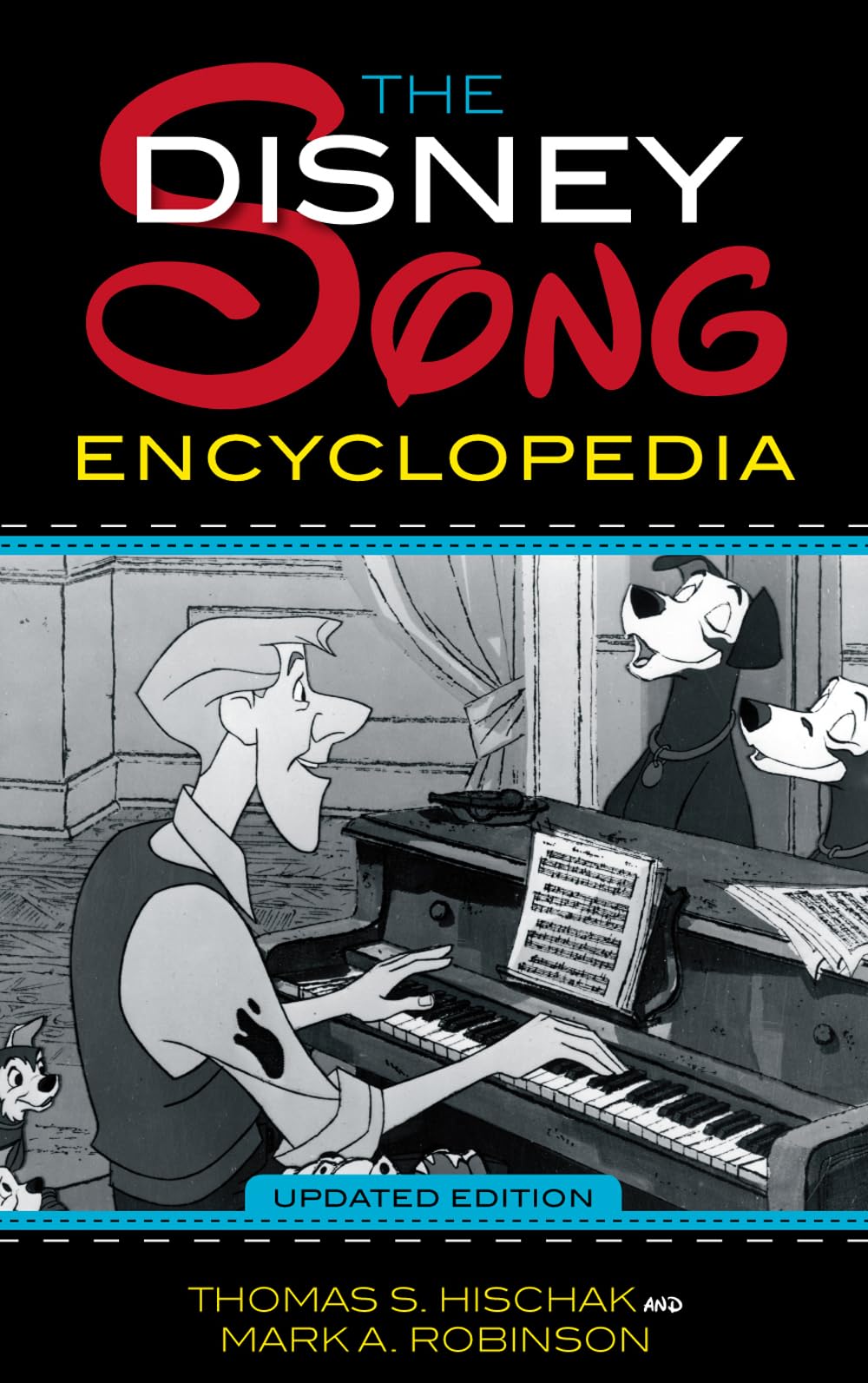
Songs written for Disney productions over the decades have become a potent part of American popular culture. Since most Americans first discovered these songs in their youth, they hold a special place in one’s consciousness.
The Disney Song Encyclopedia describes and discusses hundreds of famous and not-so-famous songs from Disney films, television, Broadway, and theme parks from the 1930s to the present day. Over 900 songs are given individual entries and presented in alphabetical order. The songwriters and original singers are identified, as well as the source of the song and other venues in which it might have been used over the years. Notable recordings of the song are also listed.
But most important, the song is described and what makes it memorable is discussed. This is not a reference list but a true encyclopedia of Disney songs. The book also contains a preface describing the criteria for selecting the songs, a glossary of song terms, a list of all the Disney songs and their sources, a songwriter’s directory in which every song by each composer/lyricist is listed, a bibliography, a guide to recordings and DVDs of Disney productions, and an index of people and titles.
Walt Disney, a man of profound intuition and artistic vision, understood the transformative power of sound. In Steamboat Willie (1928), the synchronized clanging and jaunty melodies weren’t just a novelty; they were a revelation. They imbued the animated world with a sense of life and immediacy, forging a direct emotional link with the audience. This early innovation set the stage for Disney’s unwavering commitment to musical excellence, a commitment that has consistently placed music at the forefront of its creative endeavors.
Interestingly, Walt Disney had no formal musical training. He was primarily a cartoonist and filmmaker who recognized something profound: music could breathe life into animation. “There’s a terrific power to music,” Disney once told his staff “You can run these pictures and they’d be dragging and boring, but the minute you put music behind them, they have life and vitality they don’t get in any other way.” This understanding led him to devote significant attention to the musical aspects of his productions, despite his lack of technical musical knowledge.
Walt Disney possessed an uncanny ability to know exactly what style of music would enhance a particular scene. He encouraged his animators to study music, recognizing its natural rhythms as fundamental to creating compelling animation. Two of his legendary “nine old men,” Frank Thomas and Ollie Johnston, noted that music was “undoubtedly the most important addition” to any production, giving it “integrity, style, emphasis, meaning and unity.”
Music is undoubtedly the most important addition that will be made to the picture. It can do more to bring a production to life, to give it integrity, style, emphasis, meaning and unity, than any other single ingredient. With the surge of a full orchestra, there will be bigness and majesty and soaring spirits; with a nervous, fluttering melody line on a single instrument, or pulsating drumbeats, there will be agitation, apprehension, suspicion. Music can build tension in commonplace scenes or ease it in ones that have become visually too frightening.
Frank Thomas and Ollie Johnston, “Disney Animation: Illusion of Life”

Walt’s appreciation for music was so complete that he built entire films around it. Fantasia stands as perhaps his most ambitious musical project, challenging his animators to create visual interpretations of classical masterpieces. Under his guidance, Disney composers and songwriters continually pushed boundaries, developing innovative techniques for synchronizing music with animation – methods still used throughout the film industry today.
This pioneering spirit extended beyond mere technical achievements. Disney’s music typically carried messages of hope and touched universal human emotions. As one Disney songwriter observed, Walt’s most successful films “had heart” and “would reach out and touch one of our human emotions.” This emotional resonance helped ensure that Disney films weren’t just for children but rather touched the child in everyone.
The Disney musical tradition has continued to evolve long after Walt’s time. In the 1990s, the company successfully transitioned to Broadway, beginning with Beauty and the Beast and followed by critical successes like The Lion King. Simultaneously, home video and DVD releases brought Disney music directly into households worldwide, further cementing these songs in popular culture.
Even rival animators acknowledged Disney’s musical innovations. Chuck Jones of Warner Brothers fame noted that “practically every tool we use today was originated at the Disney studio.” Disney films didn’t simply evolve gradually – they made quantum leaps that took both animation and film music to new heights.
Walt Disney once wrote, “I cannot think of the pictorial story without thinking about the complementary music which will fulfill it.” As film historian Leonard Maltin observed, music wasn’t merely “a key ingredient” of Walt Disney’s success – it was “the foundation” of it. Though he couldn’t read music or play an instrument, Disney possessed an innate musicality and understood intuitively how music could enhance storytelling.
This emotional resonance is a cornerstone of the Disney brand. By tapping into universal emotions like love, loss, joy, and hope, Disney music creates a shared experience that transcends cultural and linguistic barriers. When a child hears “A Whole New World” from Aladdin, they are not simply listening to a song; they are transported to a realm of wonder and possibility. This emotional connection fosters a sense of loyalty and affection for the Disney brand, creating lifelong fans who carry these cherished memories with them.
The strategic use of music in live-action films further reinforces this brand identity. While the transition from animation required a more nuanced approach, Disney successfully adapted its musical legacy for a new medium. The live-action Beauty and the Beast (2017) not only honored the beloved animated score but also expanded upon it, creating a richer, more immersive musical experience. The power of these musical revivals is immense, each song an emotional touchstone to preexisting beloved works, therefore enforcing brand loyalty, and the emotional response.
In the theme parks, music becomes an integral part of the immersive experience. From the nostalgic melodies of Main Street, U.S.A., to the adventurous themes of Adventureland, music is carefully curated to transport guests to different worlds. Attractions like “it’s a small world” rely on music to create a sense of unity and shared experience, while the “Grim Grinning Ghosts” theme from “The Haunted Mansion” adds a playful layer of spookiness to the ride. This careful orchestration of sound enhances the storytelling, creating a sense of wonder and excitement that leaves a lasting impression.
The reach of Disney music extends beyond the confines of its films and parks, permeating popular culture. Iconic songs have been covered by countless artists, featured in numerous films and television shows, and used to evoke emotions in countless everyday moments. This ubiquity reinforces the Disney brand as a cultural touchstone, a symbol of magic and emotional resonance.
In essence, music is the emotional glue that binds the Disney experience together. It’s the key that unlocks the door to imagination, the force that amplifies the joy, and the language that speaks to the heart. This unwavering commitment to musical excellence has been instrumental in building the Disney brand into a global icon, a symbol of magic and emotional connection that will continue to resonate for generations to come.
This musical magic continues to resonate today, providing an experience that’s accessible to people of all ages around the world. To experience Disney is, fundamentally, to experience music.

Part of a regular series on 27gen, entitled Wednesday Weekly Reader.
During my elementary school years one of the things I looked forward to the most was the delivery of “My Weekly Reader,” a weekly educational magazine designed for children and containing news-based current events.
It became a regular part of my love for reading, and helped develop my curiosity about the world around us.
 27gen.com