
A Personal Story
You know that nurse who helped you or your loved one during a hospital stay? The one who really saw you, heard you, and knew exactly what you needed? That’s not a coincidence – it’s what great nursing is all about. Whether we realize it or not, nurses are often there for many of life’s biggest moments, from our first breath to our last, the birth and growing pains of our children, and then the reality of aging adults – first our parents, then ourselves.
In a continuation of a recent post, I want to give you “the rest of the story.”
After 10 days in the hospital, spread over 2 stays, I was looking forward to going home – and I did, for 3 uneventful days. Then the pain returned with a vengeance, and so did I – back to the hospital. Imaging soon revealed that while the ulcer was continuing to heal, the aftereffects of the perforation had inflamed the gallbladder, and a stone lodged in a duct was causing the intense pain. Surgery was scheduled for the next day, and I was discharged two days later.
The pain was gone, and it was time to continue healing at home. I couldn’t do anything except lay in bed, and for those of you who know me, you know what’s coming next:
Reading.
In this case, I wanted to know more about that wonderful team of women (mostly) and men we call nurses who had provided care for me. A quick search of my local library and a pickup by Anita delivered this marvelous book that reflects so much of what I experienced over a two-week plus stay in the hospital, all under the care of the PSC-3 Nursing team at Atrium Cabarrus.
Nurses have always been vital to human existence. A nurse was likely there when you were born and a nurse might well be there when you die. Familiar in hospitals and doctors’ offices, these dedicated health professionals can also be found in schools, prisons, and people’s homes; at summer camps; on cruise ships, and at workplaces. Yet despite being celebrated during the Covid-19 epidemic, nurses are often undermined and undervalued in ways that reflect misogyny and racism, and that extend to their working conditions – and affect the care available to everyone. But the potential power of nursing to create a healthier, more just world endures.
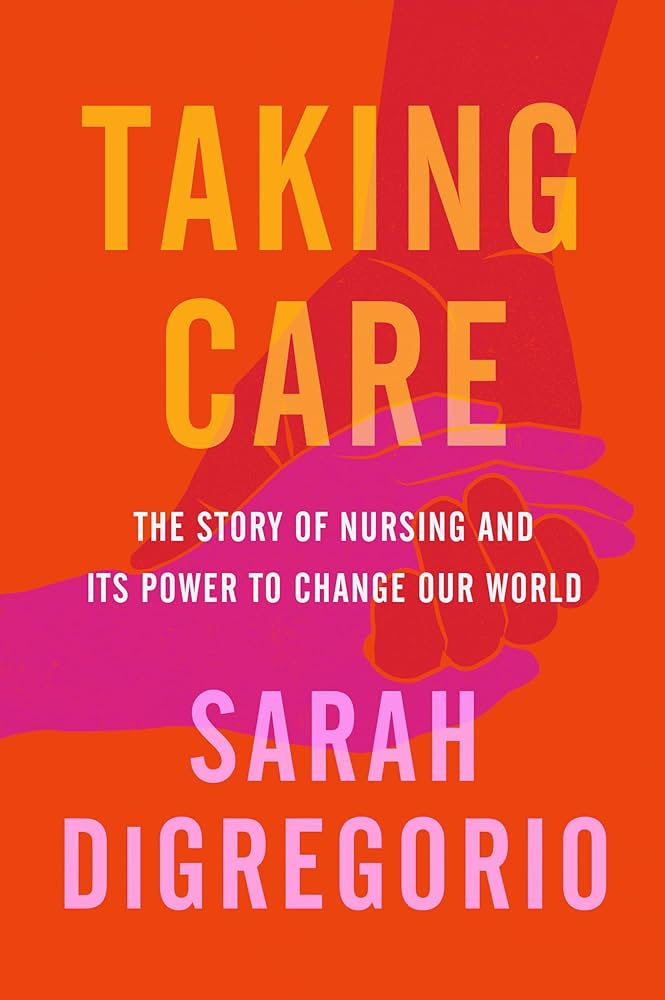
The story of nursing is complicated. It is woven into war, plague, religion, the economy, and our individual lives in myriad ways. In Taking Care, journalist Sarah DiGregorio chronicles the lives of nurses past and tells the stories of those today – caregivers at the vital intersection of health care and community who are actively changing the world, often invisibly. An absorbing and empathetic work that combines storytelling with nuanced reporting, Taking Care examines how we have always tried to care for each other – the incredible ways we have succeeded and the ways in which we have failed. Fascinating, empowering and significant, it is a call for change and a love letter to the nurses of yesterday, today, and tomorrow.
Think about what comes to mind when you hear the word “nurse.” Maybe you remember clapping during the early days of COVID, or you picture Florence Nightingale with her lamp. Perhaps you think of TV shows like M*A*S*H or countless others.. But the reality of nursing goes much deeper than any of these images suggest.
Here’s something that might surprise you: nursing is actually one of the biggest professions in the world, with over 27 million nurses and midwives globally. In the U.S. alone, there are three times as many nurses as doctors! Without nurses, our healthcare system would basically grind to a halt.
And nurses? They’re everywhere! They’re not just in hospitals – they’re on cruise ships managing outbreaks, in libraries doing free blood pressure checks, at NASA monitoring astronauts (how cool is that?), and even in state legislatures writing healthcare policies. They’re the ultimate healthcare multitaskers.
But what exactly do nurses do? Well, it’s way more than just following doctors’ orders. While doctors typically focus deeply on specific medical conditions, nurses take care of the whole picture. Think of it this way: if you’re leaving the hospital, your doctor might prescribe your medications, but your nurse is the one making sure you understand how to take them, checking if you can handle the stairs at home, and figuring out if you have someone to help with cooking.
Here’s my real-world example: imagine you need gallbladder removal surgery. Sure, the hepato-pancreato-biliary surgeon does the actual operation, but nurses are there every step of the way. They’re prepping you, putting in your IV, checking your vitals, and acting like healthcare air traffic controllers – making sure everyone from social workers to anesthesiologists to radiology staff is in the right place at the right time. After surgery, they’re watching your pain levels, managing your medications, preventing infections, and teaching your family how to care for you at home.

One nurse quoted in Taking Care put it perfectly: “Doctors figure out where the patient is and where they need to be. Nurses are the ones who actually get you there.” It’s like doctors draw the map, but nurses help you navigate the journey.
And get this – nursing isn’t just about medical procedures and medications. It’s about building relationships and understanding people in their full context – their family situation, their community, their environment. As nurse researcher Monica McLemore explained in the book, “Everyone thinks it’s just skills and tasks, like putting in IVs or reading monitors. But that’s just one part. Our real job is helping people through transitions, whether that’s recovering from illness or adapting to a new health reality.”
Think about it: nurses are often the first ones to notice when something’s off. Maybe it’s a subtle change in someone’s mental state that could signal a stroke, or maybe it’s spotting a pattern of heat-related health issues in farm workers. They’re like healthcare detectives, constantly putting together pieces of the puzzle.
The cool thing about nursing is that it’s both super scientific and deeply human. Nurses need to understand complex biology and medical procedures, but they also need to be great communicators and problem-solvers. They’re the ones asking the practical questions that doctors might not think of: “Do you feel safe walking in your neighborhood?” “Is there anyone at home who can help you?” “Do you need assistance getting food?”
And here’s something that often gets overlooked: nurses work with doctors, not for them. They’re separate but complementary professions, like two sides of the same healthcare coin. While doctors might focus on curing a specific condition, nurses focus on healing the whole person – and yes, there’s a difference!
So next time you’re in a healthcare setting, remember that the nurse caring for you is part of this amazing tradition that combines scientific knowledge, practical skills, and deep human connection. They’re not just there to take your temperature or give you medicine – they’re there to help guide you through whatever health journey you’re on, making sure you have what you need every step of the way.
After all, sooner or later, we all need someone to nurse us through tough times. And when that time comes, it’s pretty amazing to have someone who knows both the science of healing and the art of caring on your side.

With grateful appreciation to all the nursing team of PSC-3; you are caring professionals to the core.
Thank you.

Part of a regular series on 27gen, entitled Wednesday Weekly Reader.
During my elementary school years one of the things I looked forward to the most was the delivery of “My Weekly Reader,” a weekly educational magazine designed for children and containing news-based current events.
It became a regular part of my love for reading, and helped develop my curiosity about the world around us.
 27gen.com