
Bridges are more than mere structures of steel and stone. They are powerful metaphors for life’s most profound journeys – connecting what was to what could be, spanning the uncertain spaces between known and unknown landscapes.
When we stand at the beginning of a bridge, the view can be intimidating. The planks beneath our feet might feel unstable, the distance to the other side shrouded in mist. Life’s transitions often feel exactly like this – a trembling moment of uncertainty, where the past recedes behind us and the future remains undefined.
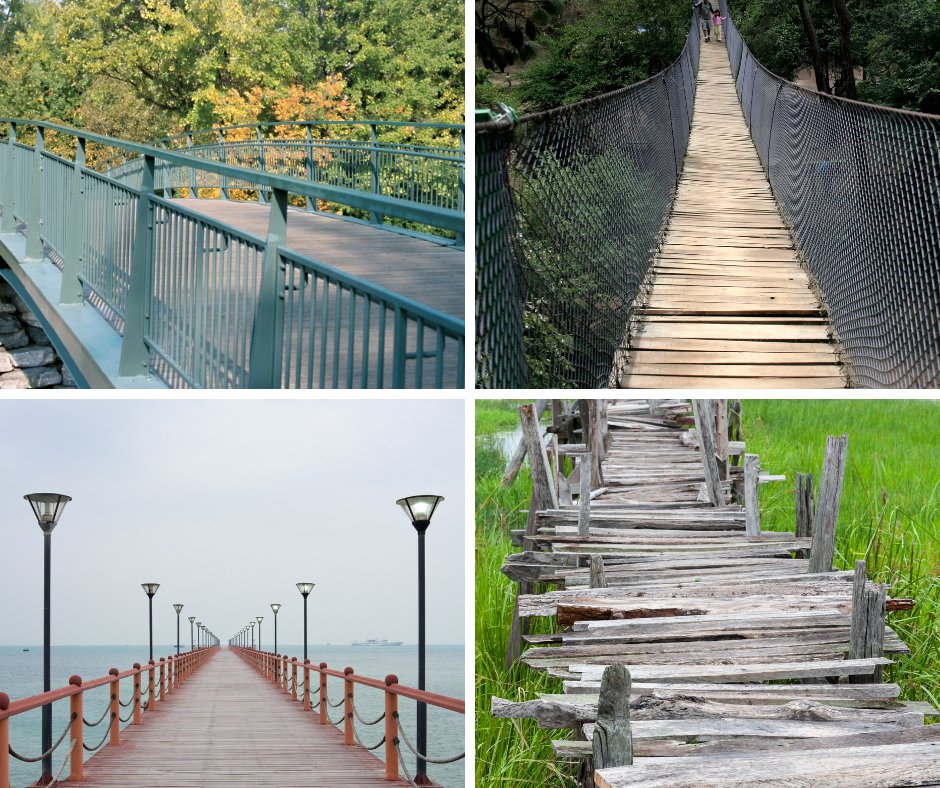
Each bridge has its own character. Some are sturdy suspension bridges, their cables providing intricate support systems. Others are simple wooden crossings, requiring careful, deliberate steps. Similarly, our personal transitions vary – some are carefully engineered transformations, others spontaneous leaps of faith.
The act of crossing requires courage. Just as a bridge walker must trust the engineering beneath their feet, we must trust our own resilience during life’s changes. The wooden boards might creak, the wind might buffet us, but forward movement is possible. Each step is an act of trust – in ourselves, in the path we’ve chosen, in the possibility of what awaits.
Bridges connect more than physical spaces; they connect states of being. Leaving a job, ending a relationship, moving to a new city – these are bridge moments. We’re suspended between what we knew and what we’re becoming. The middle of the bridge is often the most vulnerable place, where we can look back at familiar terrain or gaze forward into uncharted territory.
Some bridges are long, requiring endurance. Others are short, demanding only a moment of boldness. Some have guardrails, offering security, while others challenge us to balance with nothing but our own determination. Life’s transitions mirror these bridge experiences – some transformations are gradual and supported, others demand we leap with minimal safety nets.
Importantly, not all bridge crossings are solitary journeys. Some bridges are wide enough for companions. Friends, family, mentors – they can walk alongside us, offering encouragement, sharing the weight of uncertainty. Their presence doesn’t eliminate the challenge, but it transforms the crossing from a potentially lonely trek into a shared adventure.
When we finally reach the other side, we are changed. The bridge was never just about getting from one point to another, but about the transformation occurring with each step. We arrive different – more resilient, more knowing, with a broader perspective of the landscape we’ve traversed.
Rather then focusing on the obstacle in your path, focus on the bridge over the obstacle.
Mary Lou Retton
Life’s bridges remind us: transitions are not obstacles, but opportunities. They are not about perfect, fearless passage, but about moving forward with authenticity, courage, and hope.

If you liked this article or you like bridges, check out this post:


 27gen.com