
As Julia Child once said, “It is hard to imagine a civilization without onions.”
Historically, she’s been right – and not just in the kitchen. Flourishing in just about every climate and culture around the world, onions have provided the essential basis not only for sautés, stews, and sauces, but for medicines, metaphors, and folklore. Now they’re Mark Kurlansky’s most flavorful infatuation yet as he sets out to explore how and why the crop reigns from Italy to India and everywhere in between.
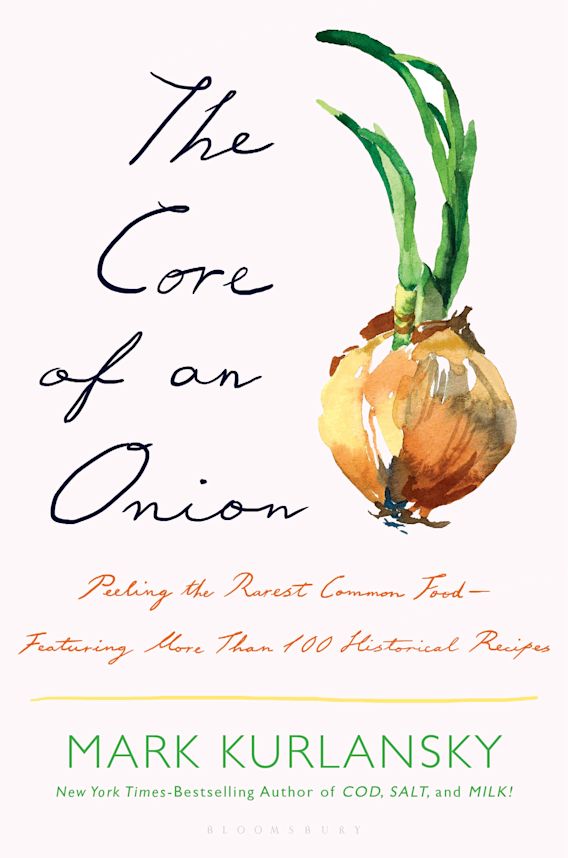
Featuring historical images and his own pen-and-ink drawings, Kurlansky begins with the science and history of the only sulfuric acid–spewing plant, then digs through its twenty varieties and the cultures built around them. Entering the kitchen, Kurlansky celebrates the raw, roasted, creamed, marinated, and pickled.
Including a recipe section featuring more than one hundred dishes from around the world, The Core of an Onion shares the secrets to celebrated Parisian chef Alain Senderens’s onion soup eaten to cure late-night drunkenness; Hemingway’s raw onion and peanut butter sandwich; and the Gibson, a debonair gin martini garnished with a pickled onion.
Just as the scent of sautéed onions will lure anyone to the kitchen, The Core of an Onion is sure to draw readers into their savory stories at first taste.
In his latest culinary exploration, renowned food historian Mark Kurlansky takes readers on a journey through the pungent world of onions in The Core of An Onion. Known for his deep dives into singular food subjects like frozen food, salt, and milk, Kurlansky now turns his attention to this ubiquitous allium that has shaped cuisines and cultures around the globe for millennia.
Kurlansky peels back the layers of the onion’s history, tracing its origins and spread across continents. He reveals that onions were likely first cultivated in Central Asia over 5,000 years ago, quickly becoming a staple in diets from China to Egypt. The book explores how onions played a crucial role in sustaining ancient civilizations, providing essential nutrients and flavors to often bland diets.
One of the most intriguing aspects of The Core of An Onion is Kurlansky’s examination of the vegetable’s cultural significance. He uncovers how onions have been revered, feared, and even worshipped throughout history. In ancient Egypt, for instance, onions were considered symbols of eternity due to their concentric ring structure, and were often buried with pharaohs to ensure their passage to the afterlife.
The author doesn’t shy away from the onion’s notorious tear-inducing properties. He delves into the chemistry behind this phenomenon, explaining how cutting an onion releases sulfur compounds that react with the moisture in our eyes to form sulfuric acid. Kurlansky also highlights some lesser-known facts about this chemical reaction. For example, chilling onions before cutting can reduce tear production, as the volatile compounds are less active at lower temperatures.

Kurlansky’s research unearths fascinating tidbits about onions that even culinary enthusiasts might not know. For instance, the book reveals that onions were once used as currency in the Middle Ages. In 12th-century Europe, onions were sometimes accepted as rent payments and even as wedding gifts. Another surprising fact is that onions have been used in traditional medicine for centuries. Ancient Greek athletes consumed large quantities of onions, believing they would lighten the balance of their blood.
The book also explores the onion’s role in modern agriculture and cuisine. Kurlansky examines how the development of sweeter onion varieties, like the Vidalia onion from the southwest region of Georgia, has changed consumer preferences and agricultural practices. He discusses the ongoing debate among chefs and food scientists about whether cooking destroys the health benefits of onions, presenting evidence from both sides.
Equally intriguing is the focus on the genetic diversity of onions. Kurlansky reveals that there are over 700 species in the Allium genus, which includes onions, garlic, and chives. He explores how this diversity has led to a wide array of flavors and uses across different cultures, from the mild shallots favored in French cuisine to the pungent red onions commonly used in Indian dishes.
Throughout The Core of An Onion, Kurlansky weaves in recipes and cooking techniques from various cultures, demonstrating the onion’s versatility in the kitchen. He challenges readers to reconsider their relationship with this often-under appreciated ingredient, encouraging them to explore its full potential beyond mere aromatic base.
In typical Kurlansky style, the book is meticulously researched and engagingly written, making it accessible to both food history buffs and casual readers. By the end of The Core of An Onion, readers will have gained a newfound appreciation for this humble yet influential vegetable that has shaped human history and continues to play a crucial role in global cuisine and culture.

Part of a regular series on 27gen, entitled Wednesday Weekly Reader.
During my elementary school years one of the things I looked forward to the most was the delivery of “My Weekly Reader,” a weekly educational magazine designed for children and containing news-based current events.
It became a regular part of my love for reading, and helped develop my curiosity about the world around us.
 27gen.com