Revisiting the Leadership Qualities You Need to Assume the Legacy of Walt Disney

Note: This is a revised version of a post first published in early 2020. With the huge announcement earlier this week of the replacement of Disney CEO Bob Chapek by former CEO Bob Iger, I thought I would revisit the post before publishing a new one on the return of Bob Iger, what that means to the Disney company, and how hard it is to continue a founder’s vision.


For many people today, Walt Disney is not seen as a man, but instead as a nameless, faceless entertainment giant which owns the intellectual properties of the Disney Studios, Pixar Studios, Marvel, LucasFilms, and Fox. While that is all true, the man named Walter Elias Disney rose from humble beginnings to found the studio that bears his name in 1923.

After several years of barely scraping by and one disastrous setback, Disney put together a string of successes. By the early 1930s, Disney had reached what many industry leaders considered the pinnacle of success for an animated short features studio.

However, Walt Disney wasn’t at the top; he was just getting started.

I dream, I test my dreams against my beliefs, I dare to take risks, and I execute my vision to make those dreams come true.

Walt Disney

Not all visionaries are leaders, but all leaders are visionaries. You can’t lead people without a vision of where you are taking them.

What is your dream, your vision?

According to author Pat Williams, great leaders are people of vision. Without a vision, how will you know what success looks like? How will you know how to get there? Your vision is your definition of success.

Look at the quote by Walt Disney above: “I dream, I test my dreams against my beliefs, I dare to take risks, and I execute my vision to make those dreams come true.”

Author Pat Williams breaks the quote down as follows:

  • “I dream.” Walt began with a vision, a dream of the future.
  • “I test my dreams against my beliefs.” Walt made sure his vision was consistent with his beliefs, his core values, and his integrity.
  • “I dare to take risks.” He acted boldly, betting on himself to win.
  • “I execute my vision to make those dreams come true.” He focused all his energies, and those of his organization, on turning his dreams into reality.

Walt Disney died on December 15, 1966. Although the purchase of land for what would become Walt Disney World had been completed, infrastructure work had barely begun. After concentrating on theme parks for years, the quality of movies and animation had declined. Leadership of the company passed to several individuals for a few years, then to Michael Eisner for twenty years.

After rising through the ranks of ABC Television and Disney, Iger became the COO of Disney in 2000, and then in 2005, Iger was named chairman and then CEO of The Walt Disney Company.

Put yourself in Iger’s shoes, if you can imagine: How do you assume the legacy of Walt Disney?

The Ride of a Lifetime: Lessons Learned from 15 Years as CEO of the Walt Disney Company, is that story.

In the fall of 2019, Robert Iger, chairman and CEO of the Walt Disney Company, released a memoir/leadership book, based on his forty-five year career in the media and entertainment world. 
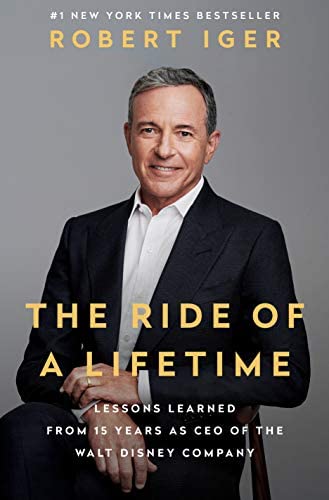
Robert Iger became CEO of The Walt Disney Company in 2005, during a difficult time. Competition was more intense than ever and technology was changing faster than at any time in the company’s history. His vision came down to three clear ideas: Recommit to the concept that quality matters, embrace technology instead of fighting it, and think bigger—think global—and turn Disney into a stronger brand in international markets.

Today, Disney is the largest, most admired media company in the world, counting Pixar, Marvel, Lucasfilm, and 21st Century Fox among its properties. Its value is nearly five times what it was when Iger took over, and he is recognized as one of the most innovative and successful CEOs of our era.

In The Ride of a Lifetime, Robert Iger shares the lessons he learned while running Disney and leading its 220,000-plus employees, and he explores the principles that are necessary for true leadership.

This book is about the relentless curiosity that has driven Iger for forty-five years, since the day he started as the lowliest studio grunt at ABC. It’s also about thoughtfulness and respect, and a decency-over-dollars approach that has become the bedrock of every project and partnership Iger pursues, from a deep friendship with Steve Jobs in his final years to an abiding love of the Star Wars mythology.


“The ideas in this book strike me as universal” Iger writes. “Not just to the aspiring CEOs of the world, but to anyone wanting to feel less fearful, more confidently themselves, as they navigate their professional and even personal lives.”

My experiences from day one have all been in the media and entertainment world, but these strike me as universal ideas: about fostering risk taking and creativity; about building a culture of trust; about fueling a deep and abiding curiosity in oneself and inspiring that in the people around you; about embracing change rather than living in denial of it; and about operating, always, with integrity and honesty in the world, even when that means facing things that are difficult to face. 

Bob Iger

As Iger neared the end of his 45+ year career and began to think back on what he had learned, he came up with ten principles that struck him as true leadership:

Optimism – A pragmatic enthusiasm for what can be achieved.

Courage – The foundation of risk-taking is courage.

Focus – Allocating time, energy, and resources to the strategies, problems, and projects that are of highest importance and value is extremely important.

Decisiveness – All decisions, no matter how difficult, and and should be made in a timely way.

Curiosity – A deep and abiding curiosity enables the discovery of new people, places, and ideas.

Fairness – Strong leadership embodies the fair and decent treatment of people. Empathy and accessibility are essential.

Thoughtfulness – Taking the time to develop informed opinions.

Authenticity – Be genuine and honest. Truth and authenticity breed respect and trust.

Relentless pursuit of perfection – A refusal to accept mediocrity or make excuses for something being “good enough.”

Integrity – High ethical standards for all things, big and small.

How can Iger’s list of principles inspire you to be a better leader?


A little backstory on the acquisition book: This is the book everyone who has even a passing interest in the Disney Corporation was waiting for. Since becoming a part of Disney’s senior management team in 1996, and especially since becoming CEO in 2005, Iger’s ideas and the values he embraced have led to the reinvention and resurgence of one of the most beloved companies in the world. 

Under Iger’s leadership, Disney acquired four powerhouse companies – Pixar, Marvel, LucasFilm, and 21st Century Fox.

Iger donated proceeds of from his book to educational initiatives aimed at fostering more diversity in the field of journalism.

When the rumors of his book first came out in the fall of 2016, it went on my watch list, and true to Amazon’s promise, it was delivered the day it was released on September 23, 2019.

Handing off the CEO role to Bob Chapek in early 2020, Iger remained executive chairman (till the end 2020) and chairman of the Board of The Walt Disney Company (till the end of 2021).


And now coming soon, the sequel to Bob Iger’s leadership post of the Walt Disney Company…

(To be continued)
My 5-Generational Cohort Family is a Microcosm of Society

The legions of ancient Rome were composed of ten cohorts each: cohesive units of 300-600 men who trained, ate, slept, fought, won, lost, lived, and died together. The strength was their ability to think, act, and react as a unit. Though composed of individuals, training and socialization equipped them to behave as if of a single mind when called to battle. Social demographers, students of the effects of population on society, use the term cohort to refer to people born in the same general time span who share key life experiences – from setting out for school for the first time together through reaching puberty at the same time, to entering the workforce or university or marriage or middle age or their dotage at the same time.

The six primary generations of today’s American lifestyle span a remarkable slice of American and world history. Three major wars, countless minor (?) ones, economic booms and busts, social upheavals, rocketing technological achievement, and even stepping beyond our planet are among the milestones that have directly and indirectly shaped the times.

I count myself fortunate to have a direct connection to all six generations. To me, understanding more about how each of them think, feel, and act is not just a mental exercise – it’s a necessary part of life.

  • Builder Generation (1922-1945) My father and mother were born into the early part of this cohort. He entered military service just as WWII was ending; she was in college and then taught school; they were part of what some call “The Greatest Generation”. Think “American values” and you’ve got their number: civic pride, loyalty, respect for authority, and apple pie. My father passed away in 2012, and my mother in 2018. They may not be physically present with me, but who I am was shaped by their influence, and they impact me every day. Additionally, this cohort, as their generation moves into their twilight years, still controls a significant part of the economy and will continue to be influential in the years ahead outside of their numbers.
  • Baby Boomers (1946-1964) My wife and I are late Baby Boomers. Born in the latter 50s, we are a part of what was until recently the largest cohort in US history. For over thirty years, the sheer size of the Boomer generation defined the organization’s social landscape in a majority-rules cultural takeover. We were the civil rights, empowerment, and diversity generation. Never content with the status quo, we are always redefining what it means to be old and cool and important and successful.
  • Generation X (1965-1982) My oldest son and one of my daughters-in-law are Xers, even though they sometimes exhibit characteristics of the next cohort as well. Technologically adept, clever, and resourceful, the Xers are a deeply segmented, fragmented cohort. Their need for feed back and flexibility, coupled with the dislike of close supervision is but one of the many complex nuances of this generation. They are all about change- they’ve changed cities, homes, and even parents all their lives. Often seen as pessimistic with an edgy skepticism, many Xers are more positive about their personal future than the group as a whole.
  • Millennials (1983-2000) My other three children, two daughters-in-law, and a son-in-law all fall into this cohort. They are the children of the soccer moms and little League dads, and endless rounds of swim meets, karate classes, dancing lessons, computer camp and … you get the picture. They consider themselves the smartest, cleverest, healthiest and most-wanted group to have ever lived. Born into the technology boom times, barriers of time and space have little absolute meaning to them. They are willing to work and learn. By sheer numbers (their total births eclipsed the Boomers by several million) they are going to dominate history in new ways. They are the hyper-connected: constantly connected to multiple devices in order to know what and whom they need to know.
  • Generation Z (2001-2015) As the generation of the first six of my grandchildren, it is important to me to try to fully understand them. Technology is the hallmark of this group, which is the first generation to be raised in the era of smartphones and social media as a daily part of life. They’re growing up amid the promise of technological innovation – but also in the environment of economic uncertainty, a sharp decrease in well-defined and reliable career paths, increasing political divides, and the effect of decades of repressed racial tensions. The preeminent event of this cohort is the 9/11 attacks and the rise of terrorism around the world (and the U.S. response to it). Consequently, when compared to their predecessors, this group is both more cautious and more anxious.
  • Alpha Generation (2016-TBD) I have two grandchildren in this cohort, and there is one more on the way! While it is too early to define the characteristics of this cohort in any meaningful way, consider the early memories of children born since 2016: They will assuredly recall adult populations that were divided, diseased, and depressed. Their early years were launched alongside the large differences of the Trump and Biden administrations; their memories will be forever marked by the pandemic, ongoing political polarization, and increasing international unrest on a scale not seen since WWII.

There are some indications that generational cohorts repeat every four generations, so we’ll just have to see. Led by the thoughts of William Strauss and Neil Howe published in the late 1990s, this idea of “cycles” is getting more attention now that their predictions of today’s Millennial cohort are proving to be on target more often than not. That will definitely be my radar in the future!

An interesting fact, and the origin of the title of this website: there are 27 years between each of the first born in the above first three generations of my family, thus 27gen.

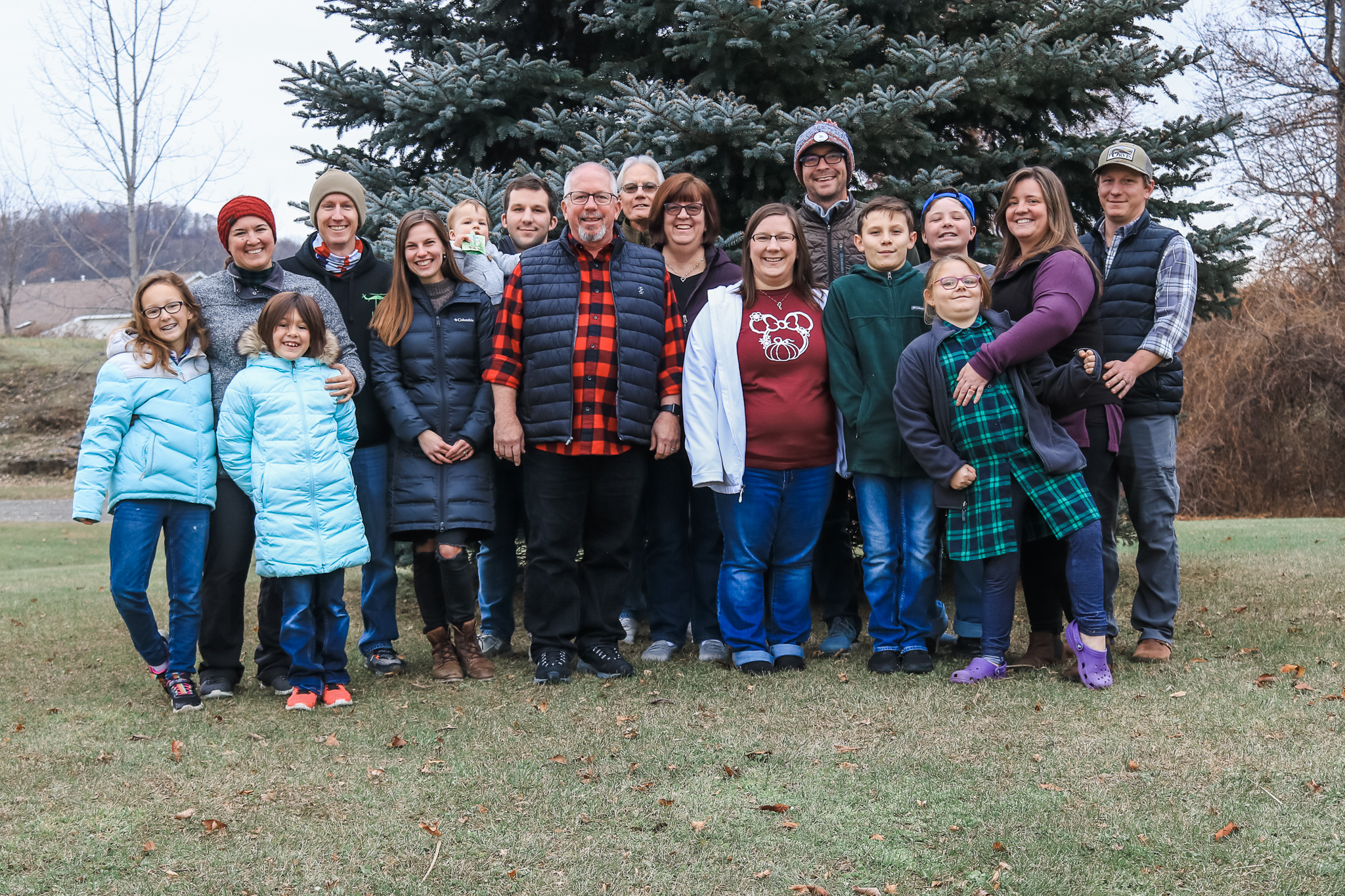
Here’s the last time all of #TheAdamsFamilyExperience was together in one place: Thanksgiving 2021, in Greenwich, NY.

The next five years are going to be very interesting as each of these five generations exert influence on each other. I will be actively watching my own microcosm of society.


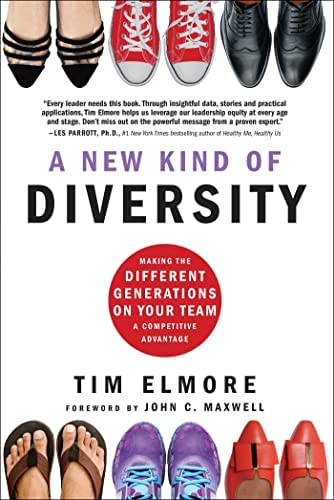
My latest reading on generations: The release of A New Kind of Diversity by Tim Elmore was much-anticipated. Elmore brings his decades of research and leadership experience to bear on what might be the biggest, most dramatic, and most disruptive shift the American workforce has ever seen: the vast diversity of several generations living—and working—together. 

For the first time in history, up to five generations find themselves working alongside each other in a typical company. The result? There can be division. Interactions between people from different generations can resemble a cross-cultural relationship. Both usually possess different values and customs. At times, each generation is literally speaking a different language!

Just in case you were wondering…

From time to time I get asked about the name of this blog. 

The quick answer? When I started this website in 2008, there were four generations of Adams boys alive, with an average of 27 years between them. 

Thus, 27gen – energized by the steady, deliberate journey in generational learning.

Our “history” spans the first transatlantic telephone call (from NYC to London) the year my father was born to smartphones now that connect the world in an instant.

In other words, there is a lot of history in play: things that have happened, things that are happening, and things that will happen.

And it is all connected.

Here’s a better explanation:

This is my son Jonathan, at two years of age, obviously having a good time at my parent’s house.

He’s now 41.

This is my grandson Jack (Jonathan’s son) at two years of age, obviously having a good time playing at his house.

He’s now 14.

Some things never change…

Some things are always changing…

I want to make sure I understand the difference.