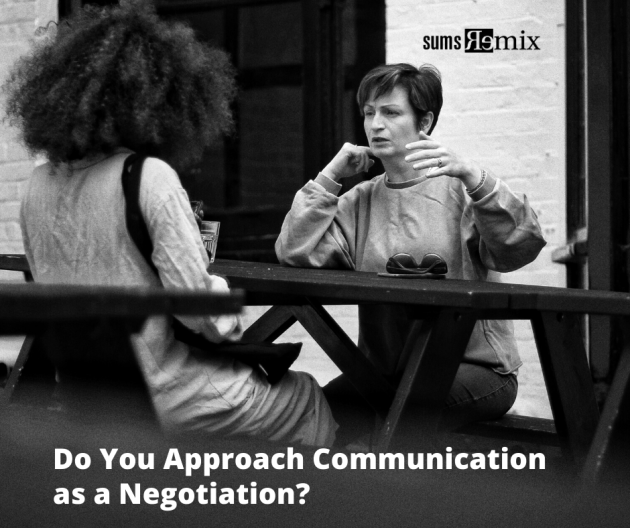
Do You Approach Communication as a Negotiation?

Do you think people care about what you have to say? The truth is that the average person doesn’t know you. It’s not that you’re not likeable or smart; it’s just a matter of survival for people in today’s world. There is simply too much out there and not enough time to take it all in.

These words by communications expert Kem Meyer succinctly point out the dilemma for communicators today: for many people, the last thing they are looking for is unsolicited information, or someone to tell them to change their ways.

And yet many, if not most, of the sermons preached by pastors attempt to do just that.

However, many people will take the time to read or listen to something that reinforces an opinion they already have or speaks to a real need in their lives. If they are not looking for it, they won’t hear it. But, if you take the time to learn what they’re looking for, you can get in on a conversation already in progress in their minds.

How then, can a leader understand their audience in such a way to make their message more receptive? How can you connect, communicate, and influence your audience toward life-long transformation?
THE QUICK SUMMARY – Never Split the Difference by Chris Voss

A former international hostage negotiator for the FBI offers a new, field-tested approach to high-stakes negotiations—whether in the boardroom or at home.

After a stint policing the rough streets of Kansas City, Missouri, Chris Voss joined the FBI, where his career as a hostage negotiator brought him face-to-face with a range of criminals, including bank robbers and terrorists. Reaching the pinnacle of his profession, he became the FBI’s lead international kidnapping negotiator. Never Split the Difference takes you inside the world of high-stakes negotiations and into Voss’s head, revealing the skills that helped him and his colleagues succeed where it mattered most: saving lives. In this practical guide, he shares the nine effective principles—counterintuitive tactics and strategies—you too can use to become more persuasive in both your professional and personal life.

Life is a series of negotiations you should be prepared for: buying a car, negotiating a salary, buying a home, renegotiating rent, deliberating with your partner. Taking emotional intelligence and intuition to the next level, Never Split the Difference gives you the competitive edge in any discussion.

A SIMPLE SOLUTION

Mention the word “negotiation” in a conversation, and the likely mental image involves police in a hostage situation, or maybe a high-powered business deal.

While those would be technically correct, at it’s very basic, negotiation is a method by which people settle differences. It is a process by which compromise or agreement is reached while avoiding argument and dispute.

In any disagreement, individuals understandably aim to achieve the best possible outcome for their position (or perhaps an organization they represent). However, the principles of fairness, seeking mutual benefit and maintaining a relationship are the keys to a successful outcome.

As a leader who is communicating a message, you are negotiating. Your listeners may be neutral toward your topic, or even against it. Even if they are “for” it, you would like to bring them on board even more.

It’s important for leaders to understand how urgent, essential, and even beautiful negotiations can be. When we embrace negotiating’s transformative possibilities, we learn how to get what we want and how to move others to a better place.

Negotiation serves two distinct, vital life functions – information gathering and behavior influencing – and includes almost any interaction where each party wants something from the other side.

Negotiation is nothing more than communication with results. Getting what you want out of life is all about getting what you want from – and with – other people. Conflict between two parties is inevitable in all relationships. So it’s useful – crucial, even – to know how to engage in that conflict to get what you want without inflicting damage.

Great negotiators are able to question the assumptions that the rest of the involved players accept on faith or in arrogance, and thus remain more emotionally open to all possibilities, and more intellectually agile to a fluid situation.

Learning the art of negotiation will help you get over the fear of conflict and encourage you to navigate it with empathy. If you are going to be great at anything – a great negotiator, a great manager, a great husband, a great wife – you’re going to have to do that.

You’re going to have to embrace regular, thoughtful conflict as the basis of effective negotiation – and of life. Your adversary is the situation and that the person you appear to be in conflict with is actually your partner.

More than a little research has shown that genuine, honest conflict between people over their goals actually helps energize the problem-solving process in a collaborative way. Skilled negotiators have a talent for using conflict to keep the negotiation going without stumbling into a personal battle.

Chris Voss, Never Split the Difference

A NEXT STEP

According to author Chris Voss, “negotiation is primarily a language of conversations and rapport: a way of quickly establishing relationships and getting people to talk and think together.”

Here are a few key lessons from Voss as you begin the journey of learning to be a negotiator.

  • A good negotiator prepares, going in, to be ready for possible surprises; a great negotiator aims to use her skills to reveal the surprises she is certain to find.
  • Don’t commit to assumptions; instead, use them as hypotheses and use the negotiation to test them regularly.
  • People who view negotiation as a battle of arguments become overwhelmed by the voices in their head. Negotiation is not an act of battle; it’s a process of discovery. The goal is to uncover as much information as possible.
  • Put a smile on your face. When people are in a positive frame of mind, they think more quickly, and are more likely to collaborate and problem-solve (instead of fight and resist). Positivity creates mental agility in both you and your counterpart.

Every negotiation, every conversation, every moment of life, is a series of small conflicts that, managed well, can rise to creative beauty.

In preparation for your next communication opportunity of any kind, review the quotes from author Chris Voss above and the four key lessons. Using those key lessons, prepare ahead of time how you will approach the communication.

After the communication, review how it went, what the impact of using one or more of Voss’ key lessons had on the conversation, and what you would do differently next time.

If applicable, ask a trusted friend or colleague who was present during the communication if they noticed anything differently in how you conducted the conversation.

Excerpt taken from SUMS Remix 104-2, released October 2018.


Part of a weekly series on 27gen, entitled Wednesday Weekly Reader

Regular daily reading of books is an important part of my life. It even extends to my vocation, where as Vision Room Curator for Auxano I am responsible for publishing SUMS Remix, a biweekly book “excerpt” for church leaders. Each Wednesday on 27gen I will be taking a look back at previous issues of SUMS Remix and publishing an excerpt.

>>Purchase SUMS Remix here<<


How to Leverage “Pre-suasion” to Gain Attention

Do you think people care about what you have to say? The truth is that the average person doesn’t know you. It’s not that you’re not likable or smart; it’s just a matter of survival for people in today’s world. There is simply too much out there and not enough time to take it all in.

These words by communications expert Kem Meyer succinctly point out the dilemma for communicators today: for many people, the last thing they are looking for is unsolicited information, or someone to tell them to change their ways.

And yet many, if not most, of the sermons preached by pastors attempt to do just that.

However, many people will take the time to read or listen to something that reinforces an opinion they already have or speaks to a real need in their lives. If they are not looking for it, they won’t hear it. But, if you take the time to learn what they’re looking for, you can get in on a conversation already in progress in their minds.

How then, can a leader understand their audience in such a way to make their message more receptive? How can you connect, communicate, and influence your audience toward life-long transformation?

THE QUICK SUMMARY – Pre-Suasion: A Revolutionary Way to Influence and Persuade by Robert Cialdini

The acclaimed New York Times and Wall Street Journal bestseller from Robert Cialdini – “the foremost expert on effective persuasion” (Harvard Business Review) – explains how it’s not necessarily the message itself that changes minds, but the key moment before you deliver that message.

What separates effective communicators from truly successful persuaders? With the same rigorous scientific research and accessibility that made his Influence an iconic bestseller, Robert Cialdini explains how to prepare people to be receptive to a message before they experience it. Optimal persuasion is achieved only through optimal pre-suasion. In other words, to change “minds” a pre-suader must also change “states of mind.”

Named a “Best Business Books of 2016” by the Financial Times, and “compelling” by The Wall Street Journal, Cialdini’s Pre-Suasion draws on his extensive experience as the most cited social psychologist of our time and explains the techniques a person should implement to become a master persuader. Altering a listener’s attitudes, beliefs, or experiences isn’t necessary, says Cialdini—all that’s required is for a communicator to redirect the audience’s focus of attention before a relevant action.

From studies on advertising imagery to treating opiate addiction, from the annual letters of Berkshire Hathaway to the annals of history, Cialdini outlines the specific techniques you can use on online marketing campaigns and even effective wartime propaganda. He illustrates how the artful diversion of attention leads to successful pre-suasion and gets your targeted audience primed and ready to say, “Yes.” His book is “an essential tool for anyone serious about science based business strategies…and is destined to be an instant classic.

A SIMPLE SOLUTION

Even the most well-planned communication opportunity often achieves lackluster results without the audience listening (and hopefully acting on your suggestions).

But what if the audience can be warmed up to your message before they even see it?

The best persuaders become the best through pre-suasion – the process of arranging for recipients to be receptive to a message before they encounter it.

Pre-suasion, a word coined by Robert Cialdini, is the process of gaining agreement with a message before it’s been sent. Although that may seem like some form of magic, it’s not. It’s established science.

That key moment is the one that allows a communicator to create a state of mind in recipients that is consistent with the forthcoming message. It’s the moment in which we can arrange for others to be attuned to our message before they encounter it. That step is crucial for maximizing desired change.

The answer involves an essential but poorly appreciated tenant of all communication: what we present first changes the way people experience what we present to them next.

The truly influential things we say and do first act to pre-suade our audiences, which then alters audience members’ associations with what we say or do next.

All told, there are any of a number of first steps besides establishing trust persuaders can take that will make audiences more redemptive to the case they intend to present.

The steps can take multiple forms, and, accordingly, they’ve been given multiple labels by behavioral scientists. They can be called frames or anchors or primes or mindsets or first impressions. I’m going to refer to them as openers – because they open up things for influence in two ways.

First, they simply initiate the process: they provide the starting points, the beginnings of persuasive appeals. But it is in their second function that they clear the way to persuasion, by removing existing barriers.

It’s because of the only-temporary receptiveness that pre-suasive actions often produce in others that I’ve introduced the concept of privileged moments.

The meaning of the word privileged is straightforward referring to special, elevated status. The word moment, though, is more complex, as it evokes a pair of meanings. One connotes a time-limited period: in this case, the window of opportunity following a pre-suasive opener, when a proposal’s power is greatest. The other connotation comes from physics and refers to a unique leveraging force that can bring about unprecedented movement. These yoke dimensions, temporal on the one hand and physical on the other, have the capacity to instigate extraordinary change in a yet third, psychological, dimension.

Robert Cialdini, Pre-Suasion: A Revolutionary Way to Influence and Persuade

A NEXT STEP

Author Robert Cialdini believes that altering a listener’s attitudes, beliefs, or experiences isn’t necessary. All that’s required is to alter the audience’s focus of attention just before requesting a relevant action.

The factor most likely to determine a person’s choice in a situation is often not the one that offers the most accurate or useful counsel; instead, it is the one that has been elevated in attention (and thereby in privilege) at the moment of decision.

“Privileged moments” are identifiable points in time when an individual is particularly receptive to a communicator’s message.

The artful channeling of attention leads to potent pre-suasion and positive outcomes.

In his earlier work, Influence, Cialdini argued that there are six concepts that empower the major principles of human social influence. Understanding and practicing these concepts will help you “pre-suade” your audience.

Reciprocation – People say yes to those they owe. Those “freebies” given away in stores? Studies show they can increase the likelihood of purchase by over 40%. Requesters who hope to commission the pre-suasive force of the rule for reciprocation have to do something that appears daring: they have to take a chance and give first. The “gift” should be meaningful, unexpected, and customized.

Liking – It may seem so common sense, but it is true: people say yes to those who they like. Two specific ways to create positive attention get the most attention: highlight similarities and provide compliments.

Social Proof – People think it is appropriate for them to believe, feel, or do something to the extent that others, especially comparable others, are believing, feeling, or doing it. Two components of that perceived appropriateness – validity and feasibility – can drive change.

Authority – When a legitimate expert on a topic speaks, people are usually persuaded. Sometimes, information becomes persuasive only because an authority is its source. This is especially true when the recipient is uncertain of what to do.

Scarcity – We want more of what we can have less of. Our aversion to losing something of value is a key factor. Scarcity also raises the judged value of that item.

Consistency – Communicators who can get listeners to take a pre-suasive step, even a small one, in the direction of a particular idea or entity will increase our willingness to take a much larger, congruent step when asked.

Review each of the above concepts, along with their brief description, and commit to applying one or more of these concepts over the next two months. Examples could include: social media posts, sermons, vision casting moments, or staff meetings. At the end of two months, review the use of each to determine how effective it was in helping your audiences take a next step in their walk with Christ.


Part of a weekly series on 27gen, entitled Wednesday Weekly Reader

Regular daily reading of books is an important part of my life. It even extends to my vocation, where as Vision Room Curator for Auxano I am responsible for publishing SUMS Remix, a biweekly book “excerpt” for church leaders. Each Wednesday on 27gen I will be taking a look back at previous issues of SUMS Remix and publishing an excerpt.

>>Purchase SUMS Remix here<<

Launch Change by Replacing Complacency with Urgency

It has become almost a cliché that the only constant today is change.

What moves it from a cliché to a truism is that the Greek philosopher Heraclitus said the same thing – 2,500 years ago.

In spite of that historical background, we all feel that change is different today: it is without end, and increasingly complex. We talk not of a single change, but of change as an ongoing phenomenon. It’s a collage, not a single simple image; one change overlaps with another, and it’s all change as far as the eye can see.

To some degree, the downside of change is inevitable. Whenever human communities are forced to adjust to shifting conditions, pain is ever present. But a significant amount of the waste and anguish we’ve witnessed in change management is avoidable.

The typical church has not operated well in a rapidly changing environment. Structure, systems, and culture have often been a drag on change rather than a facilitator.

The failure to sustain significant change recurs again and again despite substantial resources committed to the change effort, talented and committed people “driving the change,” and high stakes. In fact, leaders feeling an urgent need for change end up right: organizations that fail to sustain significant change end up facing crises.

This isn’t the sort of challenge you take on because it sounds good.

Adapting to and mastering change is not a choice. A significant part of a leader’s responsibility deals with being a change agent in the organization’s culture. In a time when changes come so fast and from so many unexpected angles, change is no longer a luxury but an imperative.

Even though change is a must for your organization, the “how-to’s” can often prove a problem. Many people lunge into change with no idea of its rules, its guiding principles, its nuances – and its dangers. Quite often disaster is the result. The only thing worse than ignoring change is leaping into it willy-nilly.

THE QUICK SUMMARY – A Sense of Urgency, by John Kotter

Most organizational change initiatives fail spectacularly (at worst) or deliver lukewarm results (at best). In his international bestseller Leading Change, John Kotter revealed why change is so hard, and provided an actionable, eight-step process for implementing successful transformations. The book became the change bible for managers worldwide.

Now, in A Sense of Urgency, Kotter shines the spotlight on the crucial first step in his framework: creating a sense of urgency by getting people to actually see and feel the need for change.

Why focus on urgency? Without it, any change effort is doomed. Kotter reveals the insidious nature of complacency in all its forms and guises.

In this exciting book, Kotter explains:

· How to go beyond “the business case” for change to overcome the fear and anger that can suppress urgency

· Ways to ensure that your actions and behaviors — not just your words — communicate the need for change

· How to keep fanning the flames of urgency even after your transformation effort has scored some early successes

Written in Kotter’s signature no-nonsense style, this concise and authoritative guide helps you set the stage for leading a successful transformation in your company.

A SIMPLE SOLUTION

You know your organization needs to change.

You may even know what the change needs to be: a new strategy, new personnel, new technology, or a significant change in direction.

But somehow, change comes too slowly, or it feels like you are pushing a boulder uphill, or that the implementation of that great new idea has stalled – again.

What’s missing, and is needed in almost all organizations today, is a real sense of urgency – a distinctive attitude and gut-level feeling that leads people to grab opportunities and avoid hazards, to make something important happen today, and constantly shed low-priority activities to move faster and smarter, now.

The real solution to the complacency problem is a true sense of urgency. Real urgency is an essential asset that must be created and re-created.

This set of thoughts, feelings, and actions is never associated with an endless list of exhausting activities. It has nothing to do with anxious running from meeting to meeting. It’s not supported by an adrenalin rush that cannot be sustained over time.

True urgency focuses on critical issues, not agendas overstuffed with the important and the trivial. True urgency is driven by a deep determination to win, not anxiety about losing. With an attitude of true urgency, you try to accomplish something important each day, never leaving yourself with a heart-attack-producing task of running one thousand miles in the last week of the race.

Increasing a True Sense of Urgency

Strategy

Create action that is exceptionally alert, externally oriented, relentlessly aimed at winning, making some progress each and every day, and constantly purging low value-added activities – all by always focusing on the heart and not just the mind.

Tactics

  • Bring the Outside In
    • Reconnect internal reality with external opportunities and hazards
    • Bring in emotionally compelling data, people, video, sites, and sounds
  • Behave with Urgency Every Day
    • Never act content, anxious, or angry
    • Demonstrate your own sense of urgency always in meetings, one-on-one interactions, memos, and email and do so as visibly as possible to as many people as possible.
  • Find Opportunity in Crises
    • Always be alert to see if crises can be a friend, not just a dreadful enemy, in order to destroy complacency.
    • Proceed with caution, and never be naïve, since crises can be deadly.
  • Deal with the NoNos
    • Remove or neutralize all the relentless urgency-killers, people who are not skeptics but are determined to keep a group complacent or, if needed, to create destructive urgency.

John Kotter, A Sense of Urgency

A NEXT STEP

Author Jon Kotter has developed a set of useful questions to consider when facing complacency and false urgency.

Discuss the following questions with your team, and identify – and eliminate – sources of complacency and false urgency.

  • Are critical issues delegated to consultants or task forces with little involvement of key people?
  • Do people have trouble scheduling meetings on important initiatives?
  • Is candor lacking in confronting the bureaucracy and politics that are slowing down important initiatives?
  • Do meetings on key issues end with no decisions about what must happen immediately (except the scheduling of another meeting)?
  • Do people run from meeting to meeting, exhausting themselves and rarely if ever focusing on the most critical hazards or opportunities?
  • Do people regularly blame others for any significant problems instead of taking responsibility and changing?
  • Are failures in the past discussed not to learn but to stop or stall new initiatives?

Excerpt taken from SUMS Remix 102-1, issued September 2018.


Part of a weekly series on 27gen, entitled Wednesday Weekly Reader

Regular daily reading of books is an important part of my life. It even extends to my vocation, where as Vision Room Curator for Auxano I am responsible for publishing SUMS Remix, a biweekly book “excerpt” for church leaders. Each Wednesday on 27gen I will be taking a look back at previous issues of SUMS Remix and publishing an excerpt.

>>Purchase SUMS Remix here<<