Vintage Brilliance: The Underrated Genius of Elders’ Crystallized Intelligence

As we grow older, our minds and cognitive abilities evolve in fascinating ways. While certain facets of fluid intelligence – the ability to think logically, process information rapidly, and solve novel problems – may decline with age, our crystallized intelligence has the opportunity to blossom. Crystallized intelligence refers to the knowledge, facts, and skills we have accumulated over a lifetime of experience and education. For modern elders, harnessing and cultivating this form of intelligence is essential for continued growth, wisdom, and engagement with the world around us.

The concept of crystallized intelligence was first introduced by Raymond Cattell in the 1960s, bridging psychometric studies with the insights of generations past – that we grow wiser as we grow older. The theme of his 1971 book, Abilities: Their Structure, Growth, and Action, could be stated as “When you are young, you can generate lots of facts; when you are old, you know what they mean and how to use them”. (From Strength to Strength, Brooks). Our rich tapestries of lived experiences become repositories of deep understanding across diverse domains. An economically-astute elder may have decades of business acumen ingrained. A passionate hobbyist maintains profound reservoirs of specialized knowledge around his lifelong interests. These deep wells of crystallized intelligence are invaluable assets to be nurtured and shared.

Depicted by the image below from the MIT Sloan Management Review, although fluid intelligence – which includes working memory and reasoning – typically begins to decline in early adulthood, crystallized intelligence (or wisdom, knowledge, and expertise) doesn’t deteriorate with age.

In our modern world of rapid technological and social change, the value of elderhood is too often discounted. However, those with decades of accumulated wisdom can offer nuanced historical context, seasoned perspectives, and profound insights to society’s challenges. Their crystallized intelligence serves as an anchor of stability and a guide towards judicious paths forward amidst turbulence. From being a voice of wisdom for younger generations to leveraging knowledge to make unique creative contributions, there are myriad opportunities for elders to have an enduring impact.

Of course, crystallized intelligence is not stagnant – it continues expanding with new knowledge and viewpoints. An intellectually humble mindset, openness to personal growth, and commitment to lifelong learning are key to distilling wisdom from our experiences. Reading widely, exploring new subjects, seeking out diverse perspectives – these are vital practices that enrich our crystallized intelligence and prevent insular thinking. Modern elders who embrace this expansive, growth-oriented mindset unlock new cognitive abilities and ways of understanding our infinitely complex world.

For individuals and societies alike, cultivating crystallized intelligence in elderhood yields profound dividends. Respecting and elevating the voices of wise elders anchors us to our shared heritage while illuminating paths towards progress. As modernity pulls swiftly forward, we should create space for the transcendent wisdom born of experience to guide the way.

This concept is not a recent discovery of the last few decades – take a look at the wisdom of the first-century BC Roman statesman, lawyer, scholar, and philosopher Marcus Tullius Cicero:


The old…should, it seems, have their physical labors reduced; their mental activities should be actually increased. They should endeavor, too, by means of their counsel and practical wisdom to be of as much service as possible to their friends, and to the young, and above all, to the state.


Cicero, De Offices

Author and social scientist Arthur C. Brooks, in his wonderful book From Strength to Strength, calls this “The Second Curve.” He challenges those in or approaching the latter years of their life to “Get on your second curve. Jump from what rewards fluid intelligence to what rewards crystallized intelligence. Learn to use your wisdom.”

How to do that? Well, in a nutshell, that’s what this whole journey of becoming a Modern Elder is about!


Inspired by From Strength to Strength, by Arthur C. Brooks


How to Find Something You Aren’t Looking For

Over the coming century, the most vital human resource in need of conservation and protection is likely to be our own consciousness and mental space.

Tim Wu, The Attention Merchants

A runner I have never been, and not likely to ever be.

A road biker (bicycle) I once was (150+ miles per week), and hope to be again one day.

Active sports participation (first as a player on various teams, and then as an active soccer coach for 14 years) is long past.

My exercise, health permitting, is walking.

A few years ago, it was three-four miles a day. Now, not a lot – some days I struggle to make a half-mile; others, a little more.

For the longest time, I listened to podcasts during these walks. I would have time to listen to at least two or three, and often came back from those walks with eight-ten voice memos on my phone.

Then one day, I walked unplugged from my phone…

Pay attention to what you pay attention to. That’s pretty much all the information you need.

Amy Krouse Rosenthal

While I will always be a learner, both by genetics and environment (vocation), I think that hour a day might be better put to use paying attention, and seeking to grow wiser, not just smarter.

The stimulation of modern life, philosopher Georg Simmel complained in 1903, wears down the senses, leaving us dull, indifferent, and unable to focus on what really matters.

In the 1950s, writer William Whyte lamented in Life magazine that “billboards, neon signs,” and obnoxious advertising were converting the American landscape into one long roadside distraction.

“A wealth of information creates a poverty of attention,” economist Herb Simon warned in 1971.

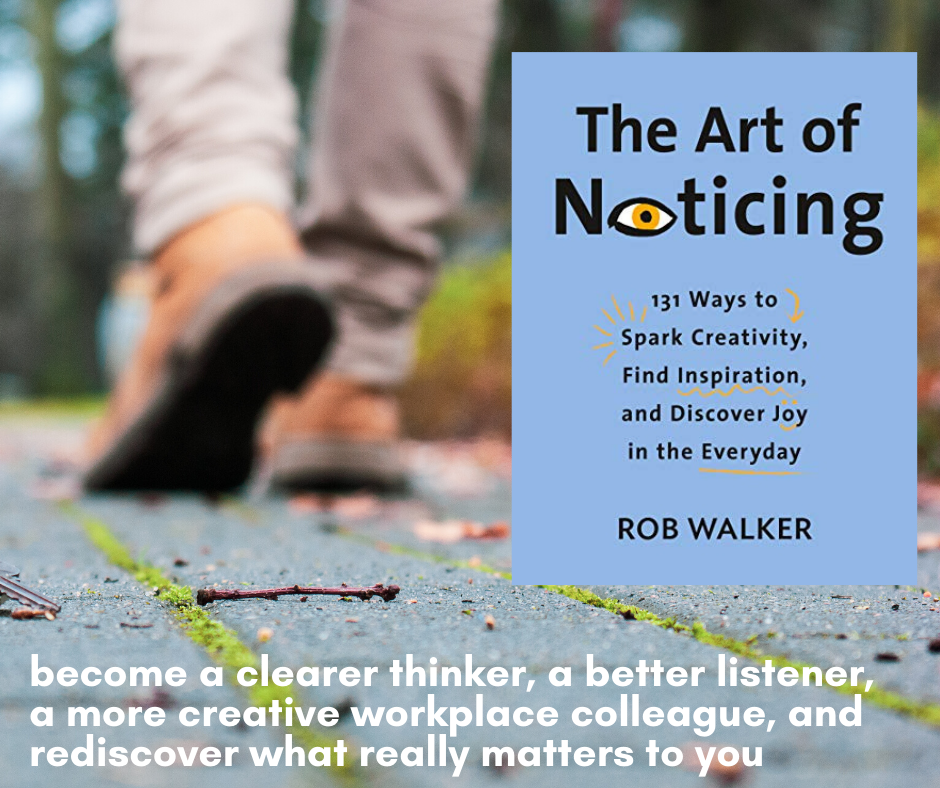
The sense that external forces seek to seize our attention isn’t new – but it feels particularly acute today. Billboards, shop windows, addictive video games, endless news cycles, and commercial appeals tantalize us from all directions. We contend with the myriad distractions flowing through the pocket-sized screens we carry with us everywhere. By various estimates, a typical smartphone owner checks a device 150 times per day – every six minutes – and touches, swipes, or taps it more than 2,500 times.

The Art of Noticing, Rob Walker

And so I walk, unplugged.

Yesterday, I watched for American flags. In my neighborhood, I’m never out of sight of one. Some are bright and relatively new, since we are not too far removed from the Independence Day period. The American flag has always been more than a piece of cloth to me. A symbol for sure, but one rich with history, sacrifice, and uncommon wisdom. No matter the season outside, the vivid red, white, and blue always speak to me in different ways.

I’ve also listened to the late summer sounds of a mid-morning North Carolina symphony of insects and birds. The insects I’m guessing are mostly cicadas and katydids – first one, then the another, then a whole chorus. And then quiet. And then it starts over.

With one section of my walk bordering a park and the streets and yards filled with trees, I can always hear birds – robins, blue jays, cardinals, sparrows, blue birds, mockingbirds, crows, hawks, and more – including a nighttime hair-raising screech owl.

I listened for sounds I didn’t hear – cars up and down the street. Most people have gone to work if they’re going, and lunchtime hasn’t yet arrived. No planes on approach to CLT – that means the winds have shifted direction, and the landing pattern, often overhead, is further to the west. About a mile away, I-77 traffic is no doubt busy – but I didn’t hear it, again thanks to the wind direction.

Tomorrow I’m walking with my feet. Well, of course I will. But I’m going to “listen” to what my feet are saying about the path I choose, and see what I can learn.

When you actively notice new things, that puts you in the present…As you’re noticing new things, it’s engaging, and it turns out…it’s literally, not just figuratively, enlivening.

Ellen J. Langer

inspired by The Art of Noticing, by Rob Walker

The Path to Wisdom: Cultivating the Heart and Mind

In a world driven by instant gratification and quick fixes, the pursuit of wisdom often takes a backseat. We are drawn to dramatic turnarounds and immediate results, neglecting the transformative power of patience, discipline, and inner growth. As the quote below by Tim Keller wisely reminds us, true wisdom is not found in shortcuts but in the enduring journey of long training and discipline. However, he emphasizes that the heart, not just the mind and will, must be trained to embark on this enlightening path.

The Power of Patience and Discipline

Wisdom is not a destination; it is a lifelong pursuit. It requires the cultivation of patience and discipline, qualities that enable us to navigate the complexities of life with grace and insight. Like a skilled craftsman honing their craft over years of dedicated practice, the path to wisdom necessitates consistent effort, perseverance, and a willingness to learn from both successes and failures.

Training the Mind and Will

Intellectual knowledge and strong determination are fundamental pillars of wisdom. Training the mind involves acquiring knowledge, critical thinking, and the ability to discern between truth and falsehood. It is through the continuous expansion of our intellectual capacities that we develop a deeper understanding of the world and gain the tools to make informed decisions.

Equally important is the training of the will—the ability to harness our inner strength, exercise self-control, and align our actions with our values. Willpower empowers us to resist temptations, overcome obstacles, and persevere in the face of challenges on our journey toward wisdom.

The Heart: The Seat of Wisdom

While training the mind and will is crucial, the quote reminds us that the heart must not be overlooked. The heart represents our emotional intelligence, compassion, empathy, and the capacity to connect with others and ourselves on a deeper level. It is through cultivating the heart that wisdom truly blossoms.

Training the heart involves developing qualities such as kindness, gratitude, forgiveness, and love. These virtues foster harmonious relationships, promote understanding, and allow us to navigate conflicts with empathy and compassion. By nurturing the heart, we become more attuned to our inner voice and the needs of others, enabling us to make choices that align with our values and benefit the greater good.

Integrating Mind, Will, and Heart

Wisdom flourishes when the mind, will, and heart are integrated and work in harmony. It is the synergy of these elements that allows us to approach challenges and decisions with clarity, balance, and a profound understanding of ourselves and the world around us.

To embark on the path of wisdom, we must engage in practices that train all aspects of our being. This may include reading and seeking knowledge, engaging in reflective practices such as meditation and journaling, embracing self-discipline, and nurturing our emotional intelligence through acts of kindness and self-care.


Modern Elders realize that the pursuit of wisdom is not a quick-fix solution but rather a lifelong journey that requires patience, discipline, and a holistic approach. By training the mind, will, and heart, we unlock the true potential for growth, understanding, and compassion within ourselves. 

Embrace the wisdom in the quote and commit to cultivating all aspects of our being, for it is through this integration that we can truly embody the transformative power of wisdom in our lives and positively impact the world around us.

Wisdom is Developed Only in Experience

Out in the open wisdom calls aloud, she raises her voice in the public square; on top of the wall she cries out, at the city gate she makes her speech. (Proverbs 1:20–21, NIV)


Wisdom invites people to learn from her, but she does so not from the ivory tower but outside, in the public square and public places of the city. Wisdom is developed only in experience. No matter how hard they study, the graduates of medical school, law school, and business school will become truly wise in their fields only out in the open, that is, in real-life experience. 

Proverbs is not an “inspirational” book with statements that immediately jump off the page at you. Wisdom cannot be conveyed by a series of TED talks or “executive briefings.” It is inaccessible to people too busy for its method. It comes through first with experience and then with deep, honest reflection on that experience. 

The journey from the Proverbs of Solomon to the writings of Socrates (via his student Plato) is not as strange as one might seem:

Wisdom is humility, accepting that we know very little or nothing at all

Socrates describes this conclusion when he states “I am wiser than that man. Neither of us probably knows anything worthwhile; but he thinks he does when he does not, and I do not and do not think I do”. Socrates is considered the wisest man in Athens by the Oracle, because instead of assuming he possesses wisdom, he accepts that wisdom is often unattainable and that we should instead continuously pursue new and truer knowledge. (from Plato’s Apology)

Socratic wisdom, then, is humility: a recognition of your own ignorance.

To continually move past this ignorance, the Socratic method uses questions to examine the values, principles, and beliefs of students in a dialogue, not a one-sided monologue by the teacher.

Wisdom emerges only as we ask thought-provoking, searching questions: 

  • When did I last see this illustrated in my life or someone else’s? 
  • Where do I need to practice this? 
  • How would my life be different if I did? 
  • What wrong thinking and attitudes result when I forget this? 

Jesus, often spoke in parables and answered questions with other questions, trying to get us to reflect, think, and grow in wisdom (Matthew 13:10; Luke 20:4; John 16:29). 

What has happened to you recently that was significantly good or difficult? Have you reflected on it with others to learn wisdom from it?

I’m reminded of a wise saying by my father: 

It’s okay to be ignorant – it just means you haven’t learned something yet. Just don’t be stupid – stupid is terminal.

Doc Adams

My journey to becoming a Modern Elder is all about reciprocity. 

Giving and receiving. Teaching and learning. Speaking and listening. 

Everyone gets older, but not everyone gets elder.

The first just happens (if you’re lucky and healthy). The other you have to earn.


Adapted from God’s Wisdom for Navigating Life by Tim and Kathy Keller, and Wisdom@Work by Chip Conley