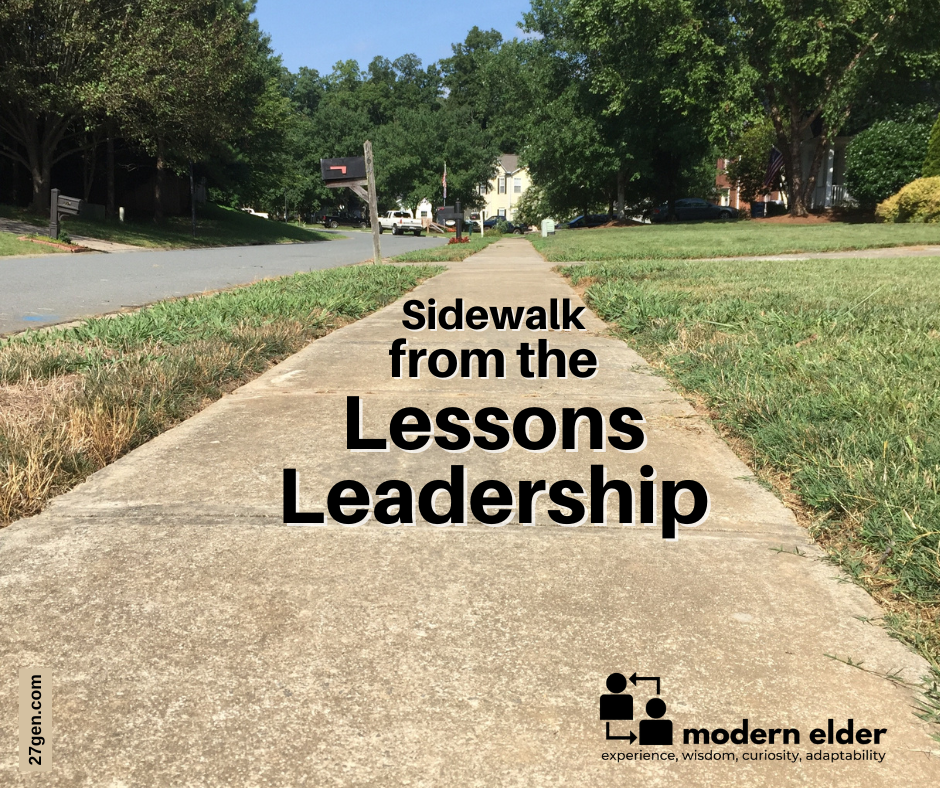
Leadership Lessons from the Sidewalk

In a recent post on walking unplugged, I mentioned that I would be walking the next day with my feet.

I wasn’t trying to be flippant – I was merely stating that your feet can tell you a lot about where you’re walking, and what you’re walking on, and in the process, you can learn a lot.

With that going through my head, I began my walk – and it wasn’t long before I realized Leadership Lessons the sidewalk could teach me.
In a short walk through my neighborhood, I felt and observed the following:

  • Raised Sidewalk – visible, growing tree roots: Leaders should always be looking for obscure things that may trip them up.
  • Sunken Sidewalk – hidden sources of erosion: Leaders should be cautious of unseen things that will bring them down and stunt their capabilities.
  • New Sidewalk Section – replacing to make it functional again: As your leadership grows and matures, you can count on learning new ways to do some things better.
  • Clean Sidewalk – appearances matter: Leaders must present themselves in the best manner possible, which instills confidence.
  • Dirty, Stained Sidewalk – see above: Conversely, sloppy appearances give others pause.
  • Cracked Sidewalk – too heavy a load: Leaders aren’t super heroes, and must balance the “load” they carry.
  • Grass in Sidewalk – maybe lazy, but at least distracted: Leaders who allow interruptions won’t be able to focus.
  • Grass growing over the Sidewalk – know your boundaries: Leaders know that boundaries help focus attention and align teams.
  • Sidewalks – take you somewhere: Leaders don’t fly solo; they must take others with them.
  • Sidewalks – make your journey easier: Well-prepared leaders are in a better position to help others on the journey.
  • Sidewalks – make your journey safer: Leaders watch out for the safety and welfare of others.
  • Sidewalks – lift you above the road: Leaders must rise above their surroundings.

In their civic role, sidewalks play a vital purpose in city, town, and suburban life. As conduits for pedestrian movement and access, they enhance connectivity and promote walking.  Safe, accessible, and well-maintained sidewalks are a fundamental and necessary investment.

But for me, they provide great leadership lessons.

And of course, I couldn’t resist sharing Shel Silverstein’s most appropriate poem:

“There is a place where the sidewalk ends
And before the street begins,
And there the grass grows soft and white,
And there the sun burns crimson bright,
And there the moon-bird rests from his flight
To cool in the peppermint wind.

Let us leave this place where the smoke blows black
And the dark street winds and bends.
Past the pits where the asphalt flowers grow
We shall walk with a walk that is measured and slow,
And watch where the chalk-white arrows go
To the place where the sidewalk ends.

Yes we’ll walk with a walk that is measured and slow,
And we’ll go where the chalk-white arrows go,
For the children, they mark, and the children, they know
The place where the sidewalk ends.”

― Shel Silverstein, Where the Sidewalk Ends


How to Find Something You Aren’t Looking For

Over the coming century, the most vital human resource in need of conservation and protection is likely to be our own consciousness and mental space.

Tim Wu, The Attention Merchants

A runner I have never been, and not likely to ever be.

A road biker (bicycle) I once was (150+ miles per week), and hope to be again one day.

Active sports participation (first as a player on various teams, and then as an active soccer coach for 14 years) is long past.

My exercise, health permitting, is walking.

A few years ago, it was three-four miles a day. Now, not a lot – some days I struggle to make a half-mile; others, a little more.

For the longest time, I listened to podcasts during these walks. I would have time to listen to at least two or three, and often came back from those walks with eight-ten voice memos on my phone.

Then one day, I walked unplugged from my phone…

Pay attention to what you pay attention to. That’s pretty much all the information you need.

Amy Krouse Rosenthal

While I will always be a learner, both by genetics and environment (vocation), I think that hour a day might be better put to use paying attention, and seeking to grow wiser, not just smarter.

The stimulation of modern life, philosopher Georg Simmel complained in 1903, wears down the senses, leaving us dull, indifferent, and unable to focus on what really matters.

In the 1950s, writer William Whyte lamented in Life magazine that “billboards, neon signs,” and obnoxious advertising were converting the American landscape into one long roadside distraction.

“A wealth of information creates a poverty of attention,” economist Herb Simon warned in 1971.

The sense that external forces seek to seize our attention isn’t new – but it feels particularly acute today. Billboards, shop windows, addictive video games, endless news cycles, and commercial appeals tantalize us from all directions. We contend with the myriad distractions flowing through the pocket-sized screens we carry with us everywhere. By various estimates, a typical smartphone owner checks a device 150 times per day – every six minutes – and touches, swipes, or taps it more than 2,500 times.

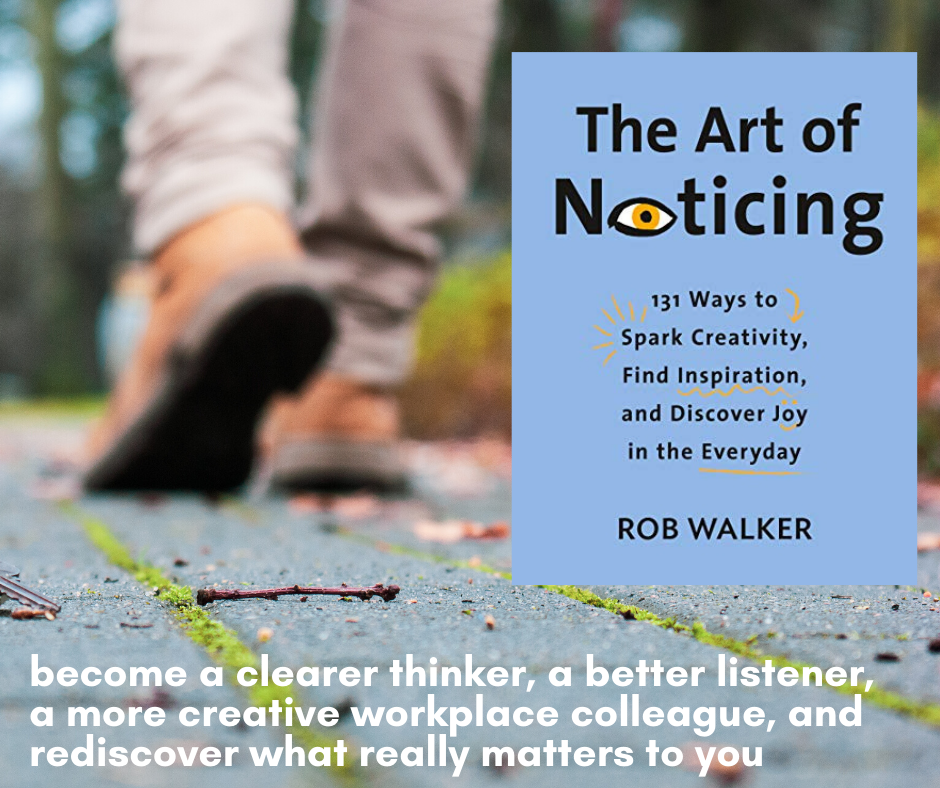
The Art of Noticing, Rob Walker

And so I walk, unplugged.

Yesterday, I watched for American flags. In my neighborhood, I’m never out of sight of one. Some are bright and relatively new, since we are not too far removed from the Independence Day period. The American flag has always been more than a piece of cloth to me. A symbol for sure, but one rich with history, sacrifice, and uncommon wisdom. No matter the season outside, the vivid red, white, and blue always speak to me in different ways.

I’ve also listened to the late summer sounds of a mid-morning North Carolina symphony of insects and birds. The insects I’m guessing are mostly cicadas and katydids – first one, then the another, then a whole chorus. And then quiet. And then it starts over.

With one section of my walk bordering a park and the streets and yards filled with trees, I can always hear birds – robins, blue jays, cardinals, sparrows, blue birds, mockingbirds, crows, hawks, and more – including a nighttime hair-raising screech owl.

I listened for sounds I didn’t hear – cars up and down the street. Most people have gone to work if they’re going, and lunchtime hasn’t yet arrived. No planes on approach to CLT – that means the winds have shifted direction, and the landing pattern, often overhead, is further to the west. About a mile away, I-77 traffic is no doubt busy – but I didn’t hear it, again thanks to the wind direction.

Tomorrow I’m walking with my feet. Well, of course I will. But I’m going to “listen” to what my feet are saying about the path I choose, and see what I can learn.

When you actively notice new things, that puts you in the present…As you’re noticing new things, it’s engaging, and it turns out…it’s literally, not just figuratively, enlivening.

Ellen J. Langer

inspired by The Art of Noticing, by Rob Walker

How Taking a Walk Will Make You a Better Neighbor

Because several posts over the last few weeks have been centered on the theme of “walking” it’s only appropriate to use the topic to introduce an amazing book about learning to love where you live.

Today’s post introduces a series of ten posts, taking a “deeper dive” into the concepts exploring the heart of Melody Warnick’s book, This is Where You Belong.

Here is Warnick’s list of ten placement behaviors that she developed on the journey to “Love where you live.”

  1. Walk more
  2. Buy local
  3. Get to know your neighbors
  4. Do fun stuff
  5. Explore nature
  6. Volunteer
  7. Eat local
  8. Become more political
  9. Create something new
  10. Stay loyal through hard times

According to author Melody Warnick, scientists call the way we learn to navigate a place “mental mapping.” The concept, based on behavioral psychology studies done several times since the 40s, showed that rats and chimpanzees who had first aimlessly explored a maze developed a cognitive map that helped them quickly scamper through it later.

One’s destination is never a place but rather a new way of looking at things.

Henry Miller

Warnick, through conversations with Jeff Speck, a city planner and author of Walkable City, believes that walking is more than transportation; it’s experience

As you walk anywhere, your five senses are taking in hundreds of stimuli. All these things combine to create another “sense”: a sense of where we are.

Through her research, and in reference to #1 on the list above, Warnick discovered that people who walk a lot feel better about their lives, and one of the principles she was coming to understand about loving where you live is that feeling good in general often translates to feeling good about where you live.

When you’re happy, for whatever reason, you also happen to be happy in the place you live.

Walking helps people discover the character of where they live and why they like it. Otherwise it’s a faceless kind of experience. You don’t come into contact with anybody. Even having the comfort of being social and being around other people is so healthy. It’ fun to walk around and say hi to people.

Matt Tomasulo

Warnick found that there was something about being on foot or on a bike that makes us explorers of where we live. Walking and biking in her town helped her develop an intimacy with the town that made her find the hidden gems and appreciate where she was.

She also believes that anyone, in any town, could have the same experience.

What about you?

Can you make a change in your routines to walk more in your neighborhood, and maybe even in your town?

Go ahead and try it.

You will be surprised by what you learn.


I can’t emphasize this enough: If you like the idea of loving where you live, of being a better neighbor, or anything remotely connected, you MUST check out the work of Melody Warnick. Follow her on social media. Buy the book. Sign up for the newsletter on her website. Peruse the website for other articles she has written. It’s all PURE GOLD!