
New Urbanism and the Christian Faith
The virtue of neighborliness is not only something I want for my neighborhood, but is something I want deeply for every residential area. I can practice neighborliness in my context while advocating for a return to neighborliness in every context.
Eric O. Jacobsen
Christians often talk about claiming our cities for Christ and the need to address urban concerns. But according to Eric Jacobsen, this discussion has remained far too abstract. Sidewalks in the Kingdom challenges Christians to gain an informed vision for the physical layout and structure of the city.
Jacobsen emphasizes the need to preserve the nourishing characteristics of traditional city life, including shared public spaces, thriving neighborhoods, and a well-supported local economy. He explains how urban settings create unexpected and natural opportunities to initiate friendship and share faith in Christ.
Helpful features include a glossary, a bibliography, and a description of New Urbanism. Pastors, city-dwellers, and those interested in urban ministry and development will be encouraged by Sidewalks in the Kingdom.
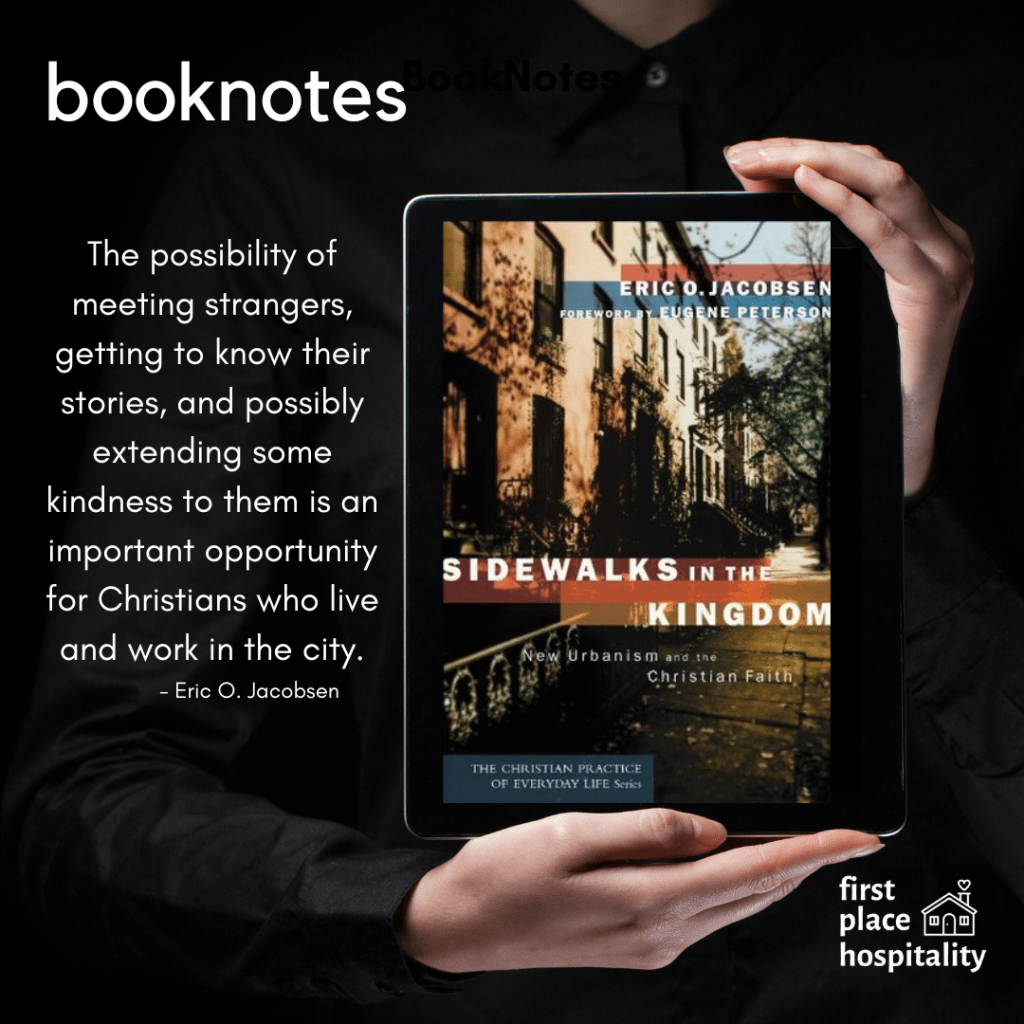
According to author Eric O. Jacobsen, the most meaningful way to define a city he has found is to say that you tend to know when you are in one. While it may sound like a cop-out, this is one area where our intuition might really be our most reliable guide.
To be more specific, there are six general features that would indicate to a visitor that he or she is in a city. These features can be understood as six distinct markers of the city.
- Public spaces
- Mixed-use zoning
- Local economy
- Beauty and quality in the built environment
- Critical Mass
- Presence of strangers
Jacobsen believes that a familiarity with these makers gives us handles upon which to hang our impressions of the communities in which we live, whether or not they qualify as cities. They also help focus and clarify our discussion about the merits of city life.
inspired by & adapted from Sidewalks in the Kingdom, by Eric O. Jacobsen

 27gen.com