The Enduring Leadership Legacy of Nehemiah

Over the past few weeks (see below), we have looked into the remarkable leadership exemplified by Nehemiah, a figure whose unwavering vision, determination, and principled approach offer invaluable lessons for leaders across generations and contexts. Through an exploration of his clarity of purpose, resilience in the face of adversity, organizational prowess, servant leadership philosophy, we have gained a profound appreciation for the enduring relevance of Nehemiah’s leadership principles.

At the heart of Nehemiah’s extraordinary achievements lies his singular vision – to rebuild the walls of Jerusalem. This clarity of purpose, fueled by a deep sense of patriotism and religious devotion, shaped his leadership approach, guiding his decisions and actions with laser-like focus. Nehemiah’s example reminds us that great leaders possess a compelling vision that inspires and unites people toward a common cause, transcending personal interests.

Yet Nehemiah’s journey was far from smooth, as he encountered formidable opposition and challenges that threatened to derail his efforts. Through an examination of his strategies for navigating these obstacles, we have witnessed the hallmarks of resilient leadership – strategic planning, contingency measures, transparent communication, and an unwavering reliance on divine guidance. Nehemiah’s ability to confront adversity head-on, rallying his people and maintaining morale, serves as a testament to the fortitude required of effective leaders in the face of daunting challenges.

Complementing his visionary leadership and resilience, Nehemiah’s organizational and project management skills were nothing short of remarkable. His meticulous planning, efficient resource allocation, coordination of diverse teams, and adept time management offer a masterclass in effective project execution. By studying Nehemiah’s approach, modern leaders can glean invaluable principles and practices for successfully orchestrating complex endeavors, ensuring that vision becomes reality.

Moreover, Nehemiah embodied the essence of servant leadership, putting the needs of his people and the greater cause before his own interests. His selflessness, empathy, and willingness to lead by example earned him the trust and respect of those he led. Nehemiah’s servant leadership philosophy challenges us to embrace humility, foster a culture of empowerment, and prioritize the collective good above personal ambition – qualities that can profoundly transform leadership dynamics in contemporary organizations and communities.

Underpinning Nehemiah’s leadership was a profound ethical and spiritual foundation. His faith and moral principles guided his decision-making, imbuing his actions with integrity and authenticity. By exploring the influence of these spiritual dimensions, we have gained insights into the power of value-based leadership, where principles and convictions serve as an unwavering compass, fostering trust and inspiring others to embrace a higher purpose.

As we conclude this series, we are left with a significant appreciation for the timeless wisdom and enduring relevance of Nehemiah’s leadership principles. His unwavering vision, resilience, organizational acumen, servant leadership philosophy, and ethical and spiritual foundations have transcended the ages, offering a blueprint for principled and impactful leadership in our modern world.

Pastor James Montgomery Boice concluded his excellent book on Nehemiah (Learning to Lead) with these words:

We need to remember Nehemiah’s faith and his great leadership characteristics. Of the many we have seen, I have been most impressed with the following:

  • Nehemiah’s submission to God. Nehemiah had no other plans for his life than to do what God had for him. He could have said with Jesus, “Not as I will, but as you will”‘ (Matthew 26:39).
  • Nehemiah’s ability to focus on the right goals. Nehemiah clearly saw the ultimate goals and the objectives leading to them. He never deviated from any of them, even for a moment.
  • Nehemiah’s wisdom in handling complex situations. The problems Nehemiah faced were all different, and the solution to one was not the solution to another. Nehemiah did not have rote answers. He handled each problem wisely, with a wisdom that came from God.
  • Nehemiah’s courage to act decisively. Because he was serving God and not man and because he knew that the purposes of God will always ultimately triumph, Nehemiah was not afraid to act boldly. His boldness left his enemies stammering, con-founded, and in awe.

Whether in the realms of business, government, non-profit organizations, or community initiatives, Nehemiah’s example serves as a clarion call for leaders to cultivate clarity of purpose, navigate adversity with courage and wisdom, exhibit organizational excellence, embrace servant leadership, and ground their actions in ethical and spiritual foundations. By embodying these principles, leaders can inspire and unite people, overcome formidable challenges, and leave a lasting legacy of positive transformation.


Here’s the full series using the biblical story of Nehemiah as an excellent role model for a Modern Elder:


Building Trust and Empowering Teams: Lessons in Servant Leadership from Nehemiah

I’m continuing a brief series using the biblical story of Nehemiah as an excellent role model for a Modern Elder:


What makes a leader truly great? Is it their professional accomplishments, the might of their authority, or the strength of their power?

For the biblical figure Nehemiah, it was quite the opposite – his remarkable leadership flowed from a counterintuitive essence of service.

As an outcast Jew in the Persian empire, Nehemiah seemed an unlikely candidate to revive a nation. Yet through his steadfast faith, humility and sacrificial devotion to the people of Israel, Nehemiah embodied the purest model of servant leadership. His extraordinary story contains insights that modern leaders would be wise to emulate. From rallying a disheartened people around a seemingly impossible vision, to empowering each person’s role in the mission, to compassionately advocating for their needs – Nehemiah’s journey exemplifies the paradoxical principle that those who lead by serving others become the greatest leaders of all.

I hope you will be inspired and challenged in this brief look at the timeless practices of servant leadership through the life of Nehemiah.

Nehemiah exhibited characteristics of a servant leader, putting the needs of the people and the cause before his own interests.

How can this leadership style be effectively applied in contemporary contexts?

This question highlights Nehemiah’s embodiment of the servant leadership philosophy, which has gained significant attention in modern leadership theory and practice.

Here are some key actions that demonstrated Nehemiah’s servant leadership:

Prioritizing the Greater Good: Nehemiah’s actions were driven by a desire to serve the collective interests of his people and the cause of rebuilding Jerusalem, rather than personal gain or ambition. He demonstrated a selfless commitment to a greater purpose beyond himself.

Empowering and Developing Others: Servant leaders focus on empowering and developing their followers. Nehemiah delegated responsibilities and involved the people in the rebuilding efforts, fostering a sense of ownership and commitment to the cause.

Leading by Example: Nehemiah led by example, working alongside his people and sharing in their struggles and hardships. This hands-on approach earned him respect and credibility as a leader who was willing to sacrifice for the greater good.

Ethical and Moral Integrity: Servant leaders are guided by strong ethical and moral principles. Nehemiah’s leadership was grounded in his faith and commitment to doing what was right, even in the face of opposition and challenges.

Listening and Empathy: Effective servant leaders are attentive to the needs and concerns of their followers. Nehemiah demonstrated empathy and a willingness to listen to his people, which likely contributed to their support and commitment to the rebuilding efforts.

Humility and Selflessness: Servant leaders are characterized by humility and a focus on serving others rather than seeking personal glory or recognition. Nehemiah’s leadership style was marked by humility and a selfless dedication to the cause.

The term “servant leadership” was coined in 1970 by Robert K. Greenleaf in his essay “The Servant as Leader.” Greenleaf defined the servant leader as one who focuses primarily on the growth and well-being of people and the communities to which they belong. The servant leader puts meeting the needs of others as the highest priority.

At its core, servant leadership is a philosophy that inverts the traditional power pyramid of organizational leadership. Rather than people serving the interests of leaders, servant leaders exist to serve and meet the needs of their teams and organizations. The servant leader shares power, puts the needs of others first, and helps people develop and perform at their highest potential.

Here are the key principles of servant leadership:

Listening Intently to Understand: Servant leaders are great listeners who strive to fully understand people’s thoughts, feelings, goals and perspectives. They don’t just listen to respond, but to gain empathy and find ways to meet people’s needs. Through listening intently, they show care, respect and validate others.

Accepting People for Their Unique Talents : Servant leaders appreciate and respect people’s inherent worth and dignity as individuals. They don’t judge, but accept people for who they are, recognizing everyone has unique strengths, talents and room to grow. This creates an inclusive environment where people feel valued.

Providing Opportunities for Learning and Growth:The servant leader is a facilitator of personal and professional growth for those they lead. They provide tools, resources, mentoring and opportunities for skill development. Their goal is to nurture people’s abilities to ultimately build a more capable team.

Behaving Ethically to Build Trust: Servant leaders live by a strong moral code of integrity, honesty and ethical behavior. They aspire to always do the right thing to build trust with those they serve. Their consistency in keeping values builds confidence in their leadership.

Empowering and Giving Ownership: Rather than controlling or micro-managing, servant leaders empower people by giving them autonomy, allowing them to take ownership of projects and make decisions within their areas of responsibility. This breeds commitment and engagement.

Committing to Serving Others’ Needs: At the heart of servant leadership is the desire to understand and proactively meet the legitimate needs of those being led – whether they are team members, customers or communities. The servant leader is always looking for ways to help and enable people’s success.

Nehemiah embodied the heart of a servant leader in his pivotal role rebuilding the walls of Jerusalem.

Though granted immense authority by King Artaxerxes, Nehemiah did not lord his power over the people. Instead, he lived among them, feeling their struggles and sharing their burdens. With deep empathy, he rallied the dispersed Israelites around a united mission, empowering every family to resurrect their city’s defenses. Nehemiah rolled up his sleeves alongside the laborers, toiling just as hard and leading by humble example. When confronted by opposition, he remained steadfast yet diplomatic, anchored in his devotion to serving God and the people.

Nehemiah’s brand of servant leadership transformed the Israelites’ fear into a fierce determination that achieved the impossible. His concern for their safety, provision for their needs, and vision for their security as a nation flowed from Nehemiah’s core purpose – to serve a calling greater than himself.


Organizational and Project Management Skills: Lessons from Nehemiah

I’m continuing a brief series using the biblical story of Nehemiah as an excellent role model for a Modern Elder:


Nehemiah demonstrated remarkable organizational and project management skills in coordinating the rebuilding efforts. What principles and practices can modern leaders draw from his approach?”

This question highlights Nehemiah’s abilities as an effective project manager and organizer, which were crucial to the successful completion of the daunting task of rebuilding the walls of Jerusalem. Here are some key points to consider:

Planning and Preparation: Nehemiah’s approach was marked by careful planning and preparation. He conducted a thorough assessment of the situation, gathered resources, and developed a comprehensive plan before starting the rebuilding process. Effective project management relies on meticulous planning and preparation.

Resource Allocation and Delegation: Nehemiah efficiently allocated resources, including materials, labor, and funds, to ensure the project’s progress. He also delegated responsibilities to different groups and families, leveraging their skills and strengths. Effective resource allocation and delegation are essential for successful project management.

Organization and Coordination: The rebuilding project involved coordinating the efforts of numerous people working simultaneously on different sections of the wall. Nehemiah’s organizational skills enabled him to oversee and coordinate these efforts effectively, preventing duplication of work and ensuring cohesion.

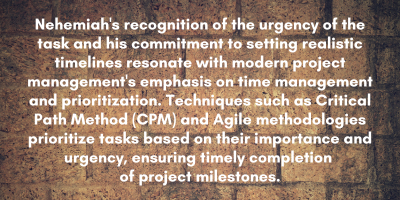
Time Management and Prioritization: Nehemiah recognized the urgency of the task and prioritized the rebuilding efforts accordingly. He set ambitious yet realistic timelines and ensured that the work progressed efficiently. Effective time management and prioritization are crucial for meeting project deadlines.

Risk Management and Contingency Planning: Nehemiah anticipated potential risks and challenges and implemented contingency plans to mitigate them. Risk management is a critical aspect of successful project management.

Monitoring and Adaptation: Nehemiah closely monitored the progress of the rebuilding efforts and was willing to adapt his approach as needed. Effective project managers must continuously monitor progress and make adjustments to address unforeseen circumstances or obstacles.

While Nehemiah’s approach shares many similarities with contemporary project management methodologies, it also reflects the unique challenges and circumstances of his time. Nonetheless, his principles of careful planning, effective resource management, and proactive risk mitigation remain timeless and applicable in modern project management contexts.


Visionary Leadership: Lessons from Nehemiah

I’m continuing a brief series using the biblical story of Nehemiah as an excellent role model for a Modern Elder:

Today, I wanted to take a look at Nehemiah’s skill as a Visionary Leader. Nehemiah had a clear and specific vision – to rebuild the walls of Jerusalem. This singular focus allowed him to channel his energy and resources towards achieving that goal. Effective leaders often have a well-defined vision that guides their actions and decision-making.


Nehemiah recognized a need, took initiative, conceptualized a vision, devised a strategy, and rallied others to support his cause.

In his work Visionary Leadership, Burt Nanus defines a vision as a compelling future scenario for an organization, one that is both realistic and attractive. It serves as a beacon, guiding the organization towards a destination that surpasses its current state, promising greater success or desirability.

Nanus argues that a potent vision possesses the ability to galvanize action, igniting enthusiasm and prompting the mobilization of resources and talents to bring it to fruition. Effective leaders possess the ability to perceive opportunities beyond the present reality, focusing not only on the immediate concerns but also on future possibilities. This foresight distinguishes them as leaders, enabling them to prioritize what truly matters amidst competing demands.

According to Nanus, vision occupies a central role in leadership, acting as an essential tool for success. Biblical leaders, grounded in the belief of a divine guide, approach leadership with prayerful dependence on God’s guidance. They maintain an optimistic yet pragmatic outlook, aligning their vision with God’s purposes and stewarding resources accordingly.

However, they remain mindful of the need to uphold the integrity of their vision amidst external pressures and personal agendas. They guard against self-serving motives that may distort the vision and hinder the fulfillment of God’s intentions. For them, maintaining alignment with God’s purposes is paramount, ensuring that their leadership endeavors reflect divine guidance and contribute to His ultimate plan.

Nehemiah’s Approach to Communicating the Vision

Articulating the vision with clarity

Nehemiah clearly communicated the goal of rebuilding the walls of Jerusalem to restore its security and honor. He didn’t leave room for ambiguity, ensuring that everyone understood the purpose and significance of the project.

His vision was specific and actionable, providing a clear direction for the entire community to rally behind.

Inspiring others with his passion and commitment

Nehemiah’s personal dedication to the vision was evident in his words and actions. His passion for the well-being of Jerusalem and its people inspired others to join him in the endeavor.

He led by example, demonstrating his commitment through hard work, sacrifice, and unwavering faith in God’s providence.

Addressing doubts and concerns

Nehemiah acknowledged and addressed the doubts and fears of the people, reassuring them of God’s favor and protection throughout the project.

He listened empathetically to the concerns raised by various stakeholders and provided rational responses, instilling confidence and trust in his leadership.

Involvement of key stakeholders

Nehemiah strategically engaged with influential leaders and officials to garner support for his vision. He sought the backing of King Artaxerxes of Persia, as well as local authorities, to secure resources and permissions for the project.

By enlisting the support of key stakeholders, Nehemiah gained credibility and legitimacy for his leadership, enhancing the likelihood of success.

Nehemiah actively involved the entire community in the vision, rallying people from all walks of life to participate in the rebuilding efforts. He organized the population into teams based on their skills and proximity to different sections of the wall, maximizing efficiency and collaboration.

Through effective delegation and coordination, Nehemiah ensured that everyone contributed their talents and resources towards achieving the shared goal.

Overall, Nehemiah’s approach to communicating the vision exemplifies key principles of effective leadership, including clarity, inspiration, empathy, and stakeholder engagement. By skillfully articulating his vision and rallying widespread support, Nehemiah was able to mobilize a diverse community towards the successful completion of a monumental task.

Nehemiah’s Visionary Leadership Lessons 

Focused leaders operate from clarity of vision.

Empathic leaders are characterized by their sensitivity to existing needs even before being developing a vision to address them. 

Passionate leaders operate from a profound sense of duty and accountability. 

Prepared leaders enhance motivation, making leadership tasks more manageable.

Collaborative leaders derive greater satisfaction from empowering others rather than solely focusing on executing tasks themselves.

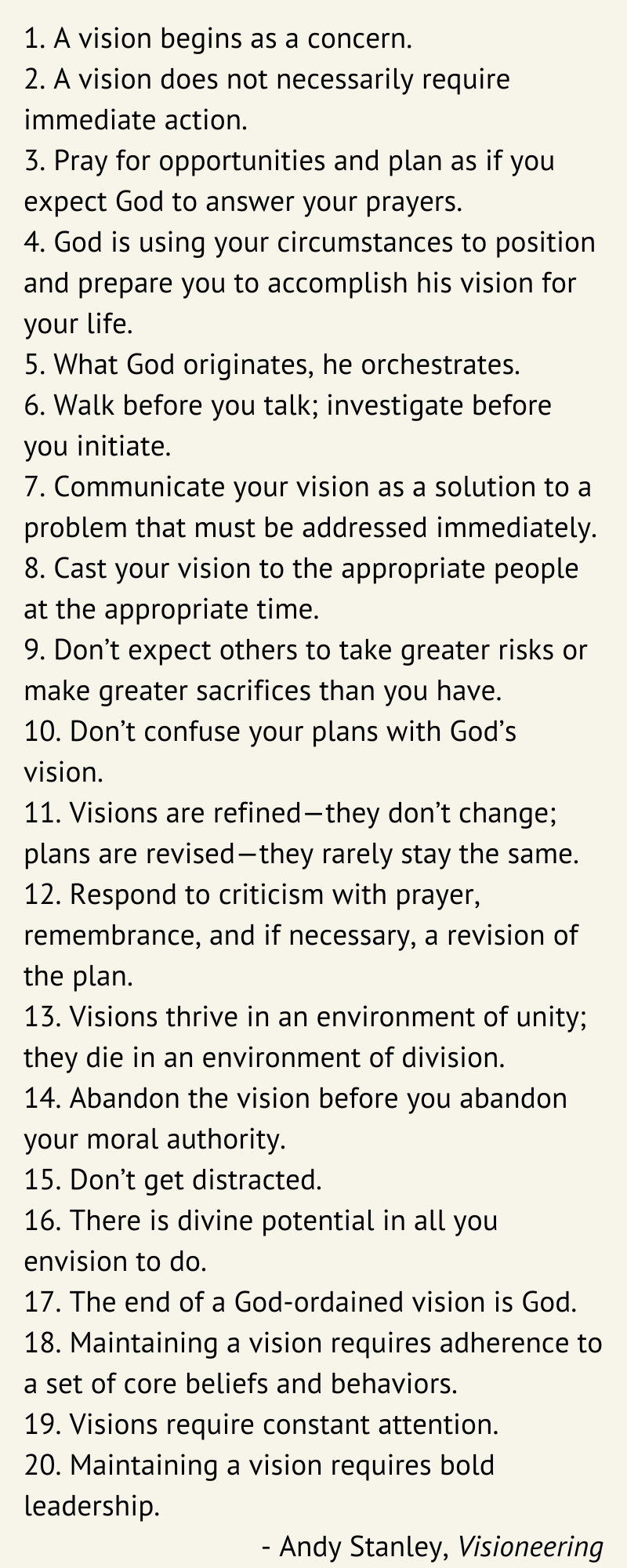
In his book Visioneering, Andy Stanley developed the following “building blocks” that leaders will find helpful as they pursue a vision for the organizations they lead.


Leadership from the Knees Up: Lessons from Nehemiah

In Nehemiah 1:5, Nehemiah implores, “I beseech Thee, O Lord God of heaven,” as he engages in prayer. When confronted with a need, our initial reaction often mirrors our flawed human nature: How can I resolve this? or Who is to blame for this situation? However, the resolution to any people problem lies not in human reasoning alone but in taking it first to God in prayer. This principle, highlighted in the first chapter of the book of Nehemiah and exemplified in Nehemiah’s life, underscores the vital role of prayer in a leader’s life.

Nehemiah’s approach before the Lord serves as a model for leaders. Firstly, he acknowledges and praises God’s greatness, recognizing Him as the ultimate authority. Secondly, Nehemiah humbly confesses his own involvement in the problem, taking responsibility instead of blaming others. This confession is not a scapegoat for others’ failures but a genuine recognition of personal culpability. Thirdly, he lays claim to God’s promises, citing previous assurances of restoration and protection for His people. Lastly, Nehemiah boldly presents his desires before God, seeking success and favor in his endeavors.

Leaders can learn from Nehemiah’s example of complete reliance on prayer, understanding that effective prayer combines conviction with action. Nehemiah 1 exemplifies the synergy between prayer and proactive engagement. Prayer is not merely words and thoughts but practical, prompting action rooted in faith and dependence on God.

The importance of prayer is underscored by four succinct reasons. Firstly, prayer necessitates patience, compelling us to wait on God’s timing rather than rushing into action. Secondly, prayer brings clarity to our vision, dispelling the fog of uncertainty and enabling us to see situations from God’s perspective. Thirdly, prayer soothes our anxieties, replacing worry with peace as we entrust our concerns to God. Lastly, prayer ignites our faith, fostering trust in God’s ability to intervene where human efforts fall short.

Nehemiah’s reliance on prayer highlights its transformative power in leadership. Through prayer, we invite God into our seemingly insurmountable challenges, trusting in His ability to accomplish what is beyond our capability. Nehemiah’s inclination to kneel before God serves as a poignant reminder for leaders to seek divine guidance and assistance in times of need.

As Charles Swindoll stated, Nehemiah modeled true leadership – from the knees up!


Inspired by Hand Me Another Brick, by Charles R. Swindoll


FROM RUINS TO RESILIENCE: Leadership in Times of Adversity

Glance through newsfeeds on your device and it won’t take long to find another story of an organizational or leadership breakdown. Although things may appear smooth and stable on the surface, beneath an often thin veneer it is not unusual to find internal strife or organizational confusion.

Guess what – that’s nothing new.

It’s been around for thousands of years…

Every leader faces problems. But should we solve them by using strategies found in best-selling leadership books?

Or is there another way?

It would be the dream of today’s content creators to write promotional materials for the memoirs of Nehemiah, the governor of Judah in the latter part of the fifth century B.C. They would almost be salivating at the opportunity to mine this amazing text from the Bible which speaks directly to contemporary concerns and offers such practical guidance in so many areas of life.

Here’s a glimpse of what that copy might look like:

Become a Leader and Discover How to:

  • Strategize and execute actionable plans
  • Influence others positively and foster a culture of cooperation
  • Navigate challenging authority figures
  • Inspire and empower team members
  • Unlock eight essential strategies for overcoming obstacles
  • Achieve success where others have faltered
  • Attain victory through collaboration rather than coercion

While each of these insights (and more) are gleaned from Nehemiah, it would be remiss to overlook its most crucial aspect: Nehemiah’s deep devotion to God. His intimate connection with God through prayer and personal piety enabled him to tap into divine wisdom, patience, skill, and perseverance, essential for accomplishing his monumental task.

And what a task it was! In 445 B.C., Nehemiah journeyed from the Persian capital of Susa to the ancient Jewish hub of Jerusalem to oversee its reconstruction. Devastated 141 years earlier by Nebuchadnezzar, the Babylonian king, Jerusalem lay in ruins, its once-majestic walls reduced to rubble. Despite the daunting circumstances and the discouragement of previous failed attempts at reconstruction by returning exiles, Nehemiah orchestrated a remarkable turnaround. In just fifty-two days, amidst fierce opposition, he oversaw the completion of the city’s formidable defenses, commencing work on August 1st and concluding on September 21st.

How did he achieve the seemingly impossible? Nehemiah attributes the success not to his own prowess but to the divine intervention of God. When granted permission by King Artaxerxes, Nehemiah acknowledged God’s favor, stating, “The king granted by requests, for the gracious hand of my God was on me.” (Nehemiah 2:8). Confronted by formidable adversaries such as Sanballat and Tobiah, Nehemiah remained steadfast, affirming, “The God of the heavens is the one who will grant us success” (v. 20). Upon completion, Nehemiah attributed the feat to divine assistance, declaring, ” …this task had been accomplished by our God” (Nehemiah 6:16).

Nehemiah exemplifies exceptional leadership qualities, offering timeless lessons. Yet, beyond his leadership acumen lies his profound reliance on God – a lesson equally vital for us today.

May God raise up leaders like Nehemiah in our time of need.


Inspired by Nehemiah: Learning to Lead, by James Montgomery Boice


Nehemiah’s Blueprint: A Biblical Model for Problem Solving

Short deadlines.

Not enough staff.

Tight budgets.

Personal attacks.

External opposition.

Internal conflicts.

A huge task.

Sound like your organization?

Hopefully not, but that was the situation that Nehemiah faced as he stood at the broken down walls of Jerusalem and wept. Fortunately, Nehemiah had a unique ability to solve the complex problems that faced him. His methods illustrate two powerful elements of systems thinking that every leader should possess. As you begin to understand these elements, they will help you solve the problems you face as a leader.

Nehemiah’s ability to solve complex problems grew out of his manner of seeing the problems – as a systems thinker. Peter Senge, one of the early proponents of systems thinking, said “Systems thinking is a discipline for seeing wholes. It is a framework for seeing interrelationships rather than things, for seeing patterns of change rather than static ‘snapshots’ “.

Two elements of systems thinking made a difference for Nehemiah. He saw what Senge labeled “the subtle interconnectedness that gives living systems their unique character,” and he saw the ‘structures’ that underlie complex situations”.

The result? He was so successful in his work that, when people saw it, “they realized that this work had been done with the help of God” (Nehemiah 6:16). Each step of the way, Nehemiah had sought the Lord for direction. God answered those prayers by providing favor, strength, and wisdom.

How will you use systems thinking to “rebuild the walls” you encounter?

Nehemiah’s approach to rebuilding the walls of Jerusalem serves as a prime example of problem-solving in the Bible. 

He grasped the problem’s scope by carefully considering the report he received, understanding its importance in shaping subsequent actions. This involved not just hearing the report but also probing the messengers for additional details.

He empathized with the suffering of his people, feeling deeply for them and for the honor of God. This compassionate stance underpinned his entire plan.

Nehemiah turned to prayer, petitioning the “God of heaven” fervently and humbly. His prayer was marked by reverence, confession, and a plea for divine favor, recognizing the need for God’s intervention in his interactions with King Artaxerxes.

He waited for the right moment to approach the king, having spent months in prayerful preparation. Even when the opportunity arose, Nehemiah continued to seek God’s guidance through prayer.

Upon reaching Jerusalem, Nehemiah quietly assessed the situation, taking time to understand the condition of the wall before revealing his plan. This thoughtful approach mirrored that of a skilled physician diagnosing a patient’s ailment.

Nehemiah involved the community in the solution, recognizing that the problem was a collective concern. With a rallying cry, he gathered support for the rebuilding effort, instilling confidence in the people by reminding them of God’s favor.

Nehemiah’s example highlights the importance of prayer, empathy, careful planning, and community involvement in problem-solving. Leaders can glean valuable insights from his actions by studying this narrative closely.