How Curiosity Fuels Adaptability as the Modern Elder’s Superpower

In the fast-paced and ever-changing landscape of the 21st century, adaptability has become more than just a valuable skill – it’s a necessity. For Modern Elders, the ability to embrace change, learn new concepts quickly, and remain flexible in thought and action is nothing short of a superpower. It’s the quality that allows seasoned professionals to stay relevant, contribute meaningfully, and thrive in a world of constant flux.

For me, the heart of adaptability lies an insatiable curiosity – a burning desire to understand, explore, and engage with the world around us. The most prominent personal expression of that curiosity is my reading regimen: daily reading in multiple books across different topics. I have found that this habit acts as a powerful catalyst for change and growth. It propels me to ask questions, challenge assumptions, and delve into unfamiliar territories without fear. Curiosity fuels the willingness to embrace new technologies, ideas, and ways of thinking, making the process of adaptation not just necessary, but exciting. It transforms potentially daunting changes into intriguing puzzles to be solved, and converts the unknown from a threat into an opportunity for discovery.

This relentless inquisitiveness keeps the mind agile and receptive, allowing the journey to becoming a Modern Elder to connect disparate ideas, spot emerging trends, and find innovative solutions to complex problems. In essence, curiosity is the engine that drives adaptability, ensuring that Modern Elders remain not just relevant, but vital in our rapidly evolving world. It’s the quality that turns lifelong learning from a chore into a joy, and makes the journey of constant adaptation a thrilling adventure rather than a burdensome task.
Embracing Change: The Modern Elder’s Mindset

The first component of adaptability is the willingness to embrace change. This can be challenging, especially when we’ve spent years or decades honing our expertise in particular areas. However, as the Greek philosopher Heraclitus wisely noted, “The only constant in life is change.”

For Modern Elders, embracing change means:

  • Cultivating a growth mindset: Psychologist Carol Dweck’s research shows that believing in our ability to learn and grow – regardless of age – is crucial for adaptability.
  • Staying curious: Approaching new situations with genuine interest rather than skepticism or fear.
  • Seeing change as an opportunity: Instead of viewing changes as threats to your established knowledge or position, see them as chances to learn and evolve.
  • Being open to new experiences: Regularly stepping out of your comfort zone to try new things, both professionally and personally.

Learning New Concepts Quickly

The ability to grasp new ideas efficiently is a hallmark of adaptability. While it’s a myth that older adults can’t learn new things, it’s true that we may need to approach learning differently as we age. Here are some strategies for quick learning:

  • Connect new information to existing knowledge: Use your vast experience as a framework to understand new concepts.
  • Practice active learning: Engage with material through discussion, application, or teaching others.
  • Break complex concepts into smaller, manageable parts: This can make intimidating new ideas more approachable.
  • Utilize multiple learning methods: Combine reading, listening, watching, and hands-on practice to reinforce new knowledge.
  • Focus on understanding core principles: Once you grasp the fundamentals, details often fall into place more easily.

Flexibility in Thought and Action

Adaptability isn’t just about absorbing new information – it’s also about being flexible in how we think and act. This means:

  • Challenging your own assumptions: Regularly question your long-held beliefs and be willing to update them based on new evidence.
  • Considering multiple perspectives: Practice looking at situations from different angles, including those of younger colleagues or those from different backgrounds.
  • Being willing to change course: If a particular approach isn’t working, be ready to pivot and try something new.
  • Balancing tried-and-true methods with innovation: Use your experience to inform new approaches, rather than letting it limit you.

The Paradox of Modern Elder Adaptability

Interestingly, adaptability for Modern Elders presents a unique paradox. On one hand, years of experience can sometimes make it harder to adapt, as we may be more set in our ways. On the other hand, that same wealth of experience can be a powerful tool for adaptability when leveraged correctly.

Modern Elders have seen trends come and go, weathered various challenges, and likely adapted to significant changes many times throughout their careers. This experience can provide a valuable perspective on change, making it less daunting. Moreover, years of diverse experiences offer a rich tapestry of knowledge to draw from when facing new situations.

Cultivating Adaptability

Like any skill, adaptability can be developed and strengthened. Here are some ways to enhance your adaptability:

  • Seek out new experiences regularly: Take a class in an unfamiliar subject, attend diverse industry events, or try new technologies.
  • Practice mindfulness: Being present and aware can help you notice changes more quickly and respond more flexibly.
  • Develop a learning routine: Set aside time each week for learning something new, whether it’s related to your field or entirely different.
  • Surround yourself with diverse perspectives: Engage with people of different ages, backgrounds, and viewpoints to challenge your thinking.
  • Reflect on past adaptations: Remind yourself of times you’ve successfully adapted in the past to boost your confidence in your ability to do so again.

The Power of Adaptive Modern Elders

In a world where change is the only constant, adaptable Modern Elders have a unique and powerful role to play. They bring a combination of rich experience and fresh perspective that is invaluable in navigating complex challenges. By embracing change, learning quickly, and remaining flexible, Modern Elders can continue to make significant contributions, mentor younger colleagues, and help bridge the gap between accumulated wisdom and cutting-edge innovation.

Remember, adaptability isn’t about erasing or devaluing your years of experience – it’s about leveraging that experience in new and dynamic ways. As a Modern Elder, your adaptability allows you to remain relevant, continue growing, and offer unique value in our rapidly changing world. It truly is your superpower in the journey of lifelong learning and contribution.


Part Two in a SeriesFind the Introduction here, along with previously published articles.


Wisdom Meets WiFi: Digital Literacy in the Modern Elder Journey

In the journey to becoming a Modern Elder, few skills are as crucial as digital literacy. As our world becomes increasingly digitized, the ability to navigate and leverage technology is no longer optional – it’s essential. For Modern Elders, digital literacy is the bridge that connects decades of wisdom with the fast-paced digital present.

My experience with the digital world began in college with a room-sized computer that ran our business class programs with a punchcard deck – which officially makes me a dinosaur! It quickly accelerated over the years of graduate school and my first full-time position to a network of PCs, then to standalone computers, to now having the world at your fingertips through your mobile phone. For a timely and relevant fact, the computing power in a modern smartphone surpasses the combined computing power of all the computers used in the historic Apollo 11 moon landing July 20, 1969 – 55 years ago tomorrow.

My children grew up in school with computer labs; my grandchildren are digital natives, not knowing anything less than living a fully-connected life all the time.

But what exactly does digital literacy entail for a Modern Elder? It’s more than just knowing how to send an email or post on social media. True digital literacy encompasses two key aspects: proficiency in using digital tools and platforms, and a deeper understanding of emerging technologies and their implications.

Proficiency in Digital Tools and Platforms

The first step in digital literacy is developing competence with the tools and platforms that dominate today’s work and social environments. This includes:

  • Productivity suites: Mastering tools like Microsoft Office or Google Workspace is crucial. These suites are the backbone of modern business communication and collaboration.
  • Communication platforms: Familiarity with video conferencing tools like Zoom or Microsoft Teams, as well as instant messaging platforms like Slack, is essential in today’s remote and hybrid work environments.
  • Social media: Understanding how to navigate and use platforms like LinkedIn, Twitter, or Instagram can be valuable for networking, personal branding, and staying connected with industry trends.
  • Cloud storage and collaboration tools: Knowing how to use services like Dropbox, Google Drive, or OneDrive enables seamless collaboration and file sharing.
  • Industry-specific software: Depending on your field, there may be specialized software that’s important to master.

Developing proficiency in these areas doesn’t mean you need to become a tech guru overnight. Start with the tools most relevant to your work or interests, and gradually expand your knowledge. Remember, the goal is not to know everything, but to be comfortable enough to use these tools effectively and to continue learning as needed.

Understanding Emerging Technologies and Their Implications

Beyond practical skills, a digitally literate Modern Elder should have a broader understanding of emerging technologies and their potential impact. This includes:

  • Artificial Intelligence and Machine Learning: Understanding the basics of AI and its applications in various industries.
  • Blockchain and Cryptocurrencies: Grasping the fundamentals of these technologies and their potential to disrupt finance and other sectors.
  • Internet of Things (IoT): Recognizing how connected devices are changing homes, cities, and industries.
  • Augmented and Virtual Reality: Understanding these technologies’ potential applications in fields from education to healthcare.
  • Cybersecurity: Being aware of digital security threats and best practices for protection.

This understanding doesn’t need to be deeply technical. The goal is to grasp these technologies’ potential impacts on society, business, and daily life. This knowledge allows Modern Elders to provide valuable perspective and foresight in discussions and decision-making processes.

The Path to Digital Literacy

Becoming digitally literate as a Modern Elder is a journey, not a destination. Technology is continually evolving, and staying current requires ongoing effort. Here are some strategies to enhance your digital literacy:

  • Online courses: Platforms like Coursera, edX, or LinkedIn Learning offer courses on various digital skills and technologies.
  • Workshops and webinars: Many organizations offer training sessions on specific tools or technologies.
  • Reverse mentoring: Partner with younger colleagues who can share their digital native expertise.
  • Practice: Regular use of digital tools is the best way to become proficient.
  • Stay informed: Follow tech news and trends through reputable sources.

Remember, the value of a Modern Elder lies in the combination of accumulated wisdom and contemporary knowledge. By developing digital literacy, you’re not just keeping up – you’re uniquely positioning yourself to bridge the gap between traditional insights and cutting-edge innovations.

Digital literacy is not just about staying relevant; it’s about enhancing your ability to contribute meaningfully in our digital world. As a Modern Elder, your experience and perspective, when combined with digital fluency, can provide unparalleled value in navigating the challenges and opportunities of our technology-driven era. Embrace the digital journey—your wisdom, amplified by technology, has the power to shape our collective future.


Part One in a SeriesFind the Introduction here, along with previously published articles.

Embracing the Journey: Becoming a Modern Elder in Today’s World

In an era of rapid technological advancement and shifting demographics, a new paradigm of wisdom and experience is emerging: the Modern Elder. This concept, pioneered by entrepreneur and author Chip Conley, challenges traditional notions of aging and redefines the role of seasoned professionals in our fast-paced, digital-first world.

But what exactly is a Modern Elder, and why is this concept so crucial in our current landscape? How can one embark on this journey of personal and professional evolution? These are the questions I will explore in an upcoming series of ten articles, each delving into a crucial aspect of becoming a Modern Elder.

The traditional view of elders as repositories of wisdom, passing down knowledge to younger generations, has been upended by the breakneck pace of technological change. Yet, the need for wisdom, context, and perspective has never been greater. Modern Elders bridge this gap, combining years of experience with a willingness to learn, adapt, and engage with new ideas and technologies.

This series will guide you through the essential elements of Modern Eldership, from embracing lifelong learning and navigating the digital landscape to cultivating emotional intelligence and reimagining mentorship. Along the way I will explore strategies for building resilience, developing your personal brand, and creating a lasting legacy in the digital age.

Each article will offer practical insights to help you navigate this transformative journey. Whether you’re in your 40s and looking ahead, or in your 60s and seeking to redefine your role, this series will provide valuable guidance for anyone aspiring to become a Modern Elder.

This exploration is the continuation of an ongoing journey I began in May 2023. As you go along on this journey, remember that becoming a Modern Elder is not about clinging to outdated notions of authority or resisting change. Instead, it’s about leveraging your unique experiences and wisdom while remaining open, adaptable, and engaged with the world around you.

Join me as I delve into topics such as:

  1. Redefining wisdom in the digital age
  2. Embracing lifelong learning
  3. Bridging generational gaps
  4. Navigating the digital landscape
  5. Harnessing emotional intelligence
  6. Reimagining mentorship
  7. Cultivating resilience
  8. Building your personal brand
  9. Achieving work-life integration
  10. Creating a lasting legacy

Each weekly article will provide insights, strategies, and actionable steps to help you evolve into a Modern Elder – someone who combines the wisdom of age with the curiosity and adaptability often associated with youth.

In a world grappling with complex challenges, the unique combination of experience, adaptability, and perspective that Modern Elders bring is more valuable than ever. It is my goal that this series will empower you to embrace this role, contributing meaningfully to your workplace, community, and beyond.

Stay tuned for the first article, where we’ll dive deep into the concept of Modern Eldership and explore how it’s redefining wisdom in our digital age. Whether you’re looking to stay relevant in your career, mentor the next generation, or simply grow and evolve in our rapidly changing world, this series will provide the insights and tools you need.

The journey to becoming a Modern Elder is one of continuous growth, learning, and adaptation. It’s about remaining curious, open, and engaged, regardless of your age. I invite you to join me on this transformative journey, as I continue to explore what it means to be a Modern Elder in today’s world.


This article introduces a series; here is the rest of the series, as it is published:

  1. Wisdom Meets WiFi: Digital Literacy in the Modern Elder Journey
  2. How Curiosity Fuels Adaptability as the Modern Elder’s Superpower
  3. Soft Skills, Strong Impact: Emotional Intelligence for Today’s Modern Elder
  4. Reading Between the Lines: Cultivating Continuous Learning Through Reading
  5. From Boomers to Zoomers: Fostering Connection in Multigenerational Environments
  6. Wisdom Exchange: The Dual Path of Mentorship for Modern Elders
  7. Connecting the Dots: The Modern Elder’s Approach to Strategic Thinking
  8. Bending, Not Breaking: The Modern Elder’s Path to Resilience
  9. Bridging Worlds: Cultivating Cultural Competence in Modern Elders
  10. Relationships & Relevance: A Modern Elder’s Approach to Personal Branding & Networking


Beyond the Bleah: Embracing Blue Zone Habits for a Vibrant Future

Growing up in the 1960s, I had the distinct advantage of parents who were avid newspaper readers. Part of that luxury came from the fact that my father owned a gas station, and the morning (and for many years, evening) editions of the Nashville papers provided plenty of conversation fodder for the regular customers who frequented his business.

Of course, the first section I was interested in was the comics, and first in the comics was the Peanuts strip by Charles Schulz. And as with many – children and adults alike – my favorite character in the Peanuts comic strip was Snoopy. Because newspaper seemed to vanish after a day or so, the gift of the first Peanuts Treasury book in 1969 was a true treasure – one that is still in my library.

In the “Peanuts” comic strip, Snoopy, Charlie Brown’s imaginative beagle, is known for many quirks and catchphrases. One of his most memorable expressions is the simple yet evocative “bleah.”

The Bleah Zone

“Bleah” first appeared in the Peanuts comics as Snoopy’s way of expressing disgust, disappointment, or general dissatisfaction. Creator Charles M. Schulz used this expression to give Snoopy a unique “voice” without resorting to actual speech bubbles, as Snoopy’s thoughts were typically shown in thought balloons.

When Snoopy says “bleah,” it’s often accompanied by a distinctive facial expression – a look of disgust with his tongue sticking out. This expression is used in various situations:

1. Food-related disgust: Often when faced with dog food he doesn’t like.

2. Disappointment: When plans fall through or expectations aren’t met.

3. Annoyance: In response to other characters’ actions or statements.

4. General dissatisfaction: As a commentary on life’s little frustrations.

“Bleah” became one of Snoopy’s trademark expressions, instantly recognizable to Peanuts fans. Its simplicity and versatility made it a popular phrase beyond the comics, often used by people to express their own feelings of disgust or disappointment in a lighthearted way.

The expression has been featured in Peanuts TV specials, merchandise, and even entered common usage among fans. It represents Snoopy’s ability to convey complex emotions through simple, dog-like utterances, adding to his charm as a character who bridges the human and canine worlds.

“Bleah” remains a quintessential part of Snoopy’s character, embodying his expressive nature and the comic strip’s ability to convey relatable emotions through seemingly simple means.

For the purpose of this discussion, however, there is also a phonetically similar sounding phrase that is important: the Blue Zone.

The Blue Zone

“Blue zones” are regions where people live significantly longer than average. This concept, and the research surrounding it, has gained popularity in health and lifestyle studies over the past two decades.

The term “blue zone” was first coined by Dan Buettner, a National Geographic fellow, in 2005. It originated from a demographic study of Sardinia, Italy, where researchers used blue markers to highlight areas with a high concentration of centenarians. His latest book, The Blue Zone: Secrets for Living Longer, brings readers a beautifully illustrated and informative guide to the places on Earth where people live the longest—including lessons learned, top longevity foods, and the behaviors to help you live to 100.

Buettner and his team identified five blue zones worldwide:

  • Okinawa, Japan
  • Sardinia, Italy
  • Nicoya, Costa Rica
  • Ikaria, Greece
  • Loma Linda, California, USA

Blue zone research focuses on common lifestyle factors among these long-lived populations, including:

  • Plant-based diets
  • Regular physical activity
  • Strong social connections
  • Sense of purpose
  • Stress reduction techniques

Today, blue zone research informs public health initiatives, urban planning, and individual lifestyle choices. Some cities and communities have implemented “Blue Zones Projects” to promote healthier living based on these principles.

The concept has also influenced the food industry, with “blue zone” diets becoming popular among health-conscious consumers.

While the research has its critics who point out potential confounding factors, the blue zone concept continues to shape discussions about longevity and healthy aging…

…two very important parts of the journey to becoming a Modern Elder!

While working through Chip Conley’s wonderful book, Learning to Love Midlife, these two concepts come together in the first of twelve reasons of why life gets better with age.

We Have More Life Left Than We Thought

As we approach middle age, it’s crucial to differentiate between life span and health span. Life span refers to our total years of life, while health span describes the period we remain free from serious illnesses and capable of independent living. 

In the U.S. life spans have been increasing over the past decades. In my case, having reached age 65 last year, there’s at least a 50 percent chance I will live past 85. 

Fortunately, health spans are also increasing, with those reaching 85 more likely to have maintained an active lifestyle in their later years. It’s possible to slow down biological aging compared to chronological aging.

The 20th century saw remarkable progress in extending life expectancy, with a global average increase of 30 years. Now, the focus shifts to enhancing the quality of these additional years, ensuring that extended lives are filled with depth and meaning.

Dan Buettner, a faculty member at Modern Elder Academy and author of the renowned Blue Zones research referenced above, has identified nine key factors associated with living long, healthy lives. His work examines regions worldwide known for exceptional longevity:

  1. Move Naturally – The world’s longest-living people garden and go for walks. They don’t necessarily pump iron.
  2. Have a Purpose – Being clear about one’s sense of purpose can add seven to eight years to one’s life expectancy.
  3. Downshift – People with a long life span-and a long health span — incorporate practices into their daily lives that reduce stress and promote mental health.
  4. Eat by the 80 Percent Rule – Healthy agers stop eating when their stomachs are 80 percent full.
  5. Eat Plants – A plant-based diet with a limited amount of meat can extend your life several years.
  6. Drink Alcohol Moderately – People in Blue Zones drink regularly and moderately, generally with friends and/or food.
  7. Belong to a Faith Community – Attending faith-based services weekly can add four to fourteen years of life expectancy.
  8. Prioritize Loved Ones – Whether it’s with blood- or chosen-family, those who live to be centenarians have deep bonds with their kin.
  9. Find a Healthy Tribe – The people who live the longest thrive in social circles that support healthy behaviors and a sense of connection.

If your current life style is more like Snoopy’s “bleah zone,” it doesn’t mean you can’t improve your longevity. Adopting lifestyle habits from “blue zones” – regions known for exceptional longevity – can potentially increase your both your life span and your health span.

It’s important to note that as you enter middle age, behaviors that seemed harmless in your youth may begin to have more significant impacts on your health. This stage of life is a crucial time to recognize and act on our ability to shape our future health and longevity through our choices and habits.

What will it be? On the journey to becoming a Modern Elder, which choice will you make:

Bleah or Blue?


Inspired by:


The Power of Panoramic Perception: Unlocking Leadership Agility with Horizon Gazing Practices


It’s not what you look at, its how you look at it.

It’s not just about what you visually observe, but rather how you perceive and engage with your surroundings that can impact your well-being. While spending time outdoors in nature is undoubtedly beneficial, you may not be fully capitalizing on those advantages if you’re not actively working to heighten your senses and awareness. 

An intriguing theory suggests that our ancestors would scan the horizon panoramically to check for potential threats, inducing a calming state when no immediate danger was present. Conversely, if a threat emerged, their vision would narrow to laser focus, triggering the fight-or-flight stress response. This notion raises the possibility that simply adjusting how we look at our environment could influence our emotional state.

Neuroscientific research supports this idea. Studies show that when we visually lock onto something stressful or exciting, our field of view constricts to increase focus while our eyes subtly turn inwards. However, by expanding our peripheral vision to take in a wider view, we can effectively disengage the body’s stress reaction pathways. Deliberately relaxing our gaze to encompass our full surroundings can induce physiological calm.

But vision isn’t the only sense that affects well-being. Often, we become so consumed by internal thoughts during outdoor activities that we fail to truly experience and appreciate our multisensory surroundings. By mindfully engaging each of our senses in turn – absorbing the sounds, feeling the air currents, touching textures – we activate different regions of the brain. This grounding practice helps center us in the present moment while allowing an opportunity to find perspective amidst life’s stresses.

The key is not just passively observing nature, but purposefully directing your senses to fully immerse yourself in the experience. Adopting this intentional mindset can unlock the rejuvenating benefits that connection with the outdoor world can provide.

The intentional mindset described above can also be helpful in another type of gazing at the horizon.

The concept of “horizon gazing” refers to the practice of looking ahead and anticipating future trends, changes, and potential opportunities or challenges that may arise. In the context of leadership development, both for individuals and organizations, horizon gazing plays a crucial role in preparing leaders to navigate and adapt to an ever-changing landscape.

For individuals aspiring to develop their leadership skills, horizon gazing helps them cultivate a forward-thinking mindset. By continuously scanning the horizon for emerging developments in their industry, technology, societal shifts, and other relevant domains, they can better anticipate the future demands and competencies required of effective leaders. This foresight enables them to proactively acquire the necessary knowledge, skills, and mindsets to lead effectively in the face of impending changes.

In an organizational context, horizon gazing is a vital component of strategic planning and leadership development initiatives. Organizations that embrace this practice are better positioned to identify and respond to potential disruptions, emerging customer needs, and competitive threats or opportunities. By fostering a culture of horizon gazing, organizations can:

Identify future talent requirements: By anticipating future trends and challenges, organizations can better understand the leadership competencies and skills that will be needed to navigate the changing landscape. This allows them to develop targeted leadership development programs and succession planning strategies to cultivate the required talent pipeline.

Adapt organizational structures and processes: Horizon gazing can reveal the need for organizational restructuring, process optimization, or the adoption of new technologies or business models. By recognizing these needs early, organizations can proactively adapt and equip their leaders with the necessary tools and capabilities to lead through transformational changes.

Foster innovation and agility: Leaders who are adept at horizon gazing are better equipped to anticipate and respond to market shifts, customer preferences, and technological advancements. This agility enables organizations to stay ahead of the curve, fostering a culture of innovation and continuous improvement.

Mitigate risks and seize opportunities: By identifying potential risks and opportunities on the horizon, organizations can develop contingency plans, implement risk mitigation strategies, and position themselves to capitalize on emerging opportunities before their competitors.

Ultimately, the practice of horizon gazing cultivates a forward-thinking mindset and strategic foresight, which are essential qualities for effective leadership in an ever-changing world. By embedding this concept into leadership development efforts, individuals and organizations can better prepare themselves to navigate uncertainty, adapt to change, and seize emerging opportunities for growth and success.

In other words, I’m adding the skill of horizon gazing to my journey to becoming a Modern Elder.


Vintage Brilliance: The Underrated Genius of Elders’ Crystallized Intelligence

As we grow older, our minds and cognitive abilities evolve in fascinating ways. While certain facets of fluid intelligence – the ability to think logically, process information rapidly, and solve novel problems – may decline with age, our crystallized intelligence has the opportunity to blossom. Crystallized intelligence refers to the knowledge, facts, and skills we have accumulated over a lifetime of experience and education. For modern elders, harnessing and cultivating this form of intelligence is essential for continued growth, wisdom, and engagement with the world around us.

The concept of crystallized intelligence was first introduced by Raymond Cattell in the 1960s, bridging psychometric studies with the insights of generations past – that we grow wiser as we grow older. The theme of his 1971 book, Abilities: Their Structure, Growth, and Action, could be stated as “When you are young, you can generate lots of facts; when you are old, you know what they mean and how to use them”. (From Strength to Strength, Brooks). Our rich tapestries of lived experiences become repositories of deep understanding across diverse domains. An economically-astute elder may have decades of business acumen ingrained. A passionate hobbyist maintains profound reservoirs of specialized knowledge around his lifelong interests. These deep wells of crystallized intelligence are invaluable assets to be nurtured and shared.

Depicted by the image below from the MIT Sloan Management Review, although fluid intelligence – which includes working memory and reasoning – typically begins to decline in early adulthood, crystallized intelligence (or wisdom, knowledge, and expertise) doesn’t deteriorate with age.

In our modern world of rapid technological and social change, the value of elderhood is too often discounted. However, those with decades of accumulated wisdom can offer nuanced historical context, seasoned perspectives, and profound insights to society’s challenges. Their crystallized intelligence serves as an anchor of stability and a guide towards judicious paths forward amidst turbulence. From being a voice of wisdom for younger generations to leveraging knowledge to make unique creative contributions, there are myriad opportunities for elders to have an enduring impact.

Of course, crystallized intelligence is not stagnant – it continues expanding with new knowledge and viewpoints. An intellectually humble mindset, openness to personal growth, and commitment to lifelong learning are key to distilling wisdom from our experiences. Reading widely, exploring new subjects, seeking out diverse perspectives – these are vital practices that enrich our crystallized intelligence and prevent insular thinking. Modern elders who embrace this expansive, growth-oriented mindset unlock new cognitive abilities and ways of understanding our infinitely complex world.

For individuals and societies alike, cultivating crystallized intelligence in elderhood yields profound dividends. Respecting and elevating the voices of wise elders anchors us to our shared heritage while illuminating paths towards progress. As modernity pulls swiftly forward, we should create space for the transcendent wisdom born of experience to guide the way.

This concept is not a recent discovery of the last few decades – take a look at the wisdom of the first-century BC Roman statesman, lawyer, scholar, and philosopher Marcus Tullius Cicero:


The old…should, it seems, have their physical labors reduced; their mental activities should be actually increased. They should endeavor, too, by means of their counsel and practical wisdom to be of as much service as possible to their friends, and to the young, and above all, to the state.


Cicero, De Offices

Author and social scientist Arthur C. Brooks, in his wonderful book From Strength to Strength, calls this “The Second Curve.” He challenges those in or approaching the latter years of their life to “Get on your second curve. Jump from what rewards fluid intelligence to what rewards crystallized intelligence. Learn to use your wisdom.”

How to do that? Well, in a nutshell, that’s what this whole journey of becoming a Modern Elder is about!


Inspired by From Strength to Strength, by Arthur C. Brooks


Glazed Greatness: The Delicious Lessons of Krispy Kreme and Dunkin’

Most Fridays you will find a post here dealing with my journey to becoming a Modern Elder. That journey is based around four concepts: experience, wisdom, curiosity, and adaptability.

Today I’m linking that train of thought to the fact that it is National Donut Day, and the common thread will be found in reviewing the histories of two of the largest and best-known donut chains in the U.S. – Krispy Kreme and Dunkin’ – for leadership principles.

The source of information on these companies comes from two books: Making Dough: The 12 Secrets Ingredients of Krispy Kreme’s Sweet Success (2004) and Around the Corner to Around the World: A Dozen Lessons I Learned Running Dunkin’ Donuts (2020). In addition, I dropped in on three local donut shops in the last week, culminating in a trip to the Krispy Kreme corporate headquarters in Charlotte, NC, and their flagship store.

It turns out that there is a great deal you can learn from donuts.

Mention the words “Krispy Kreme” and people start licking their lips. The company inspires such loyal customer devotion that new store openings routinely cause traffic jams and attract widespread media attention.

With its iconic green and red logo, tantalizing “Hot Now” sign, and melt-in-your-mouth original glazed recipe, Krispy Kreme has become a beacon of joy and indulgence in a world often sorely lacking in both.

More than eight decades after the first doughnut was handed to a customer in Winston-Salem, North Carolina, Krispy Kreme has grown into one of the world’s most beloved brands.

How has Krispy Kreme managed to build such a successful brand and business, especially since it spends no money on advertising? What does the future hold for this unique corporation? And what can other businesses do to emulate Krispy Kreme’s amazing accomplishments?

“Making Dough: The 12 Secret Ingredients of Krispy Kreme’s Sweet Success” offers an insightful exploration into the rise and success of Krispy Kreme, one of America’s most beloved doughnut brands. Authored by Kirk Kazanjian and Amy Joyner, the book provides a comprehensive narrative that intertwines business strategies, company culture, and personal anecdotes to unveil the key elements that contributed to Krispy Kreme’s rapid growth and enduring appeal.

The book is structured around twelve core principles that the authors identify as fundamental to Krispy Kreme’s achievements. These “secret ingredients” are not merely business tactics but also embody the ethos and values that the company espouses. Each chapter delves into one of these principles, supported by interviews with key figures, historical context, and detailed case studies.

  1. Mix good taste with show business
  2. Be picky about your partners
  3. Make good use of your time and resources
  4. Expand and protect your brand
  5. Think big, but grow carefully
  6. Be a guerrilla marketer with a soft touch
  7. Maintain high standards
  8. Harness the power of technology
  9. Give back to the community
  10. Select, train, and treat your employees well
  11. Build on your success
  12. Keep them coming back

Making Dough provides an entertaining and informative business history of a beloved American brand. The authors appear to have extensively researched Krispy Kreme and gained insights from interviews with executives, franchisees, analysts and others. 

The book’s central core of “12 secret ingredients” provides a useful framework for understanding Krispy Kreme’s success and keeps the storytelling engaging. At times this device was a bit contrived or oversimplified the company’s actual history, but overall it highlights important elements that made Krispy Kreme stand out.

Making Dough is an easy, interesting read with lessons applicable to many businesses – not just a niche story for doughnut lovers. Readers will find an inspiring entrepreneurial and branding success story with insights into franchising, experiential retail, building customer loyalty, and managing growth. 

However, since the book was published in 2004, it doesn’t cover Krispy Kreme’s later struggles, including accounting scandals, over expansion, and various leadership departures.

In summary, Making Dough is a worthwhile read for anyone interested in Krispy Kreme’s history, retailing, franchising or brand-building – just keep in mind it covers a limited time period in the company’s history.

Filled with interesting anecdotes and fascinating facts, Making Dough tells the compelling true story of a company that has managed to maintain a wholesome, small-town image, while achieving phenomenal success through a mixture of customer loyalty, high product standards, technological advancements, and community involvement.

Making Dough shows you how Krispy Kreme’s delectable delights rose to the top and continue to tempt the world. Pour yourself a tall glass of cold milk, grab a napkin (or six), and get ready to discover why, when it comes to donuts, there’s just no beating the OG (Original Glazed, that is) as it comes hot off the line.

Step right up and grab a front-row seat, folks, because we’re about to take a deep dive into the sugary, caffeine-fueled world of Dunkin’, the coffee and donut juggernaut that’s been keeping America running for over seven decades. From its humble beginnings as a single coffee shop in Quincy, Massachusetts, to its current status as a global breakfast behemoth with over 12,000 locations worldwide, Dunkin’ has been serving up smiles and satisfying cravings with its iconic pink and orange logo. 

But what’s the secret sauce behind this donut dynasty? How did a simple coffee and pastry shop become a cultural phenomenon, inspiring everything from wedding cakes to sneaker collaborations? Is it the mouth-watering aroma of freshly brewed coffee that lures in bleary-eyed commuters every morning? The dizzying array of colorful, creative donut flavors that make your taste buds do a happy dance? The warm, friendly atmosphere that makes you feel like you’re part of one big, donut-loving family?

Around the Corner to Around the World: A Dozen Lessons I Learned Running Dunkin’ Donuts by Robert Rosenberg is an enlightening memoir and business guide from the former CEO of Dunkin’ Donuts. Rosenberg recounts his experiences and shares the wisdom he gained during his 35-year tenure leading the company. The book is structured around twelve key lessons, each encapsulating essential insights and strategies that contributed to Dunkin’ Donuts’ evolution from a regional chain to a global powerhouse.

  1. Leadership is paramount.
  2. Family Businesses pose unique challenges.
  3. Quality matters.
  4. Effective planning process.
  5. Importance of striking the right balance between exploitation and experimentation.
  6. The tasks and character of an effective CEO.
  7. The importance of trust and mood in coordinating action.
  8. The exceptional benefits of franchising.
  9. Innovate – test – iterate.
  10. Alignment is critical.
  11. Pick and groom a successor.
  12. Transferable lessons for a life well-lived.

Around the Corner to Around the World offers a candid and engaging look at the challenges and triumphs of running an iconic American business. Rosenberg’s storytelling is straightforward, insightful, and often humorous. He doesn’t sugarcoat his own mistakes or the difficulties Dunkin’ faced.

The book is more than just a corporate history. Rosenberg uses his experience to draw out broader lessons about leadership, entrepreneurship, branding, and adapting to change. Many of these lessons, like the importance of hiring talent, fostering innovation, and understanding your own strengths and weaknesses, will resonate with business leaders in any industry.

At the same time, the book provides a fascinating inside look at the evolution of Dunkin’ Donuts. Rosenberg offers detail on key decisions and turning points, like the creation of Munchkins, the introduction of bagels, and the shift away from a wholesale model. He’s honest about the missteps, like ill-fated attempts to expand to Europe and California.

One minor critique is that the 12-lesson structure can feel a bit forced at times. Some lessons overlap or could be combined. Additionally, those looking for a tell-all may be disappointed. While candid, Rosenberg focuses more on business lessons than personal gossip. Finally, though published in 2020, the time period covered ends in 1998 and thus lacks all the changes made in the last two decades.

Overall, Around the Corner to Around the World is an insightful, engaging read for anyone interested in business leadership, entrepreneurship, or the history of an iconic American brand. Rosenberg comes across as a sincere, savvy leader who played a pivotal role in Dunkin’s success.

Around the Corner to Around the World will make you want to grab a cup of your favorite Dunkin’ brew, sit back, and get ready to discover why America truly “Runs on Dunkin’.” But be warned: by the time you finish reading, you might just find yourself craving a Boston Kreme or a Munchkin (or a dozen).


In the ever-evolving landscape of business and entrepreneurship, the enduring success of Krispy Kreme and Dunkin’ Donuts serves as a testament to the power of unwavering commitment, strategic innovation, and a deep understanding of customer desires. These doughnut dynasties have not only satiated our collective sweet tooth but have also imparted invaluable lessons on branding, leadership, and the art of building a dedicated following. As we savor the insights gleaned from their remarkable journeys, we are reminded that true greatness often lies in the simplest of pleasures – a warm, freshly baked doughnut and a cup of coffee shared with loved ones. In a world of ever-changing trends, the timeless allure of these doughnut empires reminds us that sometimes, the sweetest things in life are the ones that never go out of style.


In your donut appetite is still not satisfied, here’s few more articles to fill you up!


The Enduring Leadership Legacy of Nehemiah

Over the past few weeks (see below), we have looked into the remarkable leadership exemplified by Nehemiah, a figure whose unwavering vision, determination, and principled approach offer invaluable lessons for leaders across generations and contexts. Through an exploration of his clarity of purpose, resilience in the face of adversity, organizational prowess, servant leadership philosophy, we have gained a profound appreciation for the enduring relevance of Nehemiah’s leadership principles.

At the heart of Nehemiah’s extraordinary achievements lies his singular vision – to rebuild the walls of Jerusalem. This clarity of purpose, fueled by a deep sense of patriotism and religious devotion, shaped his leadership approach, guiding his decisions and actions with laser-like focus. Nehemiah’s example reminds us that great leaders possess a compelling vision that inspires and unites people toward a common cause, transcending personal interests.

Yet Nehemiah’s journey was far from smooth, as he encountered formidable opposition and challenges that threatened to derail his efforts. Through an examination of his strategies for navigating these obstacles, we have witnessed the hallmarks of resilient leadership – strategic planning, contingency measures, transparent communication, and an unwavering reliance on divine guidance. Nehemiah’s ability to confront adversity head-on, rallying his people and maintaining morale, serves as a testament to the fortitude required of effective leaders in the face of daunting challenges.

Complementing his visionary leadership and resilience, Nehemiah’s organizational and project management skills were nothing short of remarkable. His meticulous planning, efficient resource allocation, coordination of diverse teams, and adept time management offer a masterclass in effective project execution. By studying Nehemiah’s approach, modern leaders can glean invaluable principles and practices for successfully orchestrating complex endeavors, ensuring that vision becomes reality.

Moreover, Nehemiah embodied the essence of servant leadership, putting the needs of his people and the greater cause before his own interests. His selflessness, empathy, and willingness to lead by example earned him the trust and respect of those he led. Nehemiah’s servant leadership philosophy challenges us to embrace humility, foster a culture of empowerment, and prioritize the collective good above personal ambition – qualities that can profoundly transform leadership dynamics in contemporary organizations and communities.

Underpinning Nehemiah’s leadership was a profound ethical and spiritual foundation. His faith and moral principles guided his decision-making, imbuing his actions with integrity and authenticity. By exploring the influence of these spiritual dimensions, we have gained insights into the power of value-based leadership, where principles and convictions serve as an unwavering compass, fostering trust and inspiring others to embrace a higher purpose.

As we conclude this series, we are left with a significant appreciation for the timeless wisdom and enduring relevance of Nehemiah’s leadership principles. His unwavering vision, resilience, organizational acumen, servant leadership philosophy, and ethical and spiritual foundations have transcended the ages, offering a blueprint for principled and impactful leadership in our modern world.

Pastor James Montgomery Boice concluded his excellent book on Nehemiah (Learning to Lead) with these words:

We need to remember Nehemiah’s faith and his great leadership characteristics. Of the many we have seen, I have been most impressed with the following:

  • Nehemiah’s submission to God. Nehemiah had no other plans for his life than to do what God had for him. He could have said with Jesus, “Not as I will, but as you will”‘ (Matthew 26:39).
  • Nehemiah’s ability to focus on the right goals. Nehemiah clearly saw the ultimate goals and the objectives leading to them. He never deviated from any of them, even for a moment.
  • Nehemiah’s wisdom in handling complex situations. The problems Nehemiah faced were all different, and the solution to one was not the solution to another. Nehemiah did not have rote answers. He handled each problem wisely, with a wisdom that came from God.
  • Nehemiah’s courage to act decisively. Because he was serving God and not man and because he knew that the purposes of God will always ultimately triumph, Nehemiah was not afraid to act boldly. His boldness left his enemies stammering, con-founded, and in awe.

Whether in the realms of business, government, non-profit organizations, or community initiatives, Nehemiah’s example serves as a clarion call for leaders to cultivate clarity of purpose, navigate adversity with courage and wisdom, exhibit organizational excellence, embrace servant leadership, and ground their actions in ethical and spiritual foundations. By embodying these principles, leaders can inspire and unite people, overcome formidable challenges, and leave a lasting legacy of positive transformation.


Here’s the full series using the biblical story of Nehemiah as an excellent role model for a Modern Elder:


Building Trust and Empowering Teams: Lessons in Servant Leadership from Nehemiah

I’m continuing a brief series using the biblical story of Nehemiah as an excellent role model for a Modern Elder:


What makes a leader truly great? Is it their professional accomplishments, the might of their authority, or the strength of their power?

For the biblical figure Nehemiah, it was quite the opposite – his remarkable leadership flowed from a counterintuitive essence of service.

As an outcast Jew in the Persian empire, Nehemiah seemed an unlikely candidate to revive a nation. Yet through his steadfast faith, humility and sacrificial devotion to the people of Israel, Nehemiah embodied the purest model of servant leadership. His extraordinary story contains insights that modern leaders would be wise to emulate. From rallying a disheartened people around a seemingly impossible vision, to empowering each person’s role in the mission, to compassionately advocating for their needs – Nehemiah’s journey exemplifies the paradoxical principle that those who lead by serving others become the greatest leaders of all.

I hope you will be inspired and challenged in this brief look at the timeless practices of servant leadership through the life of Nehemiah.

Nehemiah exhibited characteristics of a servant leader, putting the needs of the people and the cause before his own interests.

How can this leadership style be effectively applied in contemporary contexts?

This question highlights Nehemiah’s embodiment of the servant leadership philosophy, which has gained significant attention in modern leadership theory and practice.

Here are some key actions that demonstrated Nehemiah’s servant leadership:

Prioritizing the Greater Good: Nehemiah’s actions were driven by a desire to serve the collective interests of his people and the cause of rebuilding Jerusalem, rather than personal gain or ambition. He demonstrated a selfless commitment to a greater purpose beyond himself.

Empowering and Developing Others: Servant leaders focus on empowering and developing their followers. Nehemiah delegated responsibilities and involved the people in the rebuilding efforts, fostering a sense of ownership and commitment to the cause.

Leading by Example: Nehemiah led by example, working alongside his people and sharing in their struggles and hardships. This hands-on approach earned him respect and credibility as a leader who was willing to sacrifice for the greater good.

Ethical and Moral Integrity: Servant leaders are guided by strong ethical and moral principles. Nehemiah’s leadership was grounded in his faith and commitment to doing what was right, even in the face of opposition and challenges.

Listening and Empathy: Effective servant leaders are attentive to the needs and concerns of their followers. Nehemiah demonstrated empathy and a willingness to listen to his people, which likely contributed to their support and commitment to the rebuilding efforts.

Humility and Selflessness: Servant leaders are characterized by humility and a focus on serving others rather than seeking personal glory or recognition. Nehemiah’s leadership style was marked by humility and a selfless dedication to the cause.

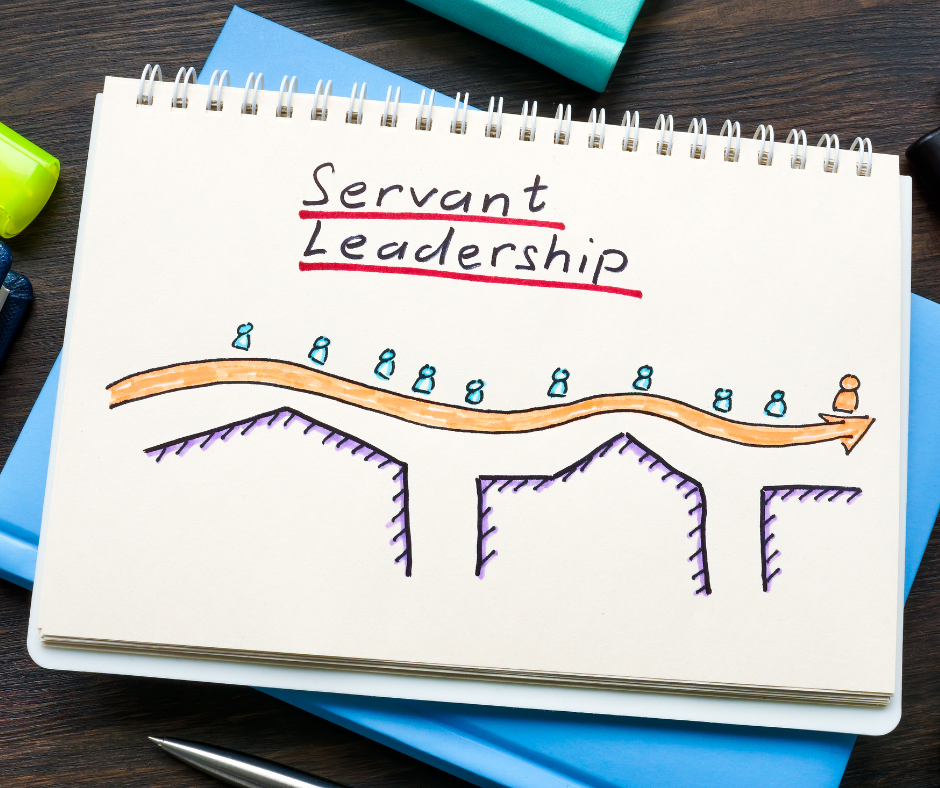
The term “servant leadership” was coined in 1970 by Robert K. Greenleaf in his essay “The Servant as Leader.” Greenleaf defined the servant leader as one who focuses primarily on the growth and well-being of people and the communities to which they belong. The servant leader puts meeting the needs of others as the highest priority.

At its core, servant leadership is a philosophy that inverts the traditional power pyramid of organizational leadership. Rather than people serving the interests of leaders, servant leaders exist to serve and meet the needs of their teams and organizations. The servant leader shares power, puts the needs of others first, and helps people develop and perform at their highest potential.

Here are the key principles of servant leadership:

Listening Intently to Understand: Servant leaders are great listeners who strive to fully understand people’s thoughts, feelings, goals and perspectives. They don’t just listen to respond, but to gain empathy and find ways to meet people’s needs. Through listening intently, they show care, respect and validate others.

Accepting People for Their Unique Talents : Servant leaders appreciate and respect people’s inherent worth and dignity as individuals. They don’t judge, but accept people for who they are, recognizing everyone has unique strengths, talents and room to grow. This creates an inclusive environment where people feel valued.

Providing Opportunities for Learning and Growth:The servant leader is a facilitator of personal and professional growth for those they lead. They provide tools, resources, mentoring and opportunities for skill development. Their goal is to nurture people’s abilities to ultimately build a more capable team.

Behaving Ethically to Build Trust: Servant leaders live by a strong moral code of integrity, honesty and ethical behavior. They aspire to always do the right thing to build trust with those they serve. Their consistency in keeping values builds confidence in their leadership.

Empowering and Giving Ownership: Rather than controlling or micro-managing, servant leaders empower people by giving them autonomy, allowing them to take ownership of projects and make decisions within their areas of responsibility. This breeds commitment and engagement.

Committing to Serving Others’ Needs: At the heart of servant leadership is the desire to understand and proactively meet the legitimate needs of those being led – whether they are team members, customers or communities. The servant leader is always looking for ways to help and enable people’s success.

Nehemiah embodied the heart of a servant leader in his pivotal role rebuilding the walls of Jerusalem.

Though granted immense authority by King Artaxerxes, Nehemiah did not lord his power over the people. Instead, he lived among them, feeling their struggles and sharing their burdens. With deep empathy, he rallied the dispersed Israelites around a united mission, empowering every family to resurrect their city’s defenses. Nehemiah rolled up his sleeves alongside the laborers, toiling just as hard and leading by humble example. When confronted by opposition, he remained steadfast yet diplomatic, anchored in his devotion to serving God and the people.

Nehemiah’s brand of servant leadership transformed the Israelites’ fear into a fierce determination that achieved the impossible. His concern for their safety, provision for their needs, and vision for their security as a nation flowed from Nehemiah’s core purpose – to serve a calling greater than himself.


Organizational and Project Management Skills: Lessons from Nehemiah

I’m continuing a brief series using the biblical story of Nehemiah as an excellent role model for a Modern Elder:


Nehemiah demonstrated remarkable organizational and project management skills in coordinating the rebuilding efforts. What principles and practices can modern leaders draw from his approach?”

This question highlights Nehemiah’s abilities as an effective project manager and organizer, which were crucial to the successful completion of the daunting task of rebuilding the walls of Jerusalem. Here are some key points to consider:

Planning and Preparation: Nehemiah’s approach was marked by careful planning and preparation. He conducted a thorough assessment of the situation, gathered resources, and developed a comprehensive plan before starting the rebuilding process. Effective project management relies on meticulous planning and preparation.

Resource Allocation and Delegation: Nehemiah efficiently allocated resources, including materials, labor, and funds, to ensure the project’s progress. He also delegated responsibilities to different groups and families, leveraging their skills and strengths. Effective resource allocation and delegation are essential for successful project management.

Organization and Coordination: The rebuilding project involved coordinating the efforts of numerous people working simultaneously on different sections of the wall. Nehemiah’s organizational skills enabled him to oversee and coordinate these efforts effectively, preventing duplication of work and ensuring cohesion.

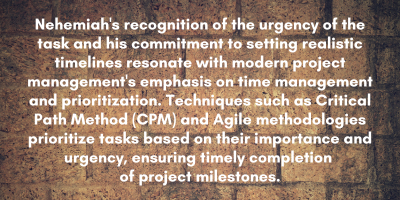
Time Management and Prioritization: Nehemiah recognized the urgency of the task and prioritized the rebuilding efforts accordingly. He set ambitious yet realistic timelines and ensured that the work progressed efficiently. Effective time management and prioritization are crucial for meeting project deadlines.

Risk Management and Contingency Planning: Nehemiah anticipated potential risks and challenges and implemented contingency plans to mitigate them. Risk management is a critical aspect of successful project management.

Monitoring and Adaptation: Nehemiah closely monitored the progress of the rebuilding efforts and was willing to adapt his approach as needed. Effective project managers must continuously monitor progress and make adjustments to address unforeseen circumstances or obstacles.

While Nehemiah’s approach shares many similarities with contemporary project management methodologies, it also reflects the unique challenges and circumstances of his time. Nonetheless, his principles of careful planning, effective resource management, and proactive risk mitigation remain timeless and applicable in modern project management contexts.