It doesn’t work to imagine what’s going on in people’s heads – you have to ask them.
You have to have a conversation.
A good conversation is an act of joint exploration. Somebody floats a half-formed idea. Somebody else seizes on the nub of the idea, plays with it, offers their personal perspective based on their memories, and floats it back so the other person can respond. A good conversation sparks you to have thoughts you never had before. A good conversation starts in one place and ends up in another.
Author David Brooks spent time talking with conversation experts and reading their books. He put together the following list of some of the nonobvious ways to become a better conversationalist.
Treat attention as an on/off switch, not a dimmer. If you’re in a conversation, you’re going to stop doing anything else and just pay attention to this.
Be a loud listener. When another person is talking, you want to be listening so actively that you’re practically burning calories. Active listening is an invitation to express.
Favor familiarity. People have trouble picturing and getting excited about the unfamiliar, but they love to talk about what they know.
Make them authors, not witnesses. Good conversationalists don’t only want to talk about what happened, they want to know how you experienced what happened.
Don’t fear the pause. Wait for the end of the other person’s comment, and then pause a few beats to consider how to respond to what’s been said.
Do the looping. Repeat what someone just said in order to make sure you accurately received what they were trying to project.
The midwife model. In conversation, a midwife is there not to lead with insights but to receive and build on the insights the other person is developing.
Keep the gem statement at the center. In the midst of many difficult conversations, there is a truth underneath the disagreement, something both parties can agree upon.
Find the disagreement under the disagreement. When you search for the disagreement under the disagreement, you are looking for the moral, philosophical roots of why you each believe what you do.
Don’t be a topper. When someone tells you about a situation, don’t turn around and say, “I know exactly what you mean. Here’s what’s going on with me.”
The experience of being listened to all the way on something – until our meaning is completely clear to another human being – is extremely rare in life.
Mónica Guzmán
In the pursuit of meaningful, engaging conversations, it’s essential to develop a set of social skills and master the art of conversation. The ultimate goal is to make the experience of being actively listened to and truly understood a more common occurrence in our lives.
When I was young, I wanted to be knowledgeable, but as I got older, I wanted to be wise. Wise people don’t just possess information; they possess a compassionate understanding of other people. They know about life.
David Brooks
Along the journey of becoming a Modern Elder, I want to become more present with people, have bigger conversations, and find deep pleasure in human connection.
As a textbook introvert, I struggle with the previous sentence, but there’s always hope…
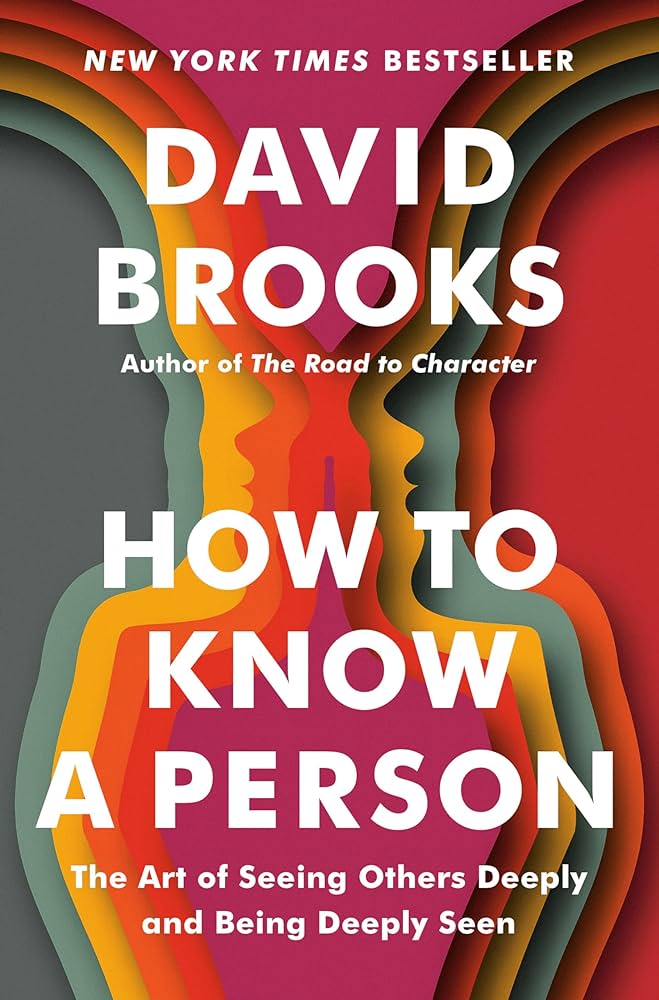
David Brooks observes, “There is one skill that lies at the heart of any healthy person, family, school, community organization, or society: the ability to see someone else deeply and make them feel seen – to accurately know another person, to let them feel valued, heard, and understood.”
And yet we humans don’t do this well. All around us are people who feel invisible, unseen, misunderstood. In How to Know a Person, Brooks sets out to help us do better, posing questions that are essential for all of us: If you want to know a person, what kind of attention should you cast on them? What kind of conversations should you have? What parts of a person’s story should you pay attention to?
Driven by his trademark sense of curiosity and his determination to grow as a person, Brooks draws from the fields of psychology and neuroscience and from the worlds of theater, philosophy, history, and education to present a welcoming, hopeful, integrated approach to human connection. How to Know a Person helps readers become more understanding and considerate toward others, and to find the joy that comes from being seen. Along the way it offers a possible remedy for a society that is riven by fragmentation, hostility, and misperception.
The act of seeing another person, Brooks argues, is profoundly creative: How can we look somebody in the eye and see something large in them, and in turn, see something larger in ourselves? How to Know a Person is for anyone searching for connection, and yearning to be understood.
Building meaningful relationships and fostering a sense of community boils down to mastering a series of small, tangible social skills. It’s about navigating disagreements without damaging connections, gradually unveiling vulnerability, being an attentive listener, gracefully concluding conversations, seeking forgiveness when needed, gently turning down others without causing heartbreak, comforting those in distress, and hosting gatherings where everyone feels embraced. It’s also about the ability to empathize and see things from another’s perspective.
Within any group, there are two types of individuals: Diminishers and illuminators. Diminishers focus on themselves, making others feel insignificant through stereotypes and assumptions. On the flip side, illuminators exhibit a persistent curiosity about others, asking the right questions to understand different viewpoints. They shine a light on people, making them feel respected and valued.
Despite being crucial life skills, these aren’t typically taught in schools, leaving a gap in practical knowledge about offering the rich attention we all crave. At the core of a healthy person, family, school, organization, or society lies a fundamental skill: the ability to deeply see and make others feel seen, to understand and value them.
This goes beyond mastering a set of techniques; it’s a way of life. To truly know someone, you need to grasp how they perceive the world, experiencing it through their eyes. Building relationships is an ongoing effort to understand others on a profound level and let them feel heard, valued, and comprehended. It’s about knowing how they know you.
Some people are much better at seeing people than others are. In any collection of humans, there are diminishers and there are illuminators. Diminishers are so into themselves, they make others feel insignificant. They stereotype and label. If they learn one thing about you, they proceed to make a series of assumptions about who you must be. Illuminators, on the other hand, have a persistent curiosity about other people. They have been trained or have trained themselves in the craft of understanding others. They know how to ask the right questions at the right times — so that they can see things, at least a bit, from another’s point of view. They shine the brightness of their care on people and make them feel bigger, respected, lit up.
David Brooks
Take a look at some of the following characteristics of Diminishers and Illuminators as developed by Brooks. Do you recognize yourself in any of them?
Diminisher Tactics
First Impressions: It’s that quick sizing-up moment when you meet someone, where you open your eyes, direct your gaze, and take them in.
Egotism: Some folks struggle to step outside their own viewpoints. They just aren’t curious about others.
Anxiety: Ever met someone drowning in the noise of their thoughts? It’s like they’ve got a whole party in their head, and they can’t quite tune into what’s happening in yours.
Naïve Realism: Ever thought your perspective was the one true reality, assuming everyone sees the world just as you do? That’s naive realism in action.
The Lesser-Minds Problem: While we’re privy to our thoughts, we only catch a snippet of what’s happening in other minds. This leads to the perception that our inner world is far more intricate than theirs.
Objectivism: Picture someone adopting a detached, dispassionate stance to understand entire populations but missing the individual stories.
Essentialism: Ever grouped people together, thinking they’re more similar than they really are? Or believed others from different groups are fundamentally different from “us”? That’s essentialism.
The Static Mindset: Imagine forming fixed perceptions of people, maybe based on past encounters, and not bothering to update them to reflect who they are now. That’s the static mindset in action.
The Illuminator’s Look
Gentleness: It’s about having a genuine emotional concern for others, recognizing the ties that bind us and the commonalities we share.
Openness: Pushing aside insecurities and self-absorption to fully engage in the experience of someone else.
Curiosity in Action: Cultivating the spirit of an explorer and honing the skill of imagining to truly see others.
Warmth: While some treat understanding as an intellectual exercise, for many, it’s a whole-body experience filled with emotion and affection.
Kindness: A generous spirit that looks for the best in people.
A Complete View: It’s easy to misjudge when you only see a fragment of someone rather than their whole being.
Striving to cast an illuminating gaze that is tender, generous, and open, we set ourselves on the right path. This approach helps us move beyond the clichéd character types we often lazily assign to people, ultimately enhancing how we present ourselves to the world.
The real process of, say, building a friendship or creating a community involves performing a series of small, concrete actions well: being curious about other people; disagreeing without poisoning relationships; revealing vulnerability at an appropriate pace; being a good listener; knowing how to ask for and offer forgiveness; knowing how to host a gathering where everyone feels embraced; knowing how to see things from another’s point of view.




 27gen.com