Loving My Actual Neighbor

7 Practices to Treasure the People Right in Front of You

Jesus was 100 percent clear: Love God, love others. May we do so in a way that is honoring to both our Creator and those he created, with respect for all involved and dignity in every interaction.

Alexandra Kuykendall

As Christians, we know we are called to love our neighbor. We may even grasp that “neighbor” encompasses more than just the people living next door or down the street. But what we too often don’t know is how to begin. How do we love our neighbor? Where do we start? What does this look like in our increasingly isolated world?

Following practices outlined in the first chapter of 2 Peter, Alexandra Kuykendall lays out the framework for where to begin. From practicing humility to listening with understanding to being generous in our relationships, Loving My Actual Neighbor offers practical, start-now steps readers can take to love their neighbors. With her approachable, friendly tone and down-to-earth advice, Kuykendall has carved out for herself a place in the hearts of readers, who will be thrilled to extend her commonsense approach into this sphere of their lives.

As we begin the journey together of exploring how to love our neighbors well, may we remember that God’s grace is covering it all. We are imperfect people stumbling through life, trying to love other imperfect people.

If we are getting more honest in relationships, there will be moments (or days or weeks or years) that will be difficult. Things won’t go as we picture they will. The mess will seep out and we will miss opportunities that come up. We will likely say things we regret, and we will face feeling and ideas that make us uncomfortable.

But we will also experience life as God intended with more depth as we interact with those right in front of us on a more intentional level.

Loving My Actual Neighbor


How Your Members Can Use Their “Table” as a Bridge to Their Neighbors

Breaking bread together has been shown to connect us deeply in ways that no other experience can. A study from the University of Oxford showed that when we eat and drink together, our bonds are strengthened, we become increasingly content, and we experience a more intensified connection to the larger community.

According to author Leonard Sweet (From Tablet to Table), if we really want to learn someone’s story, sitting down at the table and breaking bread together is the best way to start. The story of Christianity didn’t take shape behind pulpits or on altars or in books. The story of Christianity takes shape around tables, as people face one another as equals, telling stories, memories, enjoying food, with one another.

In other words, as author Hugh Halter (Happy Hour Etiquette) states, “The Gospel will not be heard until our front doors open, our tables are set, and we practice the art of hospitality, celebration, and party.”

This issue of SUMS Remix looks at solutions that will help your members learn to use their “tables” as a bridge to their neighbors. The solutions include: 

Jesus ate all kinds of food around all kinds of tables in all kinds of places with all kinds of people. To be a disciple of Jesus (then and now) is to love to eat, no matter what Jesus cooks and no matter where he sets the table. Even when only two are gathered, three are always present. Wherever we break bread together, Jesus is always at the table.

Leonard Sweet, From Tablet to Table

A Simple and Sustainable Vision for Loving Your Next-Door Neighbors

We seek to provide a sustainable vision for the “low and slow” lifestyle of neighboring and supply practical tools that help people invest in their communities, value each step in the process, and build meaningful, gospel-motivated relationships with their fellow image-bearers right next door.

Chris and Elizabeth McKinney

In a culture where most people don’t know their neighbors’ names, where we are lonelier than ever, where we don’t know how to talk to people who are different from us, Chris and Elizabeth discovered that they couldn’t live without their neighbors.

It was on this journey of discovery that the McKinneys wrote Placed for a Purpose for those who want to grow in what Jesus Christ said was the most important thing we could ever do with our lives – to love God and love our neighbors.

They’re inviting you to grab some friends and go love your neighbors together.

Drop over to their website for a full introduction to Chris and Elizabeth and their journey to neighboring.

You will also want to listen to their podcast.

Along the way, be sure to check out their book, as well as other connections they can make with like-minded churches and leaders.


Lead a Church that Knows, and Loves, Its Neighbors

Let’s play a word game – read the word at the end of this sentence, then jot down the first three things that come to your mind in the space below: Neighbor.

What was on your list? Was it Mr. Rogers, or the latest mobile game “Hello Neighbor,” or maybe a generic group of people?

What about a specific person or family? Someone whom you know more than just a first name – someone whom you have established some sort of relationship that goes beyond the surface.

“Neighbor” is one of those words that can encompass dozens of meanings, good and bad experiences, and warm memories or frightful nightmares.

Neighbor certainly has connotations beyond someone who lives near or next door to you – and rightfully so. But let’s start there – the person who lives in close proximity to you.

Do you understand who your neighbor is? Even better are you leading a church full of people who understand who their neighbors are?

This SUMS Remix will help you answer these two vital questions, for the health of your church, and your ministry. The solutions include: 


5 Everyday Ways to Love Your Neighbor and Change the World

What would you call someone who listens without judgment, offers you wise counsel but helps you make your own decision, and loves you no matter what?

That’s a friend!

Jesus had a nickname given to him by the religious leaders of His day – Friend of Sinners (Matthew 11:16-19).

Jesus’ simple strategy to reach the world was friendship and blessing.

There is no better model for what it looks like to “go and bless” than Jesus. His entire life was a blessing. The Gospels give us numerous examples of how Jesus blessed the people He encountered.

Dave Ferguson and Jon Ferguson

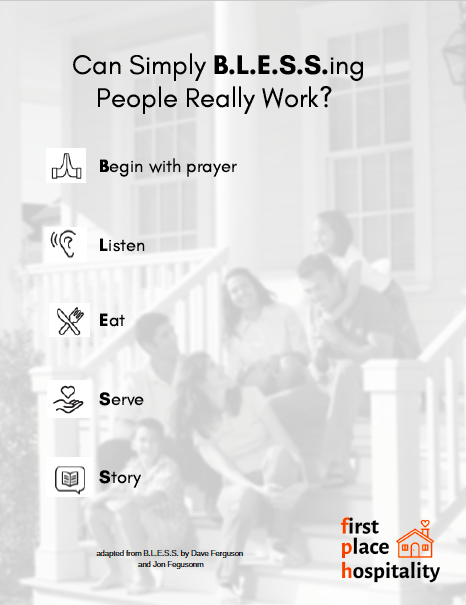
B.L.E.S.S. authors Dave Ferguson and Jon Ferguson made a list of all the ways Jesus practiced being a blessing to people, and narrowed it down to the top five. The resulting B.L.E.S.S. practices are five everyday ways that Jesus loved his neighbors.

B: Begin with prayer

When Jesus started His earthly mission, Luke 6 tells us that He went out on a mountain and prayed. Prayer is both how you discover your mission and how you live out your mission.

L: Listen

Asking questions and then listening was central to Jesus’ life and teachings. Any relationship starts with listening to someone’s words and life. True listening may be the kindest and most loving gift you can give someone.

E: Eat

Jesus liked to eat! Over and over, as in Matthew 9, we find Jesus with tax collectors and sinners…doing what? Eating! There is something about sharing a meal together that moves any relationship past acquaintance toward friendship.

S: Serve

Jesus told us straight up, “The Son of Man did not come to be served, but to serve…” (Matthew 20:28). He modeled for us that once you begin with prayer, listen, and eat with someone, there is a good chance that you’ll discover how you can best serve the person God is asking you to bless.

S: Story

When people were ready to listen, Jesus would share his story, as in John 14 with Thomas. When you befriend and bless people, they feel relationally safe and want to know your story. Then, and only then, can you tell them how the love of God and Jesus’ life, death, and resurrection have changed you.

Using the brief descriptions above, and downloading the PDF tool below, write out practices in each of the five B.L.E.S.S. categories.

How will you use one of these practices each day?

Remember, though: B.L.E.S.S. is not a checklist.

Many well-intentioned people have taken these missional rhythms and turned them into a set of linear steps to be performed one at a time. The B.L.E.S.S. practices are NOT a checklist or another church program you graduate from. They are simple, everyday ways to bless the people around you. Never focus more on the practices than on the people you are seeking to bless!


inspired by B.L.E.S.S. by Dave Ferguson and Jon Ferguson

How to Lead a Life of Hospitality that Draws You into the Lives of Others in Tangible Ways

The heart of God’s purpose for humankind is relationships – first, with God Himself; then, with one another. Arguably, there is no better place to build relationships than at the table with good food and great conversation.

Len Sweet, in his book From Tablet to Table states it eloquently:

Remember God’s first command in the Bible? Eat.

Remember God’s last command in the Bible? Drink.

And everything in between is a table – a life-course meal on which is served the very bread of life and cup of salvation.

It’s time to bring back the table to our homes, to our churches, and to our neighborhoods and the world.

The table is a recurring biblical theme, one that our fast-paced, drive-through, Instant Pot culture finds unfamiliar.

What would happen if we brought back the table as a sacred object of furniture in every home, church, and community?

Are we truly hungry to accept Jesus’ invitation –  “Come and follow” – and to go wherever He leads, even if it means next door?

Especially if it means following Him next door!

What would it take for the table to return to the center of our family lives – and by extension, to those God has placed in our circle and situations?

This issue of SUMS Remix looks at solutions that will help you learn how to engage with your neighbors, establishing and deepening your relationships through hospitality. The solutions include: 

SUMS Remix 103, released October 2018