
As Christians, how should we interact with the place and people around us?

I’ve become thoroughly convinced through God’s Word that we are all beautifully created, explicitly called, and graciously reminded to pursue the common good right where we live. And I’ve been genuinely inspired by stories of Christians in much harsher times than our own doing just that in ways that were beautiful, rewarding, and intriguing to the world around them.
Don Everts
The truth is, after all this study and research and introspection, most of my doubts are simply gone. They are being replaced by a “living hope,” as Peter put it in that letter to believers in Asia Minor. I see this beautiful, ancient path in front of me.
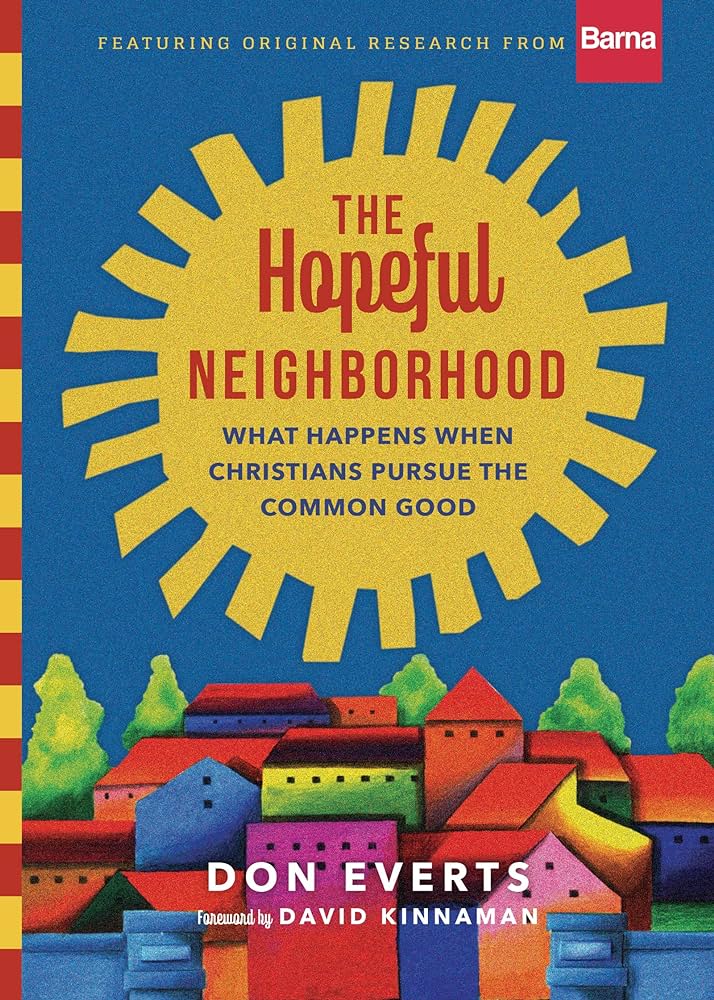
Are you tired of hearing people dismiss the church as an irrelevant relic? (Do you secretly wonder if they are right?) Don Everts explores an exciting reality that is revealed in Scripture, shown throughout history, and confirmed in the latest research: when Christians pursue the common good of the neighborhood, the world stands up and notices. It turns out this is exactly what we’re called to do. When Christians make good things, we bring blessings and hope to our local community.
With original research from the Barna Group and Lutheran Hour Ministries on how Christians relate to our neighborhoods, The Hopeful Neighborhood is filled with constructive, practical ways that Christians and churches can bless those around us. As Christians join together for the common good, we bring hope to the world, credibility to the church, and glory to God.
Author Don Everts believes that we all tread the same journey: from division to unity, from insignificance to relevance. This path leads to a more interconnected and harmonious way of life, to a gentler and more considerate manner of impacting the world, to a Christian presence in our nation that is more compelling and appealing, to a fuller utilization of the talents bestowed upon us by God, and to deeper connections with those who may not share our faith.
This journey begins right at our doorsteps and, guided by God’s grace, extends to encompass the places and people in our immediate surroundings.
Though this path may seem unfamiliar in an era marked by division, self-preservation, and indifference towards our neighbors, it is, in fact, an ancient and well-trodden route. Its simplicity lies in the transition from oneself to the community one resides in. Regardless of our location, we are part of a neighborhood, and perhaps God is urging us to be more mindful of this fact.
As Everts and his wife entered into the empty nest stage of life and contemplated whether to relocate to a new neighborhood or stay in their existing one, they found themselves in no hurry to make a decision. What they did know is that wherever they end up, they want to truly inhabit that place, no longer wishing to merely exist in a location. Rather, they seek to fully engage with it.
Regardless of their eventual neighborhood, their desire is for it to be a beacon of hope. They aspire to extend hospitality by welcoming others into their home for meals and fostering a sense of community among their neighbors. They aim to collaborate with those around them, utilizing their collective talents for the betterment of their shared environment and the people within it. Above all, they want to strive to ensure that no one in their neighborhood ever goes unnoticed or unacknowledged for decades on end.
That’s what The Hopeful Neighborhood Project is all about.
 27gen.com